

The Evergreen Lace Table Runner is a long, airy strip of lace squares joined together, all in one deep forest green. Each square has a raised flower at its center, a ring of chain spokes, and an open loop edge. Once the squares are joined, the lace reads as one continuous holiday filigree down the middle of the table.
The runner uses a single color, so the texture carries the design. The style is classic and a little vintage. It drapes cleanly over the end of the table, where three chunky tassels hang from each short edge.
This pattern uses US crochet terms. The finished runner measures 14.5 in (36.8 cm) wide by 55 in (139.7 cm) long, not counting the tassels. Each tassel adds about 4 in (10.2 cm).
Construction is modular. You make 36 identical square motifs and join them as you go on the last round, building a grid 3 squares wide and 12 squares long. A two-round scalloped border finishes the edge. Then you add three tassels to each short end.
Finished Size and Construction
- Finished size: 14.5 in x 55 in (36.8 cm x 139.7 cm), plus tassels
- Skill level: Intermediate
- Terminology: US crochet terms
- Yarn weight: Sport weight (2) mercerized cotton
- Hook: 3.5 mm (E-4)
- Number of pieces: 36 square motifs, plus 6 tassels
- Layout: 3 motifs wide x 12 motifs long
- Motif size: 4.5 in x 4.5 in (11.4 cm x 11.4 cm)
- Size before border: 13.5 in x 54 in (34.3 cm x 137.2 cm)
- Border depth: 0.5 in (1.3 cm) per side
- Tassel length: 4 in (10.2 cm)
Materials
Choose a smooth sport-weight mercerized cotton or cotton blend. Mercerized cotton shows each stitch crisply, holds the raised flower well, and blocks flat. Avoid fuzzy or very soft acrylics, because the lace will lose its shape.
Yarn:
– Forest Green: 300 g, about 930 m (about 6 balls of 50 g / 155 m each)
Here is where that yarn goes: about 6 g per motif (216 g in total), about 25 g for the border, and about 36 g for the six tassels. The quantities include a margin of about 8 percent for gauge differences and swatching.
Tools:
– 3.5 mm (E-4) crochet hook
– Tapestry needle
– Scissors
– Stitch markers
– Stiff card, 4.5 in (11.4 cm) tall, for tassels
– Blocking mats and rustproof pins
– Spray bottle
– Tape measure
Abbreviations (US Terms)
- ch: chain
- sl st: slip stitch
- sc: single crochet
- hdc: half double crochet
- dc: double crochet
- sp(s): space(s)
- st(s): stitch(es)
- rep: repeat
- bpsc: back post single crochet. Insert the hook from the back of the work, around the post of the stitch, and complete a sc.
Special stitch: Puff. (Yarn over, insert hook in st, pull up a loop to 0.25 in / 0.6 cm) 3 times, yarn over, pull through all 7 loops on hook.
Gauge and Checkpoints
Make one complete motif and block it before you start the rest. Gauge matters here because any error is multiplied across 36 squares.
Checkpoints for one motif:
– After Round 3 (flower): 2 in (5.1 cm) across
– After Round 5: 3 in (7.6 cm) square
– After Round 6: 3.75 in (9.5 cm) square
– After Round 7 (blocked): 4.5 in x 4.5 in (11.4 cm x 11.4 cm)
If your motif is too big: go down to a 3.25 mm hook, or tighten your chains. A motif that is only 0.25 in (0.6 cm) too large adds 3 in (7.6 cm) to the runner’s length.
If your motif is too small: go up to a 3.75 mm hook. Make sure your chain loops are not pulled tight. Loose, even chains open up the lace.
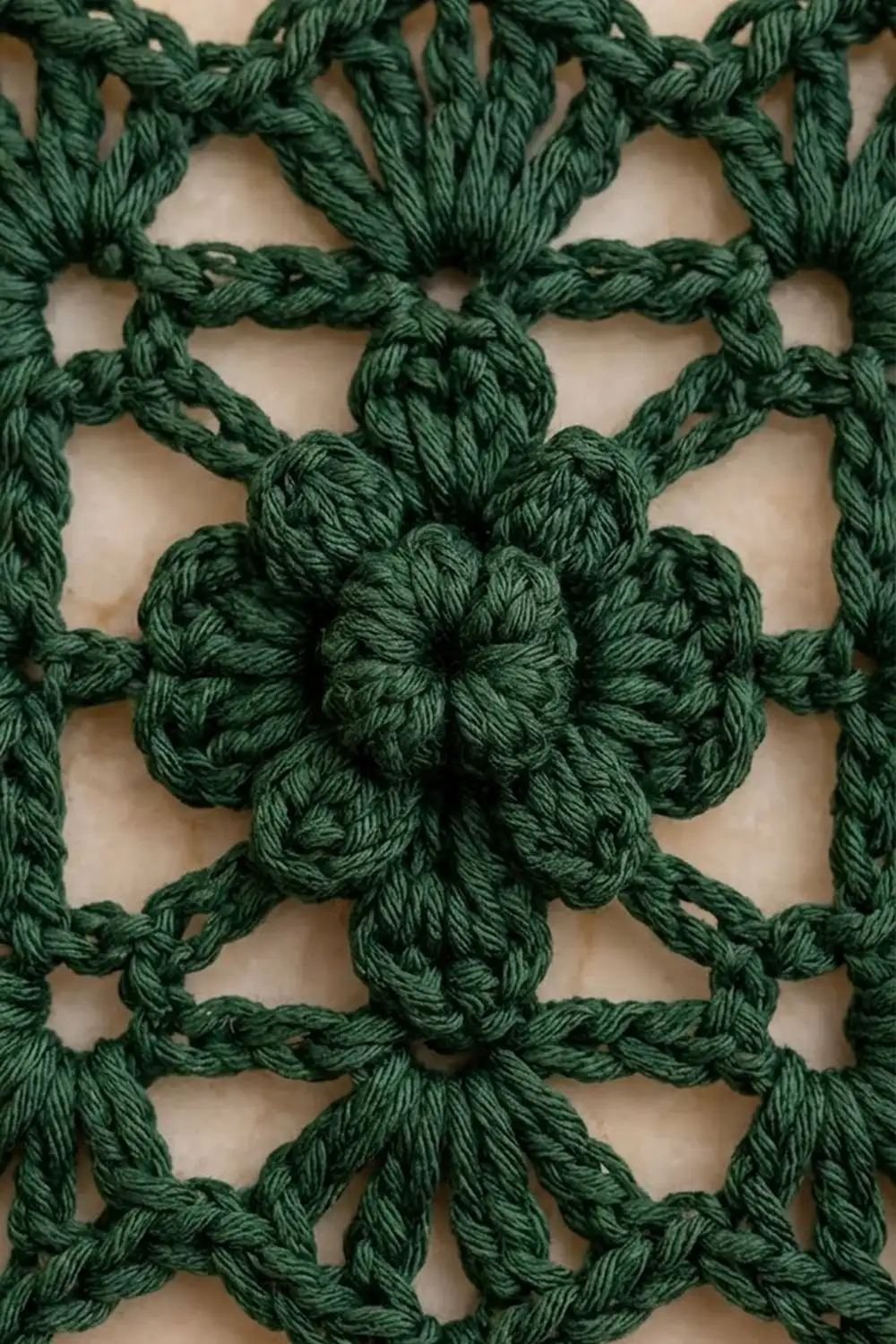
Motif Pattern (make 36)
All motifs are worked the same way through Round 6. Round 7 is the joining round. Work the first motif’s Round 7 without joins.
Round 1: Make a magic ring. Ch 3 (counts as dc), 15 dc in ring, sl st to top of ch-3. Pull the ring closed. (16 dc)
Round 2: Ch 2 (does not count as a st), puff in same st as join, ch 3, skip next dc, puff in next dc, ch 3, skip next dc; rep from * 6 more times, sl st to top of first puff. (8 puffs, 8 ch-3 sps)*
Round 3 (flower petals): Sl st into first ch-3 sp, ch 1, (sc, hdc, 3 dc, hdc, sc) in each ch-3 sp around, sl st to first sc. (8 petals, 56 sts)
The petals cup forward to form the raised flower. Push them gently toward the front before you continue.
Round 4 (spokes): Ch 1. Working behind the petals, bpsc around the first puff of Round 2, ch 5, bpsc around next puff, ch 5; rep from * 6 more times, sl st to first bpsc. (8 bpsc, 8 ch-5 sps)*
These ch-5 loops sit behind the petals. They turn the circle into a frame that the next round squares off.
Round 5 (squaring): Sl st into first ch-5 sp. Ch 3 (counts as dc), (2 dc, ch 3, 3 dc) in same sp for the first corner, ch 2, 3 dc in next ch-5 sp, ch 2, (3 dc, ch 3, 3 dc) in next ch-5 sp; rep from * 2 more times, then rep from * to ** once, sl st to top of ch-3. (36 dc, 9 per side; 4 ch-3 corner sps; 8 ch-2 sps)*
Round 6 (mesh): Sl st in next 2 dc and into the corner sp. Ch 3 (counts as dc), (2 dc, ch 3, 3 dc) in same sp, [ch 4, sc in next ch-2 sp] twice, ch 4, (3 dc, ch 3, 3 dc) in next corner sp; rep from * 2 more times, then rep from * to ** once, sl st to top of ch-3. (24 dc, 8 sc, 4 ch-3 corner sps, 12 ch-4 loops, 3 per side)*
The middle 3-dc group on each side now sits under the center ch-4 loop. This keeps each side open and lacy.
Round 7 (loop edge): Sl st in next 2 dc and into the corner sp. Ch 1, (sc, ch 5, sc) in same sp, [ch 4, sc in next ch-4 loop] 3 times, ch 4, (sc, ch 5, sc) in next corner sp; rep from * 2 more times, then rep from * to ** once, sl st to first sc. Fasten off. (20 sc, 4 ch-5 corner loops, 16 ch-4 side loops)*
Per-side count: each side has 6 loops: 1 corner loop, 4 side loops, and 1 corner loop. This count already includes both corner loops.
Mercerized cotton is slippery, so weave each tail in at least three directions.
Make All Pieces
Make 36 motifs in Forest Green, at about 6 g each (216 g in total).
Layout grid (3 wide x 12 long):
Row 1:   M1   M2   M3
Row 2:   M4   M5   M6
Row 3:   M7   M8   M9
Row 4:   M10  M11  M12
Row 5:   M13  M14  M15
Row 6:   M16  M17  M18
Row 7:   M19  M20  M21
Row 8:   M22  M23  M24
Row 9:   M25  M26  M27
Row 10:  M28  M29  M30
Row 11:  M31  M32  M33
Row 12:  M34  M35  M36
Work row by row, left to right. M1 is made complete. Each later motif is joined to its neighbors while you work its Round 7.
Joining
Method: Join as you go on Round 7, with the right side of both motifs facing up.
Side loop join (replaces a ch 4): Ch 2, sl st into the matching ch-4 loop of the finished neighbor, ch 2, then continue with the next sc as written.
Corner join (replaces a ch 5): Ch 2, sl st into the neighbor’s ch-5 corner loop, ch 2, then work the closing sc of the corner.
Stitch-to-stitch logic: each shared side pairs 6 loops with 6 loops. Corner loop joins corner loop, and the 4 side loops join the 4 side loops in order. No loop is skipped and none is joined twice, so the motifs sit square.
Where four corners meet: join the third and fourth motifs into the sl st of the first corner join, not into the loop itself. This keeps the meeting point to one tidy spot.
Tension: match your join chains to your normal chains. Tight joins pucker the seams. Loose joins leave gaps. Lay the work flat after every row.
Size checkpoint: after Row 4, the piece measures 13.5 in x 18 in (34.3 cm x 45.7 cm). After all 12 rows, it measures 13.5 in x 54 in (34.3 cm x 137.2 cm).
Border
Border gauge: Round 1 puts one sc in every edge loop, so the border follows the motif loop count exactly. Round 2 fills the chains for a firm scallop. Together, the two rounds add 0.5 in (1.3 cm) to every side.
Starting counts: each long side has 12 motifs x 6 loops = 72 loops. Each short side has 3 motifs x 6 loops = 18 loops. The 4 outer corner loops of the runner each belong to both a long side and a short side. So the total number of separate loops is 72 + 72 + 18 + 18 – 4 = 176.
Round 1: Join yarn in any outer corner loop of the runner. Ch 1, (sc, ch 5, sc) in that corner loop. Continue around the edge, working 1 sc in each loop. Between loops on the same motif edge, ch 5. Between the two corner loops that meet at a seam, ch 1. Work (sc, ch 5, sc) in each of the runner’s outer corner loops. Sl st to first sc.
- Long side: 72 sc (including one sc of each corner pair), 60 ch-5 sps (5 per motif x 12), 11 ch-1 seam sps
- Short side: 18 sc, 15 ch-5 sps (5 per motif x 3), 2 ch-1 seam sps
- Plus 4 corner ch-5 sps
- Total: 180 sc (176 loops + 4 extra corner sc), 154 ch-5 sps, 26 ch-1 sps
Round 2: Sl st into next ch-5 sp. Ch 1. Work 5 sc in each side ch-5 sp, 1 sl st in each ch-1 seam sp, and (3 sc, ch 3, 3 sc) in each corner ch-5 sp. Sl st to first sc. Fasten off.
- Long side: 300 sc (60 x 5), 11 sl sts
- Short side: 75 sc (15 x 5), 2 sl sts
- Corners: 6 sc and 1 ch-3 sp each
- Total: 774 sc (600 + 150 + 24)
Why the math works: every motif side gives the same 6 loops, so the border repeats evenly with 5 ch-5 sps per motif edge. At each seam, the ch-1 and the sl st pull the paired corner loops together instead of adding length. The extra corner sc and ch-3 give each corner of the runner room to turn flat.
Tassels (make 6)
Wrap yarn 30 times around the 4.5 in (11.4 cm) card. Slide a 10 in (25.4 cm) strand under the wraps at the top and knot it tightly. Cut through the loops at the bottom. To form a round head, wrap a second strand 8 times around the bundle, 0.75 in (1.9 cm) below the top, and knot it. Trim the tassel evenly to 4 in (10.2 cm).
Attach one tassel to the outer edge of each end motif, at the third sc of the 5-sc group in that edge’s middle ch-5 sp. Each short end gets 3 tassels.
Final Blocking
- Weave in all remaining ends.
- Soak the runner in cool water for 10 minutes, then press the water out in a towel. Do not wring.
- Lay it flat on blocking mats, right side up.
- Pin the four corners to 14.5 in x 55 in (36.8 cm x 139.7 cm).
- Pin each seam point along the edges so every motif is 4.5 in (11.4 cm) square.
- Lightly pin each border scallop outward.
- Lift each center flower forward with your fingertips.
- Let it dry completely, then unpin. Steam the tassels and trim them if needed.
Final Quality-Control Checklist
- 36 motifs, each 4.5 in (11.4 cm) square
- Every motif has 8 raised petals and 6 loops per side
- All seams are joined loop to loop, with no skipped loops
- Four-corner meeting points share one sl st
- Border has 180 sc in Round 1 and 774 sc in Round 2
- Runner measures 14.5 in x 55 in (36.8 cm x 139.7 cm)
- 3 centered tassels on each short end, all 4 in (10.2 cm) long
- All ends are woven in securely
Troubleshooting
Flower lies flat: your puffs are too short. Pull up longer loops in Round 2, and push the petals forward before Round 4.
Motif cups: the Round 4 ch-5 loops are too short. Try ch 6, or loosen your tension.
Motif ruffles: your chains are too long. Go down a hook size.
Seams gap: shorten the join chains to ch 1 on each side of the sl st.
Border waves: use 4 sc per ch-5 sp in Round 2. If the border pulls in instead, use 6.
Care
Hand wash in cool water with mild soap, and dry flat, reshaping the flowers while damp. Store the runner rolled, not folded.
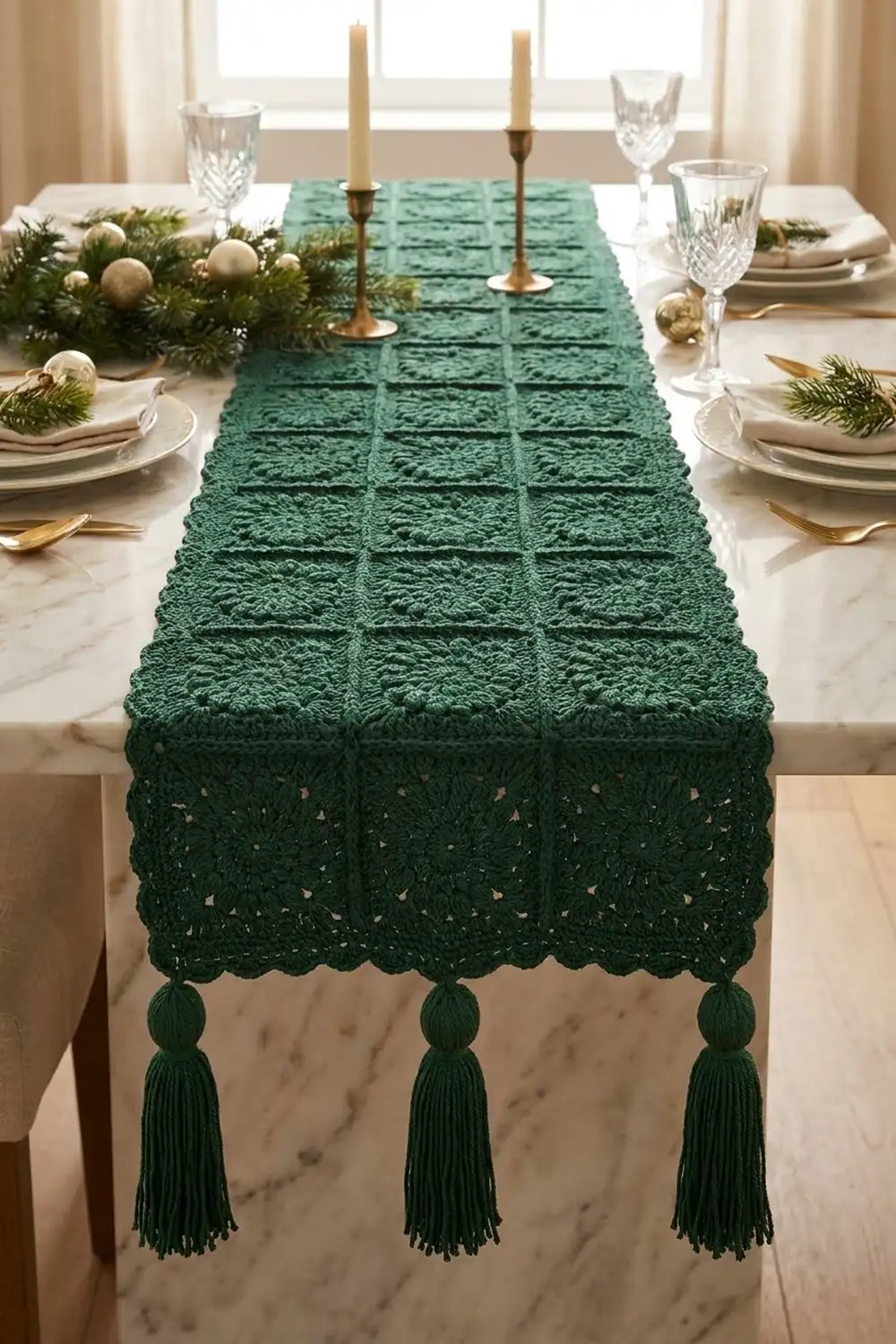
Final Notes
The measurements build step by step. Round 7 makes a 4.5 in (11.4 cm) motif with 6 loops per side. Three motifs across give 13.5 in (34.3 cm), and twelve down give 54 in (137.2 cm). The 0.5 in (1.3 cm) border brings the runner to 14.5 in x 55 in (36.8 cm x 139.7 cm), and six 4 in (10.2 cm) tassels finish the ends.
Check your first motif, keep your join tension even, and the rest will fall into place.
Happy crocheting!