

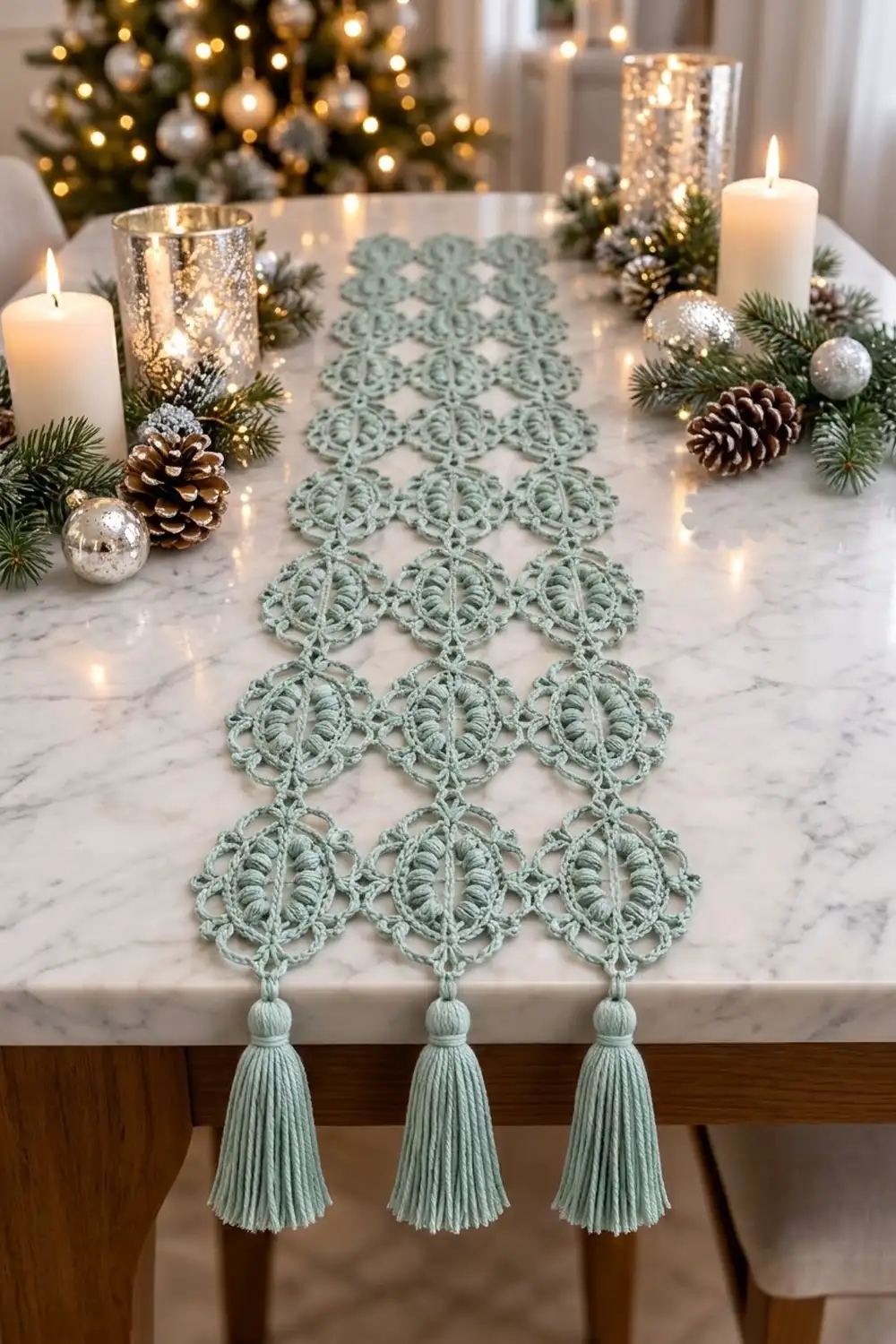
The Frosted Sage Table Runner is a lacy, airy runner made from pointed oval motifs. Each oval has a slim chain spine down the center, two columns of puff stitches, a raised frame of double crochets and an outer round of picot arches. The arches give the edge its frosted, scalloped look.
The whole runner uses one color, a soft sage green cotton. With a single shade, the texture does the decorating: the puffs, arches and open diamond spaces. It looks good on a winter or holiday table and also works year-round.
This pattern uses US crochet terms. The finished runner measures 12 in (30.5 cm) wide by 54 in (137.2 cm) long. Each short end gets 4 in (10.2 cm) tassels, so the total length is 62 in (157.5 cm).
You will make 27 identical oval motifs and join them as you go on the last round, in a grid 3 motifs wide and 9 motifs long. The picot arches form the outer edge, and three tassels finish each short end.
Finished Size and Construction
- Finished size: 12 in x 54 in (30.5 cm x 137.2 cm); 62 in (157.5 cm) long including tassels
- Skill level: Intermediate
- Terminology: US crochet terms
- Yarn weight: DK (light worsted, weight 3) cotton
- Hook: 3.5 mm (E-4)
- Number of pieces: 27 oval motifs + 6 tassels
- Layout: 3 motifs across x 9 motifs long
- Motif size: 4 in x 6 in (10.2 cm x 15.2 cm)
- Motif size before border round (after Round 3): 2.75 in x 4.75 in (7.0 cm x 12.1 cm)
- Border depth: Round 4 picot arches add about 0.625 in (1.6 cm) on every side
Materials
Choose a smooth mercerized or combed cotton in DK weight. Cotton keeps the puffs crisp and blocks flat. Avoid fuzzy or splitty yarn, because it blurs the picots and makes joins hard to see.
For color, pick a muted sage, seafoam or pale eucalyptus green. A mid-light shade shows the puff shadows best. Very pale colors flatten the texture, and very dark ones hide the picots.
- Sage green DK cotton: 250 g, about 550 m (based on 50 g / 110 m balls; 5 balls)
- Motifs: about 6 g (13 m) each, 162 g (356 m) total
- Tassels: about 3.4 g (7.5 m) each, 20 g (45 m) total
These quantities include a generous margin for gauge differences and a test motif.
Tools:
- 3.5 mm (E-4) crochet hook
- Tapestry needle
- Scissors
- Stitch markers
- Stiff card, 4.5 in (11.4 cm) tall, for tassels
- Blocking mats, rust-proof pins and a spray bottle
- Measuring tape
Abbreviations (US Terms)
- ch – chain
- sl st – slip stitch
- sc – single crochet
- dc – double crochet
- sk – skip
- sp – space
- st(s) – stitch(es)
- yo – yarn over
Puff stitch (puff): (Yo, insert hook in st, yo and pull up a loop to 0.5 in [1.3 cm] tall) 4 times, yo and pull through all 9 loops on hook, ch 1 to close. The closing ch does not count as a st.
Picot: Ch 3, sl st in 3rd ch from hook.
Picot arch: Ch 3, picot, ch 3.
Standing sc: With a slipknot on the hook, insert hook in st or sp, yo, pull up a loop, yo, pull through both loops.
Gauge and Checkpoints
Gauge is measured on one complete motif. Make one test motif before you start the runner and block it lightly.
- After Round 1: 2.75 in x 0.75 in (7.0 cm x 1.9 cm)
- After Round 2: 3.5 in x 1.75 in (8.9 cm x 4.4 cm)
- After Round 3: 4.75 in x 2.75 in (12.1 cm x 7.0 cm)
- After Round 4: 6 in x 4 in (15.2 cm x 10.2 cm)
If your motif is more than 0.25 in (0.6 cm) too big, go down one hook size. If it is too small by the same amount, go up one hook size. Small differences add up: an extra 0.25 in (0.6 cm) per motif makes the runner 2.25 in (5.7 cm) longer over 9 motifs.
Watch puff height too. If your puffs are much taller than the dc in Round 3, the frame will ripple. Pull the puff loops up evenly to match the dc height.
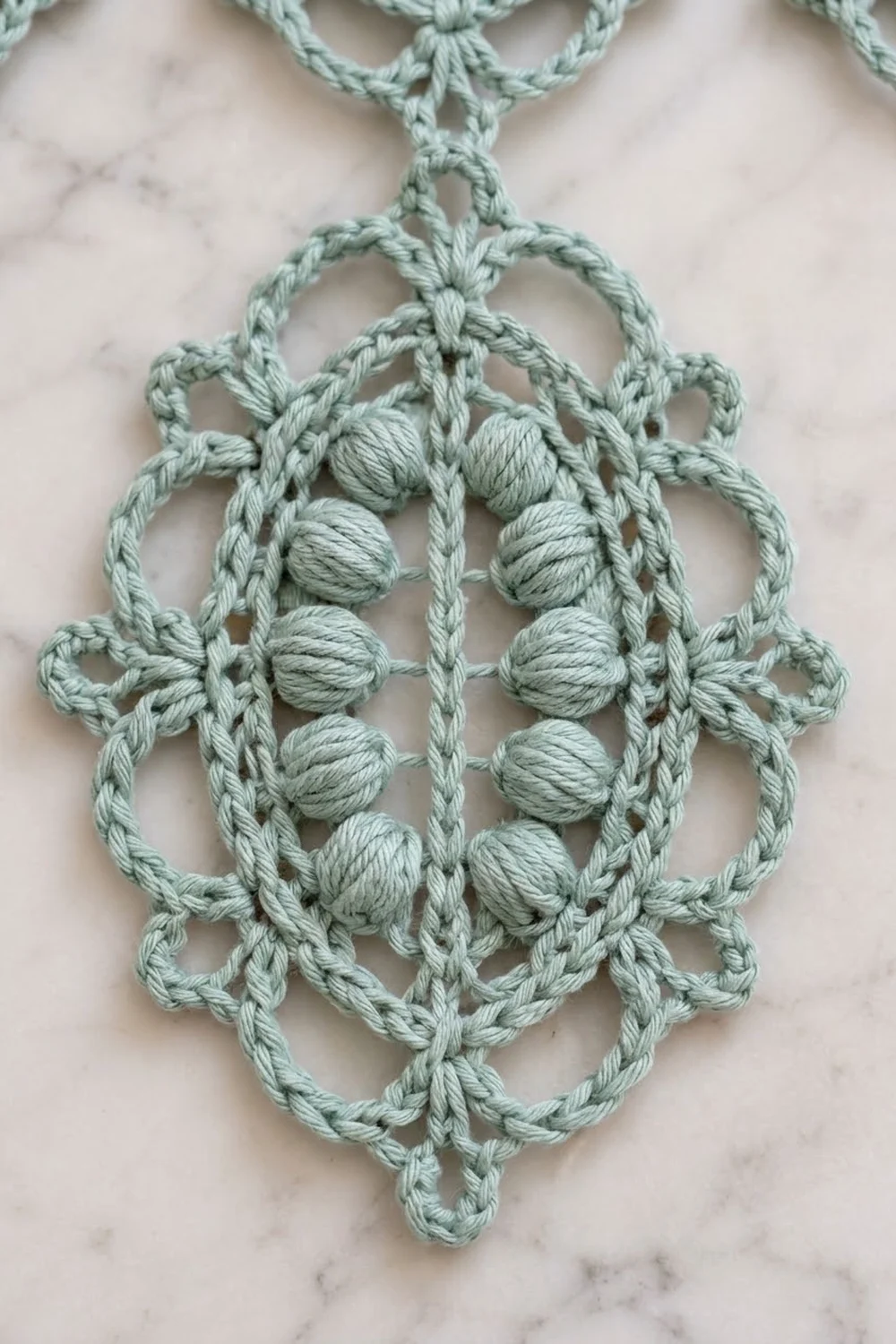
Oval Motif (Make 27)
The first motif is worked all the way through. Every other motif joins to its neighbors during Round 4 (see Joining).
Foundation: Ch 13.
Round 1 (spine): Sc in 2nd ch from hook and in next 10 ch (11 sc), 3 sc in last ch. Working along the opposite side of the foundation chain, sc in next 10 ch, 2 sc in last ch (the same ch that holds the first sc). Join with sl st to first sc. (26 sc)
Each long side now has 10 sc, and each end has 3 sc. The bottom end is the 3-sc group in the last ch. The top end is the first sc plus the 2 sc at the end of the round.
Round 2 (puffs): Ch 2 (does not count as a st).
- Side A: [Puff in next st, ch 1, sk next st] 5 times.
- Bottom end: Dc in next st, (dc, ch 2, dc) in next st, dc in next st.
- Side B: [Puff in next st, ch 1, sk next st] 5 times.
- Top end: Dc in next st, (dc, ch 2, dc) in next st, dc in the first sc of Round 1.
Join with sl st to top of first puff. (18 sts: 10 puffs and 8 dc; plus 10 ch-1 sps and 2 ch-2 tip sps)
You now have two columns of five puffs, one on each side of the sc spine.
Round 3 (frame): Ch 3 (counts as first dc).
- Side A: Dc in next ch-1 sp, [dc in next puff, dc in next ch-1 sp] 4 times. (10 dc on this side, including the beginning ch 3)
- Bottom end: Dc in next dc, 2 dc in next dc, (2 dc, ch 2, 2 dc) in ch-2 sp, 2 dc in next dc, dc in next dc. (10 dc)
- Side B: [Dc in next puff, dc in next ch-1 sp] 5 times. (10 dc)
- Top end: Dc in next dc, 2 dc in next dc, (2 dc, ch 2, 2 dc) in ch-2 sp, 2 dc in next dc, dc in next dc. (10 dc)
Join with sl st to top of beginning ch 3. (40 dc and 2 ch-2 tip sps)
From tip to tip, each half of the oval has exactly 20 dc: 5 dc from the top end, 10 side dc and 5 dc from the bottom end. Fasten off. Round 4 starts at the top tip so both halves line up.
Round 4 (picot arches): Join yarn with a standing sc in the top ch-2 tip sp, ch 4, sc in same sp (tip loop made).
- First half: [Picot arch, sk 3 dc, sc in next dc] 5 times. The 5th sc goes in the last dc before the bottom tip.
- Bottom tip: (Sc, ch 4, sc) in ch-2 sp.
- Second half: [Picot arch, sk 3 dc, sc in next dc] 5 times. The 5th sc goes in the last dc before the top tip.
Join with sl st to first sc. Fasten off and weave in ends. (14 sc, 10 picot arches, 2 ch-4 tip loops)
Each half uses 5 x 4 = 20 dc, which matches Round 3 exactly. The 3rd arch on each half sits at the widest point of the oval. These are the side joining arches.
Make All Pieces
Make 27 motifs in sage green. Work 1 motif complete, and join the other 26 during Round 4.
Layout (each [O] is one motif; rows read top to bottom):
Row 1:  [O]-[O]-[O]
         |   |   |
Row 2:  [O]-[O]-[O]
         |   |   |
  ...    (repeat for Rows 3-8)
         |   |   |
Row 9:  [O]-[O]-[O]
Horizontal links (–) join the 3rd picot arch of each facing half. Vertical links (|) join tip loops. Work Row 1 from left to right, then work each following row from left to right.
Joining
Use join-as-you-go on Round 4. You join only at existing picots and tip loops, so no stitches are added to any motif.
Joining a tip loop: Instead of ch 4, work ch 2, sl st in the neighbor’s ch-4 tip loop, ch 2.
Joining a picot: Instead of a picot, work ch 1, sl st in the neighbor’s picot, ch 1, sl st in the first of these 2 ch. Then continue with the second ch 3 of the arch.
Which points to join:
- If a motif has a neighbor on its left, join its left 3rd arch to that neighbor’s right 3rd arch.
- If a motif has a neighbor above, join its top tip loop to that neighbor’s bottom tip loop.
- Interior motifs make up to 2 joins as you work them (left and top). Later motifs make the joins on their right and bottom.
Total joins: 24 vertical (3 columns x 8) and 18 horizontal (9 rows x 2).
Tension: Keep the join sl sts as loose as your regular chains. Tight joins pull the ovals out of shape and close up the diamond spaces.
Right side: Keep every motif right side up when you join, with the puffs facing you. Before each join, check that the neighbor isn’t flipped.
Checkpoint: After Row 3, the strip should measure 12 in x 18 in (30.5 cm x 45.7 cm) before blocking, within 0.5 in (1.3 cm).
Border (Picot Edge and Tassels)
This runner has no separate border round. The Round 4 picot arches form the edge, and tassels finish the short ends. This keeps the open, scalloped outline.
Border gauge: 5 picot arches per motif half, or 5 arches per 6 in (15.2 cm) of long edge.
Long sides: 9 motifs x 5 arches = 45 picot arches per long side. All 45 stay free. The tip loops between motifs along the edge are joined vertically and don’t count here.
Short ends: 3 motifs x 1 tip loop = 3 free tip loops per end, with one tassel on each.
Why the math works: Every motif keeps its own 5 arches per half and 1 tip loop per point. All joins are made inside existing picots and loops. So each edge count is just (motifs along that side) x (that motif’s per-side count), with nothing added at the seams.
Tassels (make 6):
- Wrap yarn 30 times around the 4.5 in (11.4 cm) card.
- Slide a 10 in (25.4 cm) strand under the top and tie it tightly.
- Cut the loops at the bottom and remove the card.
- Wrap a 12 in (30.5 cm) strand 6 times around the bundle, 0.75 in (1.9 cm) below the top. Knot it and bury the ends inside.
- Trim the tassel to 4 in (10.2 cm).
- Use the top strand to tie each tassel to a free tip loop on the short ends.
Final Blocking
- Lay the runner on blocking mats, right side up.
- Mist it evenly until damp but not dripping.
- Pin the outer corners to 12 in x 54 in (30.5 cm x 137.2 cm).
- Pin every tip join and side join so the ovals sit straight and the diamond spaces open.
- Pin each picot on the long sides so the arches are round.
- Gently pinch each puff to round it.
- Let it dry completely before unpinning. For a crisper finish, mist with light spray starch before drying.
- Steam the tassels lightly and comb them straight. Re-trim them to 4 in (10.2 cm) if needed.
Final Quality-Control Checklist
- 27 motifs, each 4 in x 6 in (10.2 cm x 15.2 cm)
- Each motif has 10 puffs (5 per side) and 40 dc in Round 3
- Each motif has 10 picot arches and 2 tip loops
- 24 vertical and 18 horizontal joins, none twisted
- Runner measures 12 in x 54 in (30.5 cm x 137.2 cm)
- 45 free picot arches on each long side
- 3 tassels per end, each 4 in (10.2 cm)
- All ends woven in securely
Troubleshooting
Puffs look flat: Pull the loops up to the full 0.5 in (1.3 cm) and always close with ch 1.
Oval cups or ruffles: Check that Round 3 has exactly 40 dc and each end has 10 dc. Too many end stitches make it ruffle, and too few make it cup.
Arches don’t meet the tip evenly: Recount Round 3 by halves. Each half must have 20 dc.
Runner is too long: Your hook is probably too large. Check one motif against the 6 in (15.2 cm) checkpoint.
Joins pucker: Loosen the join sl sts and block again.
Joined the wrong arch: Undo back to the join and count arches from the tip again. The side join is always the 3rd arch.
Spine twists: Make sure the foundation chain isn’t twisted before Round 1.
Tassels are uneven: Trim them again after steaming.
Care
Hand wash in cool water with mild soap, roll in a towel to remove the water, and dry flat, re-pinning if needed. Do not tumble dry.
Final Notes
Here’s the measurement chain. A 2.75 in x 0.75 in (7.0 cm x 1.9 cm) spine grows into a 4.75 in x 2.75 in (12.1 cm x 7.0 cm) frame, then a 4 in x 6 in (10.2 cm x 15.2 cm) motif. Three motifs across give 12 in (30.5 cm), and nine motifs long give 54 in (137.2 cm). Add 4 in (10.2 cm) tassels at each short end for 62 in (157.5 cm) overall.
Get one motif right and the rest of the runner follows. Measure your test motif carefully, keep your joins relaxed and block it generously.
Happy crocheting!