
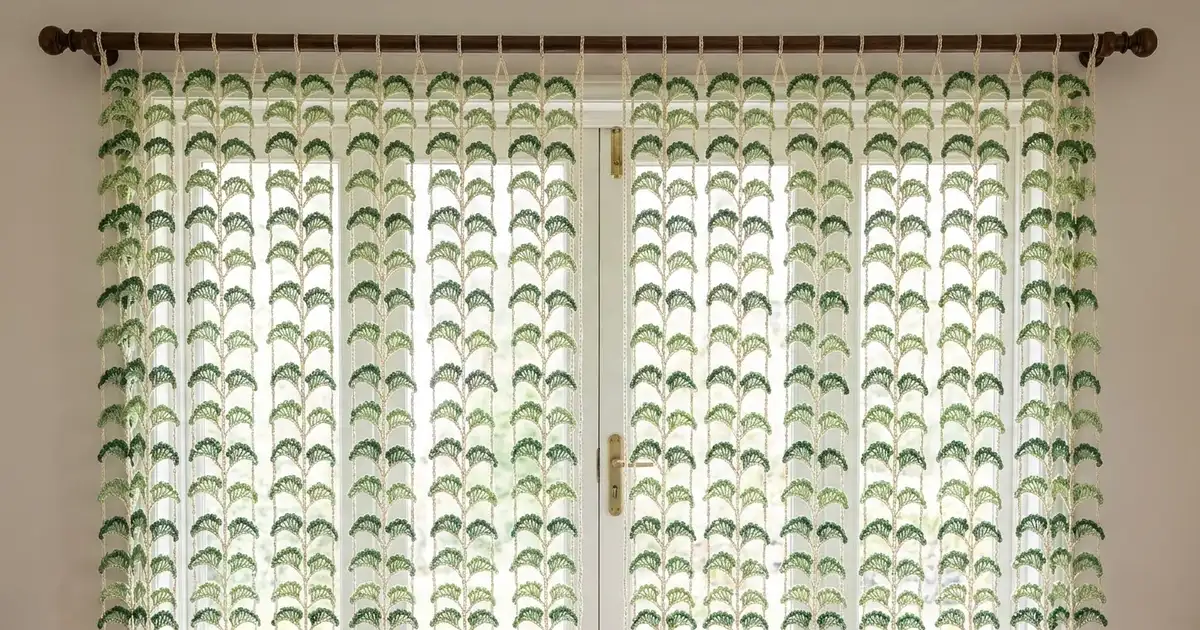
This curtain is a cascade of small two-tone leaves on slim cream cords. Each strand has a central chain spine, mirrored pairs of fan-shaped leaves, and a thin cord down each side that holds the leaf tips in line. When the strands hang together, they read as a soft green screen that still lets light and air through.
The palette is dark forest green, light sage green, and cream. Every leaf has a fan of treble ribs in one green and a scalloped edge in the other. The pairs alternate down the strand, so the color shifts gently as you look along it. The style is vintage botanical: airy, a little formal, and easy to make in short sessions.
The pattern uses US crochet terms. The finished curtain is 64 in (162.6 cm) wide and 72 in (182.9 cm) long, not counting the hanging loops. It has 16 strands, each 4 in (10.2 cm) wide.
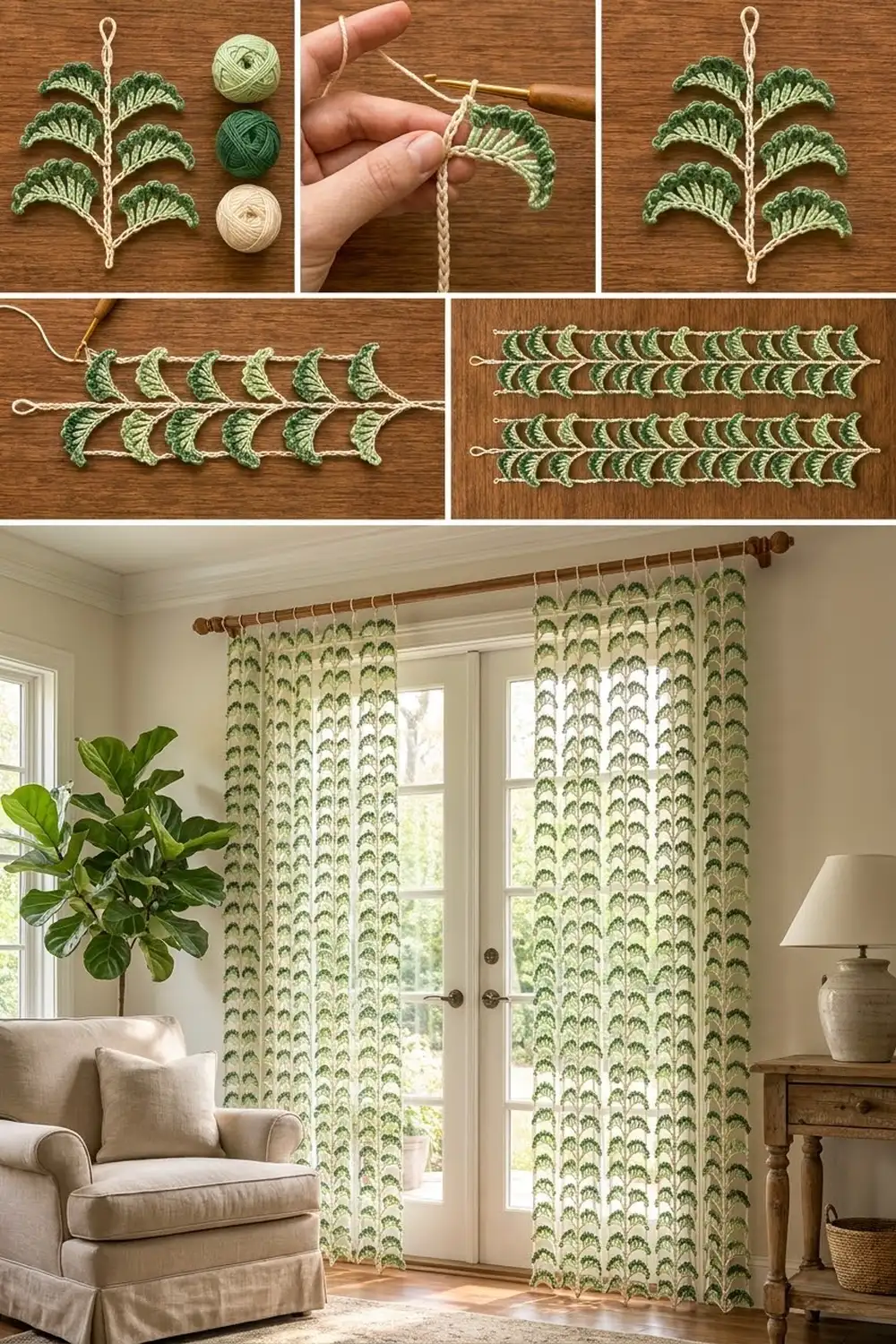
To make it, you crochet all the leaves first. Next you chain each spine from the top down, joining leaves as you go. Then you add the two side cords, which act as the border. Finally you block the strands and hang them by their loops.
Finished Size and Construction
- Finished size: 64 in (162.6 cm) wide × 72 in (182.9 cm) long, plus 2 in (5.1 cm) hanging loops
- Skill level: Easy-intermediate (repetitive, simple stitches)
- Terminology: US
- Yarn weight: Sport (CYC 2, fine), cotton
- Hook: 3.25 mm (US D/3)
- Number of pieces: 16 strands, built from 1,152 leaf motifs
- Layout: 16 strands hung side by side, 1 row
- Piece size: each strand 4 in (10.2 cm) × 72 in (182.9 cm)
- Size before border: 3.5 in (8.9 cm) × 72 in (182.9 cm)
- Border depth: 0.25 in (0.6 cm) per side (one side cord on each edge)
Materials
Choose a smooth, mercerized sport-weight cotton of about 300 m per 100 g (165 yd per 50 g). Cotton holds the leaf shape, hangs straight, and doesn’t stretch like acrylic does. Buy each color from a single dye lot.
- Dark forest green: 850 g / 2,550 m
- Light sage green: 850 g / 2,550 m
- Cream: 400 g / 1,200 m
These quantities include about a 10 percent margin for swatching and tails.
Tools:
- 3.25 mm (US D/3) crochet hook
- Tapestry needle
- Scissors
- Rustproof pins and a blocking board
- Tape measure
- Locking stitch markers
- Spray bottle or steamer
- Curtain rod up to 1 in (2.5 cm) in diameter
Abbreviations (US Terms)
- ch – chain
- sl st – slip stitch
- sc – single crochet
- hdc – half double crochet
- dc – double crochet
- tr – treble crochet
- st(s) – stitch(es)
- RS / WS – right side / wrong side
Special stitch – scallop: (hdc, dc, hdc) all in the same st.
Corner X / Corner Y: each leaf has two corners on its straight edge. Corner X is the inner corner, where the leaf joins the spine. Corner Y is the outer tip, where the side cord tacks on.
Gauge and Checkpoints
Gauge is checked on the pieces themselves, not on a flat swatch.
- Chain gauge: 5 ch = 1 in (2.5 cm), so 10 ch = 2 in (5.1 cm).
- Leaf, Row 1: fan measures 1.25 in (3.2 cm) across the straight edge.
- Leaf, finished: 1.75 in (4.4 cm) across × 0.9 in (2.3 cm) tall.
Test first: make 8 leaves (4 of A and 4 of B), then build a short test strand with 4 pairs (see Spine). Its spine should measure 8 in (20.3 cm) from the base of the loop to the end of the tail, and it should be 3.5 in (8.9 cm) wide across the leaf tips.
If your leaves are too big, use a 3.0 mm hook. If they’re too small, use a 3.5 mm hook. If only the chain gauge is off, change hooks for the cream cord alone. Leaf size and spine spacing are checked separately.
Leaves
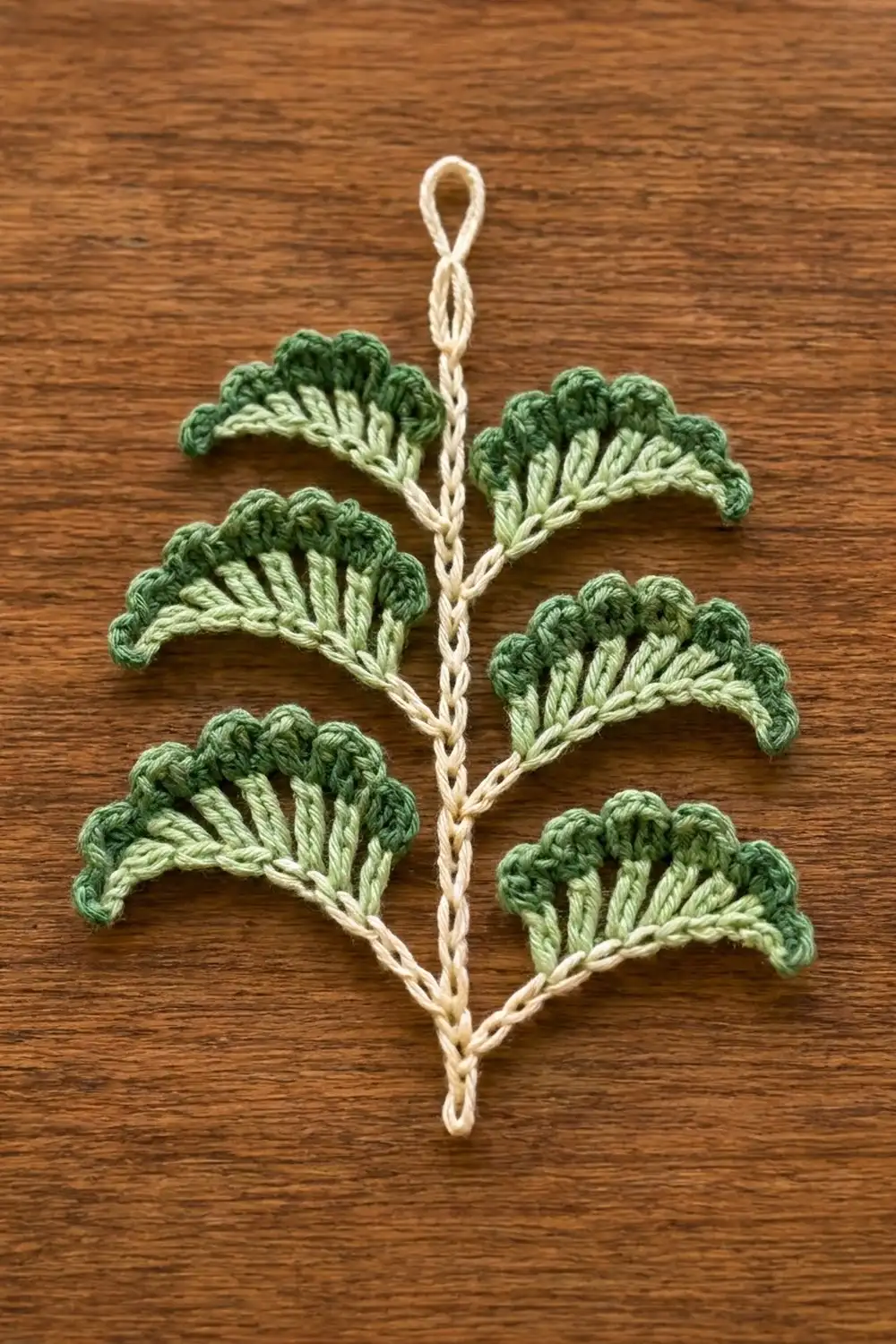
All leaves are identical in shape. Only the colors change.
- Leaf A: Row 1 in light sage, Row 2 in dark green.
- Leaf B: Row 1 in dark green, Row 2 in light sage.
Row 1 (fan color): Ch 5. Work 11 tr in the 5th ch from the hook. The skipped 4 ch count as the first tr. (12 tr) The beginning ch is Corner X and the last tr is Corner Y. Fasten off, leaving a 6 in (15.2 cm) tail.
The tr spread into a half-circle with the starting ch at the center of the straight edge. Checkpoint: 1.25 in (3.2 cm) across.
Row 2 (edge color): With RS facing, join with a sl st in the last tr (Corner Y). Ch 1. Sc in the same st (st 1). Scallop in the next st, sc in the next st. Repeat from * to * 4 more times, covering sts 2–11. Sc in the top of the beginning ch (st 12, Corner X).
Count: 1 sc + 5 × (3 scallop sts + 1 sc) + 1 sc = 22 sts, with 5 scallops. Fasten off, leaving a 6 in (15.2 cm) tail.
This row gives the leaf its bumpy outer edge. It starts with an sc at Corner Y and ends with an sc at Corner X, so both corners are firm points to join into.
Weave in the tails along the straight edge. Checkpoint: 1.75 in (4.4 cm) × 0.9 in (2.3 cm).
Make All Pieces
Each strand has 36 leaf pairs, alternating A and B and starting with A at the top:
- Per strand: 18 A pairs and 18 B pairs, so 36 Leaf A and 36 Leaf B (72 leaves).
- For 16 strands: 576 Leaf A and 576 Leaf B (1,152 leaves).
- Each leaf uses about 2.0 m of each green, tails included.
Strand layout as seen from the room, top to bottom:
Pair 1:  A | spine | A
Pair 2:  B | spine | B
Pair 3:  A | spine | A
...      (alternate)
Pair 36: B | spine | B
Curtain layout, all loops on the rod:
[S1][S2][S3][S4][S5][S6][S7][S8][S9][S10][S11][S12][S13][S14][S15][S16]
Store the leaves in labeled bags of 36 A and 36 B, one pair of bags per strand.
Spine (Joining the Leaves)
Work with cream. The left leaf of each pair lies RS up. The right leaf is flipped WS up, so it mirrors the left one. The treble fan and scallops look the same from both sides.
Hanging loop: Ch 20 and sl st in the first ch to form a ring. This makes a 4 in (10.2 cm) loop that hangs 2 in (5.1 cm) when folded over the rod.
Lead: Ch 5. (1 in / 2.5 cm)
Leaf pair join:
- Ch 2 for the left branch. Sl st in the Corner X sc of the left leaf. Sl st in each of the 2 branch ch back toward the spine.
- Ch 2 for the right branch. Sl st in the Corner X sc of the right leaf. Sl st in each of the 2 branch ch back.
Each branch is 1 sl st into 1 stitch, which is exactly one join point per leaf. The leaves now hang down and outward at about 30 degrees.
Repeat: Ch 10, then join the next leaf pair. Repeat from * to * 34 more times, for 36 pairs in total.
Tail: Ch 5 and fasten off.
Spine count: 5 + (35 × 10) + 5 = 360 ch = 72 in (182.9 cm).
Tension advice: keep the spine ch at the same size as the gauge ch. Tight branches pull the leaves flat against the spine, and loose ones let them flop. After every 6 pairs, check that the spine measures 12 in (30.5 cm) per 60 ch.
Size checkpoint: before you add the border, the strand should be 3.5 in (8.9 cm) across the Corner Y tips and 72 in (182.9 cm) long.
Border (Side Cords)
Border gauge: 5 ch = 1 in (2.5 cm), and 5 sc worked along that ch also = 1 in (2.5 cm). Work one cord on each side of the strand, with RS facing.
Row 1 (chain and tack): With cream, ch 20 and sl st in the first ch to form a loop that matches the spine loop. Lay the cord level with the spine loop. Ch 10, then sl st in the Corner Y sc of the first leaf on that side. Ch 10, sl st in the Corner Y sc of the next leaf on that side. Repeat from * to * 34 more times.
Count: 10 + (35 × 10) = 360 ch, with 36 tacks. Don’t fasten off.
Row 2 (return): Ch 1. Working back up the cord in the back bump of each ch, sc in each ch and skip the tack sl sts. Sl st in the base of the cord loop.
Count: 360 sc per side. Fasten off and weave in the ends.
Repeat Rows 1–2 on the other side, for 360 sc on each side.
Why the math works: the tacks are 10 ch apart, the same as the leaf pairs on the spine, so every leaf hangs at the same angle. The cord lead is 10 ch rather than 5 because each Corner Y sits about 1 in (2.5 cm) below its spine join (the 30-degree tilt plus the branch). The cord ends at the last Corner Y, 72 in (182.9 cm) down, which is level with the bottom of the spine. Spine and cords are both 360 ch long, so they hang together without twisting.
The sc row makes each cord about 0.25 in (0.6 cm) wide. That brings the strand from 3.5 in (8.9 cm) to 4 in (10.2 cm).
Hanging the Strands
The strands are never stitched to each other. Slide the 3 loops of each strand (left cord, spine, right cord) onto the rod in order. Hang them from S1 to S16 with the cords of neighboring strands touching.
Checkpoint: 16 × 4 in (10.2 cm) = 64 in (162.6 cm) across the rod. If your rod is wider, space the strands evenly rather than stretching them.
Final Blocking
- Lay one strand flat on a long surface or on blocking boards in sections.
- Mist it lightly until damp, or hover steam over it without touching it.
- Pin the spine straight and check that it’s 72 in (182.9 cm) long.
- Open each leaf fan into a clean half-circle. Pin Corner X and Corner Y so the straight edge sits at 30 degrees.
- Pin each side cord straight, 0.25 in (0.6 cm) outside the leaf tips. The strand should be 4 in (10.2 cm) wide.
- Shape the 5 scallops on each leaf with your fingertips.
- Let it dry completely. Unpin it, then hang it for 24 hours so gravity evens out the chains.
Final Quality-Control Checklist
- Every leaf has 12 tr and 22 edge sts, with 5 scallops.
- Each strand has 36 pairs, alternating A and B and starting with A.
- The spine has 360 ch and each side cord has 360 sc.
- All 36 tacks on each side are on a Corner Y sc.
- The strand is 4 in (10.2 cm) × 72 in (182.9 cm).
- All 3 loops are the same size.
- All tails are woven in and none show from the RS.
- There are 16 strands and they total 64 in (162.6 cm) across.
Troubleshooting
- Fan cups instead of lying flat: your tr are too tight. Loosen them, or go up a hook size for Row 1 only.
- Fan ruffles: you may have worked 12 tr into the ch instead of 11. Recount.
- Scallops are uneven: make sure each scallop sits in an even-numbered st (2, 4, 6, 8, 10).
- Leaves twist on the spine: you probably joined into the wrong corner. Join Corner X to the spine and Corner Y to the cord.
- Cord is shorter than the spine: your sc row is tight. Work into the back bump only and relax your grip.
- Strand curls sideways: the cords are uneven. Recount each cord to 360.
- Strands tangle when hung: steam them again and let them hang longer. Cotton relaxes with time.
Care
Hand wash in cool water with mild soap, roll the strands in a towel, and dry them flat before rehanging. Don’t wring or tumble dry them, because that tangles the cords.
Final Notes
Here is the full measurement chain. A 1.25 in (3.2 cm) treble fan becomes a 1.75 in (4.4 cm) leaf. Pairs of leaves sit every 2 in (5.1 cm) on a 360-ch spine that’s 72 in (182.9 cm) long, making a strand 3.5 in (8.9 cm) wide. Cords of 360 sc bring each strand to 4 in (10.2 cm). Sixteen strands make a 64 in (162.6 cm) curtain. If you check each stage as you go, the curtain will come out the right size.
Happy crocheting!