

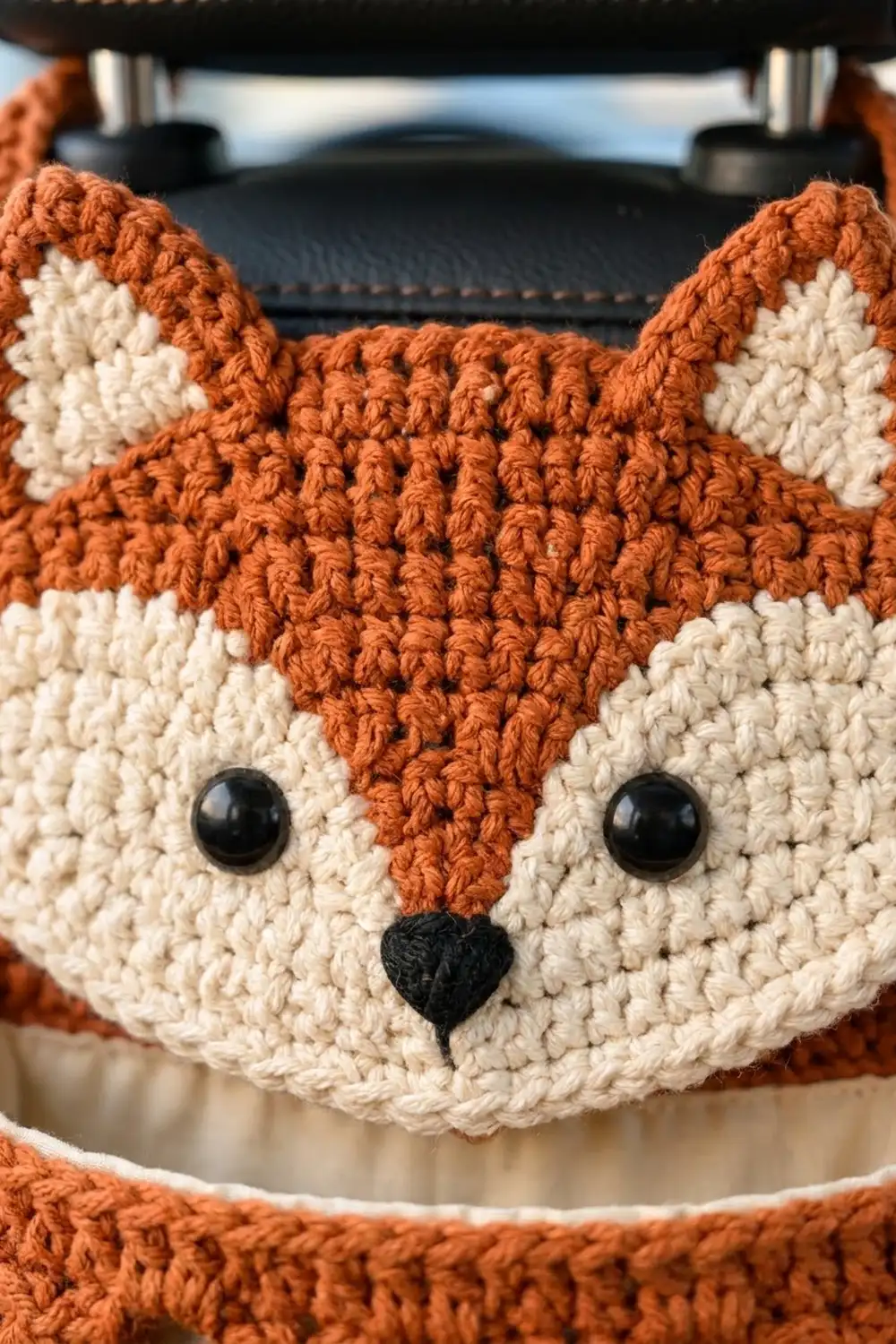
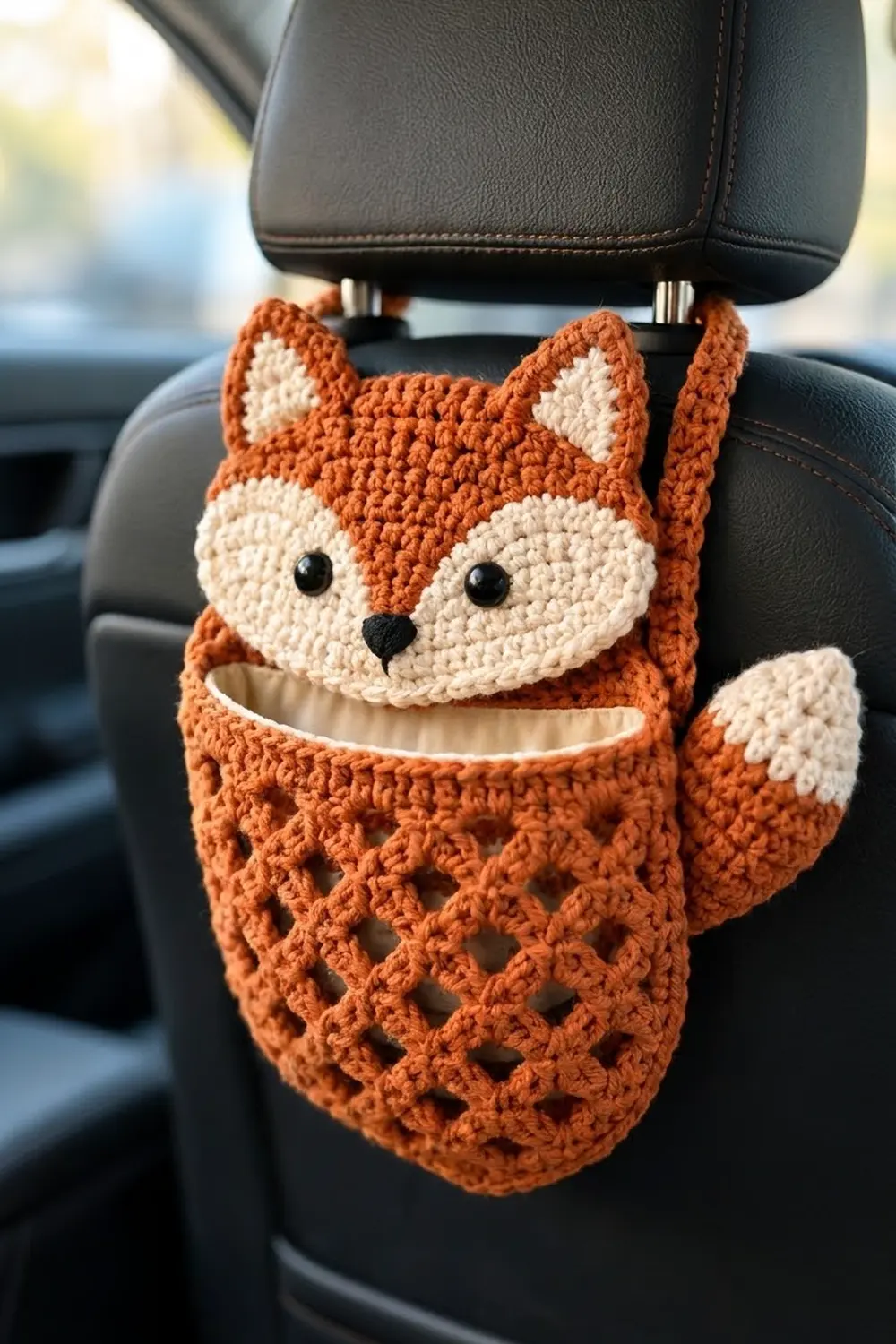
This fox car seat organizer hangs from a headrest and keeps small things within reach. It has a rust-orange fox face with cream cheeks, cream inner ears, black eyes and a little black nose. Below the face is a deep diamond-mesh pocket, and a plump cream-tipped tail sticks out on one side.
It uses two yarn colors: warm rust orange and cream. A cream cotton lining keeps small items from slipping through the mesh and shows as a neat line at the pocket opening.
The pattern uses US crochet terms. The finished body measures 11.6 in (29.5 cm) wide by 14.75 in (37.5 cm) tall. With the ears it is 17 in (43.2 cm) tall.
You make a solid back panel, a mesh pocket, a head with two cheeks, layered ears, a stuffed tail and two straps. A two-round border joins the pocket to the panel. The other pieces are sewn on afterward.
Finished Size and Construction
- Finished size: 11.6 in x 14.75 in (29.5 cm x 37.5 cm) body; 17 in (43.2 cm) to ear tips
- Skill level: Intermediate
- Terminology: US
- Yarn weight: Worsted (#4)
- Hook: 5.0 mm (H-8)
- Number of pieces: 11 (back panel, pocket, head, 2 cheeks, 2 outer ears, 2 inner ears, tail, 2 straps)
- Layout: pocket on the lower panel, head on the upper panel, ears above the head, tail on the right
- Piece sizes: back panel 10.6 in x 13.75 in (26.9 cm x 34.9 cm); pocket 10.6 in x 9.5 in (26.9 cm x 24.1 cm)
- Size before border: 10.6 in x 13.75 in (26.9 cm x 34.9 cm)
- Border depth: 0.5 in (1.3 cm) per side
Materials
Choose a smooth, firmly twisted worsted acrylic or cotton blend. It needs to hold its shape in a warm car. Fuzzy or very soft yarn will let the mesh sag.
- Rust orange: 200 g / 380 m
- Cream: 25 g / 48 m
- Black: about 2 m of worsted scrap, for the nose
These quantities include a margin of about 15%.
Tools and notions:
- 5.0 mm (H-8) hook
- Two 12 mm black safety eyes
- Two 1 in (2.5 cm) flat buttons
- About 15 g fiberfill
- Cream cotton fabric, 12 in x 11 in (30.5 cm x 27.9 cm), plus sewing needle and thread
- Tapestry needle, stitch markers, clips, scissors, tape measure
Abbreviations (US Terms)
- ch chain
- sc single crochet
- dc double crochet
- sl st slip stitch
- st(s) stitch(es)
- sk skip
- sp space
- inc 2 sc in the same st
- sc2tog single crochet 2 together
- RS right side
Special stitch: ch-5 mesh loop. Ch 5, then sc into the center of the next ch-5 loop. Stacked rows of these loops form diamonds.
Gauge and Checkpoints
Gauge: 14 sc x 16 rows = 4 in (10.2 cm). In mesh, 9 ch-5 loops span 10.6 in (26.9 cm), and 2 mesh rows = 1 in (2.5 cm).
Make the pocket first as your test piece. It uses every stitch in the pattern, and its width has to match the back panel.
Checkpoints:
- Row 5 (panel or pocket): 37 sts, 10.6 in (26.9 cm) wide, 1.25 in (3.2 cm) tall
- Pocket Row 18: 7.75 in (19.7 cm) tall
- Pocket Row 25: 9.5 in (24.1 cm) tall
- Panel Row 41: 10.25 in (26.0 cm) tall
- Panel Row 55: 13.75 in (34.9 cm) tall
- Head Rnd 10: 8.4 in x 5.3 in (21.3 cm x 13.5 cm)
Too big: go down 0.5 mm in hook size. Too small: go up 0.5 mm. If only the mesh is off, change the loops to ch 4 or ch 6 and check that the pocket still comes out 9.5 in (24.1 cm) tall.
Back Panel
Use rust orange. Turn at the end of every row. The ch 1 at the start of a row does not count as a stitch.
Row 1: Ch 30, sc in 2nd ch from hook and in each ch across. (29 sts)
Row 2: Ch 1, inc in first st, sc to last st, inc in last st. (31 sts)
Rows 3–5: Repeat Row 2. (33, 35, 37 sts)
Rows 2–5 round off the lower corners.
Rows 6–41: Ch 1, sc across. (37 sts)
Row 42: Ch 1, sc2tog, sc to last 2 sts, sc2tog. (35 sts)
Row 43: Ch 1, sc across. (35 sts)
Rows 44–55: Repeat Rows 42–43 six times. (33, 33, 31, 31, 29, 29, 27, 27, 25, 25, 23, 23 sts)
Row 55 has 23 sts and is 6.6 in (16.8 cm) wide. The narrowed top sits hidden behind the head. Fasten off.
Mesh Pocket
Use rust orange.
Rows 1–5: Work as Back Panel Rows 1–5. (37 sts)
Row 6 (mesh setup): Ch 1, sc in first st, ch 5, sk 3, sc in next st; repeat from * 9 times. (10 sc, 9 loops)
That uses 1 + (9 x 4) = 37 sts.
Row 7: Ch 5 (counts as dc + ch 2), turn, sc in first loop, ch 5, sc in next loop; repeat from * 8 times, ch 2, dc in last sc. (8 full loops + 2 half loops)
Row 8: Ch 1, turn, sc in dc, ch 5, sc in next loop; repeat from * 8 times, ch 5, sc in 3rd ch of turning ch. (9 loops, 10 sc)
Rows 9–18: Repeat Rows 7–8 five times.
Each sc lands in the center of a loop from the row below, and that offset makes the diamonds.
Row 19 (conversion): Ch 1, sc in first sc, 3 sc in next loop, sc in next sc; repeat from * 9 times. (10 sc worked into the 10 sc + 27 sc worked into the 9 loops = 37 sts)
Rows 20–25: Ch 1, sc across. (37 sts)
Rows 19–25 form the solid top band. Fasten off.
Head
Use rust orange and work in continuous rounds. Every round has two straight sides of 11 sts and two curved ends.
Rnd 1: Ch 14, sc in 2nd ch from hook, sc in next 11 ch, 3 sc in last ch. Working along the other side of the chain, sc in next 11 ch, 2 sc in first ch. (28 sts: 3 per end)
Rnd 2: Sc 11 along each side; inc in each of the 3 sts at each end. (34 sts)
Rnd 3: Sc 11 along each side; at each end work (sc 1, inc) 3 times. (40 sts)
Rnds 4–10: Work the same way, adding one more sc before each inc on every round. Rnd 10 ends are (sc 8, inc) 3 times. (46, 52, 58, 64, 70, 76, 82 sts)
On round n, each end has 3n sts. Rnd 10 count: 11 + 30 + 11 + 30 = 82 sts. Sl st and fasten off.
Cheeks (Make 2)
Use cream.
Rnd 1: Ch 8, sc in 2nd ch from hook, sc in next 5 ch, 3 sc in last ch. Working along the other side, sc in next 5 ch, 2 sc in first ch. (16 sts)
Rnds 2–4: Work as for the head, with 5 sc along each side. (22, 28, 34 sts)
Each cheek measures 4.0 in x 2.25 in (10.2 cm x 5.7 cm). Leave a long tail for sewing.
Ears
Outer ears (make 2, rust orange):
Row 1: Ch 13, sc in 2nd ch from hook and across. (12 sts)
Rows 2–12: Ch 1. On even rows, sc across. On odd rows, sc2tog, sc to last 2 sts, sc2tog. (12, 10, 10, 8, 8, 6, 6, 4, 4, 2, 2 sts)
Row 13: Sc2tog. (1 st)
Each outer ear is 3.4 in (8.6 cm) wide and 3.25 in (8.3 cm) tall.
Inner ears (make 2, cream):
Row 1: Ch 7, sc in 2nd ch from hook and across. (6 sts)
Rows 2–6: Shape as for the outer ear. (6, 4, 4, 2, 2 sts)
Row 7: Sc2tog. (1 st)
Each inner ear is 1.7 in (4.3 cm) wide and 1.75 in (4.4 cm) tall.
Tail
Work in continuous rounds.
Rnd 1 (cream): 6 sc in a magic ring. (6 sts)
Rnds 2–6: (Sc 1, inc) 3 times, then add one more sc before each inc on every round. (9, 12, 15, 18, 21 sts)
Rnd 7: Change to rust orange. Sc around. (21 sts)
Rnd 8: (Sc 6, inc) 3 times. (24 sts)
Rnds 9–14: Sc around. (24 sts)
Rnd 15: (Sc 2, sc2tog) 6 times. (18 sts)
Rnd 16: Sc around. (18 sts)
Rnd 17: (Sc 1, sc2tog) 6 times. (12 sts)
Rnd 18: Sc around, then stuff lightly. (12 sts)
Rnd 19: Sc2tog 6 times. (6 sts)
Close the opening. Pressed flat, the tail measures 4.75 in x 3.4 in (12.1 cm x 8.6 cm).
Straps (Make 2)
Use rust orange.
Row 1: Ch 6, sc in 2nd ch from hook and across. (5 sts)
Rows 2–37: Ch 1, sc across. (5 sts)
Row 38 (buttonhole): Ch 1, sc 1, ch 3, sk 3, sc 1.
Row 39: Ch 1, sc 1, 3 sc in ch-3 sp, sc 1. (5 sts)
Row 40: Ch 1, sc across. (5 sts)
Each strap measures 1.4 in x 10 in (3.6 cm x 25.4 cm).
Make All Pieces
- Rust orange: back panel, pocket, head, 2 outer ears, 2 straps, tail body
- Cream: 2 cheeks, 2 inner ears, tail tip
      [ear]          [ear]
   [  HEAD + 2 CHEEKS     ]
   [  pocket top band     ]
   [   DIAMOND MESH       ] [tail]
   [   POCKET over        ]
   [   BACK PANEL         ]
    \____________________/
Joining
Lining: Cut the fabric to 11.6 in x 10.5 in (29.5 cm x 26.7 cm) and round the two lower corners. Press under 0.5 in (1.3 cm) on every edge. Hand-sew the top edge to the wrong side of the pocket, just below Row 25. The sides and bottom of the lining get caught in the border.
Alignment: Lay the pocket RS up on top of the panel, also RS up, with the bottom edges matched.
- Pocket Rows 1–5 line up with panel Rows 1–5, at 1.25 in (3.2 cm).
- The 13 mesh rows (Rows 6–18) line up with panel Rows 6–31: 2 panel rows per mesh row, both 6.5 in (16.5 cm) tall.
- Pocket Rows 19–25 line up with panel Rows 32–38, at 1.75 in (4.4 cm).
Clip at each of these points. The pocket top stays open.
Method: Border Rnd 1 does the joining. At every panel stitch or row end, insert the hook through the panel and the pocket edge beside it, then sc. Along the mesh, catch the pocket at each turning ch or end stitch. Each mesh row gets 2 border sc.
Tension: Keep the joining sc as relaxed as your fabric stitches. If they are tight, the sides will pucker.
Size checkpoint: The joined piece should still measure 10.6 in (26.9 cm) wide.
Border
Border gauge: 2 rounds of sc = 0.5 in (1.3 cm).
Rnd 1 (RS): Join rust orange at the bottom-right corner. Work through both layers wherever the pocket overlaps the panel.
- Bottom: 3 sc in first foundation st, sc in next 27 sts, 3 sc in last st.
- Left side: 1 sc in each row end, Rows 2–54. (53 sc; Rows 2–38 go through both layers)
- Top: 3 sc in first st of Row 55, sc in next 21 sts, 3 sc in last st.
- Right side: 1 sc in each row end, Rows 54–2. (53 sc)
Sl st to join. Count: 27 + 21 + 53 + 53 between corners + (4 corners x 3) = 166 sts.
Rnd 2: Ch 1, sc in each st around, with 3 sc in the center st of each corner group. Sl st to join. (174 sts)
Between corner centers: bottom 29, top 23, each side 55. That gives 162 + (4 x 3) = 174.
Why the math works: The foundation’s 29 sts and Row 55’s 23 sts each already include their 2 corner sts. That leaves 27 and 21 between the corners. Rows 1 and 55 are used as corners, so each side gets 53 row ends. At this gauge, one sc per row end lies flat. Each border round adds 0.25 in (0.6 cm) per side, giving 11.6 in x 14.75 in (29.5 cm x 37.5 cm).
Appliqués:
- Sew the cheeks onto the lower half of the head, inner ends meeting at the center and tipped slightly upward.
- Fit the safety eyes at the inner top edge of each cheek, through both layers.
- Satin-stitch a black triangle nose, 0.5 in (1.3 cm) wide, where the cheeks meet.
- Sew each inner ear onto an outer ear, bottom edges aligned.
- Sew the ears behind the top of the head. The ear bases overlap the head by 1 in (2.5 cm), so 2.25 in (5.7 cm) stands above it.
- Line the head’s top up with the top of the border. Whipstitch the upper two-thirds of the head to the panel. Leave the chin free, overlapping the pocket rim by about 0.5 in (1.3 cm).
- Sew the tail to the right border, beside the pocket top, so it sticks out about 2 in (5.1 cm).
- On the back, sew each strap’s plain end 2.5 in (6.4 cm) in from the side edge, near the top. Add a button 1.5 in (3.8 cm) below each strap end.
Final Blocking
- Mist the organizer lightly. Keep steam away from the stuffed tail.
- Pin it RS up to 11.6 in x 14.75 in (29.5 cm x 37.5 cm).
- Ease the mesh gently until the diamonds are even, and pin the top band straight.
- Flatten the head and cheeks, and point the ear tips straight up.
- Let it dry completely before unpinning.
Final Quality-Control Checklist
- [ ] Body is 11.6 in x 14.75 in (29.5 cm x 37.5 cm), and 17 in (43.2 cm) to the ear tips
- [ ] Border Rnd 2 has 174 sts
- [ ] Pocket opening is free and the lining is secure
- [ ] Diamonds are even, with no twisted loops
- [ ] Eyes are locked and the face is symmetrical
- [ ] Straps button firmly around the headrest posts
- [ ] Ends are woven in at least 2 in (5.1 cm)
Troubleshooting
- Mesh is longer than 6.5 in (16.5 cm): use ch-4 loops, or a smaller hook for the mesh only.
- Pocket sides ripple: rework Rnd 1 with exactly 2 sc per mesh row.
- Head cups: you missed increases. Each end should have 3n sts on round n.
- Head ruffles: spread the end increases evenly around the curve.
- Organizer tilts: re-measure the strap placement at 2.5 in (6.4 cm) from each edge.
Care
Spot clean with mild soap and cool water, then lay flat to dry. Do not tumble dry the stuffed tail.
Final Notes
The measurement chain runs like this:
- Gauge of 14 sc x 16 rows = 4 in (10.2 cm) gives a 37-st panel and pocket 10.6 in (26.9 cm) wide.
- 55 panel rows give 13.75 in (34.9 cm), and 25 pocket rows give 9.5 in (24.1 cm).
- The border (166, then 174 sts) adds 0.5 in (1.3 cm) per side, for 11.6 in x 14.75 in (29.5 cm x 37.5 cm).
- The ears bring the total height to 17 in (43.2 cm).
Check each stage against these numbers and your fox will hang straight with a pocket that holds its shape.
Happy crocheting!