

The Frosted Wheel Table Runner is a long, airy lace strip built from a single column of wheel motifs. Each motif has a small open center, a burst of long radiating spokes, a dotted chain rim, and an open mesh frame that squares the circle off. A deep mesh border runs down both long sides, picots trim the edges, and a row of chunky tassels hangs from each short end.
Everything is worked in one color: a soft powder blue that reads like frost on a winter table. The look is classic and a little vintage, but the thick cotton keeps it bold enough to show up on a white tablecloth.
This pattern uses US crochet terms. Before tassels, the finished runner measures 13 in wide x 67 in long (33.0 cm x 170.2 cm). With the 3 in (7.6 cm) tassels at each end, it is about 73 in (185.4 cm) long.
You will make 7 identical square wheel motifs and join them in one long column. Then you work a 5-round mesh-and-picot border around the whole strip and finish with 15 tassels on each short end.
Finished Size and Construction
- Finished size: 13 in x 67 in (33.0 cm x 170.2 cm), plus 3 in (7.6 cm) tassels at each end
- Skill level: Intermediate
- Terminology: US crochet terms
- Yarn weight: Worsted weight (#4) cotton
- Hook: 5 mm (H-8)
- Number of pieces: 7 square motifs, plus border and 30 tassels
- Layout: 1 motif wide x 7 motifs long
- Motif size: 9 in x 9 in (22.9 cm x 22.9 cm)
- Size before border: 9 in x 63 in (22.9 cm x 160.0 cm)
- Border depth: 2 in (5.1 cm) on every side
Materials
Choose a smooth mercerized or combed worsted-weight cotton. Cotton holds the spokes straight, blocks crisply, and washes well after a holiday dinner. Avoid fuzzy or very soft acrylics, which blur the wheels and let the mesh stretch.
Yarn:
- Powder Blue: 450 g, about 702 m (based on 50 g / 78 m balls; 9 balls)
Approximate breakdown:
– 7 motifs: about 245 g
– Border: about 70 g
– 30 tassels: about 90 g
The 450 g total includes a margin of roughly 10 percent for gauge swatches and differences between yarn brands.
Tools:
- 5 mm (H-8) crochet hook
- Tapestry needle
- Scissors
- Stitch markers (at least 4)
- Stiff card 3.5 in (8.9 cm) tall, for tassels
- Measuring tape
- Blocking mats and rust-proof pins
- Spray bottle with clean water
Abbreviations (US Terms)
- ch: chain
- sl st: slip stitch
- sc: single crochet
- hdc: half double crochet
- dc: double crochet
- tr: treble crochet (yarn over 2 times)
- dtr: double treble crochet (yarn over 3 times)
- sp: space
- st(s): stitch(es)
- RS: right side
Special stitch:
- Picot: ch 3, sl st in the 3rd ch from hook (the first ch made).
Gauge and Checkpoints
Make one complete motif before you buy all the yarn or start the others. The whole runner depends on that first square.
Main gauge: one finished motif (Rnds 1–9) = 9 in x 9 in (22.9 cm x 22.9 cm), measured flat after a light spray.
Measurement checkpoints, measured flat:
- After Rnd 1: about 1.75 in (4.4 cm) across
- After Rnd 3 (spokes): about 6 in (15.2 cm) across
- After Rnd 5 (rim loops): about 7.5 in (19.1 cm) across
- After Rnd 6 (squared): about 8 in (20.3 cm) per side
- After Rnd 8 (mesh): about 8.5 in (21.6 cm) per side
- After Rnd 9: 9 in (22.9 cm) per side
Too big? Go down to a 4.5 mm hook and check that your dtr spokes are not loose at the top.
Too small? Go up to a 5.5 mm hook.
Fix the size now. A difference of 0.25 in (0.6 cm) per motif adds up to 1.75 in (4.4 cm) across 7 motifs.
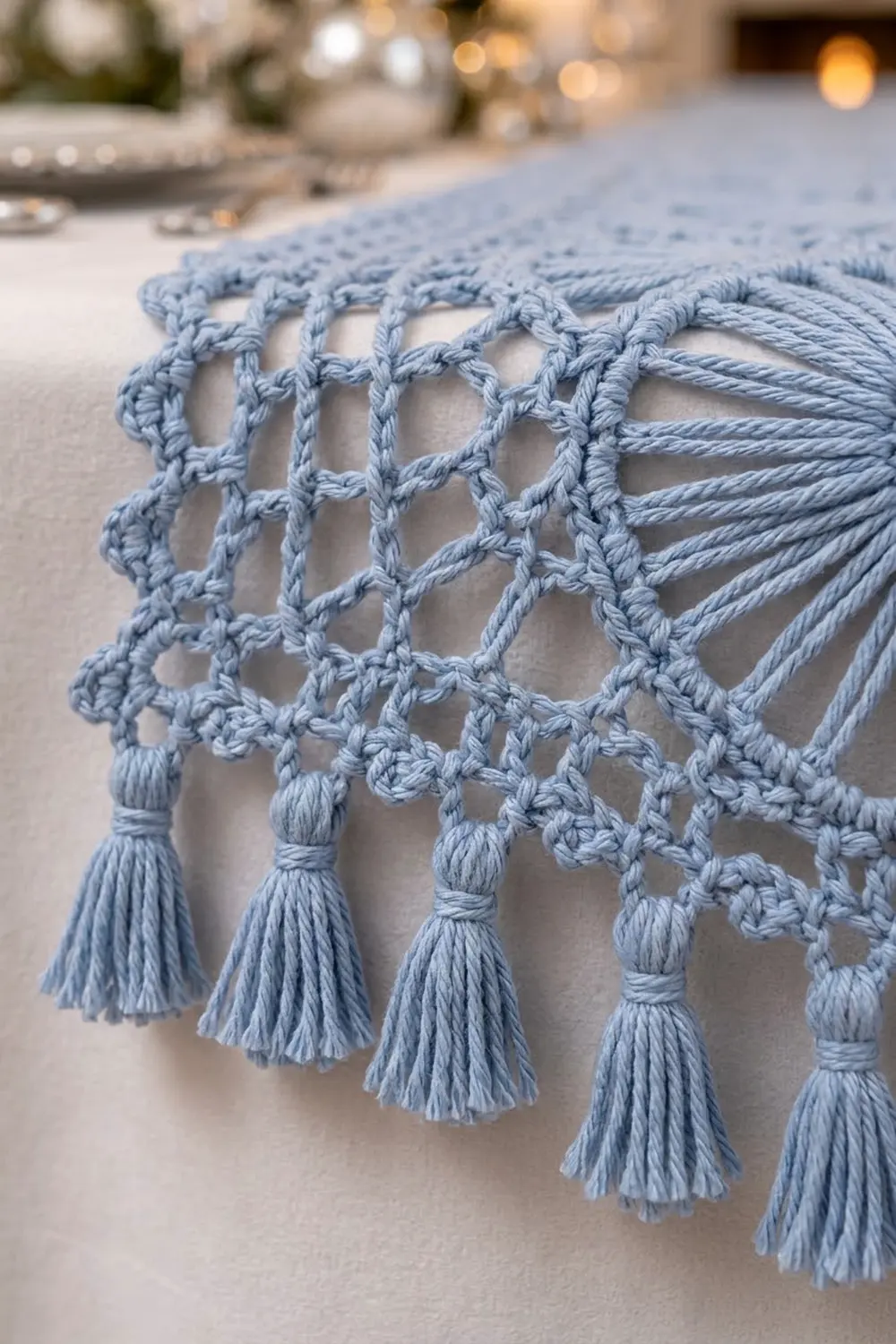
Wheel Motif (make 7)
The motif starts as a circle worked in the round and is squared off in Rnd 6. Do not turn between rounds; work with the RS facing.
Ch 8, sl st in first ch to form a ring. This ring becomes the open center of the wheel.
Rnd 1: Ch 3 (counts as dc), 23 dc in ring, sl st in top of ch-3. (24 dc)
Rnd 2: Ch 4 (counts as tr), tr in same st, 2 tr in each st around, sl st in top of ch-4. (48 tr)
Rnd 3 (spokes): Ch 5 (counts as dtr), ch 1, dtr in next st, ch 1; repeat from * around, sl st in top of beginning ch-5. (48 dtr, 48 ch-1 sp)
These long dtr posts are the radiating spokes. Keep each one straight and evenly tensioned.
Rnd 4: Ch 1, sc in same st, ch 2, sc in next dtr; repeat from * around, ch 2, sl st in first sc. (48 sc, 48 ch-2 sp)
Rnd 5 (dotted rim): Sl st in first ch-2 sp, ch 1, sc in same sp, ch 4, skip next ch-2 sp, sc in next ch-2 sp; repeat from * around, ending ch 4, skip last ch-2 sp, sl st in first sc. (24 sc, 24 ch-4 loops)
The small sc knots between loops form the beaded ring around the wheel.
Rnd 6 (squaring):
1. Sl st in next 2 ch to reach the center of the first ch-4 loop.
2. First corner: ch 5 (counts as dtr), then (dtr, ch 3, 2 dtr) in the same loop.
3. Ch 3, tr in next loop, ch 3, dc in next loop, ch 3, hdc in next loop, ch 3, dc in next loop, ch 3, tr in next loop, ch 3, (2 dtr, ch 3, 2 dtr) in next loop for corner.
4. Repeat from * 2 more times, then repeat from * to ** once.
5. Sl st in top of ch-5.
Count: 16 dtr, 20 side sts (5 per side), 24 ch-3 sp along the sides (6 per side), and 4 corner ch-3 sp. Corners sit in loops 1, 7, 13, and 19. The stepped stitch heights (dtr, tr, dc, hdc) pull the circle into a square.
Rnd 7: Sl st in next dtr and into corner ch-3 sp, ch 1, 3 sc in corner sp. Sc in each st and 3 sc in each ch-3 sp to next corner, 3 sc in corner sp; repeat around, omitting the last corner, sl st in first sc.
Per side, counting both corner center sc: 1 + 1 + 2 dtr + (6 x 3) + 5 + 2 dtr + 1 + 1 = 31 sc.
Total: 120 sc. Check: 16 dtr + 20 side sts + 72 sc in side spaces + 12 sc in corners = 120.
Place a marker in each corner center sc.
Rnd 8 (mesh):
1. Sl st in next sc (corner center).
2. Ch 6 (counts as dc + ch 3), dc in same st.
3. [Ch 1, skip next sc, dc in next sc] 15 times. The last dc lands in the next corner center sc. Then work (ch 3, dc) in that same st.
4. Repeat from * around, omitting the last (ch 3, dc).
5. Sl st in 3rd ch of ch-6.
Per side: 2 corner dc, 14 dc between corners, and 15 ch-1 sp. The math works because 29 sts sit between corner centers and 15 repeats use 30 sts, ending exactly on the next corner.
Total: 64 dc, 60 ch-1 sp, 4 corner ch-3 sp.
Rnd 9 (joining edge): Sl st in corner ch-3 sp, ch 1, 3 sc in corner sp. Sc in each dc and each ch-1 sp to next corner, 3 sc in corner sp; repeat around, omitting the last corner, sl st in first sc. Fasten off and weave in ends.
Per side, counting both corner center sc: 1 + 1 + 1 corner dc + (15 sp + 14 dc) + 1 corner dc + 1 + 1 = 35 sc.
Total: 136 sc (4 x 35 − 4 shared corners = 136). Check: 64 dc + 60 sp + 12 corner sc = 136.
Measure: 9 in x 9 in (22.9 cm x 22.9 cm).
Make All Pieces
- Powder Blue: 7 wheel motifs, each with 35 sc per side.
Spray each motif to 9 in (22.9 cm) square before joining so all 7 match.
Layout grid (1 column, 7 rows):
ROW 1: BLUE
ROW 2: BLUE
ROW 3: BLUE
ROW 4: BLUE
ROW 5: BLUE
ROW 6: BLUE
ROW 7: BLUE
Joining
Method: flat slip-stitch seam through back loops, worked on the RS.
- Place two motifs side by side, RS up, with the edges to be joined touching.
- Join yarn in the corner center sc of both motifs.
- Sl st across, working through the back loop of the matching sc on each motif. From corner center to corner center you will work exactly 35 sl sts, one for every matched pair of sc.
- Fasten off.
Join motif 1 to 2, 2 to 3, and so on, for 6 seams total.
Stitch logic: every seam pairs 35 sc with 35 sc, so no stitches are added or lost. The front loops stay free on the RS and leave a fine raised line between wheels.
Tension: keep the sl sts as loose as your sc. A tight seam will pucker and shorten the runner. If your seams come out tight, use a 5.5 mm hook for the seams only.
Size checkpoint: the joined strip measures 9 in x 63 in (22.9 cm x 160.0 cm). Each long side has 7 x 35 = 245 sc available, and each short end has 35 sc.
Border
Border gauge: the 5 border rounds add 2 in (5.1 cm) on every side.
The border is worked around the outer edge of the joined strip. Along each long side, every motif contributes its own 35 sc, including its corner sts at the seams. That gives:
– 245 sts per long side (7 x 35)
– 35 sts per short end
No sts are added at the seams, and the 4 outer corner sts are already included in these counts.
Rnd 1:
1. With RS facing, join yarn in an outer corner st so that a long side comes next. Start every border round at this corner.
2. Ch 1, 3 sc in corner st.
3. Sc in each st around, working into both corner sts at every seam and 3 sc in each outer corner st.
4. Sl st in first sc.
Count, including both corner center sc:
– Long sides: 245 + 2 = 247 sc
– Short ends: 35 + 2 = 37 sc
– Total: 2 x 247 + 2 x 37 − 4 = 564 sc
Mark the 4 corner center sc.
Rnd 2 (mesh):
1. Sl st in next sc (corner center).
2. Ch 6 (counts as dc + ch 3), dc in same st.
3. [Ch 2, skip 2 sc, dc in next sc] to the next corner center sc, then (ch 3, dc) in that same st.
4. Repeat from * around, omitting the last (ch 3, dc).
5. Sl st in 3rd ch of ch-6.
Long sides: 247 − 1 = 246 sts from corner to corner, and 246 ÷ 3 = 82 ch-2 sp, with 81 dc between corners.
Short ends: 37 − 1 = 36, and 36 ÷ 3 = 12 ch-2 sp, with 11 dc between corners.
Rnd 3 (mesh):
1. Sl st in corner ch-3 sp.
2. Ch 6 (counts as dc + ch 3), dc in same sp.
3. [Ch 2, dc in next dc] to the next corner, working into both corner dc; ch 2, (dc, ch 3, dc) in corner sp.
4. Repeat from * around, omitting the last corner.
5. Sl st in 3rd ch of ch-6.
Long sides: 83 dc between corner groups (81 + 2 corner dc) and 84 ch-2 sp.
Short ends: 13 dc and 14 ch-2 sp.
The stacked mesh of Rnds 2 and 3 forms the open grid columns along the runner.
Rnd 4: Sl st in corner ch-3 sp, ch 1, 3 sc in corner sp. Sc in each dc and 2 sc in each ch-2 sp to next corner, 3 sc in corner sp; repeat around, omitting the last corner, sl st in first sc.
Count, including both corner center sc:
– Long sides: 1 + 1 + 1 + (84 x 2) + 83 + 1 + 1 + 1 = 257 sc
– Short ends: 1 + 1 + 1 + (14 x 2) + 13 + 1 + 1 + 1 = 47 sc
– Total: 2 x 257 + 2 x 47 − 4 = 604 sc
Rnd 5 (picot edge):
1. Sl st in next sc (corner center). Ch 1, sc in same st.
2. Long side: [Sc in next 4 sc, picot] 64 times. The last repeat ends on the next corner center sc.
3. Short end: sl st loosely in each of the next 45 sc.
4. Sc in the next corner center sc, then repeat the long-side sequence from step 2.
5. Sl st loosely across the second short end.
6. Sl st in first sc and fasten off.
Long sides: 257 − 1 = 256, and 256 ÷ 4 = 64 picots, ending exactly on the corner. The short ends get sl sts only, so they stay flat and give the tassels a firm base.
Why the math works:
– Each mesh round needs (side count − 1) divisible by 3. Both 246 and 36 are.
– Each mesh round adds exactly 2 spaces per side.
– After Rnd 4, the long sides have 256 sts between corner centers, which divides evenly by 4 for the picots.
Tassels (make 30):
1. Wrap yarn 20 times around the 3.5 in (8.9 cm) card.
2. Slide a 10 in (25.4 cm) tie under the top loops and knot it tightly.
3. Cut the bottom loops.
4. Wrap a second strand 6 times around the bundle 0.5 in (1.3 cm) below the top, tie it off, and bury the ends inside.
5. Trim to 3 in (7.6 cm).
Attach tassels: On each short end, tie one tassel in each Rnd 4 sc that was worked into a Rnd 3 dc (13 tassels) and one at each corner center (2 tassels). That makes 15 tassels per end, about 0.9 in (2.3 cm) apart.
Final Blocking
- Weave in all remaining ends along the seams and mesh, not across the spokes.
- Soak the runner in cool water for 10 minutes, then press the water out in a towel. Do not wring.
- Lay it flat on blocking mats, RS up.
- Pin the corners first, to 13 in x 67 in (33.0 cm x 170.2 cm).
- Pin each seam line straight and square to the long edges.
- Pin the center of each wheel and ease the spokes into even, straight lines.
- Pin out each picot along the long sides.
- Comb the tassels straight and let them hang off the edge of the mat.
- Let it dry completely, about 24 hours, before unpinning.
Final Quality-Control Checklist
- 7 motifs, each 9 in (22.9 cm) square with 35 sc per side
- 48 even spokes in every wheel, with no missed or doubled dtr
- 6 flat seams, each 35 sl sts, no puckers
- Joined strip 9 in x 63 in (22.9 cm x 160.0 cm) before border
- Border counts: 247 / 37 after Rnd 1, and 257 / 47 after Rnd 4
- 64 picots on each long side
- 15 tassels per end, all 3 in (7.6 cm), evenly spaced
- Finished runner 13 in x 67 in (33.0 cm x 170.2 cm), corners square
Troubleshooting
Wheel ruffles after Rnd 3: your dtr are too loose or tall. Pull each loop up only to hook size, and try a smaller hook.
Wheel cups after Rnd 4: the ch-2 spaces are too tight. Loosen your chains, or work ch 3 instead and recount.
Motif is not square after Rnd 6: check that each side has the tr–dc–hdc–dc–tr sequence and that the corners sit in loops 1, 7, 13, and 19.
Seams pucker: rework them with a larger hook, or switch to a whipstitch through back loops.
Border mesh does not end on the corner: recount Rnd 1. A missed seam st throws off the multiple of 3.
Tassels look uneven: lay the runner flat and trim all 30 at once against a ruler.
Care
Hand wash in cool water with mild soap, roll in a towel, and dry flat. If the picots and spokes lose their shape, pin them out again.
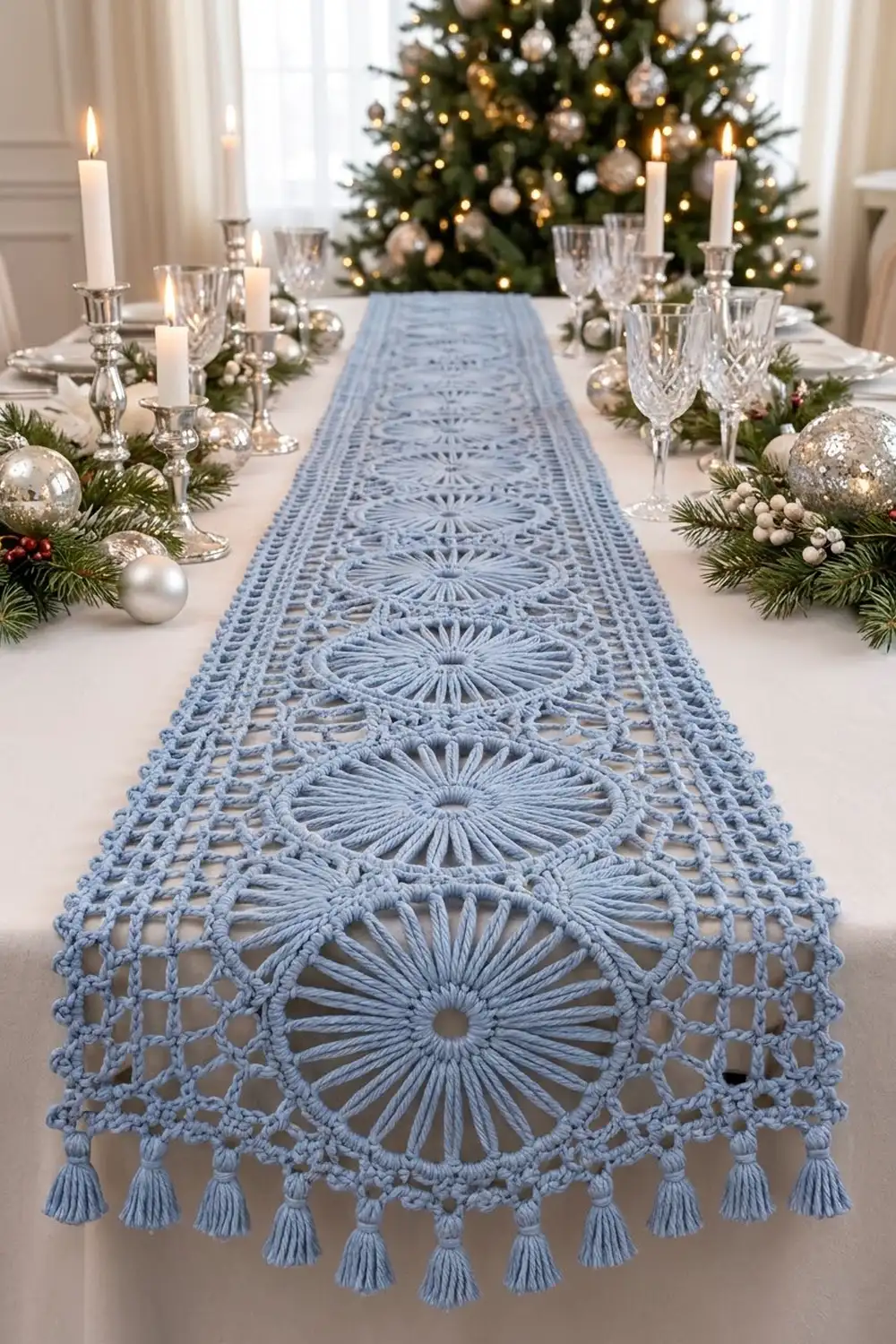
Final Notes
The measurement chain is simple:
– One motif with 35 sc per side measures 9 in (22.9 cm).
– Seven motifs joined stitch-to-stitch make a 9 in x 63 in (22.9 cm x 160.0 cm) strip, with 245 sts per long side and 35 sts per short end.
– The 2 in (5.1 cm) border brings the runner to 13 in x 67 in (33.0 cm x 170.2 cm).
– The 3 in (7.6 cm) tassels finish each end.
Check your first motif carefully, and the rest of the runner will follow.
Happy crocheting!