

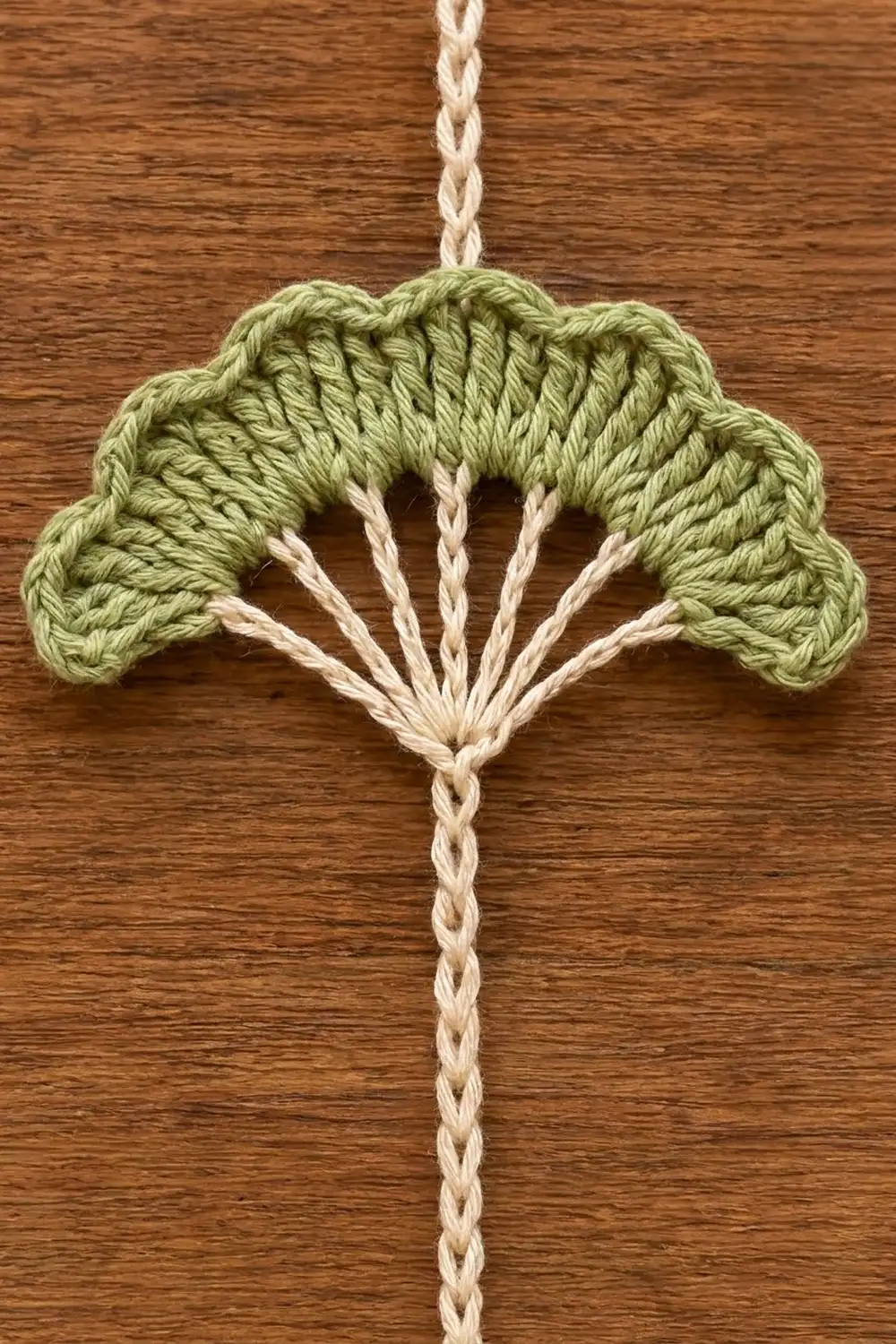
Ginkgo Breeze is a light, airy door curtain made from nine hanging strands of little ginkgo leaves. Each strand is a cream chain “stem” with fan-shaped sage green leaves branching off in pairs. A single leaf sits at the top, just below the hanging loop. Hung side by side on a wooden rod, the strands fill a doorway with a soft botanical screen that still lets light and air through.
The palette is just two colors: sage green for the leaf fans, and cream for the stems and the fine spokes that form the leaf veins. The style is calm and natural. Every leaf has a scalloped outer edge that gives the fans a gently ruffled look.
This pattern uses US crochet terms. One leaf measures 4 in (10.2 cm) wide and 2 in (5.1 cm) tall. One strand is 72 in (182.9 cm) long below its hanging loop, and the nine-strand curtain is 39.75 in (101.0 cm) wide.
Construction is simple and repetitive. You chain each strand from the top down in cream, working seven slip-stitch spokes at every leaf position. Then you work three short green rows across the spoke tips of each leaf. The strands are never sewn together; they hang separately from the rod.
Finished Size and Construction
- Finished curtain: 39.75 in (101.0 cm) wide x 73 in (185.4 cm) long, including hanging loops
- Skill level: Easy to intermediate (easy stitches, many repeats)
- Terminology: US crochet terms
- Yarn weight: DK (3) cotton
- Hook: 4.0 mm (US G-6)
- Number of pieces: 9 separate strands, 45 leaves per strand (405 leaves total)
- Layout: 9 strands in a single row, 4 in (10.2 cm) apart on the rod
- Piece size: one strand is 7.75 in (19.7 cm) wide across a leaf pair x 72 in (182.9 cm) long, plus a 1 in (2.5 cm) loop
- Leaf size before border: 3.2 in (8.1 cm) wide x 1.6 in (4.1 cm) tall after Row 2
- Border depth: the scallop edge row adds 0.4 in (1.0 cm) to every leaf
Materials
Choose a smooth, mercerized or combed DK cotton. Cotton holds the fan shape, resists stretching on a long vertical strand, and blocks crisply. Avoid fuzzy or very stretchy yarns, because the chain stems will sag. Pick a medium-light sage and a warm cream so the spokes stand out clearly against the green.
- Sage green (leaves): 750 g, about 1650 m (based on 50 g / 110 m balls)
- Cream (stems and spokes): 350 g, about 770 m
These amounts include a margin of roughly 15% for test pieces, yarn tails and joins.
Tools:
- 4.0 mm (US G-6) crochet hook
- Tapestry needle
- Scissors
- Stitch markers
- Blocking mat, rustproof pins and a spray bottle
- Tape measure
- Wooden curtain rod, at least 42 in (106.7 cm) long
Abbreviations (US Terms)
- ch – chain
- sl st – slip stitch
- sc – single crochet
- dc – double crochet
- sk – skip
- sp – space
- st(s) – stitch(es)
- RS – right side
Special stitches:
- Hub: a single ch on the stem that holds all 7 spokes of one leaf.
- Spoke: ch 6, sl st in 2nd ch from hook and in next 4 ch, sl st in hub. The skipped ch at the end is the spoke tip. The green yarn attaches there.
- Shell: 5 dc in the same st.
Gauge and Checkpoints
Before you commit to all nine strands, make one test section: a loop, the stem, the top leaf and one pair. Block it lightly and measure.
- Chain gauge: 16 ch = 3 in (7.6 cm), measured relaxed, not stretched.
- Spoke: 1 in (2.5 cm) from hub to tip.
- After leaf Row 1: the green arc spans 2.4 in (6.1 cm) across the spoke tips.
- After leaf Row 2: the leaf is 3.2 in (8.1 cm) wide x 1.6 in (4.1 cm) tall, hub to edge.
- After leaf Row 3: the leaf is 4 in (10.2 cm) wide x 2 in (5.1 cm) tall.
- Leaf pair: 7.75 in (19.7 cm) across both leaves.
- Strand checkpoint: after the top leaf and 5 pairs, the stem measures 18 in (45.7 cm) from the base of the loop.
If too big: go down to a 3.5 mm hook, or chain more snugly.
If too small: go up to a 4.5 mm hook.
If only the stem is off: keep your hook and change the chain count between hubs by 1 (13 or 15 instead of 14). Then change the number of pairs so the strand still reaches 72 in (182.9 cm).
Strand Pattern (Cream)
Each strand is one continuous chain, worked from the top down. The leaves point upward toward the rod, and the stem passes behind them.
Hanging loop: With cream, ch 12, sl st in first ch to form a ring. This loop hangs about 1 in (2.5 cm).
Stem: ch 15, then ch 1 more for the hub (16 ch). Place a marker in the hub.
Top leaf spokes: Work 7 spokes into the hub. Fan them so they open upward over about 160 degrees, with spoke 4 pointing straight up along the stem.
(16 ch on stem; 1 hub; 7 spokes.)
Pair tier (work 22 times):
- ch 14.
- ch 1 for the left hub. Work 7 spokes into it, fanned up and to the left.
- ch 1 for the right hub. Work 7 spokes into it, fanned up and to the right.
(Each tier = 14 ch + 2 hub ch = 16 ch = 3 in / 7.6 cm; 14 spokes per tier.)
Tail: ch 16. Fasten off, leaving a 4 in (10.2 cm) tail. Tie a small overhand knot at the end of the chain and trim.
Strand stem count: 16 (stem) + 22 x 16 (tiers) + 16 (tail) = 384 ch. At 16 ch per 3 in, that is 72 in (182.9 cm). Each strand has 45 hubs and 45 leaves (1 top leaf + 44 pair leaves), with 315 spokes.
Count the spokes as you go. A hub with 6 or 8 spokes changes that leaf’s Row 1 count and breaks the scallop math.
Leaf Pattern (Green)
Work the same three rows on every leaf. Hold the strand with the hub at the bottom and the spokes fanned upward, RS facing. Number the spokes 1 to 7 from left to right. Work the leaves in order from the top of the strand down, so the finished leaves rest above your work and don’t tangle.
Row 1 (RS): Join green with sc in the tip of spoke 1, ch 3, sc in the tip of next spoke; rep from * 5 more times. Turn.
(7 sc, 6 ch-3 sps.)*
The arc now links all seven spoke tips. Check that it spans 2.4 in (6.1 cm).
Row 2 (growth row): ch 3 (counts as dc) in the first sc, 3 dc in next ch-3 sp, dc in next sc; rep from * 5 more times. Turn.
(25 dc total: 1 + 6 x 4.)*
Every 4th dc (sts 1, 5, 9, 13, 17, 21 and 25) sits directly above a spoke tip. Mark st 13, which sits above the center spoke.
Don’t fasten off. Go straight on to the scallop edge below.
Border: Scallop Edge (Leaf Row 3)
In this design, the border is the scalloped outer edge of each leaf. You work it as the last row of every leaf.
Border gauge: 1 scallop is about 0.9 in (2.3 cm) along the outer curve. The border row adds 0.4 in (1.0 cm) of depth.
Row 3 (RS, trim row): ch 1, sc in first dc, sk 1 dc, shell in next dc, sk 1 dc, sc in next dc; rep from * 5 more times. Fasten off, leaving a 6 in (15.2 cm) tail.
(7 sc + 6 shells of 5 dc = 7 + 30 = 37 sts; 6 scallops.)*
Per side of the leaf: 3 scallops on the left half and 3 on the right half. The center sc in st 13 is shared between the two halves.
Why the math works: Row 2 has 25 sts, and each scallop repeat uses 4 sts (sk, shell, sk, sc). One opening sc plus 6 repeats uses exactly 1 + 6 x 4 = 25 sts, so the last sc lands in the top of the turning ch-3. Row 3 works into 13 of the 25 dc (7 sc + 6 shell bases) and skips the other 12. The sc positions (1, 5, 9, 13, 17, 21, 25) are the same dc that sit over the spoke tips, so every spoke ends in a valley between two scallops. That anchors the veins and lets each scallop flare cleanly between two spokes.
Weave the green tails into Row 2 on the wrong side, not into the spokes.
Make All Pieces
Make 9 identical strands.
- Per strand: 45 leaves (1 top + 22 pairs), 315 spokes, 384 stem ch
- Total leaves: 9 x 45 = 405
- Sage green per strand: about 83 g (about 183 m), including margin
- Cream per strand: about 39 g (about 86 m), including margin
Layout grid (rod positions, seen from the front):
Rod:  |--S1---S2---S3---S4---S5---S6---S7---S8---S9--|
in:      0    4    8    12   16   20   24   28   32
cm:      0   10.2 20.3 30.5 40.6 50.8 61.0 71.1 81.3
Each strand: loop / top leaf / 22 leaf pairs / tail
Joining: Hanging the Strands
The strands are not stitched to each other. Here, joining means mounting them on the rod at an exact spacing.
Method: Slide each hanging loop onto the rod in order, S1 to S9.
Spacing logic: Place the loops 4 in (10.2 cm) apart, center to center, so the two outer strands sit 32 in (81.3 cm) apart. Each leaf pair spans 7.75 in (19.7 cm), so the outer leaves reach 3.875 in (9.8 cm) beyond S1 and S9. Total width: 32 + 7.75 = 39.75 in (101.0 cm). The pair span is wider than the spacing, so neighboring leaves overlap by 3.75 in (9.5 cm) and interlock into a continuous screen. This width covers a standard 36 in (91.4 cm) doorway with a little overlap onto the frame.
Tension advice: Never pull a strand to even it up. Cotton chain stretches slightly under its own weight. Let all nine strands hang freely for 24 hours, then compare lengths.
Size checkpoint: Every strand should hang 72 in (182.9 cm) from the base of its loop to the knot. If one is more than 0.5 in (1.3 cm) longer, untie the tail knot and pull out a few tail ch.
Final Blocking
- Lightly spray each strand with water until it is damp, not soaked.
- Lay one section of the strand flat on the blocking mat, with the stem straight.
- Fan the 7 spokes of each leaf evenly over about 160 degrees, with the center spoke in line with its hub.
- Pin the outer edge so each leaf measures 4 in (10.2 cm) wide x 2 in (5.1 cm) tall.
- Open each scallop with a pin tip so the shells sit flat.
- Check the hub spacing: 3 in (7.6 cm) between tiers.
- Let it dry completely, then block the next section.
- Optional: a light spray starch helps the fans keep their shape while hanging.
Final Quality-Control Checklist
- 9 strands, each with 1 top leaf and 22 pairs
- Every leaf has 7 spokes and 6 scallops
- Every leaf measures 4 in (10.2 cm) x 2 in (5.1 cm)
- Each strand is 72 in (182.9 cm) long below the loop
- Loops are 4 in (10.2 cm) apart; total width is 39.75 in (101.0 cm)
- All tails are woven into green Row 2, with none visible on the front
- Tail knots are secure and trimmed
Troubleshooting
Leaf curls into a cup: The spokes are too short or Row 2 is tight. Check for the 1 in (2.5 cm) spoke length and loosen your dc.
Leaf ruffles: The spokes are too long, or you worked 4 dc in a ch-3 sp. Recount Row 2. It must be 25 dc.
Scallops are uneven at one end: You missed the turning ch-3 in Row 3. The last sc goes into its top.
Stem twists: Chains twist naturally. Block the stem flat and let the strand hang for a day before you judge its length.
Strands are different lengths: Your chain gauge drifted. Check against the 18 in (45.7 cm) checkpoint after every 5 pairs.
Green tails show through the fan: Weave them along the Row 2 dc posts in two directions, then trim close.
Care
Hand wash in cool water with a mild detergent, roll in a towel and re-block flat. Don’t tumble dry, because the long chains can tangle and stretch.

Final Notes
The whole curtain rests on one measurement chain:
- 16 ch = 3 in (7.6 cm) on the stem
- spokes are 1 in (2.5 cm) long
- Row 2 has 25 dc and is 3.2 in (8.1 cm) wide
- the scallop row has 37 sts and brings the leaf to 4 in (10.2 cm) wide
The leaves sit on 3 in (7.6 cm) tiers, and 22 pairs make a 72 in (182.9 cm) strand. Nine strands spaced 4 in (10.2 cm) apart give a 39.75 in (101.0 cm) curtain. Check each measurement as you go, and the finished screen will hang straight and even.
Happy crocheting!