
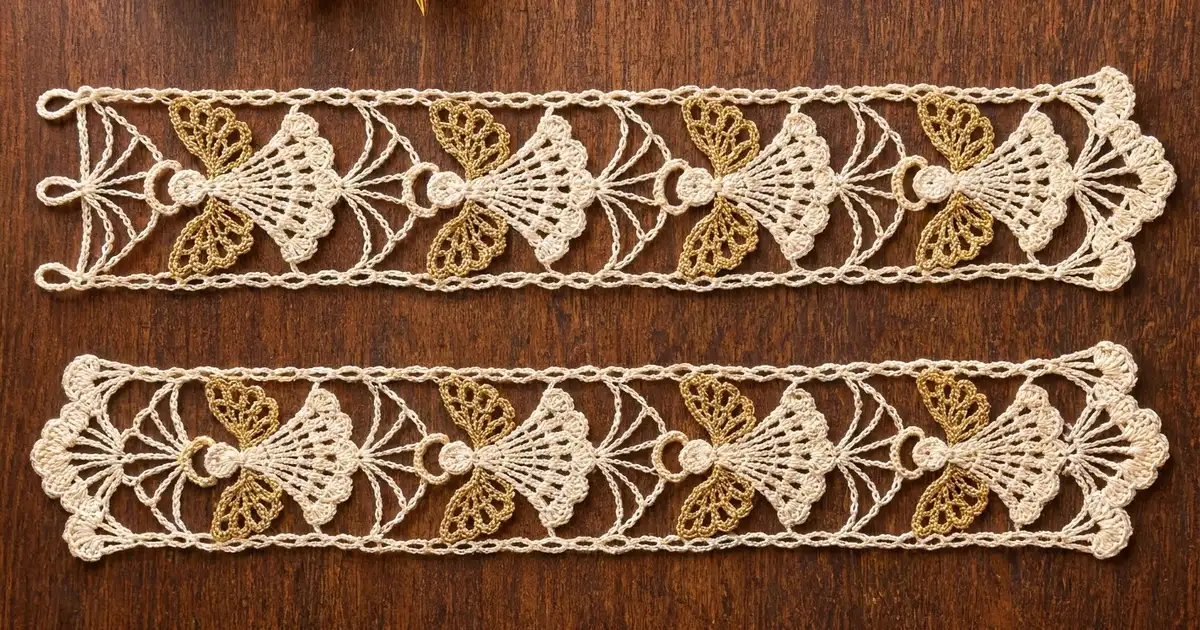
This lace strip is made in ivory cotton thread and holds four small angels. Each angel has gold metallic wings, a round head, a ring halo and a fan-shaped skirt with scalloped edges. Chain swags drape between two slim side rails, a straight bar finishes the top with a hanging loop at each corner, and a row of shell scallops finishes the bottom.
The look is classic thread lace: light and airy, with a little shine from the gold. It works well hung in a window, on a door or down the side of a shelf for the holidays.
The pattern uses US crochet terms. The finished strip is 4 in (10.2 cm) wide and 21 in (53.3 cm) long, not counting the hanging loops, which add 0.75 in (1.9 cm).
Here’s the construction. You make two long rails and four separate angels. Then you lay the rails side by side and work chain swag sets between them, attaching each angel as you go. Last, you add a bar with hanging loops across the top and a bar with scallops across the bottom.
Finished Size and Construction
- Finished size: 4 in × 21 in (10.2 × 53.3 cm), plus 0.75 in (1.9 cm) hanging loops
- Skill level: Intermediate
- Terminology: US
- Yarn weight: Size 10 crochet thread (Lace, 0)
- Hook: 1.75 mm steel hook (US steel 4)
- Number of pieces: 18. That’s 2 rails and 4 angels, each angel made from a body, a halo and 2 wings.
- Layout: 1 column of 4 angels between 2 rails
- Piece size: each angel has a 3.5 in (8.9 cm) wingspan and stands 2.75 in (7.0 cm) tall from the top of the halo to the hem
- Size before border: 4 in × 20 in (10.2 × 50.8 cm)
- Border depth: top 0.25 in (0.6 cm), bottom 0.75 in (1.9 cm)
Materials
Use mercerized cotton for crisp stitches that block well. For the wings, use a metallic-blend thread of the same weight. Pure metallic thread splits easily, so a cotton-metallic blend is easier to work with.
- Ivory, size 10 cotton thread: 30 g (about 96 m)
- Gold metallic-blend thread, size 10: 8 g (about 26 m)
These amounts include a margin for your gauge swatch and for tying on and weaving in.
Tools:
– 1.75 mm steel hook
– Tapestry needle with a small eye
– 10 locking stitch markers
– Rustproof pins and a blocking board
– Spray starch or a diluted fabric stiffener
– Ruler or tape measure
Abbreviations (US Terms)
- ch: chain
- sl st: slip stitch
- sc: single crochet
- dc: double crochet
- sp: space
- st(s): stitch(es)
- [ ]: repeat the steps inside the brackets as many times as stated
Special stitches:
– Shell: 7 dc in the same st.
– Center ring: ch 5, then sl st in the 5th ch from the hook. This makes a tiny ring in the middle of a chain where the swags meet.
Gauge and Checkpoints
Gauge: 37 sc = 4 in (10.2 cm), measured after blocking.
Swatch first: ch 38, sc in the 2nd ch from the hook and in each ch across (37 sc). Your row should measure 4 in (10.2 cm). Every length in this pattern comes from this gauge, because the rails are sc worked lengthwise.
Before making a full set, test one complete angel:
– Head after Round 1: 0.6 in (1.5 cm) across
– Body, head to hem: 2.25 in (5.7 cm)
– Skirt hem: 2.75 in (7.0 cm) wide
– Halo: 0.75 in (1.9 cm) across
– Each wing: 1.5 in × 1.25 in (3.8 × 3.2 cm)
If your pieces come out too big, go down to a 1.5 mm hook. If they come out too small, go up to a 2.0 mm hook. Change the hook, not the stitch counts. The swag chain lengths depend on the 3.8 in (9.7 cm) gap between the rails.
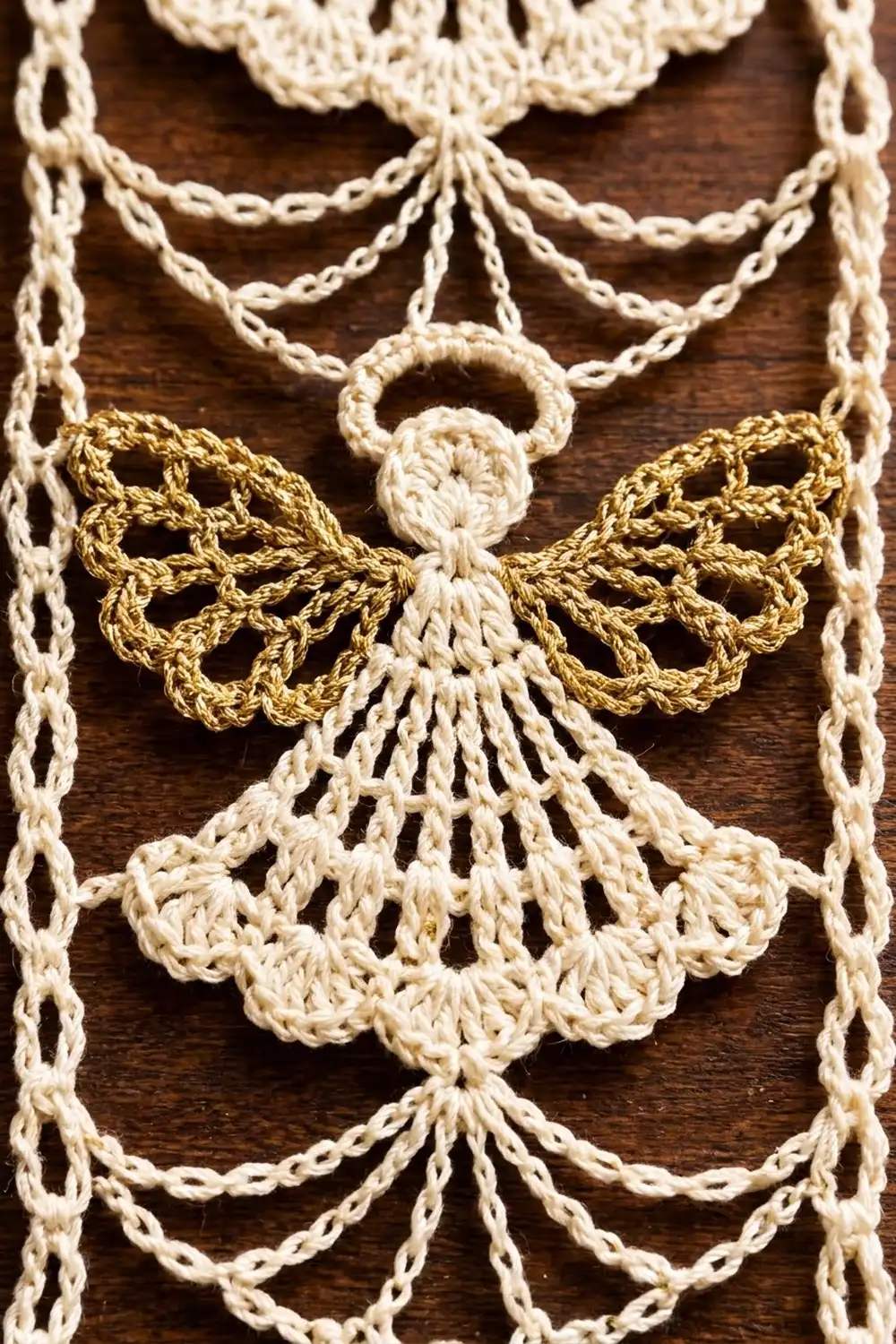
Rails (make 2, ivory)
Ch 186. Work 1 sc into the back bump of the 2nd ch from the hook and into the back bump of each ch across: 185 sc. Fasten off and leave a 4 in (10.2 cm) tail.
Working in the back bumps leaves neat chain Vs on both edges, which gives the rail a braided-chain look. The rail measures 20 in (50.8 cm).
Number the stitches starting from the end where you finished. Stitch 1 is the last sc you made, and stitch 185 sits at the foundation end. Place markers on both rails at these stitches:
- Swag points: sts 7, 11, 15 / 47, 51, 55 / 87, 91, 95 / 127, 131, 135 / 167, 171, 175
- Wing points: sts 21, 61, 101, 141
Here’s where those numbers come from. Sts 1–5 are a header of about 0.5 in (1.3 cm). Four 40-st units follow, starting at sts 6, 46, 86 and 126; each unit is about 4.3 in (10.9 cm). A 20-st bottom section, about 2.2 in (5.6 cm), starts at st 166. Inside each unit, the swags attach at the unit’s 2nd, 6th and 10th sts, and the wings at its 16th st.
Angel Body (make 4, ivory)
Head, Round 1: Ch 4 and sl st to form a ring. Ch 3 (counts as dc), work 11 dc in the ring, then sl st to the top of the ch-3: 12 dc. The head is a solid circle 0.6 in (1.5 cm) across. Call the ch-3 dc 1; it’s the top of the head.
Row 1 (shoulders): Sl st in each of the next 5 dc, so you’re now in dc 6. Work (ch 3, 2 dc) in dc 6, 2 dc in dc 7 and 3 dc in dc 8: 8 dc. Turn.
Row 2: Ch 4 (counts as dc + ch 1), dc in the next dc, [ch 1, dc in the next dc] 6 times: 8 dc and 7 ch-1 sps. Turn.
Row 3: Ch 4 (counts as dc + ch 1), [dc in the next ch-1 sp, ch 1, dc in the next dc, ch 1] 6 times, dc in the last ch-1 sp, ch 1, dc in the 3rd ch of the turning ch: 15 dc and 14 ch-1 sps. Turn.
Row 4: Ch 5 (counts as dc + ch 2), skip the ch-1 sp, dc in the next dc, then [ch 2, skip the ch-1 sp, dc in the next dc] 13 times. Work the last dc into the 3rd ch of the turning ch. You have 15 dc and 14 ch-2 sps. These dc columns form the radiating spokes of the skirt. Turn.
Row 5 (scallop hem): Ch 1, sc in the first dc, then [skip the ch-2 sp, shell in the next dc, skip the ch-2 sp, sc in the next dc] 7 times. Work the last sc into the 3rd ch of the turning ch. This uses all 15 dc: 7 shells and 8 sc, for 57 sts. Fasten off.
Checkpoint: the hem measures 2.75 in (7.0 cm) wide, and the body measures 2.25 in (5.7 cm) from the top of the head to the hem.
Halo (make 4, ivory)
Ch 14 and sl st to form a ring. Ch 1, work 22 sc in the ring, then sl st to the first sc: 22 sc. Mark st 1 as the top center. Fasten off and leave an 8 in (20.3 cm) tail.
Using the tail, sew sts 10–14 of the halo to the top of the head, around dc 12 and dc 1. The halo should sit upright above the head, 0.75 in (1.9 cm) across.
Wings (make 8, gold)
Row 1: Ch 4 and sl st to form a ring. Ch 1, sc in the ring, then [ch 9, sc in the ring] 3 times. You have 4 sc and 3 ch-9 loops. Turn.
Row 2: In each ch-9 loop, work (sc, [ch 3, sc] 5 times), then sl st in the next sc. That gives 6 sc and 5 ch-3 picots in each of the 3 lobes, for 18 sc and 15 picots in total. Fasten off and leave an 8 in (20.3 cm) tail.
The 2nd lobe is the wing tip, and its 3rd picot is the tip point.
Assembly: Sew the base ring of one wing behind each end of Row 1 of the body, with the wing tips pointing outward. Checkpoint: the wingspan measures 3.5 in (8.9 cm).
Make All Pieces
- Ivory: 2 rails, 4 bodies, 4 halos
- Gold: 8 wings
- Assembled angels: 4
Layout:
[ TOP BAR + 2 hanging loops ]
| rail |  swag set 1 + Angel 1  | rail |
| rail |  swag set 2 + Angel 2  | rail |
| rail |  swag set 3 + Angel 3  | rail |
| rail |  swag set 4 + Angel 4  | rail |
| rail |  swag set 5 (no angel)  | rail |
[ BOTTOM BAR + 6 scallops ]
Joining
Pin the two rails to your blocking board side by side, with stitch 1 at the top. Leave a gap of 3.8 in (9.7 cm) between their inner edges. That gap is exactly 35 sts at gauge, which matches the 35 ch you’ll use in the border bars.
Swag set (work 4 times, starting at sts 7, 47, 87 and 127): In the steps below, A is the first swag point of the unit, B is the second and C is the third.
- Join ivory with a sl st in left rail st A. Ch 24, make a center ring, ch 24, then sl st in right rail st A.
- Sl st in the next 4 sts of the right rail, which brings you to st B. Ch 21, sl st in the center ring, ch 21, then sl st in left rail st B.
- Sl st in the next 4 sts of the left rail, which brings you to st C. Ch 18, then sl st in the center ring.
- Halo strands: Ch 6 and sl st in halo st 20. Sl st in halo sts 21, 22, 1, 2, 3 and 4 (6 sl sts). Ch 6, then sl st in the center ring.
- Ch 18, sl st in right rail st C, then fasten off.
Wings: Tack the tip point of each wing to its rail at that unit’s wing point (sts 21, 61, 101 or 141). Use a few small stitches with ivory thread.
Bottom swag set (sts 167, 171 and 175): Work steps 1–3 as above, skip step 4, then do step 5.
Hem ties: Join ivory in the 4th dc of the center (4th) shell of each angel’s hem. Ch 12, sl st in the center ring of the swag set below, then fasten off. Angel 4 ties to the bottom swag set.
Tension: Each swag chain should curve gently and stay the same length as its mirror on the other side. If you pull the chains tight, the rails will draw inward.
Checkpoint: the rails stay 3.8 in (9.7 cm) apart along their whole 20 in (50.8 cm) length.
Border
The border has two parts: a top bar with hanging loops and a bottom bar with scallops. Border gauge is the same as the main gauge, 37 sc = 4 in (10.2 cm).
Top bar, Row 1: Join ivory in st 1 of the left rail. Ch 1, sc in the same st, ch 35, then sc in st 1 of the right rail. You have 2 sc and 35 ch. Turn.
Top bar, Row 2: Ch 1, sc in the first sc, ch 12, sl st in the same sc (hanging loop). Sc in each of the 35 ch, then sc in the last sc, ch 12, and sl st in the same sc. That’s 37 sc (1 in each of the 2 sc and 35 ch) plus 2 ch-12 loops. Fasten off.
Bottom bar, Row 1: Join ivory in st 185 of the left rail. Ch 1, sc in the same st, ch 35, then sc in st 185 of the right rail. You have 2 sc and 35 ch. Turn.
Bottom bar, Row 2: Ch 1, sc in each st across: 37 sc (1 in each of the 2 sc and 35 ch, nothing added). Turn.
Bottom bar, Row 3 (scallops): Ch 1, sc in the first sc, then [skip 2 sc, shell in the next sc, skip 2 sc, sc in the next sc] 6 times. That’s 6 shells and 7 sc, 49 sts in total. Fasten off.
Why the math works: Each bar is 1 rail end + 35 ch + 1 rail end = 37 sts. At 37 sc = 4 in (10.2 cm), each bar matches the strip’s 4 in (10.2 cm) width. The rail ends already count as the first and last sts, so no corner stitches are added. Each scallop repeat uses 6 sts, and 1 + (6 × 6) = 37, so the six scallops fit exactly with an sc at each edge.
Final Blocking
- Weave in all ends along the rails or into the dc spokes.
- Soak the strip in cool water for 10 minutes, then roll it in a towel to press out the water.
- Pin the rails straight, 4 in (10.2 cm) apart at their outer edges and 20 in (50.8 cm) long.
- Pin each skirt open into a fan 2.75 in (7.0 cm) wide. Put a pin at the tip of each shell.
- Pin each wing lobe open so the picots show.
- Shape the swags into even curves, and pin the hanging loops round.
- Mist with starch and let the strip dry completely before you unpin it.
Final Quality-Control Checklist
- [ ] Strip measures 4 in × 21 in (10.2 × 53.3 cm)
- [ ] The rails are straight, parallel and have no twists
- [ ] All 4 angels hang centered, with their halos level
- [ ] Each wing tip is tacked at its correct rail st
- [ ] Each skirt shows 7 even shells
- [ ] Both bars have 37 sc; the bottom bar has 6 scallops
- [ ] The two hanging loops are the same size
- [ ] No loose ends are visible from the front
Troubleshooting
- Rails twist like a corkscrew: dampen them and pin them straight. Next time, keep your sc tension even and work only into the back bumps.
- The strip narrows in the middle: your swag chains are too tight. Remake them with looser chains.
- The skirt cups: your Row 4 chains are too short. Work ch 3 instead of ch 2 in every repeat; the stitch count stays the same.
- The skirt ruffles: go down one hook size for the body only.
- The angel tilts: the halo strands are uneven. Check that you made 6 sl sts across the halo, and redo the strands if needed.
- Metallic thread frays: cut shorter lengths and slide the hook in gently.
Care
Hand-wash in cool water with mild soap and lay flat to dry. Reshape the strip and re-starch it if it softens.

Final Notes
Every measurement follows from one gauge: 37 sc = 4 in (10.2 cm). The 185-st rails come out 20 in (50.8 cm) long. Each 40-st unit is about 4.3 in (10.9 cm) and holds one angel 2.75 in (7.0 cm) tall. The 35-ch bars set the width at 4 in (10.2 cm). The 0.25 in (0.6 cm) top bar and 0.75 in (1.9 cm) bottom border bring the finished strip to 21 in (53.3 cm).
Check your gauge, test one angel, and the rest will fall into place. Happy crocheting!