

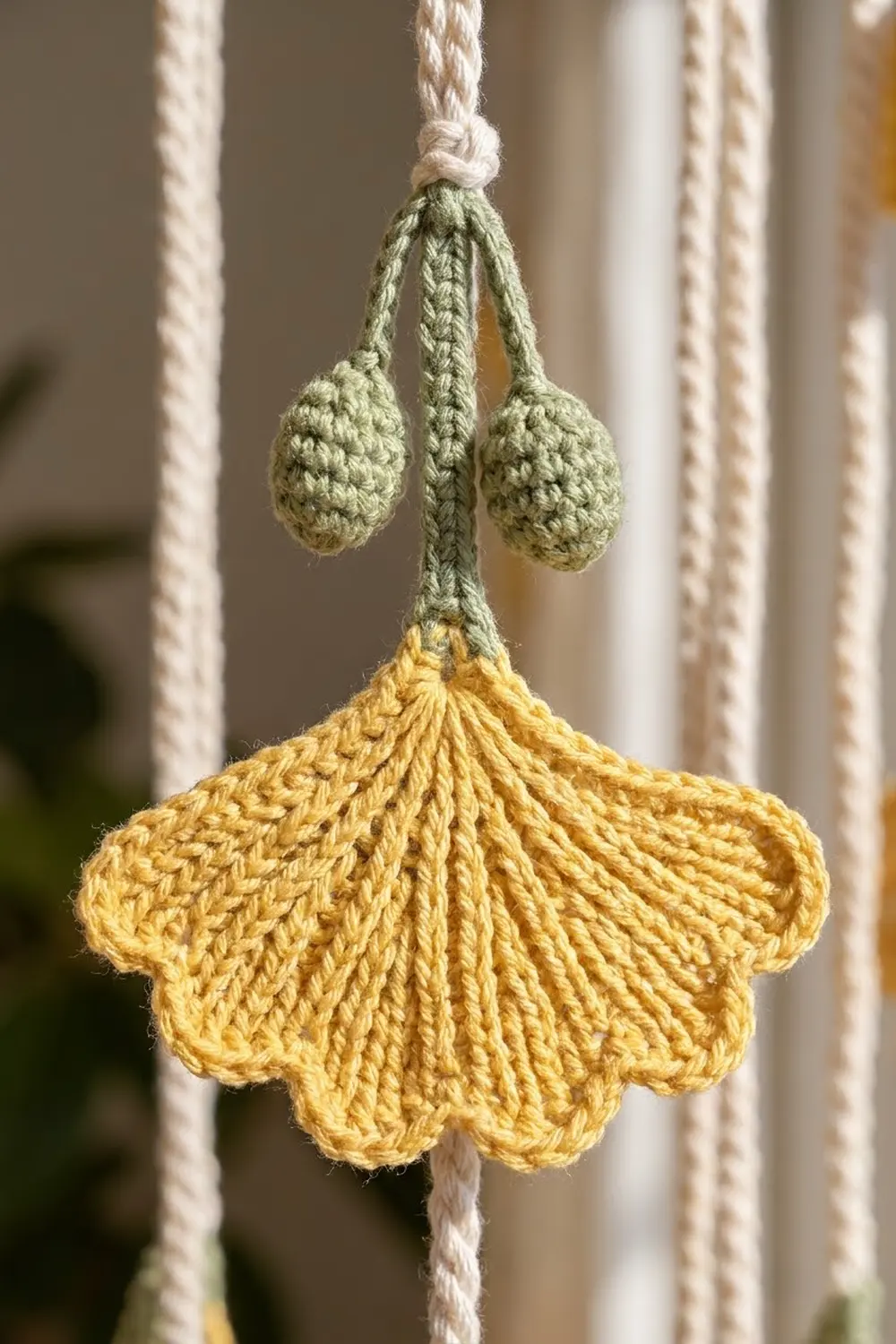
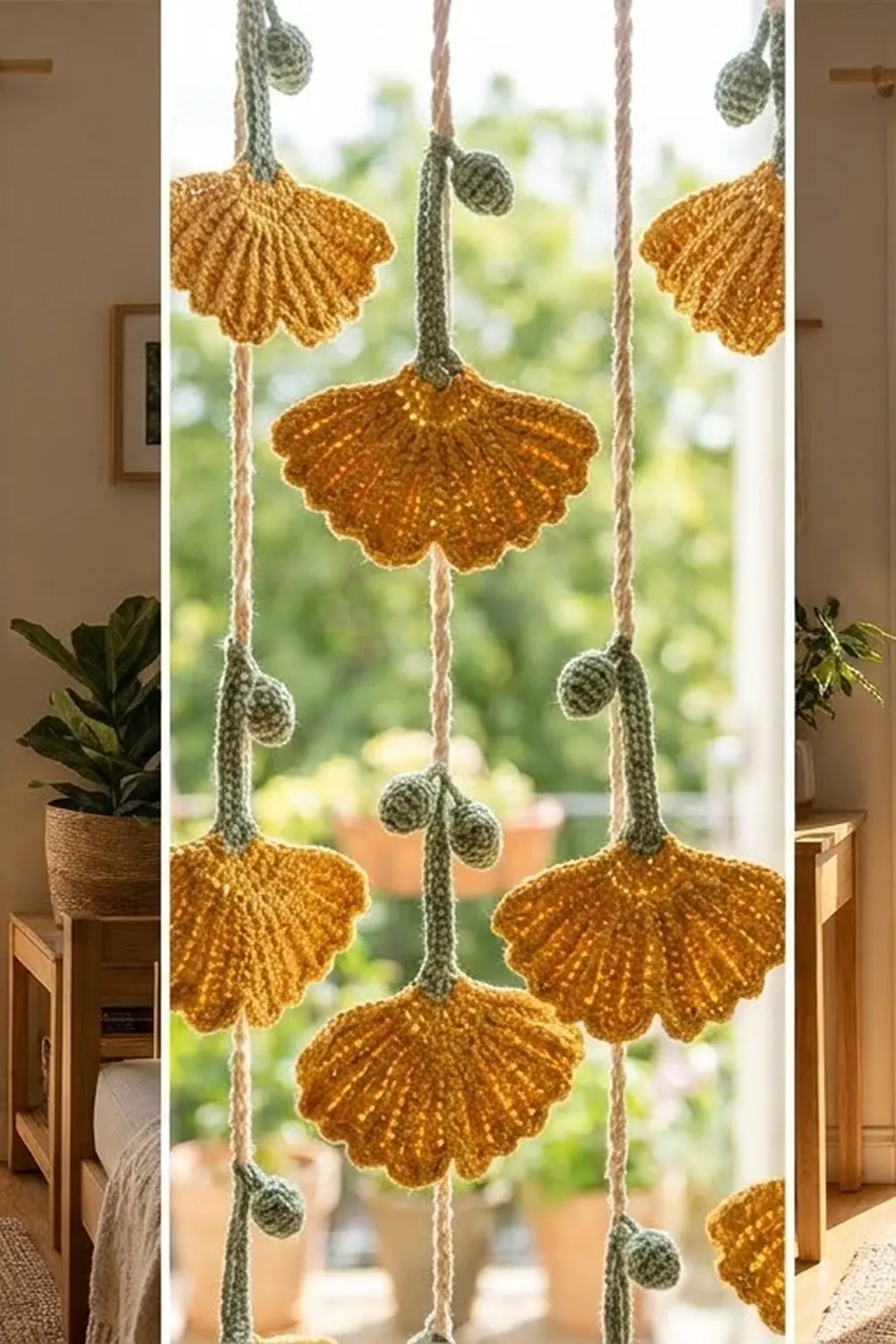
This door curtain is a column of falling ginkgo leaves. Each golden leaf is a small fan with ridges that spread out from the base, finished with a soft scalloped edge. A sage-green stem rises from the leaf and ends in two small seed buds.
The leaves are tied at even intervals along twisted cream cords hanging from a plain wooden rod. There are three colors: golden yellow, sage green, and natural cream. In a sunny doorway it filters the light like a beaded curtain, only softer.
The pattern uses US crochet terms. The finished curtain is 36 in (91.4 cm) wide and 78 in (198.1 cm) long. Each leaf is 4 in (10.2 cm) wide and 2.5 in (6.4 cm) tall.
Here is how it is made. Each leaf is worked flat in short graded rows through the back loop only, which builds the fan and its ridges. Two border rounds add the scalloped edge. The green stem and buds are worked onto the leaf base. Finally, the leaves are tied onto 18 doubled cords that are knotted over the rod.
Finished Size and Construction
- Finished curtain size: 36 in (91.4 cm) wide x 78 in (198.1 cm) long
- Skill level: Intermediate (simple stitches, a lot of repetition)
- Terminology: US crochet terms
- Yarn weight: DK (light #3) cotton
- Hook: 3.5 mm (E-4)
- Number of pieces: 189 leaf-and-stem units, plus 18 doubled cords
- Layout: 18 strands spaced 2 in (5.1 cm) apart. Odd strands carry 11 leaves and even strands carry 10, offset by half a step.
- Leaf size before border: 3.75 in (9.5 cm) wide x 2.25 in (5.7 cm) tall
- Leaf size after border: 4 in (10.2 cm) wide x 2.5 in (6.4 cm) tall
- Border depth: about 0.25 in (0.6 cm) on the curved edge
- Stem length: 2.5 in (6.4 cm)
Materials
Choose a smooth mercerized or combed DK cotton, about 120 m (131 yd) per 50 g. Cotton shows the ridges clearly, blocks to a crisp edge, and won’t stretch much while it hangs. Avoid fuzzy or very stretchy fibers.
Yarn and cord:
- Golden yellow (leaves): 650 g, about 1,560 m (1,706 yd), or 13 balls of 50 g
- Sage green (stems and buds): 250 g, about 600 m (656 yd), or 5 balls of 50 g
- Cream cord (strands): 3 mm twisted cotton cord, 85 m (93 yd)
Tools:
- 3.5 mm (E-4) crochet hook
- Wooden dowel, 40 in (101.6 cm) long and about 1 in (2.5 cm) thick, with brackets
- Large-eye tapestry needle (one that fits the cord)
- Locking stitch markers or small clips
- Measuring tape and sharp scissors
- Blocking mat, rust-proof pins, and a spray bottle
- Fray check (optional)
These amounts include a margin of about 10–15% over the measured use. That covers gauge differences, test leaves, and the long tying tails.
Abbreviations (US Terms)
- ch – chain
- sl st – slip stitch
- sc – single crochet
- hdc – half double crochet
- dc – double crochet
- tr – treble crochet
- BLO – back loop only
- st(s) – stitch(es)
- RS – right side
Special stitch – Bud (5-dc bobble): *Yarn over, insert hook in the stitch, yarn over and pull up a loop, yarn over and pull through 2 loops. Repeat from * 4 more times in the same stitch (6 loops on hook). Yarn over and pull through all 6 loops, then ch 1 to lock. The result is a firm oval pod about 0.5 in (1.3 cm) long.
Gauge and Checkpoints
Gauge: 20 sc and 22 rows = 4 in (10.2 cm) in sc worked flat with a 3.5 mm hook.
Make one full test leaf with its stem and block it before you make any more. With 189 leaves, a small error adds up quickly.
Checkpoints:
- After Row 1: the row measures 2.25 in (5.7 cm) from the sl st end to the top of the last tr.
- After Row 18: the fan measures 3.75 in (9.5 cm) between the outer tips and 2.25 in (5.7 cm) from base to edge.
- After the border: the leaf measures 4 in (10.2 cm) x 2.5 in (6.4 cm).
- After the stem: the stem measures 2.5 in (6.4 cm) from leaf base to bud junction.
If the leaf is too big, go down to a 3.25 mm hook. If it is too small, go up to a 3.75 mm hook. If the fan won’t open fully, pull each tr’s first loop up a little taller.
Leaf
Worked flat in golden yellow. Every row after Row 1 is worked in BLO, and that creates the ridges. The base of the leaf (the narrow point) is always the sl st end of each row. The tr end forms the curved outer edge.
Foundation: Ch 13.
Row 1 (RS): Sl st in 2nd ch from hook, sc in next 2 ch, hdc in next 2 ch, dc in next 3 ch, tr in next 4 ch. Turn. (12 sts)
This row runs from base to edge.
Row 2: Ch 4 (counts as first tr). Working in BLO: tr in next 3 sts, dc in next 3 sts, hdc in next 2 sts, sc in next 2 sts, sl st in last st. Turn. (12 sts)
This row runs from edge back to base.
Row 3: Ch 1 (does not count). Working in BLO: sl st in first st, sc in next 2 sts, hdc in next 2 sts, dc in next 3 sts, tr in next 3 sts, tr in top of turning ch-4. Turn. (12 sts)
Rows 4–18: Repeat Rows 2 and 3 seven more times, then work Row 2 once more. (12 sts in every row; 18 rows total)
Every row has the same 12 stitches. The fan opens because the tr end of each row is much taller than the sl st end, so every row adds a thin wedge around the base point. Row 18 ends at the base. Do not fasten off.
Checkpoint: There are 18 ridges spreading out from one base point. The fan is 3.75 in (9.5 cm) across and 2.25 in (5.7 cm) tall.
Border (Scalloped Leaf Edge)
Border gauge: 2 sc per row end along the curve. This keeps the 36 sc on the curve flat without ruffling.
The leaf has three sides: Side A (the top of Row 18), the curve (the tr ends of all 18 rows), and Side B (the underside of the foundation chain). The count for each side already includes the stitch where it meets the next side, so there are no extra corner stitches.
Round 1: Ch 1 (does not count), turn.
- Side A: sc in each st of Row 18, working from the base out to the edge. (12 sc)
- Curve: 2 sc in the end of each row, working from Row 18 back to Row 1. (36 sc)
- Side B: sc in the bottom loop of each foundation ch, working back to the base. (12 sc)
Join with sl st to first sc. (60 sc = 12 + 36 + 12)
Round 2 (conversion round): Ch 1 (does not count). Do not turn.
- Side A: sl st in each of the next 12 sc. (12 sl st)
- Curve: Sl st in next st, hdc in next st, 2 dc in next st, 2 dc in next st, hdc in next st, sl st in next st. Repeat from * 5 more times. (6 scallops; 48 sts)*
- Side B: sl st in each of the next 12 sc. (12 sl st)
Join with sl st to first sl st. (72 sts = 60 sts worked 1 per st + 12 extra dc)
Why the math works: 36 curve stitches split evenly into 6 repeats of 6 sts. Each repeat adds 2 stitches, so the curve gains 6 x 2 = 12 and goes from 36 to 48. The sl st sides add no height, so the straight edges stay flat. Where two repeats meet, the pair of sl sts makes a dip. The dip between repeats 3 and 4 falls exactly at the center of the curve, after 18 of the 36 stitches, and becomes the ginkgo notch.
Fasten off yellow and weave in the ends along Side A.
Stem and Buds
Worked in sage green, starting at the bud junction so that both tails end up where the stem ties onto the cord.
Leaving a 12 in (30.5 cm) starting tail, make a slip knot and place it on the hook.
Branch A: Ch 7, Bud in 3rd ch from hook, sl st in next 4 ch. (7 ch used: 2 skipped, 1 Bud, 4 sl st; you are back at the junction)
Branch B: Ch 9, Bud in 3rd ch from hook, sl st in next 6 ch. (9 ch used: 2 skipped, 1 Bud, 6 sl st; back at the junction)
Because the branches are different lengths, the two buds hang at different heights.
Stem: Ch 16, then sl st into the sl st at the leaf base. Working back along the chain, sl st in each of the 16 ch to the junction. (16 sl st)
Fasten off, leaving a 12 in (30.5 cm) tail. You now have two long tails at the junction.
Checkpoint: The stem is 2.5 in (6.4 cm) long and firm because it is doubled with sl sts. The whole leaf unit hangs 5 in (12.7 cm) from junction to leaf edge.
Make All Pieces
Make 189 leaf-and-stem units:
- Golden yellow: 189 leaves, about 3 g each
- Sage green: 189 stems with 378 buds, about 1 g per stem
Block the leaves in batches of 20 as you go.
Cords: Cut 18 cream cords, each 166 in (421.6 cm) long. That is twice the 78 in (198.1 cm) drop plus 10 in (25.4 cm) for the knot and trimming.
Layout grid (O = tie point, measured down from the rod):
Strand:   1  2  3  4  5  6  7  8  9 10 11 12 13 14 15 16 17 18
3 in      O  .  O  .  O  .  O  .  O  .  O  .  O  .  O  .  O  .
6.5 in    .  O  .  O  .  O  .  O  .  O  .  O  .  O  .  O  .  O
...       (alternate every 3.5 in)
73 in     O  .  O  .  O  .  O  .  O  .  O  .  O  .  O  .  O  .
- Odd strands: leaves at 3 in (7.6 cm), then every 7 in (17.8 cm), down to 73 in (185.4 cm). 11 leaves x 9 strands = 99.
- Even strands: leaves at 6.5 in (16.5 cm), then every 7 in (17.8 cm), down to 69.5 in (176.5 cm). 10 leaves x 9 strands = 90.
- Total: 99 + 90 = 189 leaves.
Joining (Assembling the Curtain)
Hang the cords: Fold each cord in half and attach it to the rod with a lark’s head knot. The curtain covers 36 in (91.4 cm), centered on the 40 in (101.6 cm) rod, so it starts 2 in (5.1 cm) in from each rod end. Place the outer strands 1 in (2.5 cm) in from the edges of the curtain and space all 18 knots 2 in (5.1 cm) apart. That gives 17 gaps x 2 in = 34 in (86.4 cm), plus 1 in (2.5 cm) on each side, for 36 in (91.4 cm).
Mark the tie points: Hang the rod at working height. Measure down from each lark’s head knot and clip a marker at every tie point on the grid.
Attach each leaf: Hold the bud junction against both cord strands at the marker. Wrap both green tails around the cord twice in opposite directions and tie a firm square knot. Run each tail through the center of the cord for 1 in (2.5 cm), then trim. The leaf hangs fan down, with the buds sitting at the cord.
Tension advice: Make the wraps snug enough that the leaf can’t slide, but not so tight that the cord kinks. Each leaf should hang straight down.
Size checkpoint: On the odd strands, the bottom leaves end at 78 in (198.1 cm): the 73 in (185.4 cm) tie point plus the 5 in (12.7 cm) leaf unit. On the even strands they end at 74.5 in (189.2 cm), which staggers the hem. Tie an overhand knot in each cord at 78 in (198.1 cm), trim 0.5 in (1.3 cm) below it, and seal the ends if you like.
Final Blocking
- Before tying, soak the leaves in lukewarm water for 10 minutes. Press the water out in a towel; don’t wring them.
- Pin each leaf RS up. Pin the base point first, then the two outer tips 4 in (10.2 cm) apart.
- Pin the curve into a smooth arc 2.5 in (6.4 cm) from the base, with one pin in each of the 6 scallops.
- Pin the center dip into a V about 0.25 in (0.6 cm) deep.
- Lay the stem out straight and spread the two buds apart.
- Let everything dry completely. Once the curtain is hung, mist and smooth any curled leaves.
Final Quality-Control Checklist
- Every leaf has 18 ridges, 60 sc in Round 1, and 72 sts with 6 scallops in Round 2.
- Every leaf measures 4 in (10.2 cm) x 2.5 in (6.4 cm), give or take 0.25 in (0.6 cm).
- Every stem is 2.5 in (6.4 cm) long and has 2 firm buds.
- There are 189 leaves: 11 per odd strand and 10 per even strand.
- The strands are 2 in (5.1 cm) apart across 36 in (91.4 cm).
- Knots are snug, tails are buried, and the cord ends are knotted at 78 in (198.1 cm).
Troubleshooting
- Fan cups: Your tr stitches are too tall for the base. Work them firmer, or block harder.
- Fan is under 3.75 in (9.5 cm): Your tr stitches are too short. Pull up taller loops, or go up a hook size.
- Curve ruffles: Recount Round 1 for exactly 36 sc on the curve.
- Uneven scallops: Check that each repeat starts and ends with a sl st, for 48 sts on the curve.
- Flat buds: Close each bobble tightly and don’t skip the ch 1 that locks it.
- Leaves slide: Add a third wrap before the square knot.
- Strands twist: Mist the cords lightly. They relax within a day.
Care
Dust the curtain gently, or vacuum it through a mesh-covered nozzle. If it needs washing, untie the leaves, hand wash them in cool water, and dry them flat before tying them back on.
Final Notes
Each measurement builds on the one before. Row 1 is 2.25 in (5.7 cm), 18 rows make a 3.75 in (9.5 cm) fan, and the border brings it to 4 in (10.2 cm) x 2.5 in (6.4 cm). The 2.5 in (6.4 cm) stem gives a 5 in (12.7 cm) leaf unit. Tied every 7 in (17.8 cm), offset by 3.5 in (8.9 cm), on 18 strands 2 in (5.1 cm) apart, the leaves fill a 36 in (91.4 cm) x 78 in (198.1 cm) curtain. Check your test leaf, then work one leaf at a time.
Happy crocheting!