

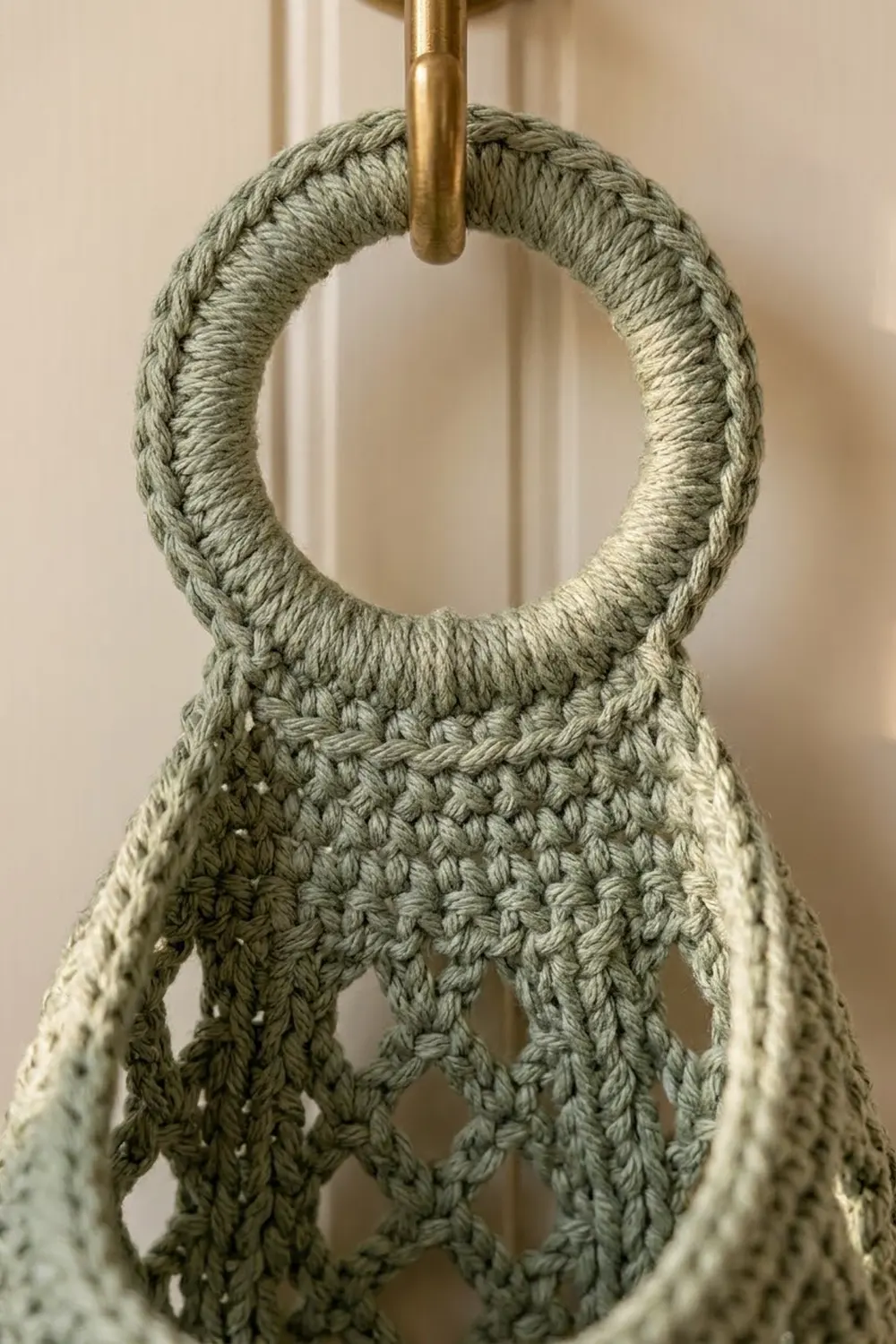
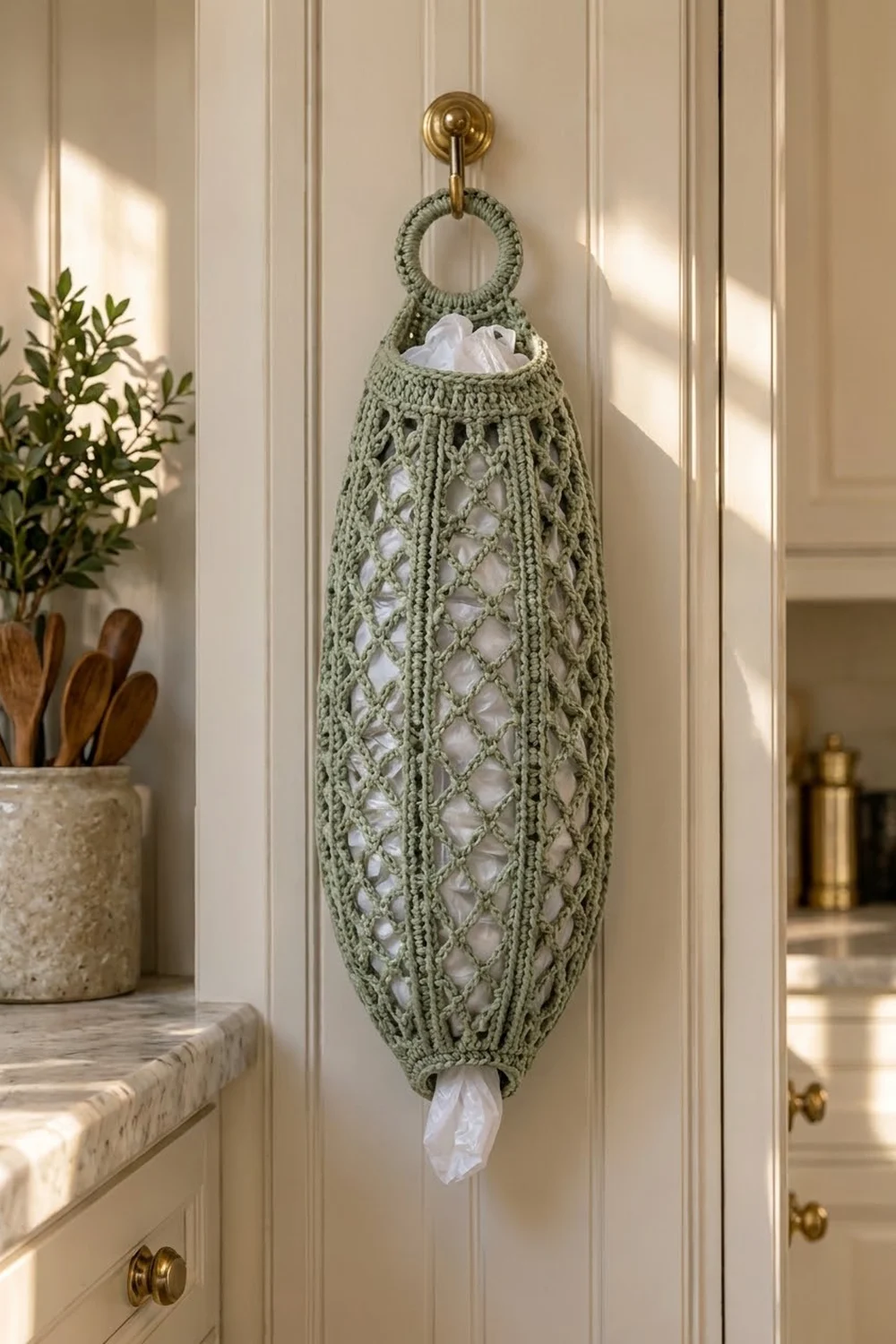
This plastic bag holder is a tall, softly rounded tube with an open diamond lattice. Six solid vertical ribs divide the mesh into panels. A firm single crochet band closes the top, and a smaller cuff at the bottom holds the bags so you can pull them out one at a time. A crochet-covered ring at the top hangs it on a hook, knob, or cabinet door.
The sample is made in one color, a calm sage green cotton, which suits a farmhouse or neutral kitchen. The white bags show through the diamonds, so you can see when it needs refilling.
This pattern uses US crochet terms. The finished holder is about 7.5 in (19.1 cm) wide flat at its widest point. The body is 17.2 in (43.7 cm) long, and the total hanging length is about 20.5 in (52.1 cm) including the ring.
You make the whole holder in one piece, from the bottom up, in joined rounds. First you work the bottom cuff, then the lattice body. The chain loops grow from ch-3 to ch-4 to ch-5 and then shrink back again. That shapes the bulge without any increases or decreases in the ribs. A top band and edging finish the opening. Last, you cover a ring and attach it with a short tab.
Finished Size and Construction
- Finished size: 7.5 in (19.1 cm) wide flat at the widest point; body 17.2 in (43.7 cm) long; about 20.5 in (52.1 cm) overall including the ring
- Skill level: Easy (confident beginner)
- Terminology: US crochet terms
- Yarn weight: Worsted (CYC 4)
- Hook: 5.0 mm (H-8)
- Number of pieces: 1 body worked in the round, plus 1 covered ring attached to it
- Layout: One tube with 6 lattice panels and 6 vertical ribs
- Piece size: 7.5 in (19.1 cm) wide flat × 17.2 in (43.7 cm) long
- Size before border: 16.1 in (40.9 cm) long through Rnd 29
- Border depth: The top band is 1.1 in (2.8 cm). The bottom edging is one slip-stitch round and adds no measurable depth.
Materials
Yarn: Use a worsted-weight cotton or cotton blend. Cotton holds the lattice open and does not sag when the holder is full. Acrylic also works, but the diamonds will stretch longer over time.
- Sage green: about 150 g / 285 m (312 yd)
This amount includes a margin of about 20 percent for your gauge swatch and for differences in tension.
Tools:
- 5.0 mm (H-8) crochet hook
- 1 plastic or metal ring, 3 in (7.6 cm) outer diameter
- 6 locking stitch markers
- Tapestry needle
- Scissors
- Tape measure
- Rust-proof pins and a spray bottle
- A rolled towel, or a cardboard tube wrapped in a towel, for blocking
Abbreviations (US Terms)
- ch – chain
- sl st – slip stitch
- sc – single crochet
- dc – double crochet
- tr – treble crochet
- beg – beginning
- rep – repeat
- rnd(s) – round(s)
- st(s) – stitch(es)
- BLO – back loop only
Special stitch: lattice loop (ch-X loop). A chain of X stitches that ends with a sc worked into the next chain loop of the round below. Work the sc around the chain (into the space), not into a single chain.
Half loop: A short chain (ch 1 or ch 2) at each end of a B-round panel. It fills the gap next to a rib so the diamonds stay offset. You never work into half loops.
Gauge and Checkpoints
Single crochet gauge: 16 sc and 18 rnds = 4 in (10.2 cm).
Lattice gauge:
- A rib (3 sts) is 0.75 in (1.9 cm) wide.
- A ch-3 panel is about 1 in (2.5 cm) wide, a ch-4 panel about 1.4 in (3.6 cm), and a ch-5 panel about 1.75 in (4.4 cm).
- A dc round is about 0.5 in (1.3 cm) tall, and a tr round is about 0.75 in (1.9 cm) tall.
Test first: This is a single piece, so its first 11 rounds are your test. Work them, then lay the tube flat and measure it before you continue.
Checkpoints (flat width × total length):
- After Rnd 5: cuff 3.75 in (9.5 cm) wide × 1.1 in (2.8 cm) long
- After Rnd 7: 5.25 in (13.3 cm) × 2.1 in (5.3 cm)
- After Rnd 11: 6.45 in (16.4 cm) × 4.1 in (10.4 cm)
- After Rnd 23: 7.5 in (19.1 cm) × 13.1 in (33.3 cm)
- After Rnd 29: 5.25 in (13.3 cm) × 16.1 in (40.9 cm)
- After Rnd 35: top 5.25 in (13.3 cm) wide × 17.2 in (43.7 cm) long
If it’s too big: go down half a hook size. If it’s too small: go up half a hook size. If only the length is off: add or remove one pair of ch-5 rounds. Each pair changes the length by 1.5 in (3.8 cm).
Pattern
Notes:
- Join every round with a sl st to the top of the beg ch. Do not turn.
- In mesh rounds, beg ch-3 counts as a dc and beg ch-4 counts as a tr.
- The ribs stack straight up, 3 sts over 3 sts. Always work rib sts into the rib sts below, whatever their height. Mark the first st of each rib.
- A rounds have 4 full loops per panel. B rounds have 3 full loops plus 2 half loops per panel. Alternating the two makes the diamonds.
Bottom Cuff
Rnd 1: Ch 30 and sl st to the first ch to form a ring, without twisting. Ch 1, sc in each ch around. (30 sc)
Rnds 2–4: Ch 1, sc in each sc around. (30 sc)
Rnd 5 (growth): Ch 1, *sc in next 3 sc, 2 sc in each of next 2 sc; rep from * 5 more times. (42 sc)
Lattice Body: Ch-3 Zone (Dc Ribs)
Rnd 6 (set-up, B): Ch 3, dc in next 2 sc, ch 1, sc in next sc, (ch 3, sc in next sc) 3 times, ch 1, dc in next 3 sc; rep from * around, ending the last rep at *. Join.
Count: 18 dc in 6 ribs, 24 sc, 18 ch-3 loops, and 12 half loops. Each repeat uses 7 sc, and 7 × 6 = 42.
Rnd 7 (A): Ch 3, dc in next 2 dc, (ch 3, sc in next ch-3 loop) 3 times, ch 3, dc in next 3 dc; rep from * around, ending at *. Join.
Count: 18 dc, 18 sc, 24 ch-3 loops.
Ch-4 Zone (Dc Ribs)
Rnd 8 (B): Ch 3, dc in next 2 rib sts, ch 2, sc in next loop, (ch 4, sc in next loop) 3 times, ch 2, dc in next 3 rib sts; rep from * around, ending at *. Join.
Count: 18 dc, 24 sc, 18 ch-4 loops, 12 half loops.
Rnd 9 (A): Ch 3, dc in next 2 dc, (ch 4, sc in next ch-4 loop) 3 times, ch 4, dc in next 3 dc; rep from * around, ending at *. Join.
Count: 18 dc, 18 sc, 24 ch-4 loops.
Rnds 10–11: Rep Rnds 8–9.
Ch-5 Zone (Tr Ribs)
Rnd 12 (B): Ch 4, tr in next 2 rib sts, ch 2, sc in next loop, (ch 5, sc in next loop) 3 times, ch 2, tr in next 3 rib sts; rep from * around, ending at *. Join.
Count: 18 tr, 24 sc, 18 ch-5 loops, 12 half loops.
Rnd 13 (A): Ch 4, tr in next 2 tr, (ch 5, sc in next ch-5 loop) 3 times, ch 5, tr in next 3 tr; rep from * around, ending at *. Join.
Count: 18 tr, 18 sc, 24 ch-5 loops.
Rnds 14–23: Rep Rnds 12–13 five more times, for 6 pairs of rounds in this zone. This is the widest part of the holder.
Upper Ch-4 Zone (Dc Ribs)
Rnds 24–27: Rep Rnds 8–9 twice.
Count after Rnd 27: 18 dc, 18 sc, 24 ch-4 loops.
Upper Ch-3 Zone (Dc Ribs)
Rnd 28 (B): Ch 3, dc in next 2 dc, ch 1, sc in next loop, (ch 3, sc in next loop) 3 times, ch 1, dc in next 3 dc; rep from * around, ending at *. Join.
Count: 18 dc, 24 sc, 18 ch-3 loops, 12 half loops.
Rnd 29 (A): Work as for Rnd 7.
Count: 18 dc, 18 sc, 24 ch-3 loops.
The lattice alone is 15 in (38.1 cm) long:
- 2 in (5.1 cm) of ch-3 rounds
- 4 in (10.2 cm) of ch-4 rounds
- 9 in (22.9 cm) of ch-5 rounds
Border
Border gauge: 16 sc = 4 in (10.2 cm). That makes 42 sc = 10.5 in (26.7 cm) around, or 5.25 in (13.3 cm) wide flat. When you flatten the band, it has 21 sts on the front and 21 on the back.
Top Band
Rnd 30 (conversion): Ch 1, *sc in each of next 3 dc, sc in each of next 4 ch-3 loops (skip the sc between loops); rep from * around. Join.
Count: 18 sc worked 1-per-rib-dc + 24 sc worked 1-per-loop = 42 sc (21 per side).
Rnds 31–34: Ch 1, sc in each sc around. (42 sc; 21 per side)
Rnd 35 (edging): Sl st in BLO of each sc around. Fasten off. (42 sl sts; 21 per side)
Bottom Edge
Turn the holder so the cuff is at the top. Join yarn in the remaining loops of the foundation ch and sl st in each loop around. Fasten off. (30 sl sts; 15 per side)
Why the Math Works
- Top: Rnd 29 measures 10.5 in (26.7 cm) around, and so do the 42 sc of the band. The band therefore lies flat, without ruffling or pulling in.
- Rib alignment: One sc per rib st plus one sc per loop gives 6 equal repeats of 7 sts, so the ribs line up with the band.
- Bottom: The 42 sc of Rnd 5 feed the set-up round exactly: 6 repeats × (3 rib sts + 4 anchor sts) = 42.
Ring Hanger
Cover the ring: Make a slip knot on your hook. Working over the ring, sc around it until it is fully covered, about 44 sc. Keep the count even and pack the stitches snugly. Join to the first sc.
Next rnd: Sl st in BLO of each sc around (44 sl sts). Fasten off and weave in the end.
Tab: Flatten the holder so 3 ribs are on the front and 3 on the back. On the back, find the center 7 of the 21 band sts: skip 7, use 7, skip 7.
- Row 1: Join with a sc in the first of the 7 center back sts of Rnd 34, then sc in next 6 sts. Turn. (7 sc)
- Rows 2–8: Ch 1, sc in each sc. Turn. (7 sc)
The tab measures about 1.8 in (4.6 cm). Pass it through the ring from front to back and fold it down inside the back of the band. Whipstitch Row 8 to the inside of Rnd 31. The ring now stands above the back of the band.
Final Blocking
- Weave in all ends, running them through the ribs rather than the lattice.
- Spray the holder until it is evenly damp. Do not soak it.
- Slide a rolled towel inside to fill out the body.
- Lay the holder flat with the ribs straight, and gently open each diamond.
- Adjust until the widest point measures 7.5 in (19.1 cm) flat and the body is 17.2 in (43.7 cm) long.
- Pin the top band and cuff into neat circles so they don’t flare.
- Let it dry completely, usually 24 hours, then remove the towel and hang the holder.
Final Quality-Control Checklist
- All 6 ribs run straight from Rnd 6 to Rnd 29.
- Each A round has 24 loops. Each B round has 18 full loops plus 12 half loops.
- The diamonds alternate cleanly, with no loop skipped or worked twice.
- The top band has 42 sts and lies flat at 5.25 in (13.3 cm).
- The cuff measures 3.75 in (9.5 cm) wide.
- The ring is fully covered and the tab is secure.
- All ends are woven in through solid stitches.
Troubleshooting
The ribs twist into a spiral. You started a round in the wrong st. Always begin in the marked first rib st and join to the top of the beg ch.
The diamonds stack instead of offsetting. You worked two rounds of the same type in a row. A and B rounds must alternate.
The ribs pucker. The rib height doesn’t match the loop length. Use tr in Rnds 12–23 and dc in all other mesh rounds.
The bottom is too loose and the bags fall out. Thread a strand of yarn through Rnd 2 and snug it in slightly.
The top band ruffles. Rnd 30 has more than 42 sts. Recount: each repeat should have 7 sc.
Care
Hand wash, or machine wash on gentle in cool water. Reshape the holder over a rolled towel and lay it flat to dry.
Final Notes
Here is the measurement chain from bottom to top:
- The cuff’s 30 sc measure 3.75 in (9.5 cm) flat.
- Rnd 5 grows the cuff to 42 sc, which splits into 6 repeats of 7 sts.
- The lattice widens from 5.25 in (13.3 cm) to 6.45 in (16.4 cm) to 7.5 in (19.1 cm), then narrows back the same way, adding 15 in (38.1 cm) of length.
- The 42-sc top band sits flat at 5.25 in (13.3 cm).
- The finished body is 17.2 in (43.7 cm) long, or about 20.5 in (52.1 cm) hanging from its ring.
If you check your work at each step, your holder will match the sample.
Happy crocheting!