

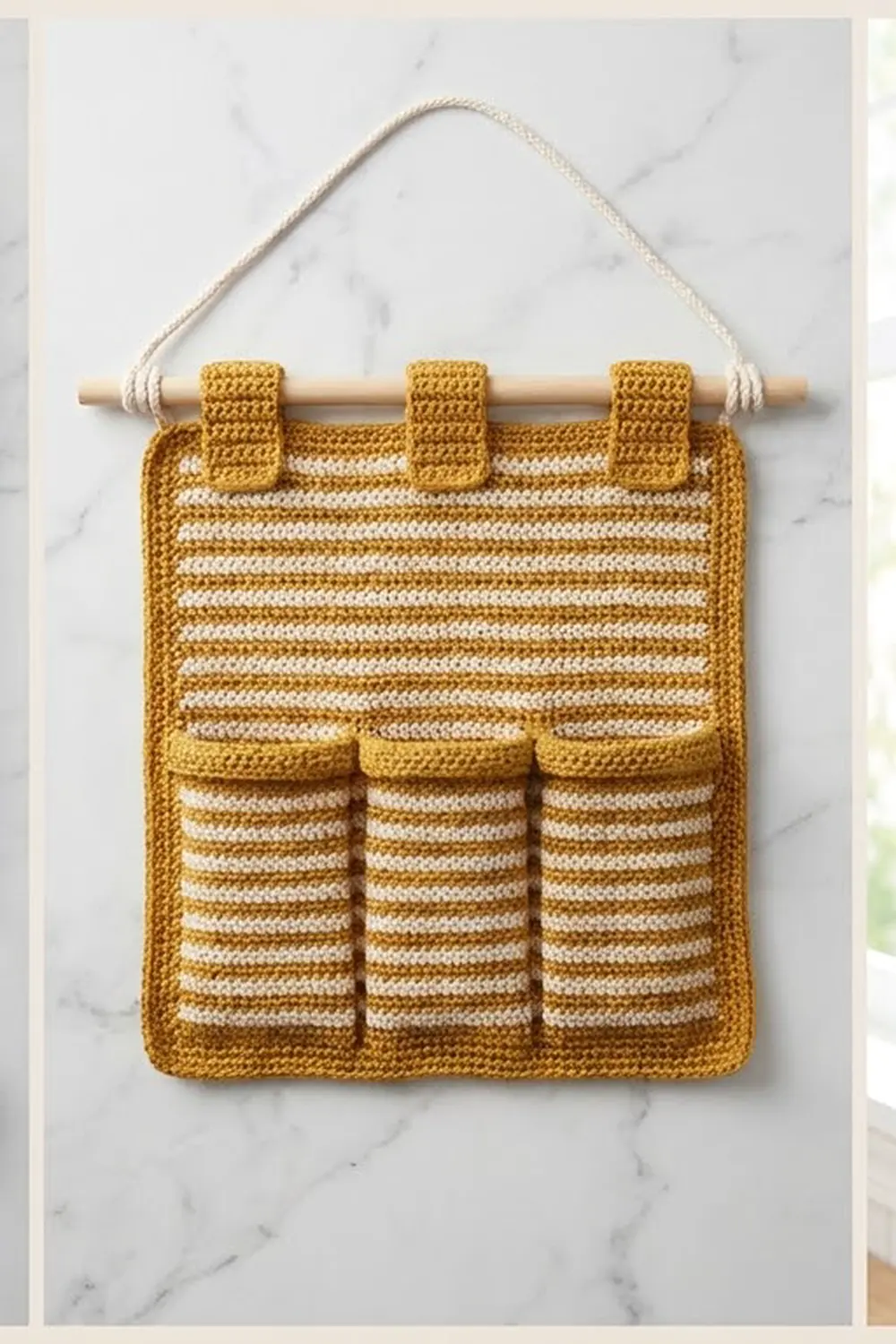
This hanging organizer keeps wooden spoons, spatulas and whisks off the counter and within reach. It is a sturdy backing panel with three deep pockets across the front, hung from a wooden dowel by three tabs and a cotton cord.
The colors are warm mustard gold and soft cream. Both colors run in vertical stripes, two mustard columns to one cream column, so the piece looks woven and a little like knitting. A solid mustard border frames the panel, and a rolled mustard rim finishes each pocket opening.
The pattern uses US crochet terms. The finished organizer is 12.75 in wide x 10 in tall (32.4 x 25.4 cm). Each pocket is 3.75 in wide x 7 in tall (9.5 x 17.8 cm).
You work the panel flat in rows of tapestry single crochet, then add a border. Each pocket is worked in the round from a chain base as a flat tube, using tapestry waistcoat stitch for the knit-look V columns. The tabs are small mustard strips. You sew everything together and hang it from the dowel.
Finished Size and Construction
- Finished size: 12.75 in x 10 in (32.4 x 25.4 cm), not counting the dowel and cord
- Skill level: Intermediate (tapestry color changes, waistcoat stitch)
- Terminology: US crochet terms
- Yarn weight: Worsted weight (#4)
- Hook: 5.0 mm (H-8)
- Number of pieces: 7 (1 panel, 3 pockets, 3 tabs)
- Layout: 3 pockets side by side across the lower panel, 3 tabs along the top edge
- Panel size before border: 11.75 in x 8.9 in (29.8 x 22.6 cm)
- Border depth: 0.5 in (1.3 cm), 2 rounds
- Pocket size (flat): 3.75 in x 7 in (9.5 x 17.8 cm)
- Tab size: 1.75 in x 3.1 in (4.4 x 7.9 cm)
Materials
Use a smooth worsted weight yarn with a firm twist. Cotton or a cotton blend works best in a kitchen because it holds its shape when the pockets are full. The amounts below assume about 180 m per 100 g.
- Color M (mustard gold): 150 g / 270 m
- Color C (cream): 75 g / 135 m
These quantities include a margin of about 20 percent for your gauge pocket and for the yarn carried inside the tapestry stitches.
Tools:
- 5.0 mm (H-8) crochet hook
- Tapestry needle
- Stitch markers
- Wooden dowel, 15 in (38.1 cm) long, 3/8 in (1.0 cm) diameter
- Cream cotton cord, 30 in (76.2 cm)
- Rust-proof pins, blocking mat, spray bottle
Abbreviations (US Terms)
- ch chain
- sc single crochet
- rev sc reverse single crochet (crab stitch)
- sl st slip stitch
- st(s) stitch(es)
- sp space
- rnd round
- wst waistcoat stitch
- M mustard, C cream
- RS right side
Tapestry sc: work sc while laying the unused color along the top of the previous row and working over it, so it is hidden inside the stitches. To change color, work the last yarn over of the stitch before the change with the new color.
Waistcoat stitch (wst): insert the hook through the center of the V of the stitch below, between its two front legs. Yarn over, pull up a loop, yarn over and pull through both loops. It looks like a knit stitch and stacks into straight columns.
Gauge and Checkpoints
Gauge: 16 sts and 18 rows = 4 in (10.2 cm) in tapestry sc with the 5.0 mm hook. Waistcoat stitch in the round should match this: 4 sts and 4.5 rnds per 1 in (2.5 cm).
Make one pocket first. It is the best test piece because waistcoat stitch is tighter, so it shows your real tension.
Checkpoints:
- Pocket after Rnd 1: 3.75 in (9.5 cm) across the flat base
- Pocket after Rnd 29: 6.4 in (16.3 cm) tall
- Finished pocket: 7 in (17.8 cm) tall
- Panel after Row 20: 11.75 in x 4.4 in (29.8 x 11.2 cm)
- Panel after Row 40: 11.75 in x 8.9 in (29.8 x 22.6 cm)
- Bordered panel: 12.75 in x 10 in (32.4 x 25.4 cm)
If too big: go down a hook size, or work over the carried strand more firmly. If too small: go up a hook size. Many makers need a 5.5 mm (I-9) hook for the pockets only. Match the gauge, not the hook label.
Pocket (make 3)
Each pocket starts from a chain. You work along both sides of the chain to make a closed, flat bottom, then work up in rounds without turning. In the colorwork section, work in a spiral and move a marker up each round.
With M, ch 16.
Rnd 1 (M): Sc in 2nd ch from hook and in each of next 14 ch (15 sc). Rotate and sc in the free loop of each of the same 15 ch (15 sc). Place marker. (30 sc)
The base is a flat oval with 15 sts per side, 3.75 in (9.5 cm) across.
Rnd 2: Join C, carrying it. Wst in next 2 sts with M, wst in next st with C; rep from * around. (30 sts: 20 M, 10 C)*
Rnds 3–29: Wst in next 2 sts with M, wst in next st with C; rep from * around. Each stitch sits on the same color below, making 10 cream columns. (30 sts each rnd)*
Checkpoint: 6.4 in (16.3 cm) tall, lying flat at 3.75 in (9.5 cm) wide. Cut C.
Rnd 30 (M): Sc in each st around, sl st to first st. (30 sc)
Rnd 31 (M): Ch 1, rev sc in each st around, sl st to join. (30 rev sc)
The reverse sc makes the thick, rolled rim. The pocket is now 7 in (17.8 cm) tall. Fasten off, leaving an 18 in (45.7 cm) tail for sewing.
Backing Panel (make 1)
The stripe repeat is 3 sts (2 M, 1 C), plus 2 M at the end. The row reads the same from both sides, so the columns stack on every row.
With M, ch 48.
Row 1 (RS, M): Sc in 2nd ch from hook and in each ch across, turn. (47 sc)
Row 2: Ch 1 (does not count as a st). Join C, carrying it. Sc in next 2 sts with M, sc in next st with C; rep from * 14 more times, sc in last 2 sts with M, turn. (47 sc: 32 M, 15 C)*
Rows 3–39: Repeat Row 2. Every M st lands on an M st, and every C st lands on a C st. (47 sc each row)
Row 40 (M): Cut C. Ch 1, sc in each st across. (47 sc) Do not fasten off. You will start the border from here.
The panel now measures 11.75 in x 8.9 in (29.8 x 22.6 cm).
Hanging Tabs (make 3)
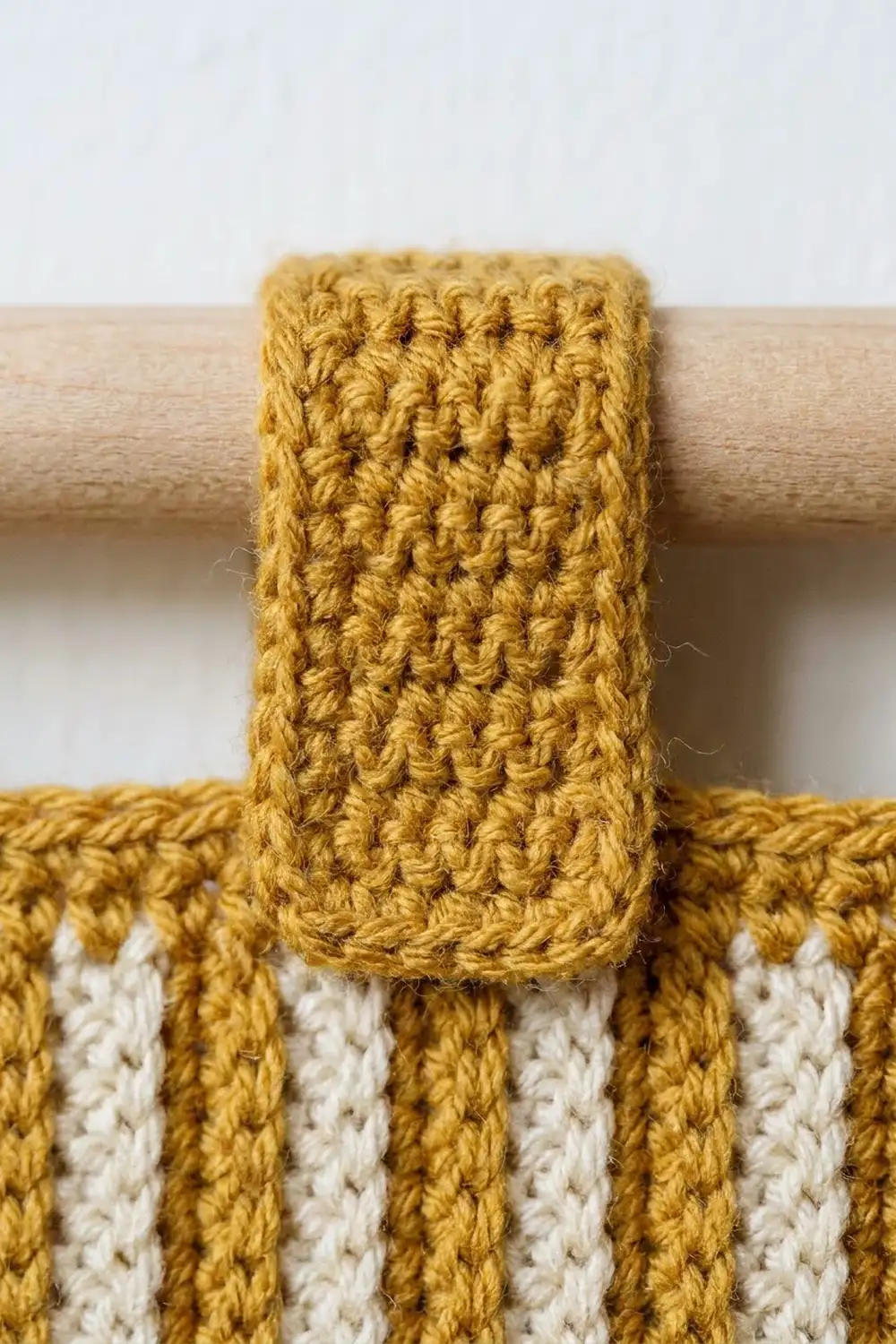
With M, ch 8.
Row 1: Sc in 2nd ch from hook and in each ch across, turn. (7 sc)
Rows 2–14: Ch 1, sc in each st across, turn. (7 sc)
Each tab is 1.75 in x 3.1 in (4.4 x 7.9 cm). Fasten off, leaving a 12 in (30.5 cm) tail.
Make All Pieces
Total pieces: 7.
- Panel: 1, M and C
- Pockets: 3, M and C
- Tabs: 3, M only
Front view, with panel stitch numbers:
 [Tab 2-8]          [Tab 21-27]          [Tab 40-46]
+---------------------------------------------------+
|                   Panel (47 sts)                  |
| +--------------+--------------+--------------+    |
| |   Pocket 1   |   Pocket 2   |   Pocket 3   |    |
| |  sts 2-16    |  sts 17-31   |  sts 32-46   |    |
| +--------------+--------------+--------------+    |
+---------------------------------------------------+
The pockets cover panel sts 2–46. That is 3 x 15 = 45 sts, with 1 st (0.25 in, 0.6 cm) of panel showing at each side: 1 + 45 + 1 = 47.
Joining
Finish the panel border (next section) and block all pieces before joining so the edges are straight.
Method: Whipstitch with the M tail, sewing only through the back layer of each pocket so the opening stays free.
Placement: Lay the panel RS up. Place Pocket 1 flat with its bottom edge on panel Row 2 and its back layer over panel sts 2–16. Place Pockets 2 and 3 over sts 17–31 and 32–46. The pocket sides touch.
Stitch-to-stitch logic:
- Bottom seam: sew 1 back-layer base st to 1 panel st, 15 to 15. Both pieces have 4 sts per 1 in (2.5 cm), so nothing puckers.
- Side seams: sew along each fold, 1 pocket rnd to 1 panel row, since both are 4.5 per 1 in. Sew pocket Rnds 1–30 to panel Rows 2–31. Leave the rev sc rim free so it rolls forward.
- Where two pockets touch, sew both folds into the same panel stitch column, one at a time.
Tension: pull each stitch snug but not tight. The panel should stay flat between stitches.
Size checkpoint: together, the pockets measure 11.25 in (28.6 cm) wide. Their tops sit about 2.3 in (5.8 cm) below the top edge of the finished panel.
Border
The border has the same gauge as the body, 4 sc per 1 in (2.5 cm), and each round adds about 0.25 in (0.6 cm). In this border, the side counts do not include the ch-2 corner spaces. Corners are counted separately.
Rnd 1 (M): Continuing from Row 40, ch 2 for the corner. Work down the side: sc in each of next 8 row ends, skip 1 row end; rep from * 3 more times, sc in each of last 4 row ends (36 sc). Ch 2. Sc in the free loop of each foundation ch (47 sc), ch 2. Work up the second side the same way (36 sc), ch 2. Sc in each st across Row 40 (47 sc)*. Sl st to first sc.
Side check: 4 x 9 = 36 row ends, plus 4 = 40 row ends, giving 4 x 8 + 4 = 36 sc. (Total: 47 + 36 + 47 + 36 = 166 sc, plus 4 ch-2 corner sps)
Rnd 2 (M): Sl st into the corner sp, ch 1. Work (sc, ch 2, sc) in each corner sp and sc in each sc along every side. Each side gains 2 sts, 1 from each corner. Top and bottom: 47 + 2 = 49 sc. Sides: 36 + 2 = 38 sc. (Total: 49 + 38 + 49 + 38 = 174 sc, plus 4 ch-2 corner sps) Fasten off.
Why the math works: 47 sts at 4 per in make 11.75 in, and 40 rows at 4.5 per in make 8.9 in. Skipping 4 row ends gives 36 side sc, which is 9 in at 4 per in. That is close enough to the 8.9 in of rows for the edge to lie flat. After Rnd 2, the top has 49 sc, which is 12.25 in (31.1 cm), and each side has 38 sc, which is 9.5 in (24.1 cm). The ch-2 corners add about 0.25 in (0.6 cm) at each end, giving 12.75 in x 10 in (32.4 x 25.4 cm).
Attach the tabs: fold each tab in half over the dowel. Sew one end to the front of the top border and the other end to the back, lined up with Row 40 sts 2–8, 21–27 and 40–46. Each tab is 7 sts wide over 7 panel sts. Slide the dowel through and tie the cord to each end with an overhand knot.
Final Blocking
- Weave in all ends through stitches of the same color.
- Pin the bordered panel RS up to 12.75 in x 10 in (32.4 x 25.4 cm). Pin the corners first, then the middle of each side.
- Pin each pocket flat to 3.75 in x 7 in (9.5 x 17.8 cm). Slide a rolled towel inside each one to keep the opening round.
- Mist everything until damp. For acrylic, steam lightly from above instead and never touch the iron to the yarn.
- Let all pieces dry completely, at least 12 hours.
- Unpin, join, then mist the seams lightly to settle them.
Final Quality-Control Checklist
- Panel measures 12.75 in x 10 in (32.4 x 25.4 cm).
- Each pocket measures 3.75 in x 7 in (9.5 x 17.8 cm).
- The panel has 15 cream columns, and each pocket has 10.
- Border Rnd 2 has 49 sc on the top and bottom and 38 sc on each side.
- Corners are square and do not cup.
- Pocket bottoms sit in a straight line on panel Row 2.
- Pocket rims roll forward and are not sewn down.
- No carried yarn shows on the front.
- The dowel hangs level.
Troubleshooting
Carried yarn shows through: keep the unused strand flat on top of the stitches and work over it firmly.
Cream columns drift: you have an extra or missing st. Count to 47 (panel) or 30 (pocket) on each row or round.
Pockets too wide for the layout: your waistcoat stitch is loose. Go down a hook size.
Pockets stiff or narrow: go up to a 5.5 mm (I-9) hook.
Border ruffles or pulls in: recheck the skip pattern. Each side must have exactly 36 sc in Rnd 1.
Organizer tilts: even out the cord knots and check that the center tab sits on sts 21–27.
Care
Remove the dowel and cord, then hand wash in cool water with mild soap. Press out the water in a towel and dry flat.
Final Notes
Everything depends on one gauge: 4 sts and 4.5 rows per 1 in (2.5 cm). At that gauge, each pocket is 3.75 in x 7 in (9.5 x 17.8 cm) and the panel body is 11.75 in x 8.9 in (29.8 x 22.6 cm). The 2-round border brings the panel to 12.75 in x 10 in (32.4 x 25.4 cm), and the three 15-stitch pockets fill 45 of the panel’s 47 stitches. If your first pocket matches gauge, every other piece will fit.
Happy crocheting!