

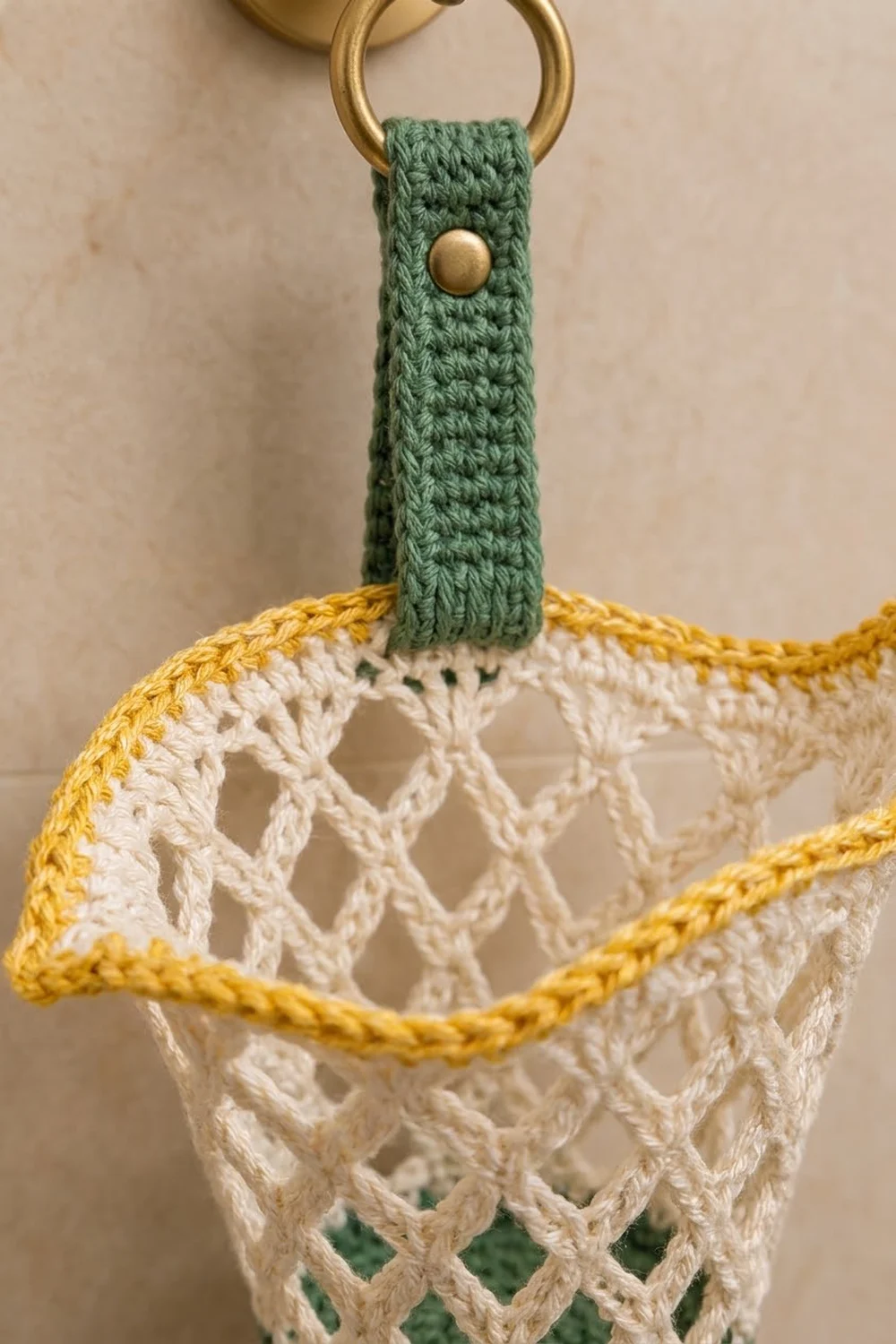
This hanging holder stacks three small mesh baskets on a green strap, one above the other. Each basket has a solid green base, open cream net sides that flare toward the top, and a wavy rim edged in golden yellow. One side of each rim rises into a soft peak, so the baskets look like little tulips or pouring jugs.
The colors are cream, green and mustard gold. The look is fresh and a little vintage, and it suits a warm bathroom with brass fittings. The brass rings and studs on the straps repeat the gold of the rims.
All instructions use US crochet terms. Each basket is about 7 in (17.8 cm) across the top opening and 5.25 in (13.3 cm) across the base. It stands 6 in (15.2 cm) tall on the low side and about 6.75 in (17.1 cm) at the peak. The finished holder hangs about 22 in (55.9 cm) long and holds one standard roll in each basket.
Each basket is worked in the round from the center of the base up. You make a flat green circle and a short green wall. Next comes a cream net that grows wider as the chain loops get longer, then a cream round that shapes the wave, then a gold edging. The three green straps are made flat and linked with brass rings, and then the baskets are sewn onto them.
Finished Size and Construction
- Finished size (one basket): 7 in (17.8 cm) top diameter, 5.25 in (13.3 cm) base diameter, 6 in (15.2 cm) tall at the low side, 6.75 in (17.1 cm) at the peak
- Assembled length: about 22 in (55.9 cm) from the top of the hanging ring to the base of the lowest basket
- Skill level: Intermediate
- Terminology: US
- Yarn weight: Worsted (#4) cotton
- Hook: 4.5 mm (US 7)
- Number of pieces: 6 (3 baskets, 3 straps)
- Layout: 1 column x 3 baskets, hanging vertically
- Strap size: 8 in x 0.9 in (20.3 cm x 2.3 cm) before folding
- Basket height before gold edging: about 5.6 in (14.2 cm) at the low side
- Gold edging depth: about 0.4 in (1.0 cm)
Materials
Use a smooth, firm worsted-weight yarn that is 100% cotton or a cotton blend. Cotton holds the basket shape, doesn’t stretch under the weight of a roll, and copes well with bathroom humidity. Avoid soft acrylic, because the net will sag.
- Cream (main color): 125 g / about 212 m
- Green (bases, walls, straps): 80 g / about 136 m
- Gold (rim edging): 25 g / about 42 m
These amounts include about 15–20% extra for gauge swatches and differences in tension.
Tools:
- 4.5 mm (US 7) crochet hook
- Tapestry needle
- Stitch markers
- Scissors and tape measure
- 1 brass O-ring, 1.5 in (3.8 cm) inside diameter
- 3 brass rectangle rings, 1 in (2.5 cm) inside width
- 6 brass sew-on studs or decorative rivets (optional)
- Rust-proof pins for blocking
Abbreviations (US Terms)
- ch – chain
- sl st – slip stitch
- sc – single crochet
- hdc – half double crochet
- dc – double crochet
- tr – treble crochet
- dtr – double treble crochet (yarn over 3 times, insert hook, pull up a loop, [yarn over, pull through 2 loops] 4 times)
- BLO – back loop only
- st(s) – stitch(es)
- sp – space
- rnd – round
Special stitch: reverse sc (crab stitch). Work from left to right if you’re right-handed. Insert the hook in the next st to the right, pull up a loop, yarn over and pull through both loops. This makes the twisted, rope-like gold edge.
Gauge and Checkpoints
Gauge: 16 sc and 18 rows = 4 in (10.2 cm) in sc worked flat.
Make one complete basket before you start the others. Small gauge errors grow as the sides flare, and a roll still has to fit.
Checkpoints:
- After Rnd 11 (base): flat circle, 5.25 in (13.3 cm) across, 66 sts.
- After Rnd 15 (green wall): wall stands upright, about 0.9 in (2.3 cm) tall.
- After Rnd 18 (first mesh section): about 1.25 in (3.2 cm) of net above the green.
- After Rnd 24 (mesh complete): about 4 in (10.2 cm) of net; opening about 6.5 in (16.5 cm) across.
- After Rnd 28 (finished): top opening 7 in (17.8 cm) across; rim circumference 22 in (55.9 cm).
If it’s too big: use a hook 0.5 mm smaller. If only the net is too wide, make every mesh loop 1 ch shorter.
If it’s too small: use a hook 0.5 mm larger. Check that a roll slides into the base with a little room to spare. If it doesn’t, add one more increase round after Rnd 11 (72 sts) and work 24 loops in the net. The rim then has 96 sts.
Basket (Make 3)
Base (Green)
You can work in continuous rounds or join each round. The instructions below use joined rounds. The ch 1 at the start of each round doesn’t count as a st.
Rnd 1: Magic ring, ch 1, 6 sc in ring, sl st to first sc. (6 sts)
Rnd 2: Ch 1, 2 sc in each st around, sl st to first sc. (12 sts)
Rnd 3: Ch 1, sc in next st, 2 sc in next st; repeat from * around, join. (18 sts)
Rnd 4: Ch 1, sc in next 2 sts, 2 sc in next st; repeat around, join. (24 sts)
Rnd 5: Ch 1, sc in next 3 sts, 2 sc in next st; repeat around, join. (30 sts)
Rnd 6: Ch 1, sc in next 4 sts, 2 sc in next st; repeat around, join. (36 sts)
Rnd 7: Ch 1, sc in next 5 sts, 2 sc in next st; repeat around, join. (42 sts)
Rnd 8: Ch 1, sc in next 6 sts, 2 sc in next st; repeat around, join. (48 sts)
Rnd 9: Ch 1, sc in next 7 sts, 2 sc in next st; repeat around, join. (54 sts)
Rnd 10: Ch 1, sc in next 8 sts, 2 sc in next st; repeat around, join. (60 sts)
Rnd 11: Ch 1, sc in next 9 sts, 2 sc in next st; repeat around, join. (66 sts)
Tip: on even rounds, work half of the plain sts before the first increase. This staggers the increases so the circle stays round and doesn’t turn into a hexagon.
Checkpoint: 66 sts, 5.25 in (13.3 cm) across, lying flat.
Green Wall
Rnd 12 (turning round): Ch 1, sc in BLO of each st around, join. (66 worked 1-per-st + 0 added = 66 sts)
The unused front loops make a crisp ridge and turn the wall upward.
Rnds 13–15: Ch 1, sc in each st around, join. (66 sts)
Place a marker in the joining st. This is the back center, where the strap will go. Fasten off green.
Mesh Sides (Cream)
The net has 22 loops in every round. The sides flare because the loops get longer, not because loops are added.
Rnd 16: Join cream in the marked st. Ch 1, sc in same st, ch 5, skip 2 sts, sc in next st; repeat from * 20 more times, ch 2, skip last 2 sts, dc in first sc. (22 loops; 22 x 3 sts = 66 sts used)
The ch 2 plus the dc equals one ch-5 loop and leaves your hook at the center of the last loop.
Rnds 17–18: Ch 1, sc around post of the dc just made, ch 5, sc in next ch-5 sp; repeat from * 20 more times, ch 2, dc in first sc. (22 loops)
Checkpoint: about 1.25 in (3.2 cm) of net.
Rnds 19–21: Ch 1, sc around post of joining st, ch 6, sc in next loop; repeat from * 20 more times, ch 3, dc in first sc. (22 loops of 6)
Rnds 22–23: Ch 1, sc around post of joining st, ch 7, sc in next loop; repeat from * 20 more times, ch 3, tr in first sc. (22 loops of 7)
Rnd 24: Ch 1, sc around post of joining st, ch 7, sc in next loop; repeat from * 20 more times, ch 7, sl st to first sc. (22 full ch-7 loops)
This round ends with a full ch 7, so the last loop is a real chain loop that the rim round can work into.
Checkpoint: about 4 in (10.2 cm) of net, with the opening about 6.5 in (16.5 cm) across. As in the finished piece, the green wall shows through the lowest diamonds.
Rim Foundation (Cream)
Rnd 25 (conversion round): Sl st into first ch-7 sp, ch 1, 4 sc in each ch-7 sp around, join. (22 loops x 4 sc = 88 sts)
This round closes the open net into a solid edge that you can shape into the wave.
Rnd 26 (wave shaping round): Ch 1, then work 1 st in each st as follows:
- sc in next 20 sts
- hdc in next 8 sts
- dc in next 8 sts
- tr in next 8 sts
- dtr in next 8 sts (peak)
- tr in next 8 sts
- dc in next 8 sts
- hdc in next 8 sts
- sc in next 12 sts
Join with sl st to first sc. (20 + 8 + 8 + 8 + 8 + 8 + 8 + 8 + 12 = 88 sts, worked 1-per-st + 0 added)
The tall sts raise one side into a peak that sits to the right of the back center. The short sts keep the other side low, which makes the wave. Fasten off cream.
Straps (Make 3)
With green, ch 33.
Row 1: Sc in 2nd ch from hook and in each ch across, turn. (32 sts)
Rows 2–4: Ch 1, sc in BLO of each st across, turn. (32 sts)
The BLO ridges run along the length of the strap and give it a ribbed look. The strap measures 8 in x 0.9 in (20.3 cm x 2.3 cm). Fasten off, leaving a 12 in (30.5 cm) tail.
Make All Pieces
- Green: 3 bases with walls (Rnds 1–15), 3 straps
- Cream: 3 mesh sides and rim rounds (Rnds 16–26)
- Gold: 3 rim edgings (Rnds 27–28, below)
Layout (top to bottom):
[ O-ring 1.5 in ]
[ Strap A ] + [ Basket 1 ]
[ Ring 1 ]
[ Strap B ] + [ Basket 2 ]
[ Ring 2 ]
[ Strap C ] + [ Basket 3 ]
[ Ring 3 ]
Gold Rim Edging
Edging gauge: 4 sts per 1 in (2.5 cm) along the edge, the same as the sc gauge.
Rnd 27: Join gold in the first sc of Rnd 26. Ch 1, sc in each st around, join. (88 sts, worked 1-per-st)
Along the tall section, keep the sc snug but don’t pull, so the edge follows the curve.
Rnd 28: Ch 1, reverse sc in each st around, join. (88 sts)
Fasten off and weave in.
Why the math works: Rnd 25 has 88 sts. Rnd 26 changes only how tall those 88 sts are, not how many there are. The gold rounds work 1 st in each st, so they also have 88. At 4 sts per in, 88 sts make a 22 in (55.9 cm) edge, which is a circle 7 in (17.8 cm) across. The edge lies smooth without ruffling or puckering.
Joining
Joining has two steps: link the straps, then sew on the baskets.
1. Link the straps. Fold 1 in (2.5 cm) of Strap A’s top end through the O-ring. Whipstitch the fold flat, stitching each of the 4 rows to the strap behind it. Fold the bottom end through Ring 1 and sew it the same way. Strap B’s top goes through Ring 1 and its bottom through Ring 2. Strap C’s top goes through Ring 2 and its bottom through Ring 3. Each strap now shows 6 in (15.2 cm) between the folds. If you’re using studs, sew one through each fold.
2. Sew on the baskets. Lay Strap A flat. Hold Basket 1 with the marked back center against the strap. The strap is 4 rows (about 1 in / 2.5 cm) wide, the same as 4 wall sts. Center it over the 2 sts on each side of the marker.
- With green, whipstitch the strap edges to the green wall through Rnds 12–15: 4 rounds x 2 edges = 8 tack points.
- With cream, tack the strap center to the back-center sc of Rnds 18, 21, and 24.
- With cream, whipstitch the strap edges to Rnds 25–26 at the back center, 2 tack points per round.
Repeat with Basket 2 on Strap B and Basket 3 on Strap C.
Tension: sew firmly, but don’t pull the net toward the strap. The back wall should stay flat, without dents.
Size checkpoint: hang the holder. It should measure about 22 in (55.9 cm) from the top of the O-ring to the base of the lowest basket. There should be a small gap between each rim and the base of the basket above it.
Final Blocking
- Wet each basket in cool water and gently squeeze out the water in a towel.
- Fill the basket with a toilet roll wrapped in a plastic bag, or a jar about 5 in (12.7 cm) wide.
- Shape the net so the diamonds are even and the loops in each round are the same size.
- Lift the peak and pinch the low side outward to set the wave.
- If the gold edge rolls inward, pin it.
- Lay the straps flat and pin them straight.
- Let everything dry completely before you hang it.
Final Quality-Control Checklist
- Each base has 66 sts and lies flat.
- Each green wall has 4 rounds and stands upright.
- Each net has 22 loops in every round, including Rnd 24.
- Rnd 25 and every round after it have 88 sts.
- All three peaks sit in the same position relative to the strap.
- The gold reverse sc is even, with no gaps.
- Straps are 4 rows wide and fold neatly around the rings.
- A roll fits easily in each basket.
- All ends are woven in securely.
Troubleshooting
Base cups or ruffles: cupping means too few sts or tension that’s too tight. Ruffling means tension that’s too loose. Change your hook size and remake the base.
Roll doesn’t fit: add one increase round to the base (72 sts), work 24 loops and 96 rim sts.
Net leans or spirals: you’re missing the center of the loop. Finish each round with the ch-plus-dc join exactly as written.
Rim ruffles: check that Rnd 25 has exactly 4 sc in each loop (88 sts).
Peak flops: use a firmer cotton, or lightly starch the top 1 in (2.5 cm).
Baskets tilt forward: add more tack points at the rim to hold the back wall against the strap.
Care
Hand wash in cool water and lay flat to dry, reshaping the baskets over a roll or jar. If the brass rings aren’t rust-proof, remove them before washing.

Final Notes
All the measurements build on each other. The 66-st base is 5.25 in (13.3 cm) across. The 22 loops grow from ch 5 to ch 7 to make about 4 in (10.2 cm) of flared net. Rnd 25 sets 88 sts, and Rnd 26 shapes the wave without changing that count. The gold rounds keep the 88 sts for a smooth rim 7 in (17.8 cm) across. Three straps with 6 in (15.2 cm) showing each, plus the rings, make a holder about 22 in (55.9 cm) long.
Happy crocheting!