

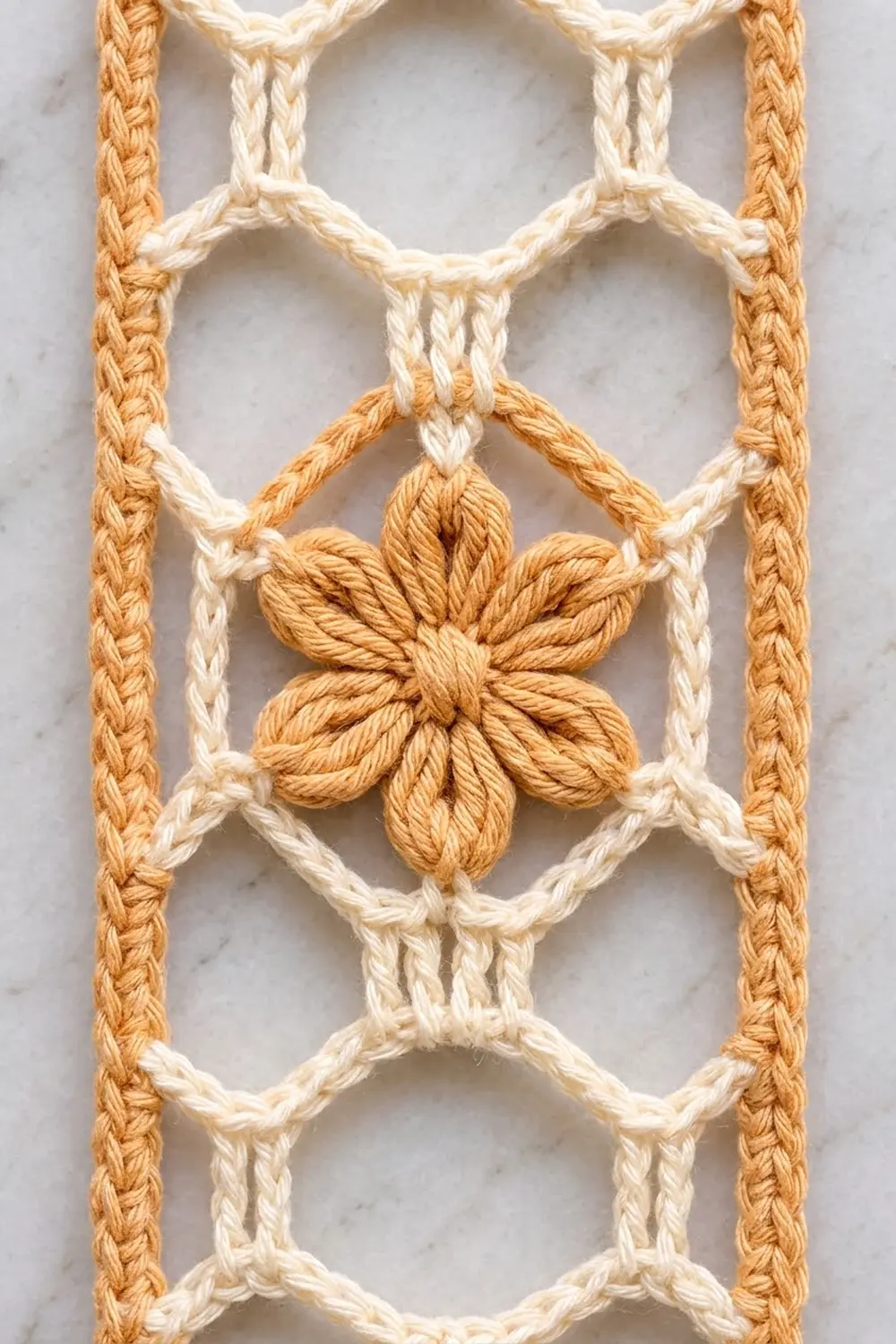
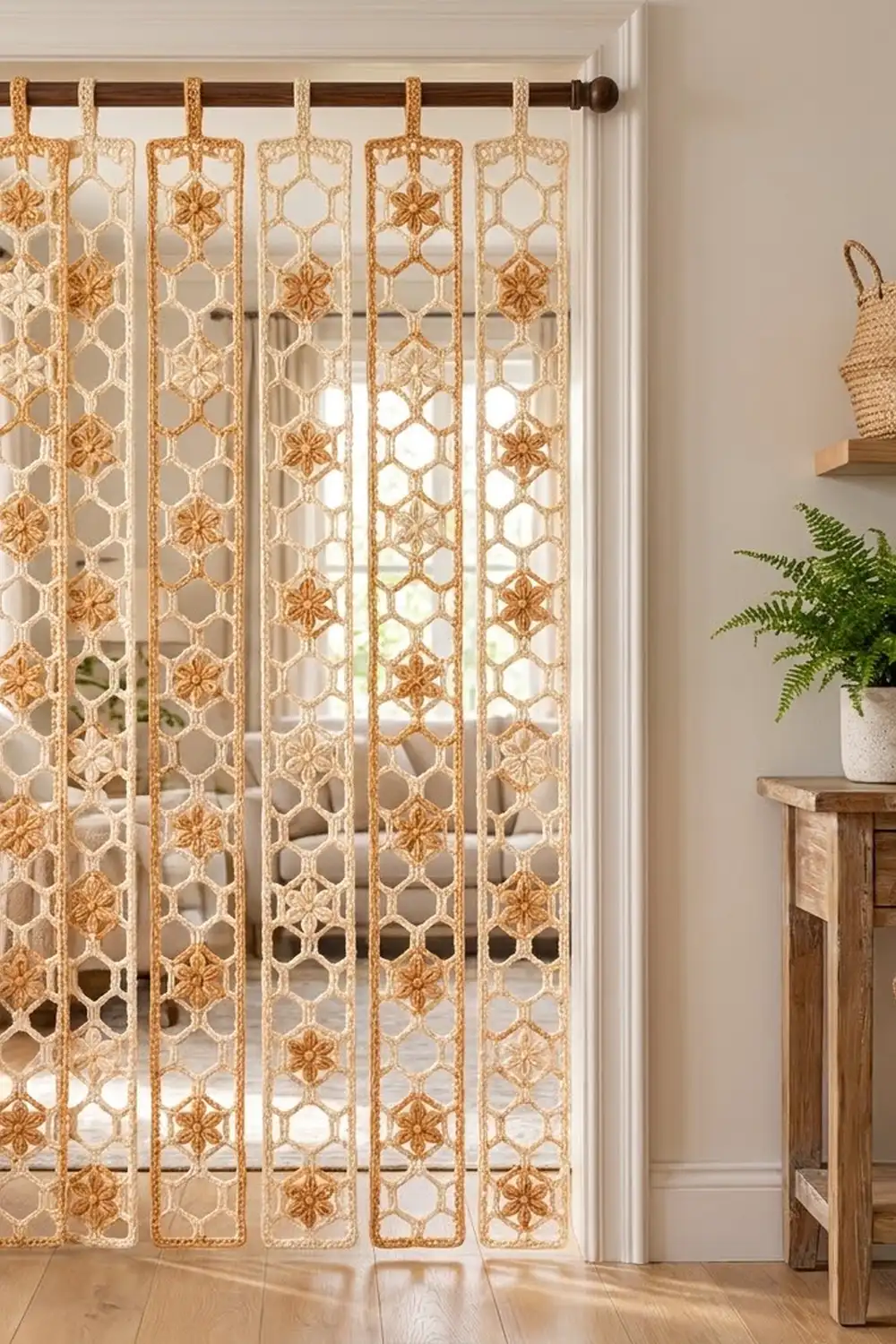
This door curtain is made of six long, airy strips. Each strip is an open honeycomb mesh with flat-topped hexagons, vertical pillar stitches, and plump six-petal flowers spaced down the center. The strips hang separately from a rod, so light and air pass through and the curtain moves easily when you walk through it.
The palette is soft cream with warm caramel. Four strips have cream mesh with a caramel outline and caramel flowers. Two strips reverse the accents: a cream outline, cream flowers, and caramel bands running through the mesh. Alternating the two versions gives the curtain a gentle rhythm.
The pattern uses US crochet terms. Each finished strip measures 6.25 in (15.9 cm) wide by 77 in (195.6 cm) long, plus a 2.25 in (5.7 cm) hanging loop.
Each strip is worked in short rows from the bottom up as a four-row honeycomb repeat. You then sew on the flowers and finish with a two-round single crochet border that includes the hanging loop. The strips are not joined to each other.
Finished Size and Construction
- Finished strip size: 6.25 in x 77 in (15.9 cm x 195.6 cm), plus a 2.25 in (5.7 cm) loop
- Total drop: 79.25 in (201.3 cm)
- Skill level: Intermediate
- Terminology: US crochet terms
- Yarn weight: Worsted (#4) cotton or cotton blend
- Hook: 5.0 mm (H-8)
- Number of pieces: 6 strips (4 Version A, 2 Version B) plus 48 flowers
- Layout: 6 strips side by side on a rod, 0.5 in (1.3 cm) apart, not joined
- Strip size before border: 5.25 in x 76 in (13.3 cm x 193.0 cm)
- Border depth: 0.5 in (1.3 cm) on every side (2 rounds)
- Rod width used: about 40 in (101.6 cm)
Materials
Choose a smooth, mercerized or combed cotton with good stitch definition. Cotton hangs straight, resists stretching better than acrylic, and shows off the pillar stitches. The quantities below assume about 170 m per 100 g.
- Cream: 1,100 g, about 1,870 m (2,045 yd)
- Caramel: 550 g, about 935 m (1,023 yd)
Tools:
– 5.0 mm (H-8) crochet hook
– Tapestry needle
– Locking stitch markers (at least 10)
– Tape measure
– Rust-proof pins and blocking mats or towels
– Curtain rod, 1 in (2.5 cm) diameter or thinner
Both quantities include a margin of roughly 10% for your gauge swatch, tails, and small tension differences.
Abbreviations (US Terms)
- ch – chain
- sl st – slip stitch
- sc – single crochet
- hdc – half double crochet
- dc – double crochet
- sp – space
- st(s) – stitch(es)
- RS / WS – right side / wrong side
Special stitch – Pillar: 3 dc worked as one group, either in 3 consecutive sts or all in the same space. Pillars form the vertical sides of each hexagon.
Gauge and Checkpoints
Base gauge: 16 sc = 4 in (10.2 cm). The border uses the same gauge.
Mesh gauge:
– 21 sts = 5.25 in (13.3 cm) wide
– Rows 1–2 = 0.75 in (1.9 cm) tall
– Each four-row repeat (Rows 3–6) = 1.5 in (3.8 cm) tall
Test one piece first. Start your first strip and work Rows 1–2 plus 4 repeats. Then lay it flat without stretching and measure:
- Checkpoint 1 (test section): 5.25 in (13.3 cm) wide by 6.75 in (17.1 cm) tall
- Checkpoint 2 (after 12 repeats): 18.75 in (47.6 cm) tall
- Checkpoint 3 (after 25 repeats): 38.25 in (97.2 cm) tall
- Checkpoint 4 (body complete): 76 in (193.0 cm) tall
If the test section matches, keep going; it becomes the bottom of Strip 1.
If your piece is too big, go down to a 4.5 mm hook. If it is too small, go up to a 5.5 mm hook. Over 50 repeats, length errors add up quickly: just 1/8 in (0.3 cm) per repeat becomes 6.25 in (15.9 cm) over the full strip. If you’re close on width but off on length, you can add or remove repeats instead. Each repeat is 1.5 in (3.8 cm).
Honeycomb Strip
Make 4 strips in Version A and 2 in Version B.
Version A colors: all mesh rows in cream.
Version B colors: Rows 1–2 in cream. Then, in every repeat, work Rows 3–4 in caramel and Rows 5–6 in cream. Work the final row in cream. Because the stripes are two rows each, both colors always end on the same side. Carry the unused color loosely up that edge; the border will hide it.
Foundation: With cream, ch 22.
Row 1 (RS): Sc in 2nd ch from hook and in each ch across, turn. (21 sc)
Row 2 (pillar row): Ch 3 (counts as dc), dc in next 2 sts, ch 3, skip 3 sts, dc in next 3 sts; repeat from * 2 more times, turn. (4 pillars = 12 dc, 3 ch-3 sps; 12 + 9 = 21 positions)*
Row 3 (arch row): Ch 1, sc in first dc, ch 5, sc in middle dc of next pillar, ch 5, sc in middle dc of next pillar, ch 5, sc in top of turning ch, turn. (4 sc, 3 ch-5 arches)
Row 4 (offset pillar row): Ch 5 (counts as dc + ch 2), 3 dc in first ch-5 arch, (ch 3, 3 dc in next ch-5 arch) twice, ch 2, dc in last sc, turn. (3 pillars + 2 edge dc = 11 dc; ch-2, ch-3, ch-3, ch-2 sps; 1 + 2 + 3 + 3 + 3 + 3 + 3 + 2 + 1 = 21 positions)
Row 5 (arch row): Ch 1, sc in first dc, ch 3, sc in middle dc of first pillar, (ch 5, sc in middle dc of next pillar) twice, ch 3, sc in 3rd ch of turning ch-5, turn. (5 sc, 2 ch-3 arches, 2 ch-5 arches)
Row 6 (pillar row): Ch 3 (counts as dc), 2 dc in first ch-3 arch, (ch 3, 3 dc in next ch-5 arch) twice, ch 3, 2 dc in last ch-3 arch, dc in last sc, turn. (4 pillars = 12 dc, 3 ch-3 sps; 21 positions, same as Row 2)
Rows 3–6 form the honeycomb repeat. The bands alternate between three full hexagons, and two full hexagons with a half-hexagon at each edge. The middle opening of every Row 6 band sits exactly on the strip’s center line, which is where the flowers go.
Repeat Rows 3–6 until you have 50 repeats in total, ending with a Row 6. The strip should measure 75.75 in (192.4 cm).
Final row (WS): Ch 1, sc in each dc and 3 sc in each ch-3 sp, ending with sc in top of turning ch. (12 sc + 9 sc = 21 sc)
The body now has 203 rows: 102 sc rows and 101 dc rows. It should measure 5.25 in x 76 in (13.3 cm x 193.0 cm). Fasten off and weave in the ends.
Six-Petal Flower
Make 32 in caramel for the Version A strips and 16 in cream for the Version B strips.
Rnd 1: Make a magic ring, ch 1, 12 sc in ring, join with sl st to first sc. Pull the ring tight so the center domes up. (12 sc)
Rnd 2: Sc in next sc, (hdc, 3 dc, hdc) in next sc; repeat from * 5 more times, join with sl st to first sc. (6 petals of 5 sts + 6 sc = 36 sts)*
Fasten off and leave a 12 in (30.5 cm) tail for sewing. Each flower measures about 1.75 in (4.4 cm) across.
Attach the flowers: Each strip gets 8 flowers, one in the middle ch-3 space of Row 6 in repeats 4, 10, 16, 22, 28, 34, 40, and 46. That spaces the flowers 9 in (22.9 cm) apart.
Mark these positions with stitch markers before sewing. Center each flower over its opening, then tack down each petal tip and make 3 small stitches through the flower’s center and the ch-3 space. The petals will overlap the surrounding pillars slightly.
Make All Pieces
| Piece | Qty | Mesh | Flowers | Border |
|---|---|---|---|---|
| Version A strip | 4 | Cream | 8 caramel each (32) | Caramel |
| Version B strip | 2 | Cream/caramel stripes | 8 cream each (16) | Cream |
Rod layout (left to right):
[ B ] [ A ] [ A ] [ A ] [ A ] [ B ]
 1     2     3     4     5     6
The cream-accented Version B strips frame the four caramel-accented Version A strips in the middle.
Hanging the Strips (No Joining)
The strips are never sewn or crocheted together. Each one hangs independently on its own loop, which lets the curtain part when someone walks through.
- Finish the border and loop on all six strips (next section) before hanging any of them.
- Slide the loops onto the rod in the order shown above.
- Leave about 0.5 in (1.3 cm) between strips: 6 x 6.25 in + 5 x 0.5 in = 40 in (101.6 cm).
- If the strips drift, mark each loop position on the rod with a small rubber ring or a drop of fabric glue.
Tension advice: All six loops must be the same size, or the bottom edges won’t line up. Count your sc into each loop carefully.
Size checkpoint: Once hung, every strip should drop 79.25 in (201.3 cm) from the top of the rod to the bottom edge. Measure all six and compare.
Border
Work the border on each strip before hanging.
- Version A: caramel border
- Version B: cream border
Border gauge: 16 sc = 4 in (10.2 cm), the same as the body.
Round 1: With RS facing, join yarn in the first st of the top edge.
- Sc in each of the 21 sts across the top, then ch 2 for the corner.
- Down the first long side, work into the row ends: 1 sc per sc row and 2 sc per dc row. That is 102 + 202 = 304 sc. Ch 2 for the corner.
- Work 21 sc across the bottom into the foundation ch loops, then ch 2.
- Work 304 sc up the second side, ch 2, and join with a sl st to the first sc.
Total: 650 sc and 4 corner ch-2 sps. In this pattern, the per-side counts do not include the corner spaces.
Round 2: Ch 1. Sc in each sc around, working (sc, ch 2, sc) in each corner ch-2 sp. Join.
- Short sides: 21 + 2 = 23 sc
- Long sides: 304 + 2 = 306 sc
- Total: 658 sc plus 4 corner ch-2 sps
Fasten off.
Why the math works: At 4 sc per inch, 21 sts equal 5.25 in (13.3 cm), which matches the body width. On the long sides, 304 sts equal 76 in (193.0 cm), which matches the body length. The side count is right because a sc row is 0.25 in (0.6 cm) tall and a dc row is 0.5 in (1.3 cm) tall, so one sc per sc row and two per dc row give exactly 4 sts per inch. Round 2 adds one stitch at each end of every side. With the corner spaces, each round adds 0.25 in (0.6 cm) on all sides, so the finished strip is 6.25 in x 77 in (15.9 cm x 195.6 cm).
Hanging loop: Count to the 12th sc of the 23 on the top edge. That leaves 11 sc on each side, so the loop is centered.
- Join border yarn there with a sl st.
- Ch 20 (about 5 in / 12.7 cm), then sl st in the same st.
- Work 30 sc into the ch-20 loop and sl st at the base.
Fasten off and weave in the ends. The loop stands about 2.25 in (5.7 cm) tall.
Final Blocking
- Soak each strip in cool water with a little wool wash for 15 minutes.
- Press out the water by rolling the strip in a towel. Don’t wring it.
- Lay the strip on mats in sections and pin it to 6.25 in (15.9 cm) wide.
- Pin each hexagon open: put one pin through the center of each pillar and pull each flower petal into shape.
- Check the length; it should be 77 in (195.6 cm). Ease it in or out a little at a time.
- Let it dry completely, then unpin.
- Hang the strip overnight before you take the final measurement so it can settle.
Final Quality-Control Checklist
- [ ] All six strips measure 6.25 in x 77 in (15.9 cm x 195.6 cm)
- [ ] Each strip has exactly 50 repeats and 203 rows
- [ ] Border Round 2 has 23 / 306 / 23 / 306 sc
- [ ] 8 flowers per strip, each on the center line, 9 in (22.9 cm) apart
- [ ] The flowers line up across the strips when hung
- [ ] All six loops are centered and the same size
- [ ] Version B stripes are carried neatly and hidden by the border
- [ ] No tails show on the RS
Troubleshooting
- Hexagons look like squares: Your ch-5 arches are too tight. Chain more loosely or go up a hook size for the arch rows only.
- Edges wave or pull in: Recount the border sts on the long sides. You need 2 sc per dc row end, not 1 or 3.
- Strip leans to one side: Check that every Row 4 starts with ch 5 and every Row 6 starts with ch 3.
- Strips grow longer when hung: Cotton relaxes over time. Block, hang overnight, then remove repeats on any remaining strips if needed.
- Flower is cupped: Rnd 1 is too tight. Rework it with a looser magic ring.
- Flower is ruffled: Work the petals with a smaller hook.
Care
Hand wash cool or machine wash on a gentle cycle in a mesh bag, then dry flat and reshape. Don’t tumble dry; heat and weight can stretch the long strips.
Final Notes
Here is the measurement chain for each strip:
- 21 sts = 5.25 in (13.3 cm)
- Rows 1–2 = 0.75 in (1.9 cm)
- Each repeat = 1.5 in (3.8 cm), and 50 repeats plus the final row = 76 in (193.0 cm)
- 304 border sts per side match that length at 4 sc per inch
- 2 border rounds bring the strip to 6.25 in x 77 in (15.9 cm x 195.6 cm)
- The 2.25 in (5.7 cm) loop gives a total drop of 79.25 in (201.3 cm)
If each strip hits these numbers, all six will hang evenly in the doorway. Happy crocheting!