

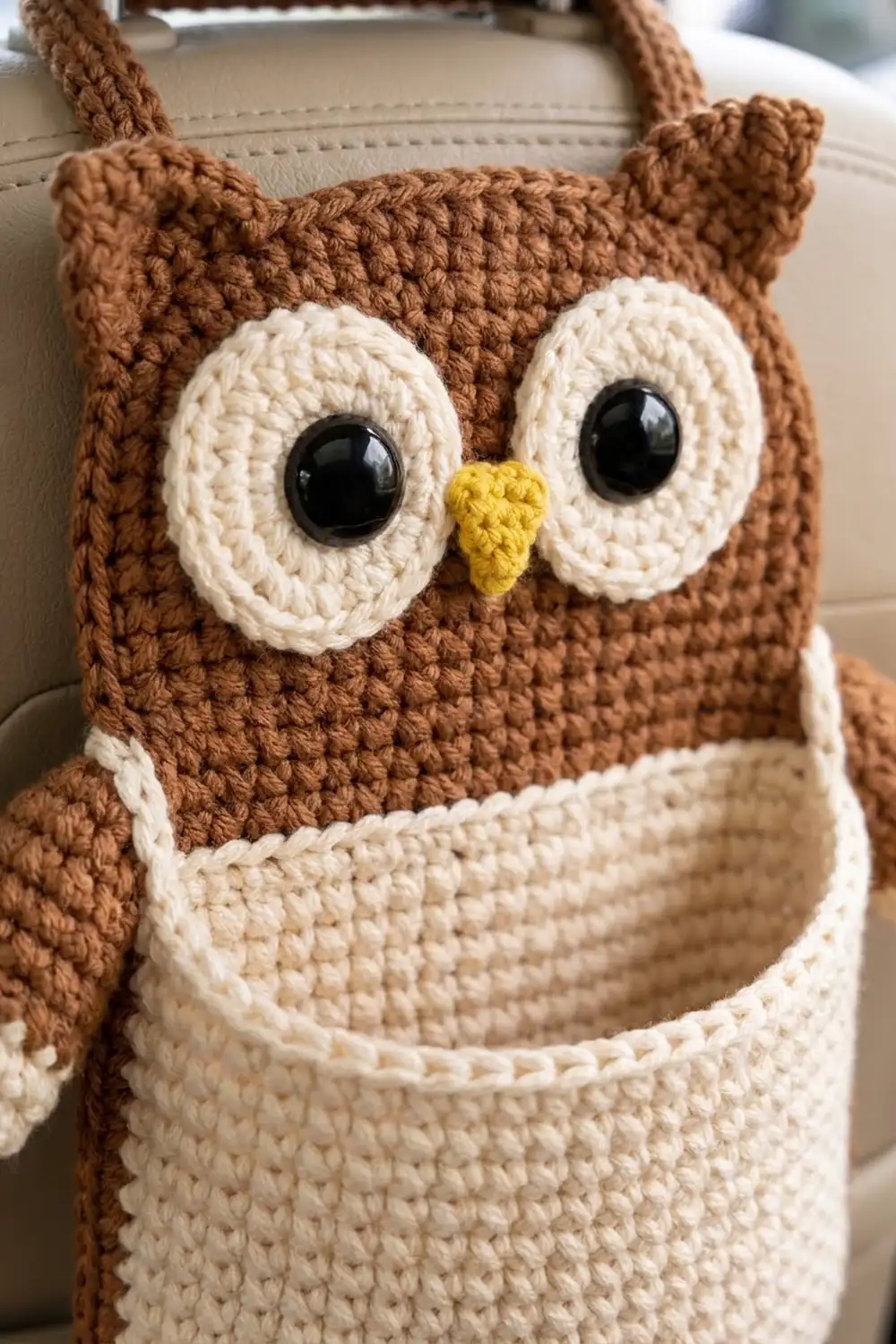
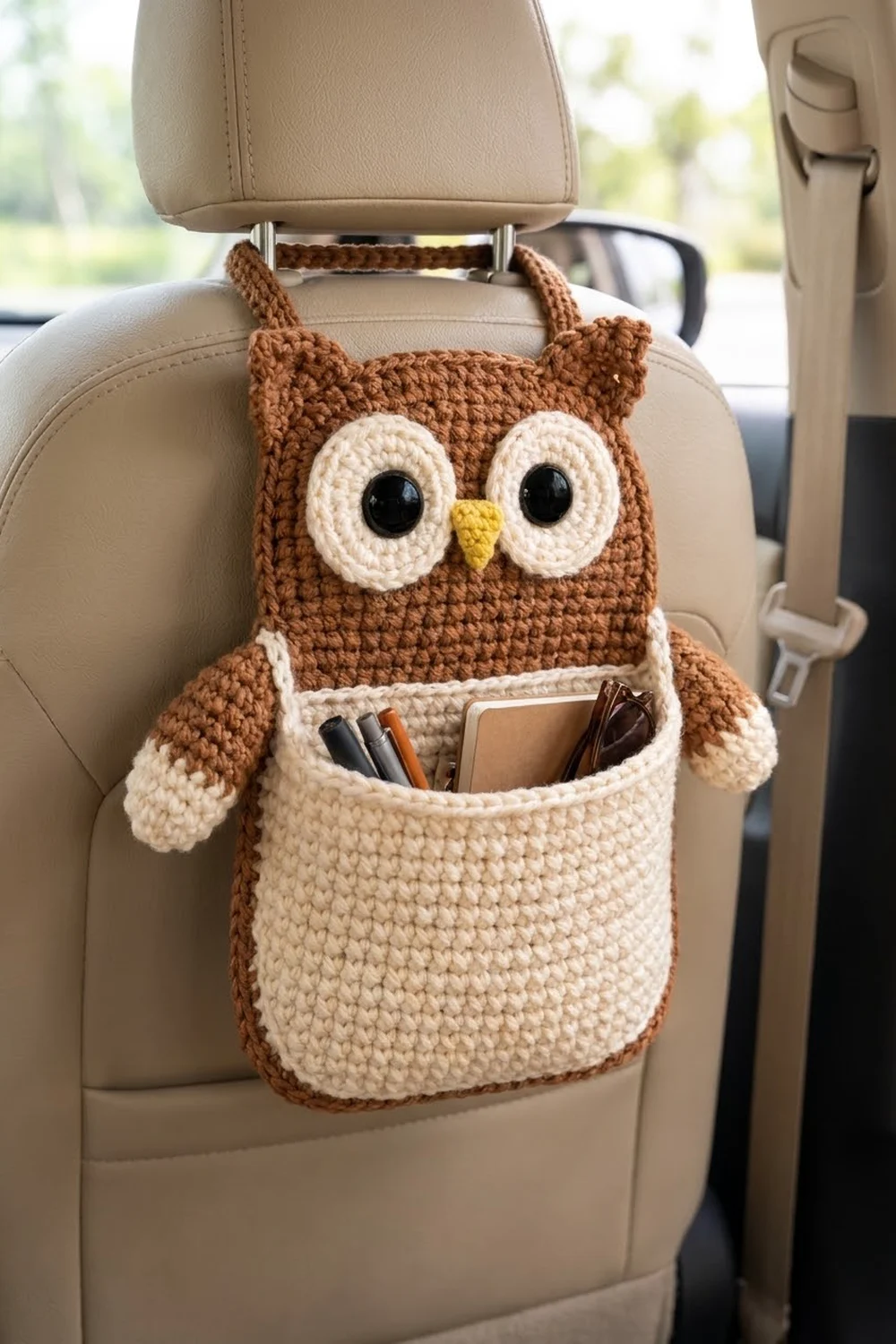
The Hoot Helper is a friendly owl that hangs on the back of a car seat and keeps pens, a phone, and sunglasses within reach. A chestnut-brown backing panel with pointed ears holds a roomy cream pocket. Big cream eyes, a yellow beak, and two chunky wings finish the face.
The palette is simple: warm brown, soft cream, a bit of bright yellow, and black safety eyes. Everything is worked in solid single crochet, which gives a dense, sturdy fabric that holds its shape in daily use.
This pattern uses US crochet terms. The finished organizer measures 11 in (27.9 cm) wide and 13 in (33.0 cm) tall at the body, or about 14.3 in (36.3 cm) to the ear tips. The pocket is 6.3 in (16.0 cm) deep.
You will crochet a flat panel in rows with the ears worked on top, then make a pocket in the round over an oval base. Next come two eyes, a beak, two wings, and two straps. You sew on the pocket and face first, add a two-round border, and then attach the wings and straps.
Finished Size and Construction
- Finished size: 11 in × 13 in (27.9 × 33.0 cm) body; 14.3 in (36.3 cm) to the ear tips
- Skill level: Easy+ (rows, rounds, oval base, simple shaping, sewing)
- Terminology: US
- Yarn weight: Worsted (#4 medium)
- Hook: 5.0 mm (H-8)
- Number of pieces: 1 panel, 1 pocket, 2 eyes, 1 beak, 2 wings, 2 straps (9 components, one finished item)
- Layout: pocket centered on the lower panel; eyes and beak on the upper panel
- Panel size before border: 10 in × 12 in (25.4 × 30.5 cm), plus 1.3 in (3.3 cm) ears
- Border depth: 0.5 in (1.3 cm), 2 rounds
Materials
Choose a smooth worsted-weight yarn, either acrylic or a cotton blend. It needs to hold up to sun and handling in a car. The amounts below assume roughly 180 m per 100 g.
- Brown (main): 130 g / 234 m
- Cream: 100 g / 180 m
- Yellow: 5 g / 9 m
- 5.0 mm (H-8) crochet hook
- 2 black safety eyes, 18 mm
- 2 buttons, 3/4 in (1.9 cm)
- Small handful of fiberfill
- Stitch markers (at least 6)
- Yarn needle, scissors, pins
- Measuring tape
All quantities include a margin of about 20 percent.
Abbreviations (US Terms)
- ch – chain
- sc – single crochet
- sc2tog – single crochet 2 together
- sc3tog – single crochet 3 together
- sl st – slip stitch
- BLO – back loop only
- MR – magic ring
- st(s) – stitch(es)
- RS – right side
Special stitch – reverse sc (crab stitch): Work from left to right (or right to left if you are left-handed). Insert the hook into the next stitch to the right, yarn over, pull up a loop, yarn over, and pull through both loops. This makes a corded, twisted edge.
Gauge and Checkpoints
Gauge: 16 sc and 18 rows = 4 in (10.2 cm), which is 4 sts and 4.5 rows per inch.
Test one piece first. Make one eye before you start anything else. After Round 7 it should measure 3.1 in (7.9 cm) across. If it is larger, go down a hook size. If it is smaller, go up a hook size. Then make the second eye at that gauge.
Checkpoints:
– Panel after Row 10: 10 in (25.4 cm) wide, 2.2 in (5.6 cm) tall
– Panel after Row 54: 10 in × 12 in (25.4 × 30.5 cm)
– Pocket base after Round 3: about 8.5 in × 1.5 in (21.6 × 3.8 cm)
– Pocket walls after Round 30: 6 in (15.2 cm) tall
– Panel after the border: 11 in × 13 in (27.9 × 33.0 cm)
If the panel width is off by more than 1/4 in (0.6 cm), change hooks and start again. The pocket has to line up stitch for stitch with the panel.
Back Panel (Brown)
Work in rows. Ch 1 at the start of each row does not count as a stitch.
Ch 41.
Row 1 (RS): Sc in 2nd ch from hook and in each ch across. Turn. (40 sts)
Rows 2–54: Ch 1, sc in each st across. Turn. (40 sts)
Mark Row 1 as the RS. Do not fasten off.
First Ear
Work over the first 8 sts of Row 54 only.
- Ear Row A: Ch 1, sc 8. Turn. (8 sts)
- Ear Row B: Ch 1, sc2tog, sc 4, sc2tog. Turn. (6 sts)
- Ear Row C: Ch 1, sc 6. Turn. (6 sts)
- Ear Row D: Ch 1, sc2tog, sc 2, sc2tog. Turn. (4 sts)
- Ear Row E: Ch 1, sc2tog twice. Turn. (2 sts)
- Ear Row F: Ch 1, sc2tog. (1 st) Fasten off.
Second Ear
Skip the next 24 sts of Row 54. These form the top edge, 6 in (15.2 cm) wide. Join brown in st 33 so that the same side faces you as for Ear Row A, then repeat Ear Rows A–F over sts 33–40.
Each ear is 2 in (5.1 cm) wide at the base and 1.3 in (3.3 cm) tall. Weave in the ends.
Pocket (Cream)
Work in joined rounds. Ch 1 at the start does not count as a stitch. Sl st to the first sc to join each round. Joining keeps the stitch positions stacked, which matters for the sewing step.
Ch 33.
Rnd 1: Sc in 2nd ch from hook, sc in next 30 ch, 3 sc in last ch. Rotate and work along the bottom loops: sc in next 30 ch, 2 sc in same ch as first sc. Join. (66 sts: 3 per end + 30 per side)
Rnd 2: Ch 1, 2 sc in first st, sc 30, 2 sc in each of next 3 sts, sc 30, 2 sc in each of last 2 sts. Join. (72 sts)
Rnd 3: Ch 1, 2 sc in first st, sc in next st, sc 30, (2 sc in next st, sc in next st) 3 times, sc 30, (2 sc in next st, sc in next st) twice. Join. (78 sts)
The Rnd 3 layout is 3 end sts, then 30 back sts (sts 4–33), 9 end sts (sts 34–42), 30 front sts (sts 43–72), and 6 end sts (sts 73–78). Check: 3 + 30 + 9 + 30 + 6 = 78. Place markers in st 4 and st 33. These mark the back wall.
Rnd 4: Ch 1, sc in BLO of each st around. Join. (78 sts) This ridge turns the wall upward.
Rnds 5–30: Ch 1, sc in each st around. Join. (78 sts) Move the markers up every few rounds so they stay in line with sts 4 and 33.
Rnd 31 (rim): Ch 1, reverse sc in each st around. Join. (78 sts) Fasten off and leave a 40 in (101.6 cm) tail for sewing.
The walls are 27 rounds, 6 in (15.2 cm) tall. With the base and rim the pocket is about 6.3 in (16.0 cm) deep, and the perimeter is 78 sts, or 19.5 in (49.5 cm).
Eyes (Make 2, Cream)
Work in continuous rounds.
- Rnd 1: 6 sc in MR. (6)
- Rnd 2: 2 sc in each st. (12)
- Rnd 3: (sc, 2 sc in next) 6 times. (18)
- Rnd 4: (sc 2, 2 sc in next) 6 times. (24)
- Rnd 5: (sc 3, 2 sc in next) 6 times. (30)
- Rnd 6: (sc 4, 2 sc in next) 6 times. (36)
- Rnd 7: (sc 5, 2 sc in next) 6 times. (42)
Sl st to the next st and fasten off, leaving a 16 in (40.6 cm) tail. Push an 18 mm safety eye through the center hole of Rnd 1, but do not attach the washer yet. Each eye is 3.1 in (7.9 cm) across.
Beak (Yellow)
- Ch 5.
- Row 1: Sc in 2nd ch from hook and in each ch across. Turn. (4 sts)
- Row 2: Ch 1, sc2tog twice. Turn. (2 sts)
- Row 3: Ch 1, sc2tog. (1 st)
Fasten off and leave a tail. The beak is a triangle 1 in (2.5 cm) wide and 0.7 in (1.8 cm) tall.
Wings (Make 2)
Start with cream and work in continuous rounds.
- Rnd 1: 6 sc in MR. (6)
- Rnd 2: 2 sc in each st. (12)
- Rnd 3: (sc, 2 sc in next) 6 times. (18)
- Rnds 4–6: Sc in each st. (18)
Change to brown and cut cream.
- Rnds 7–16: Sc in each st. (18)
- Rnd 17: (sc, sc2tog) 6 times. (12)
Stuff the cream tip lightly and leave the brown section almost flat. Flatten the opening and work 6 sc across it through both layers. Fasten off and leave a 12 in (30.5 cm) tail. Each wing is 3.8 in (9.7 cm) long and 2.3 in (5.8 cm) wide when flattened.
Straps (Make 2, Brown)
- Ch 61.
- Row 1: Sc in 2nd ch from hook and in each ch across. Turn. (60 sts)
- Row 2: Ch 1, sc 56, ch 2, skip 2 sts, sc 2. (60 sts, counting the ch-2 as 2)
Fasten off. Each strap is 15 in (38.1 cm) long and about 0.5 in (1.3 cm) wide, with a buttonhole near one end.
Make All Pieces
Check that you have every component before you assemble:
- Brown: 1 panel, 2 straps, and the brown upper part of each wing
- Cream: 1 pocket, 2 eyes, and the wing tips
- Yellow: 1 beak
Placement grid (panel stitches 1–40 across, rows 1–54 up):
Rows 55–60:  [Ear: sts 1–8]  ........ top edge 9–32 ........  [Ear: sts 33–40]
Rows 37–51:  [Eye center st 13, row 44]      [Eye center st 28, row 44]
Rows 38–42:                 [Beak: sts 19–22, point down]
Rows 24–30:  [Wing]                                             [Wing]
Rows 3–31:        [Pocket back wall: sts 6–35, 5 sts free each side]
Rows 1–2:    ............... brown panel showing below pocket ..............
Joining (Assembly)
Use whipstitch through one strand of each piece. Pull each stitch snug, but do not let it pucker. The panel should stay flat when you lay it on a table.
Pocket base: Pin the 30 back-wall front loops from Rnd 4 (sts 4–33) to Row 3 of the panel, sts 6–35. Sew one pocket stitch to one panel stitch. Both edges have 30 sts, so there is nothing to ease in.
Pocket sides: Sew the marked column at st 4 up panel st 6, then the column at st 33 up panel st 35. Both are worked across Rows 4–30, one pocket round per panel row. Pocket rounds and panel rows share the 4.5-per-inch gauge, so the 27 rounds match the 27 rows exactly.
Pocket top: Sew Rnd 30’s back sts 4–33 to panel Row 30, sts 6–35. Leave the Rnd 31 rim free so it sits as a corded ledge. The front of the pocket bows outward and makes the opening.
Eyes: Center the eyes at st 13 and st 28 on Row 44. Push each safety-eye post through the panel and fix the washer on the back. Then whipstitch around Rnd 7 of each eye.
Beak: Sew the beak over sts 19–22 with its top edge at Row 42 and the point down, overlapping the lower inner edges of the eyes.
Checkpoint: The panel still measures 10 in × 12 in (25.4 × 30.5 cm) and lies flat with no pull lines around the pocket.
Border (Brown)
Border gauge: 4 sc per inch along both stitches and row-ends, the same as the panel stitch gauge.
With the RS facing, join brown in the first foundation loop at the bottom left.
Rnd 1:
– Bottom: 2 sc in first loop, sc in next 38 loops, 2 sc in last loop. (42 sts, including both rounded corners)
– Right side: (sc in next 8 row-ends, skip 1 row-end) 6 times. (48 sts over 54 rows)
– Top: Along the second ear, sc in 5 row-ends, 3 sc in tip st, sc in 5 row-ends (13). Sc in the 24 top-edge sts (24). Along the first ear, sc in 5 row-ends, 3 sc in tip, sc in 5 row-ends (13). (50 sts)
– Left side: Work as the right side. (48 sts)
Join. (188 sts: 42 + 48 + 50 + 48)
Rnd 2:
– Bottom: Sc in each st, working 2 sc in the second st of each corner pair. (44 sts)
– Sides: Sc in each st. (48 sts each)
– Top: Sc in each st, working 3 sc in the center st of each ear tip and sc2tog at each of the 2 valleys where an ear meets the top edge. (50 + 4 − 2 = 52 sts)
Join. (192 sts: 44 + 48 + 52 + 48) Fasten off.
Why the math works: The bottom is worked one stitch per foundation stitch: 40 sts at 4 per inch is 10 in. The sides place 48 sc over 12 in, which is 4 per inch, so the edges neither flare nor pull in. Two border rounds add 0.5 in (1.3 cm) per side, giving 11 in × 13 in (27.9 × 33.0 cm).
Attach the wings: Sew the flat top of each wing to the back of the panel, behind the border, across Rows 24–30, angled slightly downward and out.
Attach the straps: Sew the end of each strap without the buttonhole to the back of the panel behind each ear, over Rows 50–54. Sew a button on each strap 4 in (10.2 cm) from the panel. To hang the organizer, wrap each strap around a headrest post and button it.
Final Blocking
- Lightly mist the whole organizer with water.
- Pin the panel face up to 11 in × 13 in (27.9 × 33.0 cm).
- Pin the ears into neat points.
- Stuff the pocket with a folded towel so it holds a rounded shape.
- Let it dry completely, which takes about 24 hours.
- Remove the pins and fluff the wings.
Final Quality-Control Checklist
- Panel measures 11 in × 13 in (27.9 × 33.0 cm)
- Border counts are 44 / 48 / 52 / 48
- Pocket is centered, with 5 panel sts free on each side
- Safety-eye washers are fully seated
- Beak is centered and points down
- Wings sit level with each other
- Buttons are secure and buttonholes fit
- All ends are woven in on the back
Troubleshooting
- Panel too wide: Your tension is loose. Go down a hook size.
- Side edges wavy: You may be working into every row-end. Skip 1 row-end in every 9.
- Side edges pulling in: You are skipping too often. Recount to 48.
- Pocket leans or twists: Rounds were worked in a spiral. Join each round.
- Pocket sags forward: Sew the Rnd 30 back stitches firmly to Row 30.
- Ear tips blunt: Make sure you worked 3 sc into the tip in both border rounds.
- Eyes look uneven: Re-measure from Row 44 before you fix the washers.
Care
Spot clean with mild soap and cool water, then lay flat to dry. Do not use a dryer, which can loosen the safety-eye washers.
Final Notes
The measurement chain is short and reliable. A 16-stitch, 18-row gauge gives a 40-stitch × 54-row panel of 10 in × 12 in (25.4 × 30.5 cm). The 30-stitch pocket back wall matches 30 panel stitches, and the 27 pocket rounds match 27 panel rows. A 2-round border, counted 44 / 48 / 52 / 48, brings the panel to 11 in × 13 in (27.9 × 33.0 cm). If you check each number as you go, your owl will hang straight and keep every pen in place.
Happy crocheting!