

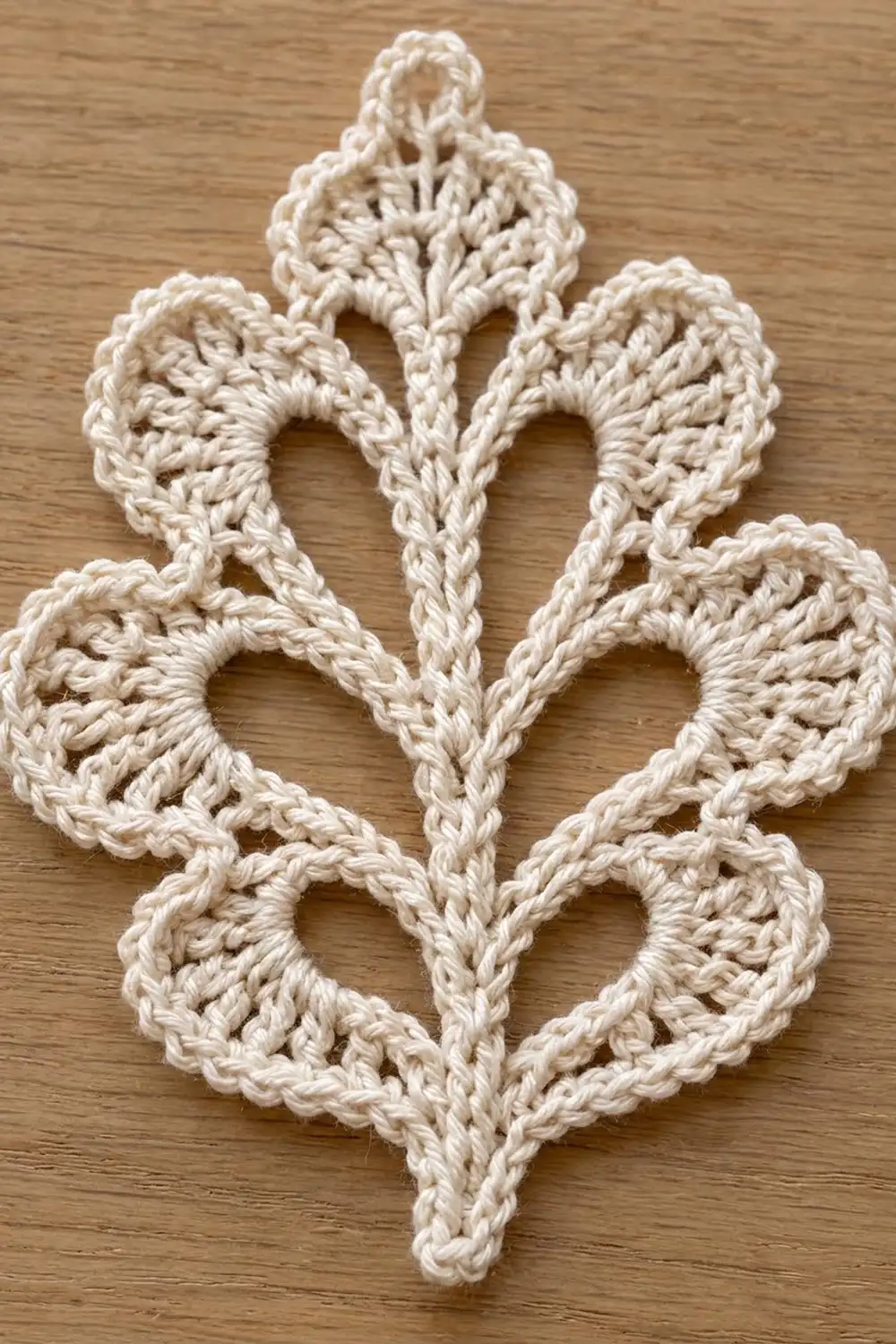
The Ivory Fern Window Leaf is a lacy single motif with a vintage, Irish-lace feel. A braided spine runs down the center. Three pairs of rounded lobes and a crown lobe branch from it, and each one frames an open teardrop window.
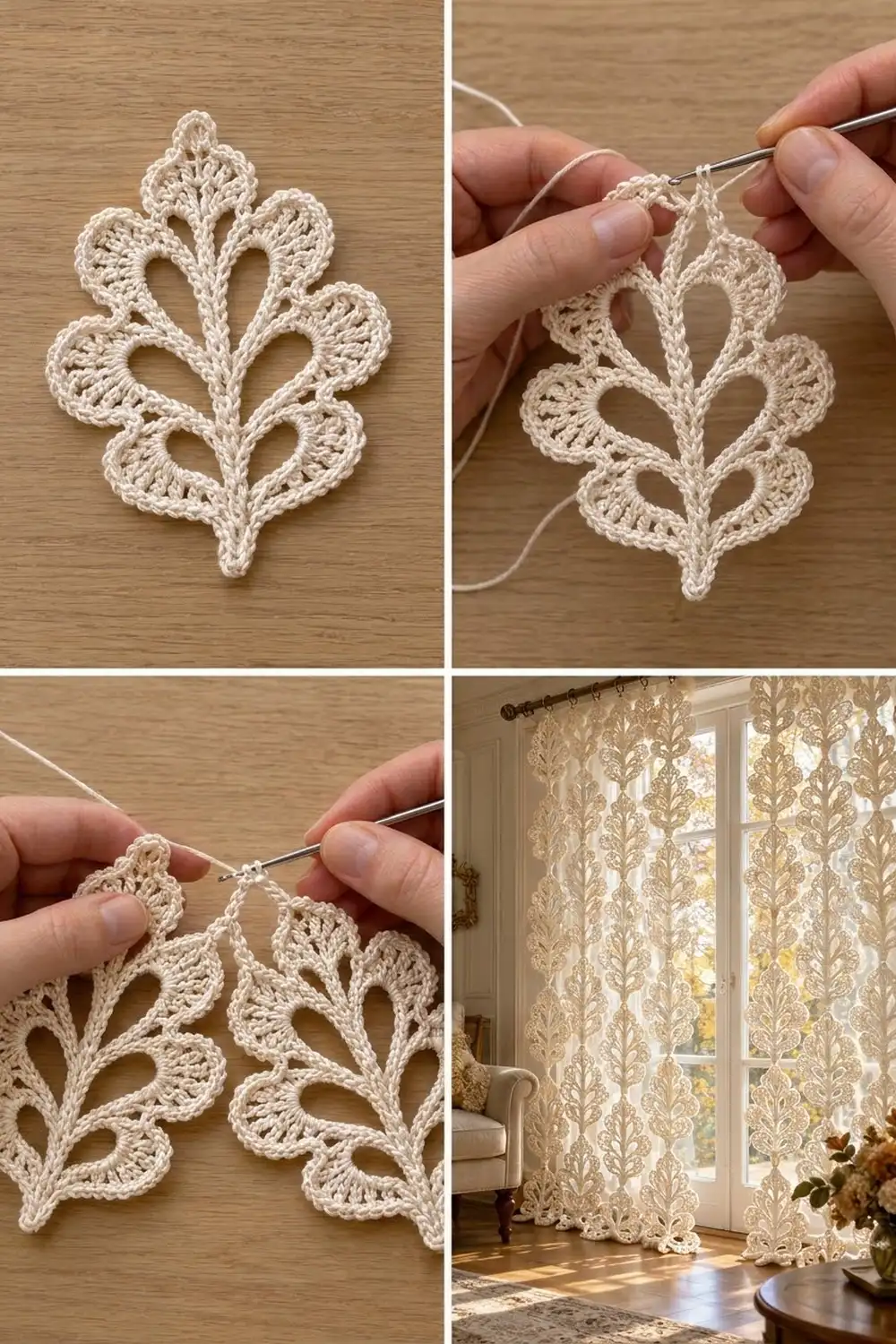
The sample is worked in one cream mercerized cotton, so the texture does all the work: a firm outline ridge, a band of radiating double crochet posts, and a crisp single crochet edge. The photo also shows motifs chained into hanging curtain strands. This pattern covers one motif.
This pattern uses US crochet terms. The finished motif measures 5 in (12.7 cm) wide by 7 in (17.8 cm) tall, not counting the 0.5 in (1.3 cm) hanging loop.
Construction is worked in one piece, in four rounds. First you chain the spine and make seven chain loops along it while you slip stitch back down. Next you cover each loop with single crochet, then build the double crochet fan band, and then finish with a single crochet edging that also forms the hanging loop.
Finished Size and Construction
- Finished size: 5 in (12.7 cm) wide x 7 in (17.8 cm) tall
- Skill level: Intermediate
- Terminology: US crochet terms
- Yarn weight: Sport weight (2), mercerized cotton
- Hook: 3.0 mm
- Number of pieces: 1
- Layout: Single leaf: central spine, 3 lobe pairs, 1 crown lobe
- Piece size: 5 in x 7 in (12.7 cm x 17.8 cm)
- Size before border (after Rnd 3): 4.5 in x 6.5 in (11.4 cm x 16.5 cm)
- Border depth (Rnd 4): 0.25 in (0.6 cm) on each edge
Materials
Yarn: Use a smooth, tightly plied mercerized cotton in sport weight, about 155 m per 50 g (170 yd per 1.75 oz). Mercerized cotton shows the spine braid and the dc posts clearly and blocks crisply. Avoid fuzzy or loosely spun yarns, because they blur the open windows.
- Cream (one color): 10 g, about 31 m (34 yd)
The quantity includes a margin of about 20% for your gauge swatch and weaving in ends.
Tools:
– 3.0 mm crochet hook
– Tapestry needle
– Scissors
– Rustproof pins and a blocking mat
– Spray bottle, plus spray starch if you want a stiffer finish
– Ruler or tape measure
Abbreviations (US Terms)
- ch – chain
- sl st – slip stitch
- sc – single crochet
- hdc – half double crochet
- dc – double crochet
- st(s) – stitch(es)
- Rnd – round
Special techniques:
- Sl st in back bump: Turn the chain over and insert the hook only under the bump on the back of the chain. That leaves both top loops free for later rounds.
- Sc over loop: Insert the hook into the open center of a chain loop, not into the individual chains, and work sc around the whole loop. This packs the stitches into a firm ridge and keeps the teardrop window open.
- Spine sts: The sl sts along the central chain between lobes. In every round, these are worked as 1 sl st in each spine st, which builds up the braided spine.
Gauge and Checkpoints
Gauge: 22 ch = 4 in (10.2 cm) when relaxed, and 22 sc = 4 in (10.2 cm) with a 3.0 mm hook. Gauge affects the size and how flat the motif lies.
This is a single piece, so the motif is your test piece. Measure at each checkpoint before going on:
- After Rnd 1: Spine is 5.5 in (14.0 cm) long from tip to crown base.
- After Rnd 2: Width across the middle lobes is 3.5 in (8.9 cm).
- After Rnd 3: 4.5 in (11.4 cm) wide x 6.5 in (16.5 cm) tall.
- After Rnd 4: 5 in (12.7 cm) wide x 7 in (17.8 cm) tall.
Too big? Change to a 2.75 mm hook, or tighten your chains. Loose chain loops are the most common cause of wide lobes.
Too small or cupping? Change to a 3.25 mm hook. If only the lobes cup, chain more loosely in Rnd 1.
Pattern
Rnd 1: Spine and Lobe Frames
Ch 31. The last ch made (ch 31) is the top of the spine, and the first ch (ch 1) is the bottom tip.
Crown loop: Ch 14, sl st in 15th ch from hook (this is ch 31). That forms a 14-ch crown loop.
Sl st in back bump of next 6 ch, ending in ch 25.
Top pair: (Ch 16, sl st in same ch) twice. That makes two 16-ch loops anchored at ch 25.
Sl st in back bump of next 8 ch, ending in ch 17.
Middle pair: (Ch 20, sl st in same ch) twice. That makes two 20-ch loops anchored at ch 17.
Sl st in back bump of next 8 ch, ending in ch 9.
Bottom pair: (Ch 16, sl st in same ch) twice. That makes two 16-ch loops anchored at ch 9.
Sl st in back bump of next 8 ch, ending at ch 1 (the tip). Do not fasten off.
Count: 7 loops (1 crown loop of 14 ch, 4 loops of 16 ch, 2 loops of 20 ch) and 30 spine sl sts.
Lay the work flat. Arrange the second loop of each pair to the right of the spine and the first loop to the left, with the crown loop pointing straight up. Check that the spine measures 5.5 in (14.0 cm).
Rnd 2: Window Outlines
This round goes up the right side of the spine, around the crown, and down the left side. On the right, work spine sl sts into one free top loop of the foundation chain. On the left, use the other top loop.
Ch 1 (does not count as a st).
Right side:
– Sl st in each of ch 2–9 (8 spine sts).
– Bottom right loop: 22 sc over loop.
– Sl st in each of ch 10–17 (8 spine sts).
– Middle right loop: 28 sc over loop.
– Sl st in each of ch 18–25 (8 spine sts).
– Top right loop: 22 sc over loop.
– Sl st in each of ch 26–31 (6 spine sts).
Crown loop: 20 sc over loop.
Left side:
– Sl st in each of ch 31–26 (6 spine sts).
– Top left loop: 22 sc over loop.
– Sl st in each of ch 25–18 (8 spine sts).
– Middle left loop: 28 sc over loop.
– Sl st in each of ch 17–10 (8 spine sts).
– Bottom left loop: 22 sc over loop.
– Sl st in each of ch 9–2 (8 spine sts).
Sl st in the tip (ch 1) to join.
Count: 224 sts (164 sc over loops: 72 right + 20 crown + 72 left; 60 spine sl sts: 30 per side).
Spread the sc evenly around each loop so the window inside becomes a clean teardrop. The middle lobes should span 3.5 in (8.9 cm).
Rnd 3: Fan Band
This round shapes each lobe into a rounded fan. Every lobe starts and ends with short stitches, which taper the lobe into the spine.
Ch 1. Work 1 sl st in each spine st throughout the round.
Bottom lobes (22 sc each):
Sl st in first sc, sc in next, hdc in next, [dc in next, 2 dc in next] 8 times, hdc in next, sc in next, sl st in last sc.
16 sc worked become 24 dc. Lobe total: 30 sts (3 + 24 + 3).
Middle lobes (28 sc each):
Sl st in first sc, sc in next, hdc in next, [dc in next, 2 dc in next] 11 times, hdc in next, sc in next, sl st in last sc.
22 sc worked become 33 dc. Lobe total: 39 sts (3 + 33 + 3).
Top lobes (22 sc each): Work as for the bottom lobes. Lobe total: 30 sts.
Crown lobe (20 sc):
Sl st in first sc, sc in next, hdc in next, [dc in next, 2 dc in next] 7 times, hdc in next, sc in next, sl st in last sc.
14 sc worked become 21 dc. Lobe total: 27 sts (3 + 21 + 3).
Work in the same order as Rnd 2: up the right side (8 spine, bottom lobe, 8 spine, middle lobe, 8 spine, top lobe, 6 spine), then the crown, then down the left side (6 spine, top lobe, 8 spine, middle lobe, 8 spine, bottom lobe, 8 spine). Sl st in the first st to join.
Count: 285 sts. That is 225 lobe sts (right side 30 + 39 + 30 = 99; crown 27; left side 99) plus 60 spine sl sts.
This is a growth round, and its complete count is 285. Each lobe’s dc section grows by half (every pair of sc becomes 3 dc), and that is what makes the lobes fan out flat around the windows. The motif should now be 4.5 in x 6.5 in (11.4 cm x 16.5 cm).
Border (Edging Round)
Border Gauge
The edging is 1 sc per st. One row of sc adds about 0.25 in (0.6 cm) along every outer edge. On this motif, the outer edges are the lobe fans, so the edging adds 0.5 in (1.3 cm) to the width (0.25 in on each side). It also adds 0.5 in (1.3 cm) to the height (0.25 in at the crown and 0.25 in at the tip).
Rnd 4: Edging and Hanging Loop
Ch 1. Keep working 1 sl st in each spine st.
Bottom, middle, and top lobes: Sc in each st across the lobe. That is 30 sc for each bottom lobe, 39 sc for each middle lobe, and 30 sc for each top lobe. The first and last sc of each lobe go into the Rnd 3 sl sts, which pulls the edge into a soft valley at the spine.
Crown lobe: Sc in each of first 13 sts, (sc, ch 6, sc) in the 14th (center) st, sc in each of last 13 sts. Crown total: 28 sc plus a ch-6 hanging loop.
Work in the same order as before. Sl st in the first st to join, then fasten off.
Counts per section:
– Right side: 99 sc (30 + 39 + 30) + 30 spine sl sts
– Crown: 28 sc + ch-6 loop
– Left side: 99 sc + 30 spine sl sts
– Round total: 226 sc + 60 sl sts + 6 ch
Why the Math Works
Rnd 4 is a trim round. Its count is the 225 lobe sts from Rnd 3 worked 1-for-1, plus 1 extra sc at the crown center: 225 + 1 = 226 sc, plus the 60 unchanged spine sl sts. The curve was already built in Rnd 3, so a 1-for-1 edge follows it without ruffling or cupping.
The spine sl sts never increase. That keeps the center slim and raised and stops the motif from stretching lengthwise. The size goes from 4.5 in x 6.5 in (11.4 cm x 16.5 cm) to 5 in x 7 in (12.7 cm x 17.8 cm) because the edging adds 0.25 in (0.6 cm) on every outer edge.
Final Blocking
- Weave in both ends along the back of the spine, where they disappear inside the braid.
- Soak the motif in cool water for 10 minutes. Press out the water gently in a towel. Do not wring.
- Lay it face up on the blocking mat. Pin the tip and the base of the hanging loop first, 7 in (17.8 cm) apart, with the spine straight between them.
- Pin the outer edge of each middle lobe so the total width is 5 in (12.7 cm).
- Pin each remaining lobe at its widest point, keeping left and right lobes mirrored.
- Put a pin inside each teardrop window and ease it open into a clean point at the spine end.
- Spray lightly with starch if you want a crisp, lace-like finish.
- Let it dry completely, at least 12 hours, before unpinning.
Final Quality-Control Checklist
- Motif measures 5 in x 7 in (12.7 cm x 17.8 cm), not counting the hanging loop.
- Hanging loop is about 0.5 in (1.3 cm) and centered on the crown.
- All seven windows are open, teardrop-shaped, and similar in size to their mirror lobe.
- Spine is straight and evenly braided from tip to crown.
- Rnd 3 counts: 30, 39, 30 per side and 27 at the crown.
- Rnd 4 counts: 99 sc per side and 28 sc at the crown.
- Edge dips cleanly at each lobe valley with no gaps.
- Ends are hidden in the spine and not visible from the front.
Troubleshooting
Windows close up or look squashed: The sc in Rnd 2 are bunched up. Spread them evenly around the whole loop, or chain the loops a little more loosely.
Lobes ruffle: Your dc are too loose, or you added extra increases. Count again (24, 33, or 21 dc) or go down a hook size.
Lobes cup: The Rnd 1 chains are too tight. Remake the loops with looser chains.
Spine curves to one side: You worked the spine sl sts too tightly on one side. Keep the tension on the spine sl sts the same on both sides, and correct it when blocking.
Left and right lobes don’t match: Check that each mirrored pair has the same number of sts in Rnds 2–4.
Hanging loop is off-center: Make sure the crown has 13 sc on each side of the (sc, ch 6, sc) stitch.
Care
Hand wash in cool water with mild soap, press flat in a towel, and dry pinned to shape. Re-starch after washing if you want the crisp finish back.
Final Notes
The measurement chain is short and easy to check:
– The 31-ch spine measures 5.5 in (14.0 cm).
– Rnd 2 outlines seven windows, with the middle lobes spanning 3.5 in (8.9 cm).
– Rnd 3 fans the lobes out to 4.5 in x 6.5 in (11.4 cm x 16.5 cm).
– Rnd 4 adds 0.25 in (0.6 cm) on every edge, for 5 in x 7 in (12.7 cm x 17.8 cm).
If each checkpoint matches, the blocked leaf will lie flat with clean, open windows. Happy crocheting!