

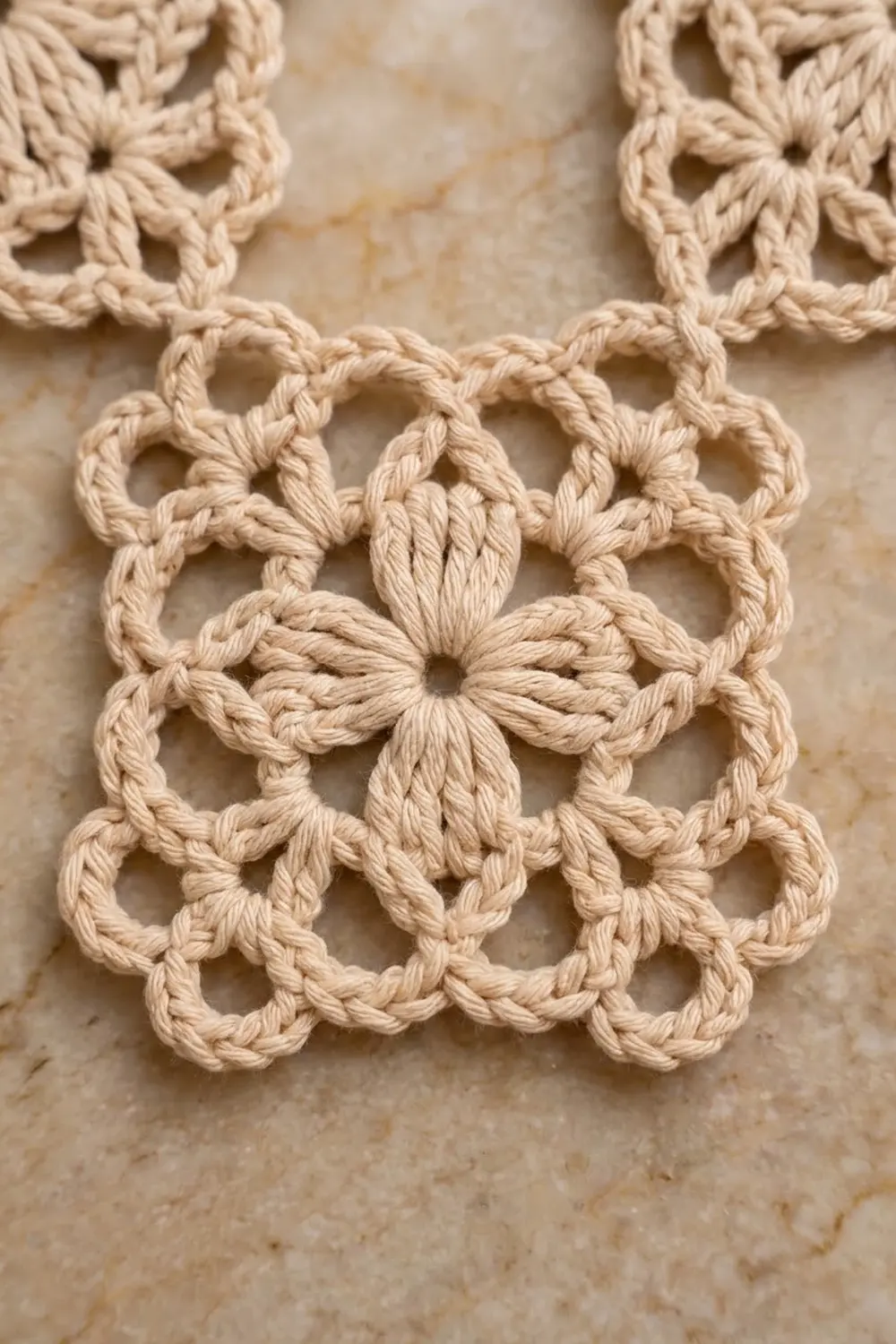
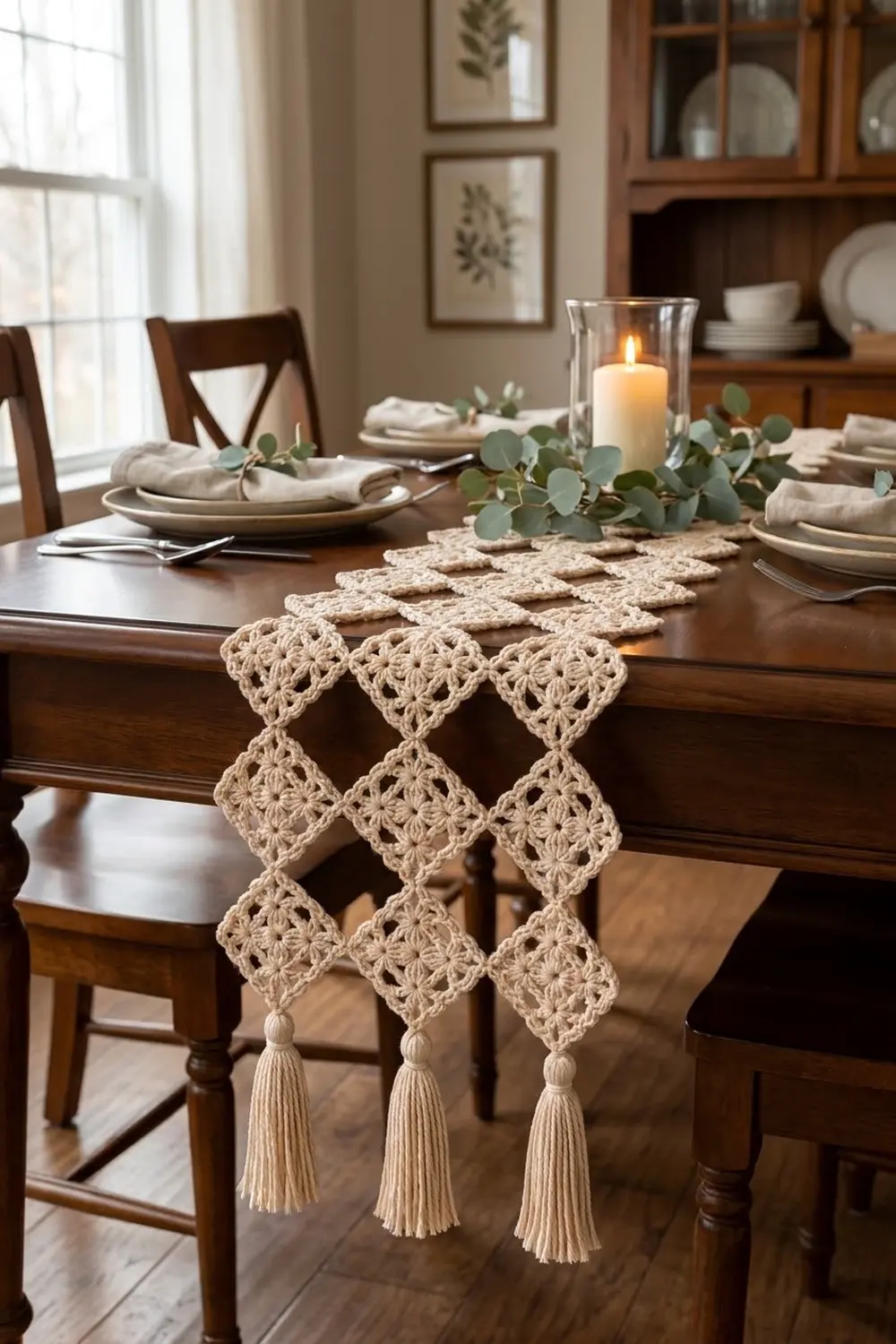
This runner is made of lacy square motifs turned on point, so each one sits as a diamond. Each motif has a solid four-petal flower in the center and an open frame of chain loops around it. The motifs touch only at their corner points, which leaves open diamond-shaped windows between them. The result is a light lattice that lets the table show through.
The sample is worked in one color, a warm ivory cotton. That keeps the focus on texture and suits a holiday table with gold and candlelight, but it works just as well all year. Three full tassels hang from the three diamond points at each short end.
This pattern uses US crochet terms. The finished runner is about 17.0 in (43.2 cm) wide and 56.6 in (143.8 cm) long, not counting tassels. With 3.5 in (8.9 cm) tassels at both ends, the total length is about 63.6 in (161.5 cm).
You’ll make 30 identical motifs, laid out 3 across and 10 rows long. The first motif is worked on its own. Every other motif joins its neighbors at the corners during its last round (join-as-you-go). The last round of each motif also forms the runner’s scalloped edge, so you don’t add a separate border. Tassels go on last.
Finished Size and Construction
- Finished size: 17.0 in x 56.6 in (43.2 cm x 143.8 cm), plus tassels
- Skill level: Intermediate
- Terminology: US crochet terms
- Yarn weight: Worsted (#4) cotton
- Hook: US H-8 (5.0 mm)
- Number of pieces: 30 motifs, plus 6 tassels
- Layout: 3 motifs across x 10 rows, set on point and joined at the corners
- Piece size: 4 in (10.2 cm) per side; 5.66 in (14.4 cm) from point to point
- Size before border: 17.0 in x 56.6 in (43.2 cm x 143.8 cm)
- Border depth: 0 in added. Round 4’s loops are the edge and stand about 0.4 in (1.0 cm) proud of the solid frame.
Materials
Choose a smooth, mercerized or combed worsted-weight cotton with good stitch definition. Fuzzy or very splitty yarns will blur the petals and loops. Cotton also blocks flat and holds the diamond shape on a table.
- Ivory (one color): 350 g, about 595 m (650 yd)
- Motifs: about 8 g / 14 m per motif, 240 g / 420 m in total
- Tassels: about 4 g / 7 m each, 24 g / 42 m in total
Tools:
– US H-8 (5.0 mm) crochet hook
– Tapestry needle
– Scissors
– Stiff card 4 in (10.2 cm) tall, for tassels
– Rust-proof pins and a blocking surface at least 18 in x 58 in (45.7 cm x 147.3 cm), or blocking in sections
– Spray bottle
– Tape measure
The quantities include about a 20% margin for your gauge test, tails, and slight gauge differences.
Abbreviations (US Terms)
- ch – chain
- sl st – slip stitch
- sc – single crochet
- dc – double crochet
- tr – treble crochet
- sk – skip
- sp – space
- st(s) – stitch(es)
- rep – repeat
- MR – magic ring
Joined corner (JC): Work this in a corner ch-7 sp: sc, ch 3, remove the hook, insert it from the front into the neighboring motif’s corner ch-7 loop, pick up the dropped loop and pull it through, ch 3, sc. Pulling the loop through counts as the sl st. Ch 3 + sl st + ch 3 takes the place of the ch-7, so the corner keeps its usual length.
Gauge and Checkpoints
Make one complete motif before you start the runner. Block it gently and measure it. Every later measurement depends on this one piece.
- After Round 1: the circle is 1.25 in (3.2 cm) across
- After Round 2: the flower is 3 in (7.6 cm) from petal tip to petal tip
- After Round 3: 3.25 in (8.3 cm) per side, measured corner to corner
- After Round 4: 4 in (10.2 cm) per side, and 5.66 in (14.4 cm) from point to point across the diagonal
If your motif is too big (for example 4.1 in / 10.4 cm per side or more), go down half a size to a 4.5 mm hook. A difference of 0.1 in per motif adds up to more than 1 in (2.5 cm) over the length of the runner.
If your motif is too small (3.9 in / 9.9 cm per side or less), go up to a 5.5 mm hook.
If your rounds are tight but the chain loops are loose (or the other way around), adjust only the chains. The loops should lie flat without pulling the corners inward.
The Motif
Each motif is worked in the round with the right side facing you throughout. Don’t turn.
Round 1: MR, ch 3 (counts as dc), 15 dc in the ring, pull the ring closed, sl st to the top of the beginning ch-3. (16 dc)
Round 2 (petals): Ch 1, sc in the same st, sk 1 st, 7 tr in the next st, sk 1 st, sc in the next st; rep from * 3 more times, leaving out the last sc on the final repeat. Sl st to the first sc. (4 petals: 28 tr + 4 sc = 32 sts)*
Each 7-tr fan opens into a rounded petal, and the sc between petals pulls the base in tight. That gives you the four-petal flower.
Round 3 (square frame): Sl st in each of the next 3 tr. Ch 1, (sc, ch 5, sc) in the next tr, which is the 4th tr and the center of the petal [corner made]. Ch 4, sk 2 tr, sc in the 7th tr of the petal. Ch 4, sk the sc between petals, sc in the 1st tr of the next petal. Ch 4, sk 2 tr; rep from * 3 more times. Sl st to the first sc. (16 sc, 4 corner ch-5 sps, 12 side ch-4 sps)*
Each petal tip now points to a corner, which squares off the circle. Each side has 3 ch-4 sps between its corners.
Round 4 (loop edge): Sl st in the next corner ch-5 sp. Ch 1, (sc, ch 7, sc) in the corner sp, [ch 5, sc in the next ch-4 sp] 3 times, ch 5; rep from * 3 more times. Sl st to the first sc. Fasten off and weave in the ends. (20 sc, 4 corner ch-7 loops, 16 side ch-5 loops = 20 loops total)*
Each side has 4 ch-5 loops plus a ch-7 corner loop at each end, which is 6 loops per side, including both corners. Since each corner belongs to two sides, the total is 4 x 6 − 4 = 20 loops, which matches the round count.
Make All Pieces
Make 1 complete motif (A1) by following Rounds 1–4. Make the other 29 motifs by working Rounds 1–3 as written and joining in Round 4 (see Joining).
Color: all 30 motifs are ivory. Turn each motif on point so that one corner points toward the end of the runner.
Layout grid (each ◇ is one motif; columns A–C, rows 1–10):
Row 10:  ◇ ◇ ◇   (A10 B10 C10)  ← tassels on top points
Row 9:   ◇ ◇ ◇
Row 8:   ◇ ◇ ◇
Row 7:   ◇ ◇ ◇
Row 6:   ◇ ◇ ◇
Row 5:   ◇ ◇ ◇
Row 4:   ◇ ◇ ◇
Row 3:   ◇ ◇ ◇
Row 2:   ◇ ◇ ◇
Row 1:   ◇ ◇ ◇   (A1 B1 C1)     ← tassels on bottom points
Neighbors in a row touch at their side points. Each motif touches the one above it at its top point.
Joining
Method: Join-as-you-go during Round 4. The only connection points are corners. Side loops are never joined.
Order:
– Row 1: A1 is complete. On B1, work its left corner as a JC into A1’s right corner. On C1, work its left corner as a JC into B1’s right corner.
– Rows 2–10: For the A motif, work its bottom corner as a JC into the top corner of the motif below. For the B and C motifs, join the bottom corner to the motif below, and the left corner to the motif on the left.
Plan where you start Round 4 so the corners come up in a convenient order. Work every other corner as a normal (sc, ch 7, sc).
Stitch-to-stitch logic: Each JC replaces one ch-7 with ch 3 + sl st + ch 3. The motif’s loop count stays the same at 20 loops, and every join is one loop to one loop. No stitches are added or lost at a seam. In total there are 20 side-to-side joins (2 per row x 10 rows) and 27 top-to-bottom joins (3 per row boundary x 9), which makes 47 joins.
Tension advice: Keep your ch-3s the same tension as your normal chains. If they’re tight, the points pucker and the diamonds tilt. If they’re loose, the lattice sags. Before you pull the loop through, check that the two motifs lie flat point to point.
Size checkpoints:
– After Row 1: 17.0 in (43.2 cm) wide, which is 3 x 5.66 in
– After Row 2: 11.3 in (28.7 cm) long
– After Row 5: 28.3 in (71.9 cm) long
If you’re off by more than 0.5 in (1.3 cm), check your gauge on the next motif.
The open spaces between every four motifs form diamond windows, each framed by 16 ch-5 loops. A 3 x 10 layout has 18 of these interior windows.
Border
This runner has no separate border rounds. Round 4 of each motif is the border, so the edge matches the lattice and the runner stays light.
Border gauge: 4 ch-5 loops plus half of each corner loop measure 4 in (10.2 cm), or about 0.8 in (2.0 cm) per ch-5 loop.
Edge counts:
– Each long edge: 10 motifs x (2 outer sides x 4 ch-5 loops) = 80 ch-5 loops, plus 10 free side-point ch-7 loops. Each outer-column motif contributes its upper-outer and lower-outer sides, including the end motifs.
– Each short edge: the inner lower sides of the end row are 1 side (A) + 2 sides (B) + 1 side (C) = 4 sides x 4 = 16 ch-5 loops, plus 3 free point ch-7 loops for the tassels.
– Total perimeter: 2 x (80 + 10) + 2 x (16 + 3) = 218 loops
Why the math works: Each motif side always has 4 ch-5 loops. Corners are shared only at joins, and a JC doesn’t add loops. Every free corner keeps its full ch-7, so the points stay crisp. Check: 48 perimeter sides x 4 = 192 ch-5 loops, plus 26 free corner loops = 218. That matches the total above.
Tassels (make 6): Wrap the yarn 30 times around the 4 in (10.2 cm) card. Thread a 12 in (30.5 cm) strand under the wraps at the top and tie it tightly. Cut the wraps open at the bottom. Wrap another strand around the bundle 0.75 in (1.9 cm) below the top, tie it, and hide the ends inside. Trim the tassel to 3.5 in (8.9 cm). Use the top tie to fasten one tassel through each free point ch-7 loop at both short ends.
Final Blocking
- Soak the runner in cool water for 10 minutes, then press the water out gently. Don’t wring it.
- Roll it in a towel to remove the extra water.
- Lay it flat with the right side up and the motifs on point.
- Pin the four outer points of the runner to 17.0 in x 56.6 in (43.2 cm x 143.8 cm).
- Pin every free point, every joined corner, and the tips of all 26 perimeter points in straight lines.
- Check that each motif measures 4 in (10.2 cm) per side and that each window is square.
- Open the ch-5 loops into even arches with your fingers.
- Comb the tassels straight and lay them flat.
- Let everything dry completely before you unpin it.
Final Quality-Control Checklist
- [ ] 30 motifs, each with 16 dc, 4 petals, and 20 loops in Round 4
- [ ] Each motif measures 4 in (10.2 cm) per side
- [ ] 47 joins, all at corners and none on the sides
- [ ] 18 interior windows, all open and square
- [ ] 218 perimeter loops with no twisted chains
- [ ] Runner measures 17.0 in x 56.6 in (43.2 cm x 143.8 cm)
- [ ] 6 tassels, 3.5 in (8.9 cm) each, firmly tied
- [ ] All ends woven in securely on the wrong side
Troubleshooting
- Petals cup or ruffle: Your trebles are too loose. Go down a hook size for Round 2 only.
- Center hole is open: Pull the magic ring tighter before you weave in the tail, then weave through the dc bases.
- Motif isn’t square: Make sure each petal has exactly 7 tr and that you start the corner sc in the 4th tr.
- Points are rounded or puckered: Your JC chains are too tight. Loosen them, or chain 4 instead of 3 and check again.
- Runner is too long: Measure one motif. If it’s over 4 in (10.2 cm), steam-block it firmly or rework it with a smaller hook.
- Tassels are uneven: Trim them together while they’re damp.
Care
Hand wash cold with a mild detergent, roll it in a towel, and dry it flat. Pin it again at the points if they need sharpening.
Final Notes
The measurement chain is simple. Round 1 is 1.25 in (3.2 cm), the flower is 3 in (7.6 cm), and the frame is 3.25 in (8.3 cm). The finished motif is 4 in (10.2 cm) per side and 5.66 in (14.4 cm) from point to point. Three points across give 17.0 in (43.2 cm), and ten points long give 56.6 in (143.8 cm). If your first motif is right, the whole runner will be right.
Happy crocheting!