

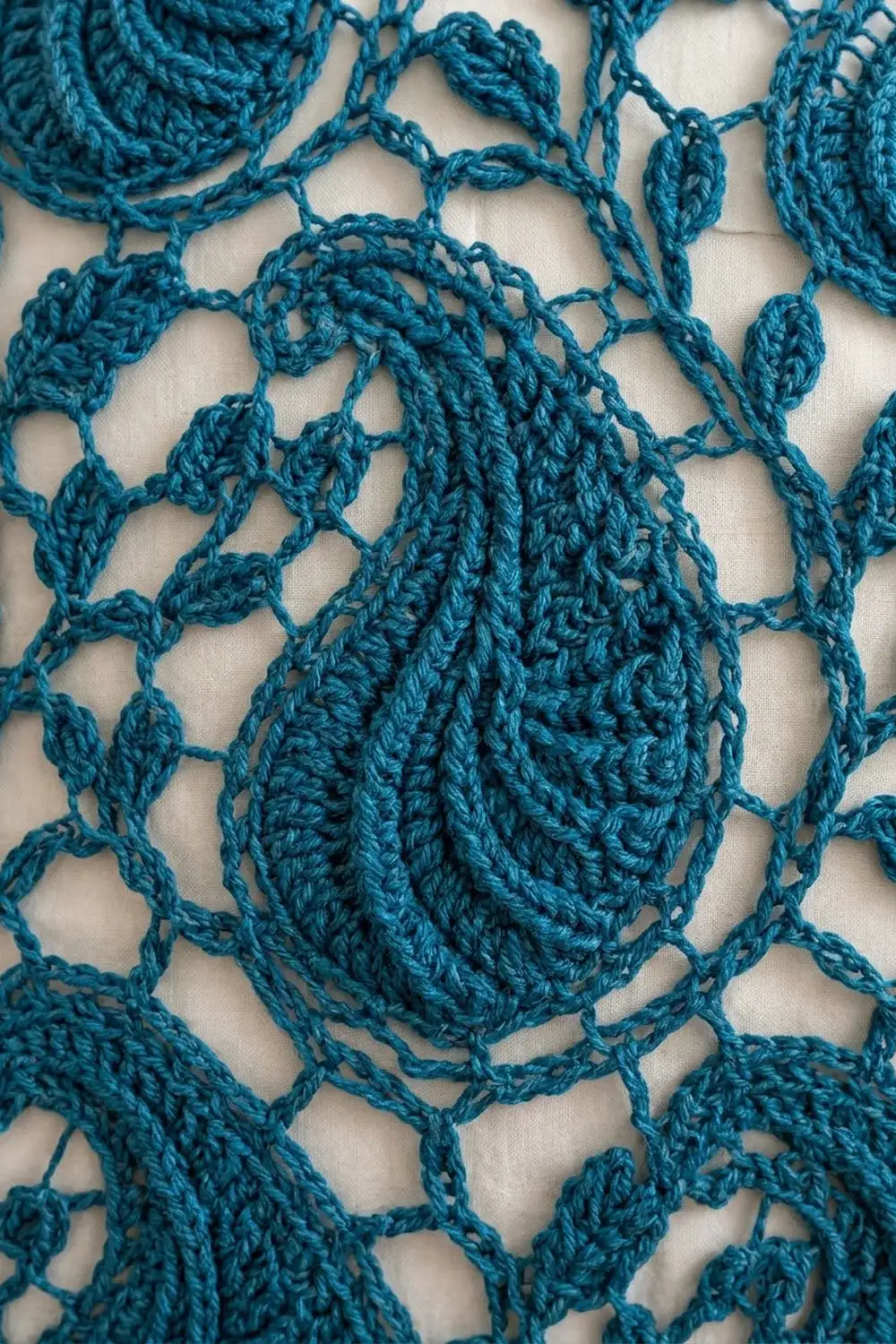
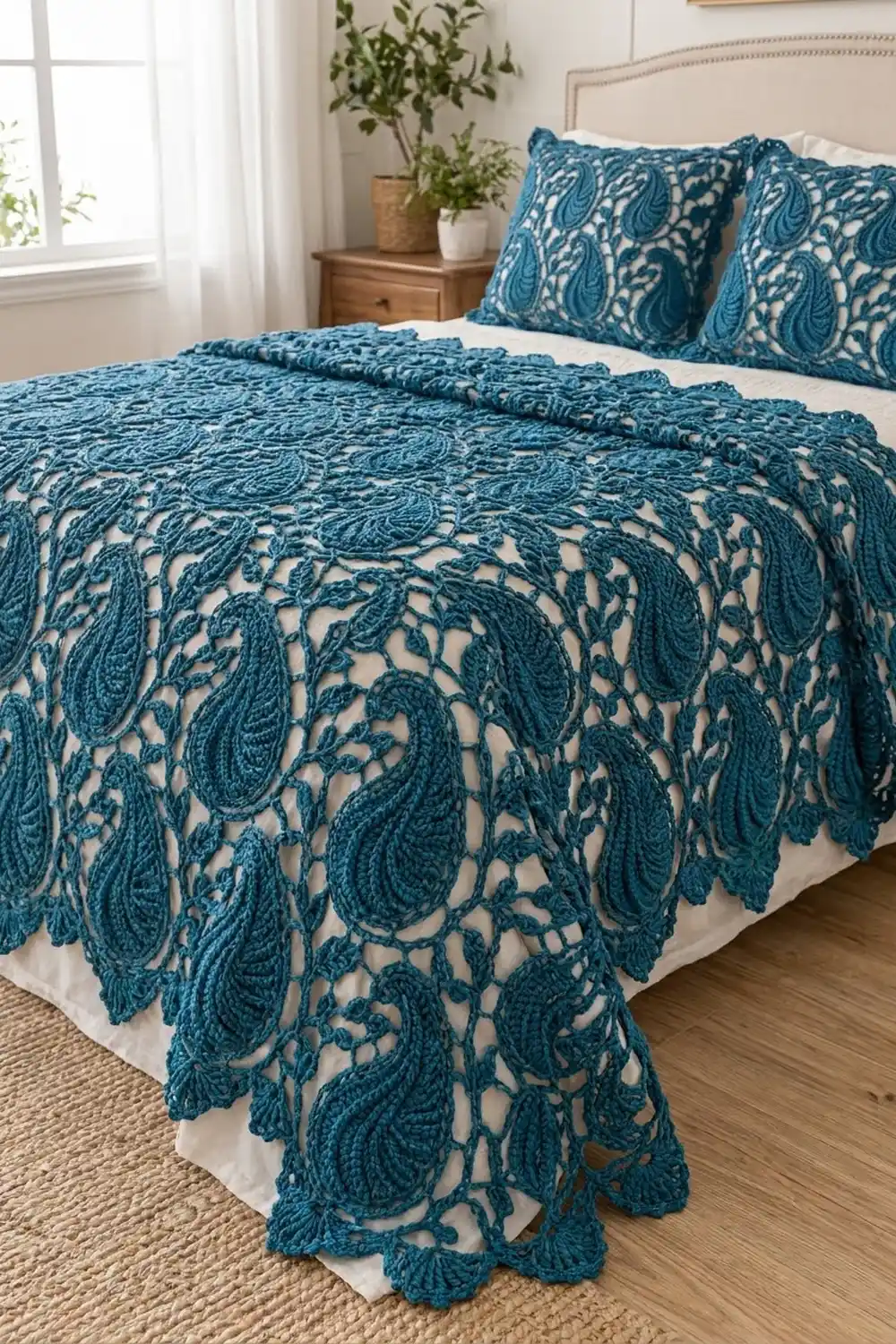
The Lagoon Paisley Lace Bedspread is a heritage-style coverlet in one deep teal blue. It is made of curled paisley motifs with raised, ridged rounds. Each paisley sits in a frame of chain vines and small leaves. Across the bed the paisleys tilt in alternating directions, and a deep scalloped shell border finishes the edge.
Because the lace is open, whatever sheet or blanket sits underneath shows through. Over white or ivory bedding, the teal paisleys stand out clearly. The look is part Irish crochet and part vintage paisley print, but each block is worked as an ordinary round-by-round motif.
This pattern uses US crochet terms. The finished bedspread measures 77.5 in x 88 in (196.9 cm x 223.5 cm) after blocking.
Here is the construction in brief. You crochet a ridged paisley with a curled tail, then frame it into a 10.5 in (26.7 cm) square with a vine-and-leaf round and a mesh round. You make 56 blocks, join them 7 across by 8 down, and add a three-round scalloped border.
Finished Size and Construction
- Finished size: 77.5 in x 88 in (196.9 cm x 223.5 cm)
- Skill level: Intermediate to experienced
- Terminology: US crochet terms
- Yarn weight: Worsted (#4) cotton
- Hook: 5.0 mm (H-8)
- Number of pieces: 56 identical blocks
- Layout: 7 blocks across x 8 blocks down
- Block size: 10.5 in x 10.5 in (26.7 cm x 26.7 cm)
- Size before border: 73.5 in x 84 in (186.7 cm x 213.4 cm)
- Border depth: 2 in (5.1 cm) on all sides
Materials
Yarn: Use a smooth worsted-weight cotton or cotton blend with good stitch definition. Mercerized cotton shows off the ridges best. Avoid fuzzy or very soft yarns, because the leaves and picots will blur.
- Deep teal blue: 2,100 g (approx. 3,990 m), based on a yarn of about 190 m per 100 g
Each block uses about 28 g (53 m). All 56 blocks use about 1,570 g, and the border uses about 250 g. The quantity above includes a margin of about 15% for gauge differences and swatching. Buy all the yarn from one dye lot.
Tools:
– 5.0 mm (H-8) crochet hook
– Tapestry needle
– Stitch markers (at least 4)
– Rust-proof pins and a blocking surface
– Spray bottle
– Measuring tape
Abbreviations (US Terms)
- ch – chain
- sl st – slip stitch
- sc – single crochet
- hdc – half double crochet
- dc – double crochet
- tr – treble crochet
- sk – skip
- sp – space
- st(s) – stitch(es)
- BLO – back loop only
- RS – right side
Picot: Ch 3, sl st in 3rd ch from hook.
Leaf: Ch 5, sc in 2nd ch from hook, hdc in next ch, dc in next ch, sc in last ch. The finished leaf hangs free on its short stem.
Gauge and Checkpoints
Main gauge: 16 sc = 4 in (10.2 cm), measured on Round 9 of the block.
Make one complete block before you buy all your yarn or start production. Check it at each of these stages:
- After Round 4: The paisley body is about 6 in (15.2 cm) long and 4 in (10.2 cm) wide.
- After Round 5: With the tail and picots, the paisley is about 7 in x 5 in (17.8 cm x 12.7 cm).
- After Round 8: The block is about 10 in (25.4 cm) square.
- After Round 9: The block is 10.5 in (26.7 cm) square when pinned flat.
If your block is larger than 10.75 in (27.3 cm), go down half a hook size. If it is smaller than 10.25 in (26.0 cm), go up half a hook size. If only the paisley is off but Round 9 matches, keep your hook and just block firmly.
Block Pattern
Part A: Paisley (Rounds 1–5)
The paisley is worked in joined rounds around a foundation chain. Each round starts at the narrow tip, which has a small ch-2 space. Working in the back loops gives the raised, feathered ridges.
Round 1: Ch 16. Sc in the 2nd ch from the hook and the next 2 ch, hdc in the next 4 ch, dc in the next 7 ch, and 7 dc in the last ch for the wide end. Rotate and work into the free loops on the other side of the chain: dc in the next 7 ch, hdc in the next 4 ch, sc in the next 3 ch. Work 1 more sc in the same ch as the first sc. Ch 2 and sl st in the first sc to join.
(36 sts: 14 on side A + 7 at the wide end + 15 on side B, plus the ch-2 tip sp)
Round 2: Sl st in the tip ch-2 sp, ch 1, sc in the sp. Working in BLO: sc in the next 14 sts, 2 sc in each of the next 7 sts, sc in the next 15 sts. Sc in the tip sp, ch 2, and sl st in the first sc to join.
(45 sts: 1 + 14 + 14 + 15 + 1)
Round 3: Sl st in the tip sp, ch 1, sc in the sp. Working in BLO: sc in the next 15 sts, then [sc in the next st, 2 sc in the next st] 7 times, then sc in the next 16 sts. Sc in the tip sp, ch 2, and join.
(54 sts: 1 + 15 + 21 + 16 + 1)
Round 4: Sl st in the tip sp, ch 1, sc in the sp. Working in BLO: sc in the next 16 sts, then [sc in the next 2 sts, 2 sc in the next st] 7 times, then sc in the next 17 sts. Sc in the tip sp, ch 2, and join.
(63 sts: 1 + 16 + 28 + 17 + 1)
Checkpoint: the paisley body is 6 in x 4 in (15.2 cm x 10.2 cm).
Round 5 (tail and picot outline): Sl st in the tip sp and ch 13.
To make the tail, work back along the chain: sc in the 2nd ch from the hook, 2 sc in each of the next 5 ch, and sc in the next 6 ch (17 tail sc). Sl st in the tip sp. The extra stitches at the free end make the tail curl. Number the tail stitches 1 to 17, starting at the free end.
For the outline, ch 1. Working through both loops around the body: [sc in the next 3 sts, Picot] 21 times. Sl st in the tip sp and fasten off.
(63 sc + 21 picots on the body, plus a 17-sc tail)
Part B: Vine-and-Leaf Frame (Rounds 6–9)
Round 6: Join the yarn with a sc in the first picot after the tip. [Ch 5, sc in the next picot] 20 times, so you finish in the 21st picot. Then ch 5, sc in tail st 16; ch 5, sc in tail st 9; ch 5, sc in tail st 2. Ch 5 and sl st in the first sc to join.
(24 ch-5 loops)
Place markers in loops 1, 7, 13, and 19. These are the corner loops, and each side of the block has 6 loops.
Round 7: Sl st in the first 2 ch and in loop 1. Ch 4 (counts as tr), ch 3, tr in the same loop to make the first corner.
Then [ch 3, (sc, Leaf, sc) in the next loop] 5 times, ch 3, (tr, ch 3, tr) in the next corner loop. Repeat from * 2 more times.
To finish, [ch 3, (sc, Leaf, sc) in the next loop] 5 times, ch 3, and sl st in the top of the beginning ch-4.
(4 corners, 20 Leaves, and 6 ch-3 side sps on each side)
Push each Leaf to the front of the work as you go.
Round 8: Sl st in the corner ch-3 sp. Ch 5 (counts as dc + ch 2), dc in the same sp.
Then [ch 2, dc in the next ch-3 sp, ch 2, dc in the same sp] 6 times, ch 2, (dc, ch 2, dc) in the corner sp. Repeat from * 2 more times.
To finish, [ch 2, dc in the next ch-3 sp, ch 2, dc in the same sp] 6 times, ch 2, and sl st in the 3rd ch of the beginning ch-5.
(Each side has 14 dc, including both corner dc, and 13 ch-2 sps. Total: 56 dc.)
Work into the chain spaces only, so the Leaves stay free on the front.
Round 9: Sl st in the corner sp, ch 1, (sc, ch 2, sc) in the corner sp.
Then sc in the next dc, [2 sc in the next ch-2 sp, sc in the next dc] 13 times, (sc, ch 2, sc) in the corner sp. Repeat from * 2 more times.
To finish, sc in the next dc, [2 sc in the next ch-2 sp, sc in the next dc] 13 times, and sl st in the first sc. Fasten off.
(Each side has 42 sc: 1 corner sc + 14 sc in the dc + 26 sc in the spaces + 1 corner sc. Total: 168 sc plus 4 ch-2 corner sps.)
Checkpoint: 42 sc at 16 sc per 4 in = 10.5 in (26.7 cm).
Make All Pieces
Make 56 blocks in deep teal blue, about 28 g (53 m) each. Weave in the ends as you finish each block, hiding them inside the solid paisley body.
To get the alternating tilt, Block B is simply Block A turned 180°. You do not need to work it any differently.
     1  2  3  4  5  6  7
 1   A  B  A  B  A  B  A
 2   B  A  B  A  B  A  B
 3   A  B  A  B  A  B  A
 4   B  A  B  A  B  A  B
 5   A  B  A  B  A  B  A
 6   B  A  B  A  B  A  B
 7   A  B  A  B  A  B  A
 8   B  A  B  A  B  A  B
You will have 28 blocks placed as A and 28 placed as B.
Joining
Method: Use a flat slip-stitch seam on the RS, worked through the back loops.
Hold two blocks side by side with the RS facing up and their edges touching. Start in the matching corner ch-2 sps and sl st through both. Then sl st through the back loop of each pair of facing sts: block 1 st 1 with block 2 st 1, and so on up to st 42. Finish with a sl st through both of the next corner ch-2 sps.
Every seam joins 42 sts to 42 sts, with no extra stitches added.
Order: Join the 7 blocks of each row into a strip. Then join the strips along their long edges. Where four corners meet, sl st through all of the corner spaces together so the point lies flat.
Tension: Keep your slip stitches as loose as the sc they join. A tight seam will make the bedspread pucker. If needed, go up one hook size for joining only.
Checkpoints:
– Two joined blocks measure 21 in (53.3 cm).
– One finished strip measures 73.5 in (186.7 cm).
– The fully joined center measures 73.5 in x 84 in (186.7 cm x 213.4 cm).
Border
Border gauge: The border uses the same gauge as the blocks, 16 sc = 4 in (10.2 cm).
Starting counts:
– Short sides: 7 blocks x 42 sts = 294 sts.
– Long sides: 8 blocks x 42 sts = 336 sts.
The ch-2 sps at the seams are already used up in the joins, so skip them. The only corner spaces you work into are the 4 outer corner ch-2 sps.
In the border, side counts do not include the corner groups.
Round 1 (conversion): Join the yarn at the start of a short side. Sc in each st across the side, but work 2 sc in the 147th st.
On the long sides, work 2 sc in the 168th st instead. At each outer corner, work (sc, ch 3, sc) in the corner sp.
(Short sides: 294 + 1 = 295 sc. Long sides: 336 + 1 = 337 sc. Each corner has a 2-sc group with a ch-3 sp.)
Round 2 (shells): On each side, sc in the first st, then [sk 2, 7 tr in the next st, sk 2, sc in the next st] across.
At each corner, sk the corner sc, work 11 tr in the ch-3 sp, and sk the next corner sc. Sl st in the first sc to join.
(Short sides: 49 shells and 50 sc. Long sides: 56 shells and 57 sc.)
Round 3 (picot scallops): For each shell, sl st in the sc before it. Then sc in the first 3 tr, work (sc, Picot, sc) in the 4th tr, and sc in the last 3 tr.
For each corner fan, sc in the first 5 tr, work (sc, Picot, sc) in the 6th tr, and sc in the last 5 tr. Join and fasten off.
(Short sides: 392 sc, 50 sl st, and 49 picots. Long sides: 448 sc, 57 sl st, and 56 picots.)
Why the math works: A shell repeat uses 6 sts. Each side needs to be 1 sc plus a whole number of repeats. The extra stitch in Round 1 makes that true: 295 = 1 + (6 x 49) and 337 = 1 + (6 x 56). Every side therefore starts and ends with a sc, and the corner fans sit evenly between them.
Depth:
– Round 1: 0.25 in (0.6 cm)
– Round 2: 1.25 in (3.2 cm)
– Round 3: 0.5 in (1.3 cm)
– Total: 2 in (5.1 cm)
Final Blocking
- Weave in all remaining ends along solid stitches.
- Lay the bedspread flat on a clean surface, such as a carpeted floor covered with towels, or work one section at a time.
- Mist it evenly until it is damp but not soaked.
- Pin the outer edge to 77.5 in x 88 in (196.9 cm x 223.5 cm). Start at the 4 corners, then pin the middle of each side.
- Pin the tip of each scallop so the curves are even, and pin out each picot.
- Smooth each paisley with your fingers so the ridges lie flat and the tails curl neatly.
- Turn the Leaves so they lie flat and point outward.
- Leave it to dry completely, at least 24 hours, before unpinning.
Final Quality-Control Checklist
- Every block measures 10.5 in (26.7 cm) and has 42 sts per side.
- Every paisley has 21 picots and a curled 17-sc tail.
- Every block has 20 Leaves, all lying on the front.
- The A/B orientation alternates correctly.
- All seams lie flat with no puckering.
- The border has 49 scallops on each short side and 56 on each long side.
- The finished size is 77.5 in x 88 in (196.9 cm x 223.5 cm).
Troubleshooting
The paisley is cupping: Your tension is tight on the wide-end increases. Loosen up, or work Rounds 2–4 with a hook half a size larger.
The paisley is ruffling: Check your counts in Rounds 3 and 4. There should be exactly 7 increases in each round.
The tail won’t curl: Make sure the 5 doubled stitches are at the free end, not at the base of the tail.
The block is not square: Re-mark the corner loops in Round 6. Each side must have exactly 6 loops.
The Leaves sit on the back: Push them forward before you work Round 8.
The border ruffles: Your tr are too tall. Use the hook one size smaller for Round 2 only.
The border pulls in: Recount Round 1. You should have 295 or 337 sts on each side.
Care
Hand wash or machine wash on a gentle cycle in cool water inside a large mesh bag. Then lay it flat to dry, reshaping the scallops while it is damp. Do not hang it, because the weight of the cotton will stretch the lace.
Final Notes
The sizes all follow from one gauge, step by step:
- Gauge: 16 sc = 4 in (10.2 cm)
- One block: 42 sts per side = 10.5 in (26.7 cm)
- Joined center: 7 x 8 blocks = 73.5 in x 84 in (186.7 cm x 213.4 cm)
- Border: adds 2 in (5.1 cm) on each side
- Finished bedspread: 77.5 in x 88 in (196.9 cm x 223.5 cm)
If your first block matches the gauge, the rest of the measurements will match too.
Happy crocheting!