

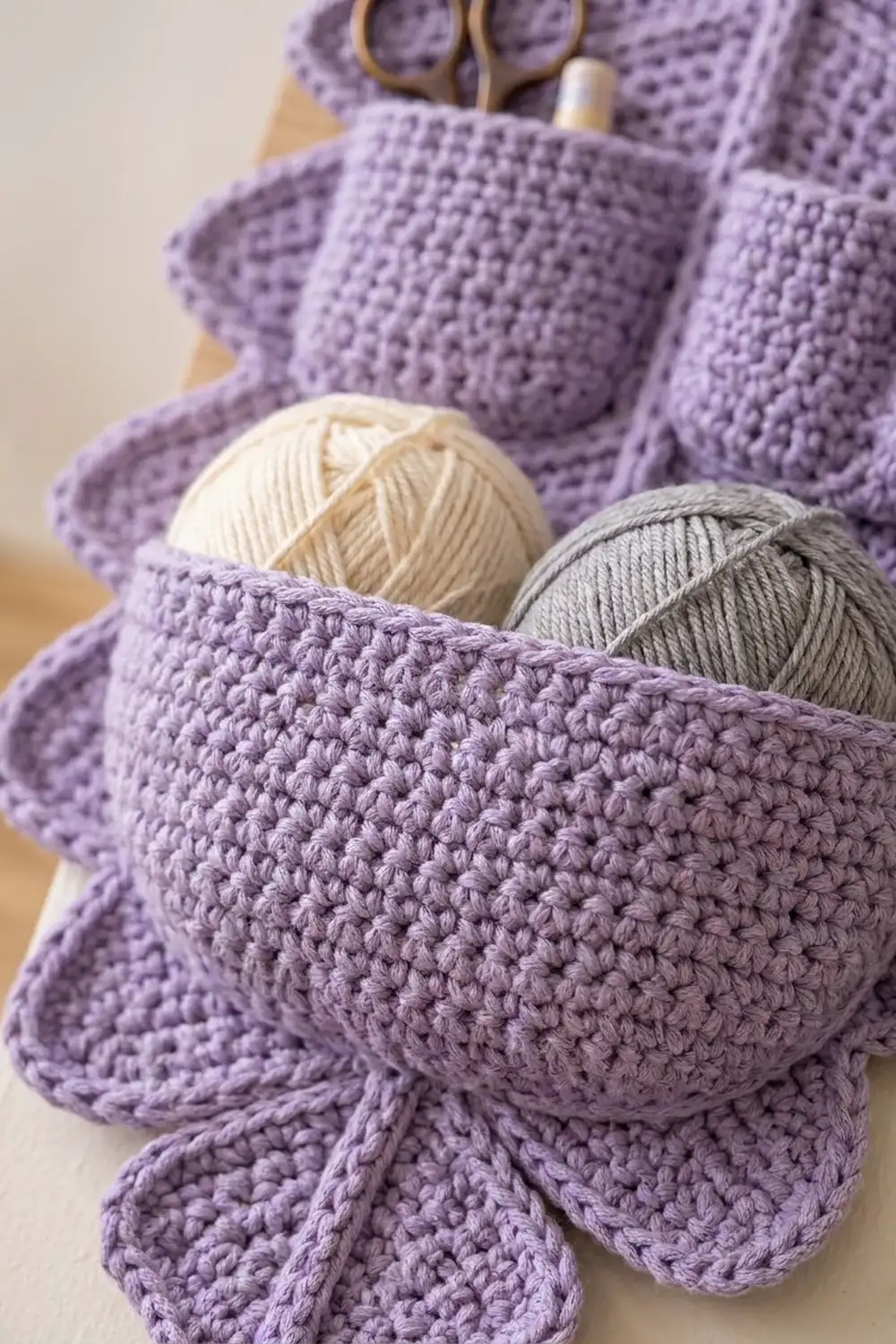
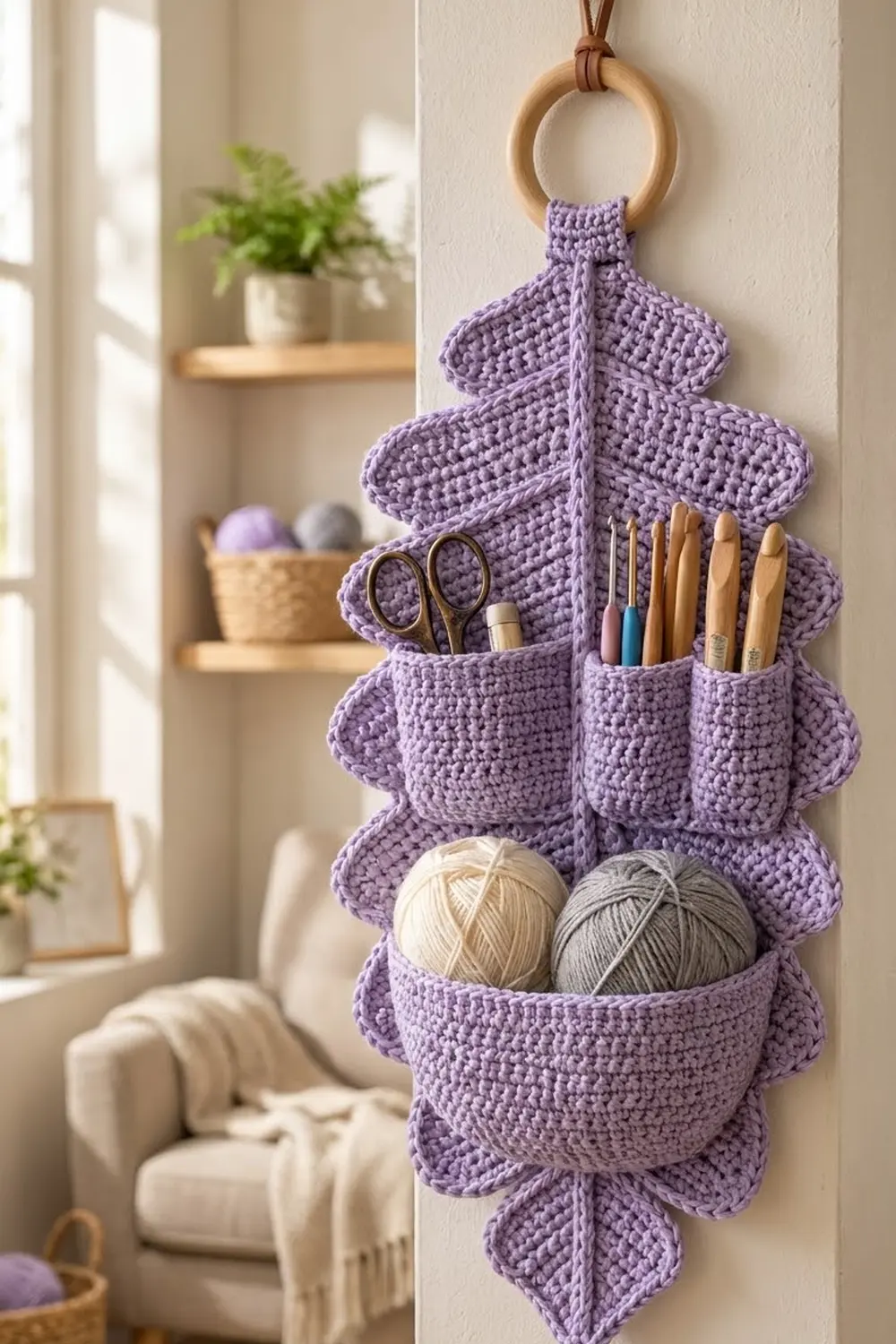
This lavender leaf wall organizer turns a stack of simple crochet ovals into useful wall decor. Five rounded lobes run down each side of a central spine. A pointed tip leaf finishes the bottom, and a raised rope vein runs down the middle. Two flat pockets hold scissors and hooks, and a deep rounded basket holds a couple of yarn balls.
The whole piece uses one soft lavender cotton. The fabric is plain single crochet, and every outer edge gets a reverse single crochet finish for a twisted, rope-like outline that matches the vein.
This pattern uses US crochet terms. The finished organizer is about 11 in (27.9 cm) wide at the widest lobes and about 25.5 in (64.8 cm) tall, measured from the top of the hanging loop to the leaf tip.
Construction is modular. You crochet a long spine strip, ten side leaflets in two sizes, one pointed tip leaf, two flat pockets and one basket. Each piece gets a reverse single crochet edge, and then everything is sewn to the spine. The top of the spine folds over a wooden ring to form the hanging tab.
Finished Size and Construction
- Finished size: about 11 in (27.9 cm) wide x 25.5 in (64.8 cm) tall
- Skill level: Intermediate
- Terminology: US crochet terms
- Yarn weight: worsted (#4) cotton
- Hook: 5.0 mm (H-8)
- Number of pieces: 15 (1 spine, 6 Large leaflets, 4 Small leaflets, 1 Tip Leaf, 2 Small Pockets, 1 Basket)
- Layout: 5 leaflets per side along the spine, the Tip Leaf at the bottom, and the pockets and basket on the front
- Spine: 2 in (5.1 cm) wide, with an 18 in (45.7 cm) leaf body plus a 4 in (10.2 cm) tab section
- Large leaflet: 6.5 x 2.5 in (16.5 x 6.4 cm) after border
- Small leaflet: 5.4 x 2.5 in (13.7 x 6.4 cm) after border
- Size before border: Large leaflet 6.25 x 2.25 in (15.9 x 5.7 cm)
- Border depth: about 0.125 in (0.3 cm) per edge
Materials
Choose a smooth, firm worsted-weight cotton or cotton blend. Cotton holds the lobe shapes and keeps the pockets from sagging when they’re full. Skip fuzzy or very stretchy yarns.
- Lavender: 200 g, about 340 m (372 yd)
This amount includes a margin of about 15% for the gauge swatch, sewing tails and the vein, which is worked with doubled yarn.
Tools
- 5.0 mm (H-8) crochet hook
- Yarn needle
- 6–8 locking stitch markers
- Rust-proof pins
- Wooden ring, 3 in (7.6 cm) diameter
- Optional: leather strap and wall hook
- Blocking mat and spray bottle
- Measuring tape
Abbreviations (US Terms)
- ch – chain
- sl st – slip stitch
- sc – single crochet
- BLO – back loop only
- rev sc – reverse single crochet
- st(s) – stitch(es)
- sp – space
- rnd(s) – round(s)
Reverse single crochet (rev sc): Work from left to right (if you’re right-handed). Insert the hook into the next stitch to the right, yarn over and pull up a loop. Yarn over again and draw through both loops. This makes the twisted rope edge.
Surface slip stitch: Hold the working yarn behind the fabric. Insert the hook from front to back through the fabric, pull up a loop, and draw it through the loop on your hook.
Gauge and Checkpoints
Gauge: 14 sc and 16 rows = 4 in (10.2 cm) in sc worked in rows.
Make one Large leaflet before you start anything else. It tests your gauge in rounds and shows you how the oval ends curve.
Large leaflet checkpoints:
- After Rnd 1: about 4.5 in (11.4 cm) long x 0.6 in (1.5 cm) wide
- After Rnd 4: 6.25 x 2.25 in (15.9 x 5.7 cm)
- After border: 6.5 x 2.5 in (16.5 x 6.4 cm)
Spine checkpoint: 20 rows = 5 in (12.7 cm), and the width is 2 in (5.1 cm).
If your leaflet is too big, go down one hook size. If it’s too small, go up one size. If the ends cup, your increases are too tight, so loosen up on them. If the ends ruffle, recount your increases.
The Oval Method
The leaflets, Tip Leaf, pocket bases and basket base all use the same oval, worked around a foundation chain. The only thing that changes between sizes is S, the number of side stitches.
- Large leaflet and Tip Leaf: S = 12 (ch 15)
- Small leaflet: S = 8 (ch 11)
- Small Pocket: S = 10 (ch 13)
- Basket: S = 20 (ch 23)
Join every round with a sl st to the first sc. The ch 1 at the start of a round doesn’t count as a stitch.
Foundation: Ch S + 3.
Rnd 1: Sc in 2nd ch from hook, sc in next S ch, 3 sc in last ch. Working along the opposite side of the chain, sc in next S ch, 2 sc in last ch (the same ch as the first sc). Join. (2S + 6 sts)
Rnd 2: Ch 1, 2 sc in first st, sc in next S sts, 2 sc in each of next 3 sts, sc in next S sts, 2 sc in each of next 2 sts. Join. (2S + 12 sts)
Rnd 3: Ch 1, sc in first st, 2 sc in next st, sc in next S sts, [sc in next st, 2 sc in next st] 3 times, sc in next S sts, [sc in next st, 2 sc in next st] 2 times. Join. (2S + 18 sts)
Rnd 4: Ch 1, sc in first 2 sts, 2 sc in next st, sc in next S sts, [sc in next 2 sts, 2 sc in next st] 3 times, sc in next S sts, [sc in next 2 sts, 2 sc in next st] 2 times. Join. (2S + 24 sts)
Each round adds 6 stitches, 3 at each end. That keeps the sides straight and turns the ends into smooth half-circles. The end where you started is End A, and the end with the first 3-sc group is End B.
| Piece | S | Rnd 1 | Rnd 2 | Rnd 3 | Rnd 4 |
|---|---|---|---|---|---|
| Small leaflet | 8 | 22 | 28 | 34 | 40 |
| Large leaflet | 12 | 30 | 36 | 42 | 48 |
| Small Pocket | 10 | 26 | – | – | – |
| Basket | 20 | 46 | 52 | 58 | 64 |
Spine and Hanging Tab
Row 1: Ch 8, sc in 2nd ch from hook and in each ch across. (7 sts)
Rows 2–88: Ch 1, turn, sc in each st across. (7 sts)
Fasten off and place a marker at the end of Row 72. Rows 1–72 form the 18 in (45.7 cm) leaf body. Rows 73–88 form the 4 in (10.2 cm) tab section.
Center vein: Hold 2 strands of lavender together. Work a surface slip stitch through the center of the 4th stitch of every row, from Row 72 down to Row 1. (72 surface sl sts) Fasten off. The doubled yarn gives a bold, braided ridge.
Leaflets
Large leaflet (make 6): Work Rnds 1–4 of the Oval Method with S = 12. (48 sts) Fasten off, leaving a 12 in (30.5 cm) tail.
Small leaflet (make 4): Work Rnds 1–4 with S = 8. (40 sts) Fasten off, leaving a 12 in (30.5 cm) tail.
Tip Leaf
Rnds 1–3: Work as for the Large leaflet. (42 sts)
Rnd 4: Ch 1, sc in first 2 sts, 2 sc in next st, sc in next 12 sts, sc in next 2 sts, 2 sc in next st, sc in next 2 sts, (sc, ch 2, sc) in next st, sc in next 2 sts, 2 sc in next st, sc in next 12 sts, [sc in next 2 sts, 2 sc in next st] 2 times. Join. (48 sts plus one ch-2 sp at End B)
The (sc, ch 2, sc) takes the place of the middle increase at End B. The stitch count stays the same, but that end now comes to a point.
Vein: Hold 2 strands together and work surface sl st along the foundation chain line, from End A to End B. (14 surface sl sts) Fasten off.
Small Pocket
Make 2.
Rnd 1: Work Rnd 1 of the Oval Method with S = 10. (26 sts)
Rnds 2–13: Ch 1, sc in each st around. Join. (26 sts)
Fasten off. Flatten the pocket so the two long sides of Rnd 1 become the front and back layers. Before the border, it measures 3.7 in (9.4 cm) wide x 3.25 in (8.3 cm) tall.
Basket
Rnds 1–4: Work the Oval Method with S = 20. (64 sts) This is the base, about 8.3 x 2.1 in (21.1 x 5.3 cm).
Rnd 5: Ch 1, sc in BLO of each st around. Join. (64 sts) The unworked front loops make a crisp fold between the base and the wall.
Rnds 6–20: Ch 1, sc in each st around. Join. (64 sts)
Fasten off. The wall is 4 in (10.2 cm) tall, and the basket is 9.1 in (23.1 cm) wide when flattened.
Make All Pieces
| Piece | Quantity | Color |
|---|---|---|
| Spine with tab | 1 | Lavender |
| Large leaflet | 6 | Lavender |
| Small leaflet | 4 | Lavender |
| Tip Leaf | 1 | Lavender |
| Small Pocket | 2 | Lavender |
| Basket | 1 | Lavender |
Row numbers in this grid count up from the bottom of the spine. Each leaflet is centered on its listed row.
          [ ring + folded tab, rows 73-88 ]
            |  bare spine, rows 65-72  |
Row 60:   Small  ==  spine  ==  Small
Row 48:   Large  ==  spine  ==  Large
          [Pocket 1, rows 36-50] [Pocket 2]
Row 36:   Large  ==  spine  ==  Large
Row 24:   Large  ==  spine  ==  Large
          [    Basket, rows 8-25     ]
Row 12:   Small  ==  spine  ==  Small
              [ Tip Leaf, point down ]
Border
Border gauge: Rev sc is worked 1 per stitch or row end and adds about 0.125 in (0.3 cm) to each edge. Work all borders before you start joining.
Large leaflets, Rnd 5: Ch 1, rev sc in each st around. Join. (48 rev sc = 48 worked 1-per-stitch + 0 added) That’s 12 per straight side and 12 around each end.
Small leaflets, Rnd 5: Ch 1, rev sc in each st around. Join. (40 rev sc = 40 + 0) That’s 8 per straight side and 12 around each end.
Tip Leaf, Rnd 5: Ch 1, rev sc in each st around, working (rev sc, ch 1, rev sc) in the ch-2 sp. Join. (50 rev sc = 48 worked 1-per-stitch + 2 added in the tip sp)
Small Pockets, Rnd 14: Ch 1, rev sc in each st around. Join. (26 rev sc = 26 + 0) That’s 10 across each layer and 3 at each fold.
Basket, Rnd 21: Ch 1, rev sc in each st around. Join. (64 rev sc = 64 + 0) That’s 20 per long side and 12 around each curved end.
Spine edging: Join at Row 1 on the right edge and work 1 rev sc in each row end up to Row 72. (72 rev sc) Fasten off, then repeat on the left edge. (72 rev sc) Don’t edge the tab or the bottom edge. The spine is now 2.25 in (5.7 cm) wide.
Why the math works: Every edging goes one-to-one into existing stitches or row ends, so no edge gains length or ruffles. Rev sc is compact enough to lie flat at 1 stitch per row end along the spine’s 16 rows per 4 in (10.2 cm). The only added stitches are the 2 at the Tip Leaf point, which sharpen the point without changing the sides.
Joining
Method: Whipstitch with matching lavender, using a yarn needle and the sewing tails.
Leaflets: Tuck End A of each leaflet 0.75 in (1.9 cm) behind the spine edging, centered on its listed row. Angle the outer end upward until the widest pair measures 11 in (27.9 cm) from tip to tip, so each leaflet reaches about 4.4 in (11.2 cm) past the spine. Working from the back, whipstitch each spine row end to the leaflet stitch directly behind it. Then tack each leaflet to its neighbor where they overlap.
Tip Leaf: Point it down and tuck End A 1 in (2.5 cm) behind Rows 1–4. Whipstitch across the 7 sts of Row 1 and up both sides of Rows 1–4.
Pockets: Place each Small Pocket with its back layer flat, its inner edge against the spine edging and its bottom at Row 36. Sew the back layer down along both side folds and across the bottom, and leave the rim open. On Pocket 2, backstitch two vertical lines through both layers and the panel, after the 4th and 9th front stitches. This makes three hook slots that are 4, 5 and 4 stitches wide.
Basket: Center the basket with the bottom of the wall at Row 8. Sew the back 32 rim stitches and both side lines to the panel, then tack down the back edge of the base.
Tab: Slip the ring over Rows 73–88. Fold the tab to the back and sew Row 88 to the back of Row 73, matching all 7 stitches.
Tension: Keep your sewing snug but not tight, because puckers show on the lobes. Work one sewing stitch per crochet stitch or row end.
Size checkpoint: The organizer should measure 11 in (27.9 cm) across the widest lobes. It should be 25.5 in (64.8 cm) long: a 2 in (5.1 cm) tab loop + the 18 in (45.7 cm) body + 5.5 in (14.0 cm) of Tip Leaf.
Final Blocking
- Lay the organizer face up on a blocking mat with the pockets empty.
- Mist it until it’s damp, not soaked.
- Pin the spine straight at 18 in (45.7 cm) from Row 1 to Row 72.
- Pin each leaflet at its outer tip so both sides match.
- Pin the Tip Leaf point and check the total length.
- Stuff the basket loosely with a towel so it dries rounded.
- Let it dry completely before you unpin it.
Final Quality-Control Checklist
- The spine is straight and 2.25 in (5.7 cm) wide with edging
- The center vein is continuous and even
- Each leaflet is within 0.25 in (0.6 cm) of its target size
- Leaflet pairs mirror each other in height and angle
- The Tip Leaf point is sharp and centered
- The pocket and basket rims are open and level
- Pocket 2 has three slots
- The tab is sewn securely around the ring
- All tails are woven in on the back
Troubleshooting
Oval ends cup: Your increases are too tight. Loosen your tension or go up a hook size.
Oval ends ruffle: Recount Rnds 2–4. Each round should add exactly 6 sts.
Rev sc edge flares: Work it more firmly, or use a hook one size smaller.
Basket sags: Sew down more of the back wall, or reblock it with a towel inside.
Spine stretches when hung: Add a second line of surface sl st beside the vein to stiffen it.
Care
Spot clean with mild soap and cool water. If it needs a full wash, hand wash it, roll it in a towel, and dry it flat with the basket shaped.
Final Notes
Here is how the measurements build on each other. A gauge of 14 stitches and 16 rows gives a 2 in (5.1 cm) spine and an 18 in (45.7 cm) body. The Oval Method gives Large leaflets that are 6.25 in (15.9 cm) before the border and 6.5 in (16.5 cm) after. Ten leaflets on the spine set the 11 in (27.9 cm) width, and the tab and Tip Leaf bring the length to 25.5 in (64.8 cm).
Check one leaflet first, trust the counts, and the rest of the organizer will come together easily.
Happy crocheting!