

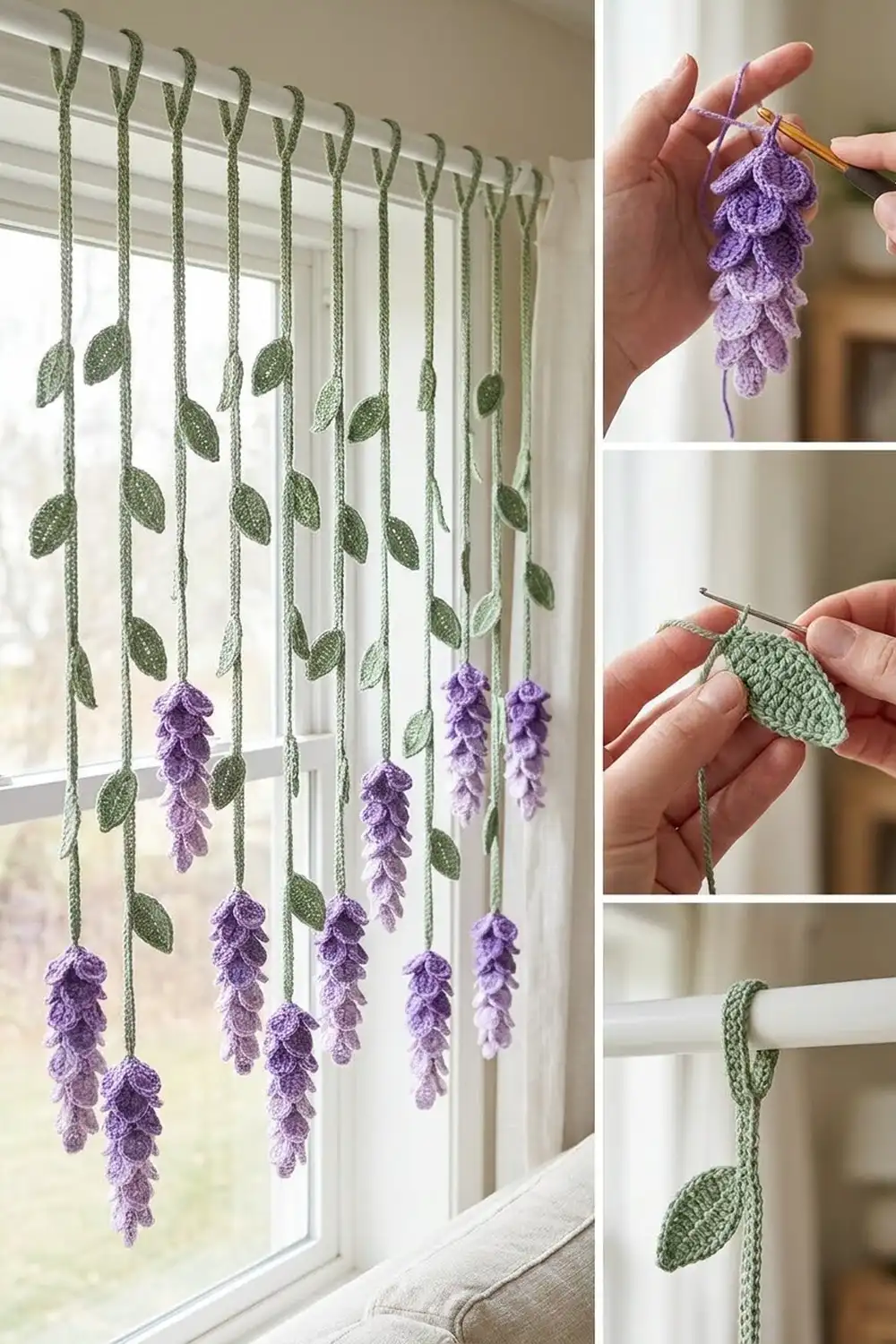
This hanging curtain is made of ten separate vertical strands. Each strand is a twisted green cord with oval leaves branching off on short stems and five drooping wisteria clusters spaced down its length. Each strand ends in a loop at the top that slips over a curtain rod.
The palette is three colors: sage green for the cords, leaves and cluster stems, medium purple for the upper petals of each cluster, and pale lilac for the smaller petals at the tip. The two purples give every cluster a soft shaded look, darker at the top and lighter at the tip, like real wisteria.
This pattern uses US crochet terms. A finished strand hangs 48 in (121.9 cm) below its rod loop, and the lowest cluster drops about 3 in (7.6 cm) further. Ten strands spaced 4 in (10.2 cm) apart fill a span of 36 in (91.4 cm), which suits a window 36–40 in (91.4–101.6 cm) wide.
To build it, you crochet the cords, the leaves and the petal strips separately. Each petal strip is wrapped in a spiral around a short green core to form a cluster. Then you sew the leaves and clusters onto the cord at set stitch positions.
Finished Size and Construction
- Finished size: 10 strands spread over 36 in (91.4 cm); drop of about 54 in (137.2 cm) from the top of the rod to the tip of the lowest cluster
- Skill level: Easy-intermediate (simple stitches, a lot of repetition, careful finishing)
- Terminology: US
- Yarn weight: DK / light worsted (#3) cotton or cotton blend
- Hook: 4.0 mm (G-6)
- Number of pieces: 10 strands; each strand = 1 cord + 10 leaves + 5 clusters (each cluster = 1 core + 1 petal strip)
- Layout: 10 strands in a single row on the rod, loops 4 in (10.2 cm) apart
- Piece sizes: cord 48 in (121.9 cm) hanging plus a 3 in (7.6 cm) loop; leaf 2 × 1 in (5.1 × 2.5 cm) plus a 1 in (2.5 cm) stem; cluster body 3.5 × 2 in (8.9 × 5.1 cm) plus a 1 in (2.5 cm) stem
- Size before border: 48 in (121.9 cm) of hanging cord per strand, before the loop is closed
- Border depth: this curtain has no fabric border. The row of rod loops is the finishing edge and drops 3 in (7.6 cm)
Materials
Pick a smooth cotton or cotton blend so petal edges stay crisp and the strands hang straight. Avoid fuzzy acrylic, because it hides the petal shapes. The amounts below assume about 115 m per 50 g.
- Sage green: 200 g / 460 m (cords, leaves, cluster cores)
- Medium purple: 100 g / 230 m (large upper petals)
- Pale lilac: 150 g / 345 m (small and medium tip petals)
These quantities include a margin of about 15–20% for swatching and sewing tails.
Tools
- 4.0 mm (G-6) crochet hook
- Tapestry needle
- 6–8 locking stitch markers
- Measuring tape
- Pins and a padded surface for blocking
- Spray bottle
- Curtain rod, up to 1.5 in (3.8 cm) in diameter
Abbreviations (US Terms)
- ch – chain
- sl st – slip stitch
- sc – single crochet
- hdc – half double crochet
- dc – double crochet
- st(s) – stitch(es)
- sp – space
- BB – back bump of the chain
Special stitch – Back-bump slip stitch cord: Work a sl st into the back bump of each chain. This gives a firm, slightly twisted cord that does not stretch much when it carries weight.
Petal sizes (each one is worked into a single ch, then followed by a sl st in the next ch, so it uses 2 ch):
- Small petal: (sl st, ch 2, 2 dc, ch 2, sl st) all in the next ch; sl st in the next ch.
- Medium petal: (sl st, ch 3, 3 dc, ch 3, sl st) all in the next ch; sl st in the next ch.
- Large petal: (sl st, ch 3, 4 dc, ch 3, sl st) all in the next ch; sl st in the next ch.
Gauge and Checkpoints
Gauge: 5 ch = 1 in (2.5 cm), and 5 back-bump sl sts = 1 in (2.5 cm) along the cord.
Before starting all ten strands, make a test set: 50 sts of cord, 1 leaf and 1 complete cluster. Check these sizes:
- Cord test: 50 sl sts = 10 in (25.4 cm).
- Leaf: 2 in (5.1 cm) long and 1 in (2.5 cm) at its widest point, not counting the stem.
- Petal strip: the foundation measures 8 in (20.3 cm) before you wrap it.
- Cluster: 3.5 in (8.9 cm) long and 2 in (5.1 cm) wide.
Too big: go down to a 3.5 mm hook. Too small: go up to a 4.5 mm hook. Cord length matters most, because 240 sts must equal 48 in (121.9 cm). If your cord gauge is still off by more than 0.25 in (0.6 cm) per 10 in (25.4 cm), change the hook again.
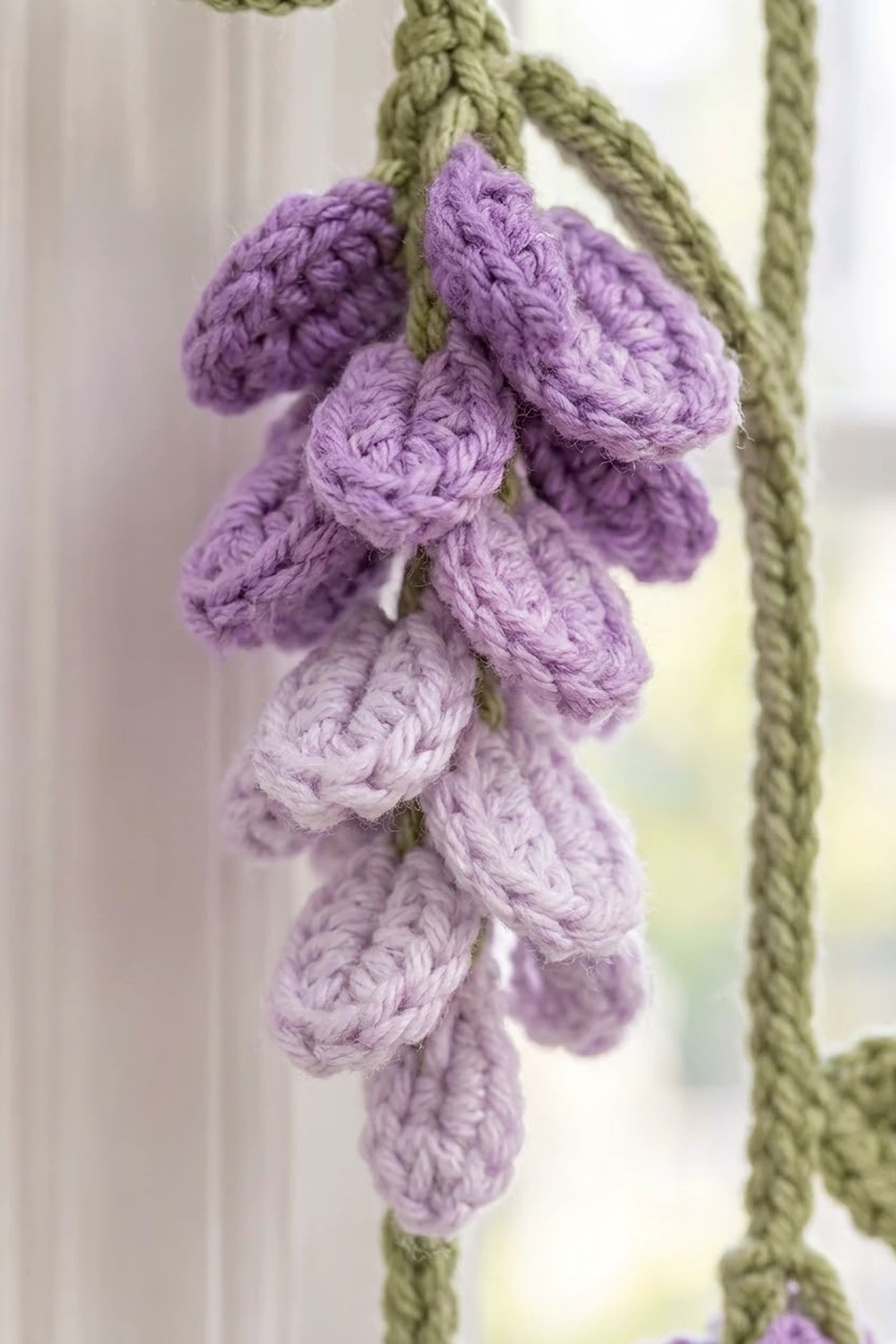
Cord (make 10)
With green, ch 271.
Row 1: Sl st in the BB of the 2nd ch from hook and in the BB of each ch across. (270 sl st)
Checkpoint: the cord measures 54 in (137.2 cm) laid flat without stretching.
Form the rod loop: Fold the last 30 sts (sts 241–270) back on themselves. Sl st into st 240 to close the loop, then fasten off. The loop is 30 sts around, which is 6 in (15.2 cm), and it hangs 3 in (7.6 cm) deep.
Stitches 1–240 are the hanging cord. St 1 is the bottom tip and st 240 is right under the loop.
Leaf (make 100)
With green, ch 11.
Round 1, first side: Sc in the 2nd ch from hook, hdc in the next ch, dc in the next 5 ch, hdc in the next ch, sc in the next ch. (9 sts)
Tip: (Sc, ch 2, sc) in the last ch. (2 sc + ch-2 sp)
Second side: Rotate the piece and work into the free loops of the foundation: sc in the next ch, hdc in the next ch, dc in the next 5 ch, hdc in the next ch, sc in the next ch. (9 sts)
Sl st into the first sc. That gives 20 sts + 1 ch-2 sp in total.
The foundation chain stays visible down the middle of the leaf and forms the vein. The short dc at the center and the sc at both ends make the pointed oval shape.
Stem: Ch 5 (1 in / 2.5 cm), then fasten off and leave a 10 in (25.4 cm) tail for sewing.
Cluster Core (make 50)
With green, ch 21.
Row 1: Sl st in the BB of the 2nd ch from hook and each ch across. (20 sl st = 4 in / 10.2 cm)
Fasten off and leave a 10 in (25.4 cm) tail at the top end. Put a marker in st 15, counting from the bottom end. Stitches 1–15 (3 in / 7.6 cm) will be covered by petals. Stitches 16–20 (1 in / 2.5 cm) stay bare and form the visible stem.
Petal Strip (make 50)
The strip is worked from the tip of the cluster to the top.
With lilac, ch 41. The first ch from the hook is skipped, which leaves 40 working ch.
Petals 1–6 (lilac): Starting in the 2nd ch from the hook, work 6 small petals. (Ch 1–12 used, 6 petals)
Petals 7–12 (lilac): Work 6 medium petals. (Ch 13–24 used, 12 petals total)
On the final sl st of petal 12, change to purple.
Petals 13–20 (purple): Work 8 large petals. (Ch 25–40 used, 20 petals total)
Check: 20 petals × 2 ch = 40 ch, so the whole foundation is used up.
Fasten off and leave an 18 in (45.7 cm) purple tail. Weave in the lilac starting tail.
Assembling a Cluster
- Hold the core with the marked end pointing up and the bare stem at the top.
- Put petal 1 at the bottom end of the core (st 1), with the petals pointing down and out.
- Wrap the strip upward around the core in a helix, about 4 turns, rising roughly 0.75 in (1.9 cm) per turn.
- Using the purple tail, sew the foundation edge of the strip to the core every 0.5 in (1.3 cm).
- Finish with petal 20 at the marker (st 15).
The small lilac petals now sit at the tip and the large purple petals at the top. This gives the tapered, two-tone shape. The cluster body should measure 3.5 × 2 in (8.9 × 5.1 cm).
Make All Pieces
Totals for the curtain:
- Green: 10 cords, 100 leaves, 50 cores
- Lilac + purple: 50 petal strips (each strip uses both colors)
Placement on each strand (stitch numbers count up from the bottom tip, st 1):
| Section | Leaf (left) | Leaf (right) | Cluster stem sewn over |
|---|---|---|---|
| 1 (top) | st 217 | st 205 | sts 193–197 |
| 2 | st 169 | st 157 | sts 145–149 |
| 3 | st 121 | st 109 | sts 97–101 |
| 4 | st 73 | st 61 | sts 49–53 |
| 5 (bottom) | st 25 | st 13 | sts 1–5 |
Each section is 48 sts, or 9.6 in (24.4 cm). Strand A follows the table as written. Strand B is mirrored: put the “left” leaf on the right side and the “right” leaf on the left.
Rod layout (10 strands):
Rod:  A  B  A  B  A  B  A  B  A  B
      |  |  |  |  |  |  |  |  |  |
      4 in (10.2 cm) between loops
Joining
In this design, joining means attaching leaves and clusters to each cord. The strands themselves are never joined to each other.
Method: Sew each piece on with its own tail and a tapestry needle, using small whipstitches through the center of the cord stitches.
Stitch-to-stitch logic:
- Leaves: Sew the last 2 ch of the leaf stem to the single cord st named in the table, so the leaf branches upward and outward.
- Clusters: Line up the 5 bare stem sts (core sts 16–20) one-to-one with the 5 cord sts in the table. The top of the core goes at the higher number. For example, core st 20 meets cord st 197 and core st 16 meets cord st 193.
- The bottom cluster sits over cord sts 1–5, so the cord ends inside its stem.
Tension: Pull each whipstitch snug enough to close any gap, but not so tight that the cord bunches. Gather or stretch along the cord and it will hang crooked.
Size checkpoint: Lay a finished strand flat. It should measure 48 in (121.9 cm) from the base of the loop to cord st 1, with the lowest cluster tip about 3 in (7.6 cm) below that.
Border (Top Hanging Loops)
This curtain has no border rounds. The only finishing edge is the row of rod loops, so the math lives there.
Border gauge: 5 sl st = 1 in (2.5 cm), the same as the cord.
- Each loop: 30 sts = 6 in (15.2 cm) around. Closed into st 240, it hangs 3 in (7.6 cm).
- Rod fit: a rod 1.5 in (3.8 cm) across has a circumference of about 4.7 in (11.9 cm). That leaves about 1.3 in (3.3 cm) of ease, so the loops slide freely.
- Spacing: 10 loops have 9 gaps. At 4 in (10.2 cm) per gap, that is 9 × 4 = 36 in (91.4 cm) from the first strand to the last.
Why the math works: each strand has 270 sts. Of these, 30 form the loop and 240 hang below it. At 5 sts per inch, the 240 sts give 48 in (121.9 cm). Five 48-st sections fill the hanging length exactly (5 × 48 = 240), which is why the clusters land evenly 9.6 in (24.4 cm) apart.
Final Blocking
- Lightly mist each cluster and leaf. Don’t soak them, because wet cotton cords stretch.
- Pin each leaf flat on a padded surface and pull the tip into a point.
- Fluff the petals downward with your fingers so they cup and overlap.
- Hang each strand from a hanger and let it dry straight, with no weight added.
- Once dry, measure the cord again. If any strand is more than 0.5 in (1.3 cm) longer than the others, shorten its loop by closing it 1–2 sts lower.
Final Quality-Control Checklist
- [ ] All 10 cords measure 48 in (121.9 cm) below the loop.
- [ ] Every loop is 30 sts and hangs 3 in (7.6 cm).
- [ ] Each strand has 10 leaves and 5 clusters in the table positions.
- [ ] Every cluster has 20 petals: 12 lilac at the tip and 8 purple at the top.
- [ ] Strands alternate A and B.
- [ ] All tails are woven in on the back of the cord or inside the cluster.
Troubleshooting
- Cord curls or twists heavily: You worked into the top loops instead of the back bumps. Rework it in the BB.
- Cord too long after hanging: Your chains were loose. Remake the cord with a hook one size smaller so 240 sts equal 48 in (121.9 cm).
- Cluster looks flat, not conical: You wrapped the strip too far apart. Rewrap at 0.75 in (1.9 cm) per turn.
- Petals point upward: The strip was wrapped upside down. Petal 1 must sit at the bottom.
- Leaf cups or ruffles: Your dc are too tall. Try a firmer tension or a hdc in place of the outer 2 dc.
- Strands tangle: Space the loops evenly at 4 in (10.2 cm) and keep them sliding on the rod.
Care
Dust gently with a cool hairdryer on its lowest setting, or hand wash in cool water. Then lay flat and reshape petals and leaves before hanging to dry.
Final Notes
The measurement chain is simple. Gauge is 5 sts = 1 in (2.5 cm). Each cord has 270 sts, which gives 240 hanging sts (48 in / 121.9 cm) plus a 30-st loop (3 in / 7.6 cm drop). Five sections of 48 sts each hold 2 leaves and 1 cluster per section. Each cluster is a 40-ch strip with 20 petals wrapped around a 15-st core. Ten strands at 4 in (10.2 cm) apart fill 36 in (91.4 cm).
Check your test set first and the rest is calm, repetitive work. Happy crocheting!