

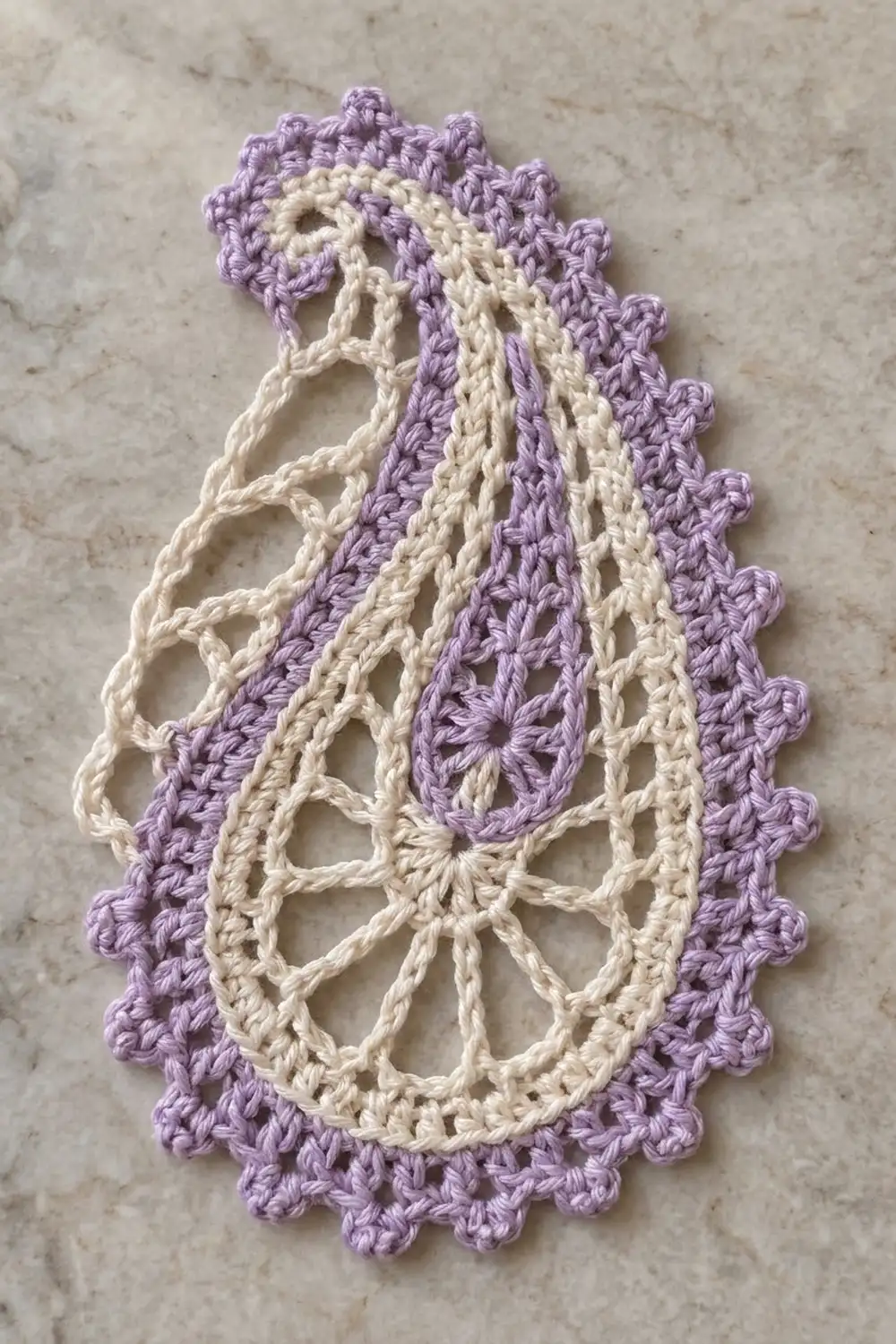
This paisley motif is a small piece of lace with a lot going on. A cream wheel of radiating spokes fills the rounded base. A solid lilac teardrop sits above the wheel inside a cream outline. A curled lilac tail sweeps up and to the left at the tip.
The palette is two colors: soft cream and lilac. The cream gives you the open lace: the wheel, the outline, and a row of chain arches down the inner curve. The lilac gives you weight: the inner teardrop, a solid band down the outer curve, the tail, and a picot border all the way around. Laid flat, it reads as a vintage, Irish-lace-style ornament.
The pattern uses US crochet terms. The finished motif measures 4 in wide x 6 in tall (10.2 cm x 15.2 cm) in fingering-weight cotton after blocking.
You make it in four stages:
- Crochet a small lilac teardrop.
- Make a cream wheel with a chain arch that frames the teardrop.
- Work a split round, lilac on the outer curve and cream arches on the inner curve, then add a short lilac tail that you curl and tack down.
- Finish the edge with a lilac picot border.
It is one motif, worked as one piece, with the small teardrop sewn into place.
Finished Size and Construction
- Finished size: 4 in x 6 in (10.2 cm x 15.2 cm)
- Skill level: Intermediate
- Terminology: US crochet terms
- Yarn weight: Fingering (#1 super fine) mercerized cotton
- Hook: 2.5 mm
- Number of pieces: 1 motif (the small inner teardrop is sewn into it)
- Layout: Single paisley, point at the top, tail curling to the left
- Piece size before border: 3.5 in x 5.5 in (8.9 cm x 14.0 cm)
- Border depth: 0.25 in (0.6 cm) on every edge
Materials
Use a smooth, mercerized cotton thread in fingering weight. It holds a crisp shape after blocking and shows the spokes and picots clearly. Avoid fuzzy or very soft cotton, because the open wheel will lose its definition.
- Cream: 6 g / 24 m (26 yd)
- Lilac: 5 g / 20 m (22 yd)
Tools:
- 2.5 mm crochet hook
- Tapestry needle
- Scissors
- 4 stitch markers
- Rust-proof pins and a blocking board or foam mat
- Spray bottle with water
These quantities include a margin of about 20 percent for gauge testing and weaving in ends.
Abbreviations (US Terms)
- ch – chain
- sl st – slip stitch
- sc – single crochet
- hdc – half double crochet
- dc – double crochet
- dtr – double treble crochet (yo 3 times, insert hook, pull up a loop, [yo, pull through 2 loops] 4 times)
- sk – skip
- st(s) – stitch(es)
- sp – space
- RS – right side
Special stitch – Picot: ch 3, sl st in the 3rd ch from the hook.
Gauge and Checkpoints
Gauge: 24 sc = 4 in (10.2 cm) with the 2.5 mm hook.
Make one full wheel (Rounds 1–3) before going further. That is your real gauge test. Check these points as you go, measured flat and lightly pressed:
- Inner teardrop: 1.25 in (3.2 cm) tall
- Wheel after Round 3: 2.25 in (5.7 cm) across
- After Round 6: 2.75 in wide x 4.5 in tall (7.0 cm x 11.4 cm)
- After Round 7: 3.5 in x 5.5 in (8.9 cm x 14.0 cm)
- After the border and blocking: 4 in x 6 in (10.2 cm x 15.2 cm)
If the wheel is larger than 2.25 in (5.7 cm), change to a 2.25 mm hook. If it is smaller, change to a 2.75 mm hook. Check the dtr spokes too. They should lie flat and straight. If they ripple, your dtr are too tall for the 12 sc around the ring, so go down a hook size.
Part 1: Inner Teardrop (Lilac)
Round 1: With lilac, ch 4, sl st to the first ch to form a ring. Ch 3 (counts as dc), 11 dc in the ring, sl st to the top of the beginning ch-3. (12 dc)
The small open center of the ring becomes the “eye” of the teardrop.
Round 2: Ch 1, hdc in the same st, 2 sc in each of the next 10 dc, hdc in the last dc, ch 5 for the point, sl st to the first hdc. (2 hdc + 20 sc = 22 sts, plus 1 ch-5 point)
This is a conversion round. All 12 dc get worked: 10 of them take 2 sc each, and the 2 hdc sit on either side of the point. The ch-5 pulls the circle into a teardrop.
Fasten off, leaving a 10 in (25.4 cm) tail for sewing. The teardrop should measure 1.25 in (3.2 cm) from the base to the tip of the point.
Part 2: Wheel and Frame (Cream)
Round 1: With cream, ch 6, sl st to the first ch to form a ring. Ch 1, 12 sc in the ring, sl st to the first sc. (12 sc)
Round 2 (spokes): Ch 5 (counts as dtr), ch 3, dtr in the next sc, ch 3, repeat from * 10 more times, sl st to the top of the beginning ch-5. (12 dtr, 12 ch-3 sps)
Each dtr is one spoke. Pull every spoke straight before moving on.
Round 3 (rim): Sl st in the first ch-3 sp, ch 1, 4 sc in the ch-3 sp, sc in the next dtr, repeat from * 11 more times, sl st to the first sc. (60 sc)
This is a conversion round: 12 sps x 4 sc = 48 sc, plus 12 sc on top of the spokes, for 60 sc. The wheel should measure 2.25 in (5.7 cm) across.
Round 4: Ch 1, sc in each sc around, sl st to the first sc. (60 sc)
This round firms up the rim and gives you a smooth base for the frame.
Place a marker in sc 45 and another in sc 60 of Round 4. The 16 sts from sc 45 to sc 60 are the top of the wheel and will sit under the teardrop. Turn the wheel so these sts face up.
Round 5 (frame arch): Ch 1, sc in each of the first 44 sc (down the left side, across the bottom, and up the right side), ch 30, sk the 16 marked sts, sl st to the first sc. (44 sc, 1 ch-30 arch)
44 sts worked + 16 skipped = 60, so the round accounts for every rim stitch. The ch-30 arch rises over the top of the wheel and forms the upper part of the paisley.
Round 6 (outline): Ch 1, sc in each of the next 44 sc. Now work into the arch chains: sc in each of the next 14 ch, (sc, ch 3, sc) in the next ch, sc in each of the last 15 ch. Sl st to the first sc. (75 sc, plus 1 ch-3 point sp)
Count: 44 + 14 + 2 + 15 = 75 sc. Chains used: 14 + 1 + 15 = 30. The ch-3 sp is the tip of the paisley.
To keep track, number the Round 6 sts in working order: wheel sts W1–W44, then arch sts A1–A31. A15 and A16 are the two sc on either side of the ch-3 point.
Set the teardrop: Place the lilac teardrop in the opening between the arch and the 16 skipped rim sts, with its point toward the ch-3 point. Use the lilac tail to tack it in 4 places:
- The base of the teardrop to the center of the skipped rim sts.
- The ch-5 point to the underside of the ch-3 point.
- The left side to the inner edge of the arch.
- The right side to the inner edge of the arch.
Weave in the end.
Checkpoint: 2.75 in wide x 4.5 in tall (7.0 cm x 11.4 cm).
Part 3: Round 7, Split Round, and Tail
Round 7 has two sections. The lilac band covers 41 sts (W19–W44 plus A1–A15). The cream arches cover 34 sts (A16–A31 plus W1–W18). 41 + 34 = 75, which matches Round 6.
Round 7a (lilac band, outer curve): With RS facing, join lilac in W19 (at the bottom of the wheel). Sc in the same st, hdc in the next st, dc in each of the next 9 sts, [2 dc in the next st, dc in each of the next 3 sts] 5 times, dc in each of the next 8 sts, hdc in the next st, sc in A15. (46 sts)
This is a conversion round: 41 sts worked once + 5 increases = 46. The sc and hdc at each end taper the band, so it fades into the bottom curve and into the point.
Tail (lilac): Do not fasten off. Ch 14. Sc in the 2nd ch from the hook, hdc in each of the next 3 ch, dc in each of the next 9 ch, sl st in the ch-3 point sp. (13 sts)
That puts 1 + 3 + 9 = 13 sts across the 13 chains left after skipping the first ch. The tail gets thicker as it reaches the point. Fasten off.
Round 7b (cream arches, inner curve): With RS facing, join cream in A16. Sc in the same st, ch 5, sk 2 sts, sc in the next st, repeat from * 10 more times, ending in W18. (12 sc, 11 ch-5 loops)
Count: 1 + (11 x 3) = 34 sts. Fasten off. Number the loops 1 to 11, starting from the loop closest to the point.
Curl the tail: Fold the tail to the left and down so it curves around the top of the inner edge. Use cream thread to tack the tail’s sc tip to the center of loop 3. Loops 1 and 2 stay open inside the curl and form the little window at the top of the paisley.
Checkpoint: 3.5 in x 5.5 in (8.9 cm x 14.0 cm).
Part 4: Picot Border (Lilac)
Border gauge: The border adds 0.25 in (0.6 cm) on every edge. Along the band, each group of 2 sc + 1 picot should measure 0.33 in (0.8 cm).
Round 8: With RS facing, join lilac in the first st of Round 7a (above W19).
- Band edge: [Sc in each of the next 2 sts, picot] 23 times. (46 sc, 23 picots)
- Tail edge: Work into the free loops of the tail’s foundation chain, from base to tip. Sc in the first ch, [picot, sc in each of the next 2 ch] 6 times. (13 sc, 6 picots)
- Arch edge: Work in loops 4 through 11: (3 sc, picot, 3 sc) in each loop. (48 sc, 8 picots)
Sl st to the first sc. Fasten off.
Round total: 46 + 13 + 48 = 107 sc, and 23 + 6 + 8 = 37 picots.
Why the math works:
- On the band and the tail you work exactly 1 sc per stitch, so neither edge gains or loses length and the outer curve stays smooth.
- Each 5-ch loop takes 6 sc, a little more than its chain count. That fills the arch so it lies flat instead of cupping.
- A picot every 2 sc on the solid edges, plus one picot per loop on the mesh, keeps the picot spacing about even all the way around.
Final Blocking
- Weave in all ends along stitches of the same color.
- Soak the motif in cool water for 10 minutes, then roll it in a towel to remove the extra water.
- Lay it RS up on the blocking board.
- Pin the outline to 4 in x 6 in (10.2 cm x 15.2 cm), with the point at the top.
- Pin each of the 12 spokes straight from the center ring to the rim.
- Pin open the 8 border arches and both open loops inside the curl.
- Pin out every picot so it stands as a small bead.
- Spray lightly and leave it until it is completely dry, at least 12 hours.
Final Quality-Control Checklist
- Wheel has 12 even, straight spokes and 60 sc on the rim.
- Lilac teardrop is centered above the wheel, point up, with 4 secure tacking points.
- Round 6 has 75 sc and a crisp ch-3 point.
- The lilac band has 46 sts and tapers at both ends.
- There are 11 cream ch-5 loops, and loops 1 and 2 are open inside the curl.
- Tail is curled left and tacked to loop 3.
- Border has 107 sc and 37 picots.
- Finished size is 4 in x 6 in (10.2 cm x 15.2 cm).
Troubleshooting
- Wheel cups: Your dtr are too short or the ch-3 sps are too tight. Loosen the chains or go up a hook size.
- Wheel ruffles: Your dtr are too tall. Go down a hook size or chain more tightly.
- Arch pulls the wheel out of shape: The ch-30 is too tight. Chain the arch again more loosely and keep it at 30 ch so the Round 6 counts stay the same.
- Teardrop puckers the frame: It is tacked too tightly. Release one tacking point and resew with slack.
- Band ripples: Your dc are loose. Rework Round 7a with a 2.25 mm hook so all 46 sts and the border count stay the same.
- Tail won’t curl: Dampen it, pin it into the curve, and let it dry before you tack it.
- Border flares on the arches: Your loops are tight. Rework Round 7b with looser ch-5 loops rather than changing the 6 sc per loop.
Care
Hand wash in cool water with mild soap and lay flat to dry. If the spokes and picots soften, pin them out again while damp.
Final Notes
Each stage has a size to check:
- The teardrop is 1.25 in (3.2 cm).
- The wheel is 2.25 in (5.7 cm) after Round 3.
- The frame is 2.75 in x 4.5 in (7.0 cm x 11.4 cm) after Round 6.
- The motif is 3.5 in x 5.5 in (8.9 cm x 14.0 cm) after Round 7.
- With the 0.25 in (0.6 cm) border, it finishes at 4 in x 6 in (10.2 cm x 15.2 cm).
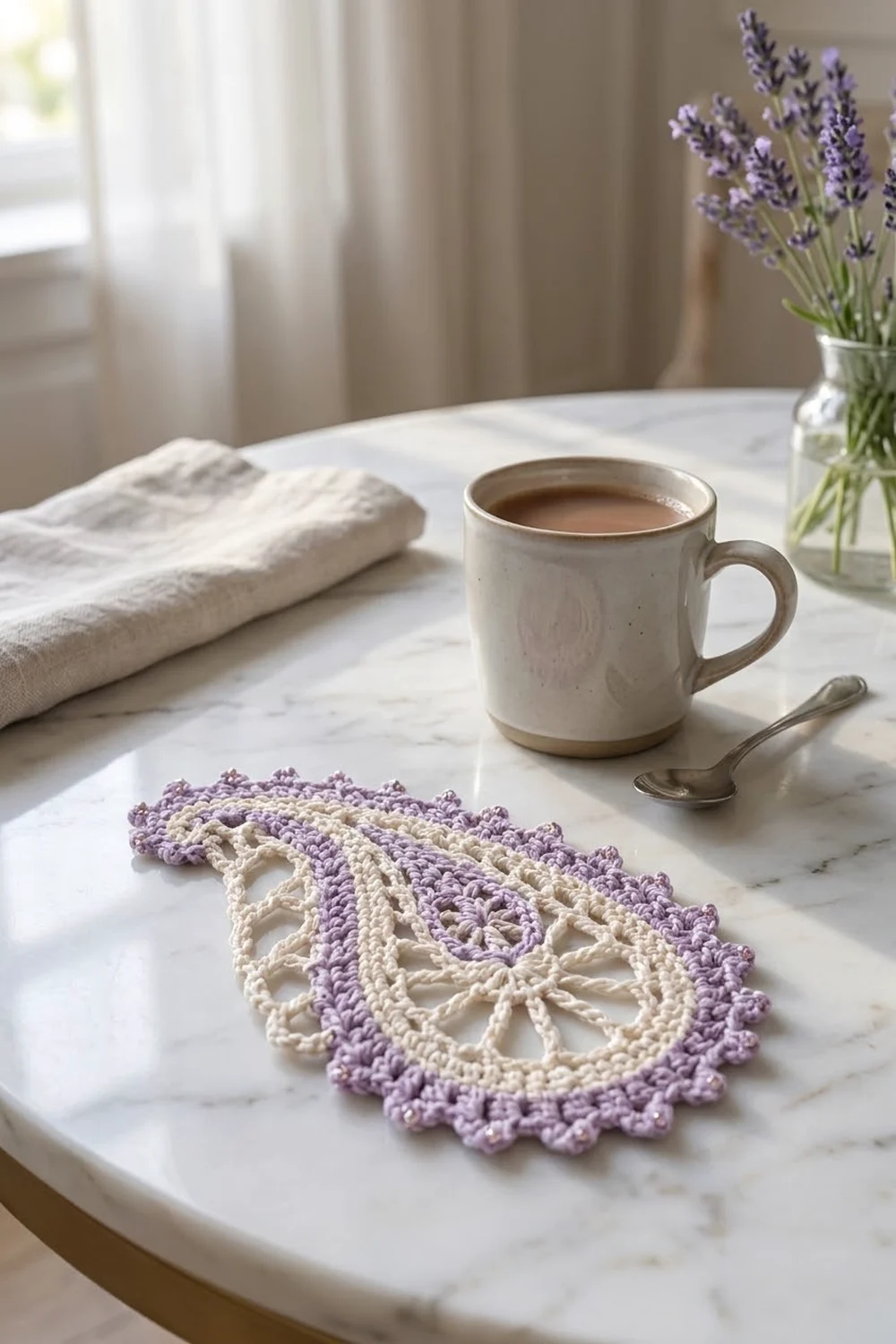
If each checkpoint is correct, the next one will be too. Use the finished motif as an appliqué, a bookmark, or a small doily.
Happy crocheting!