

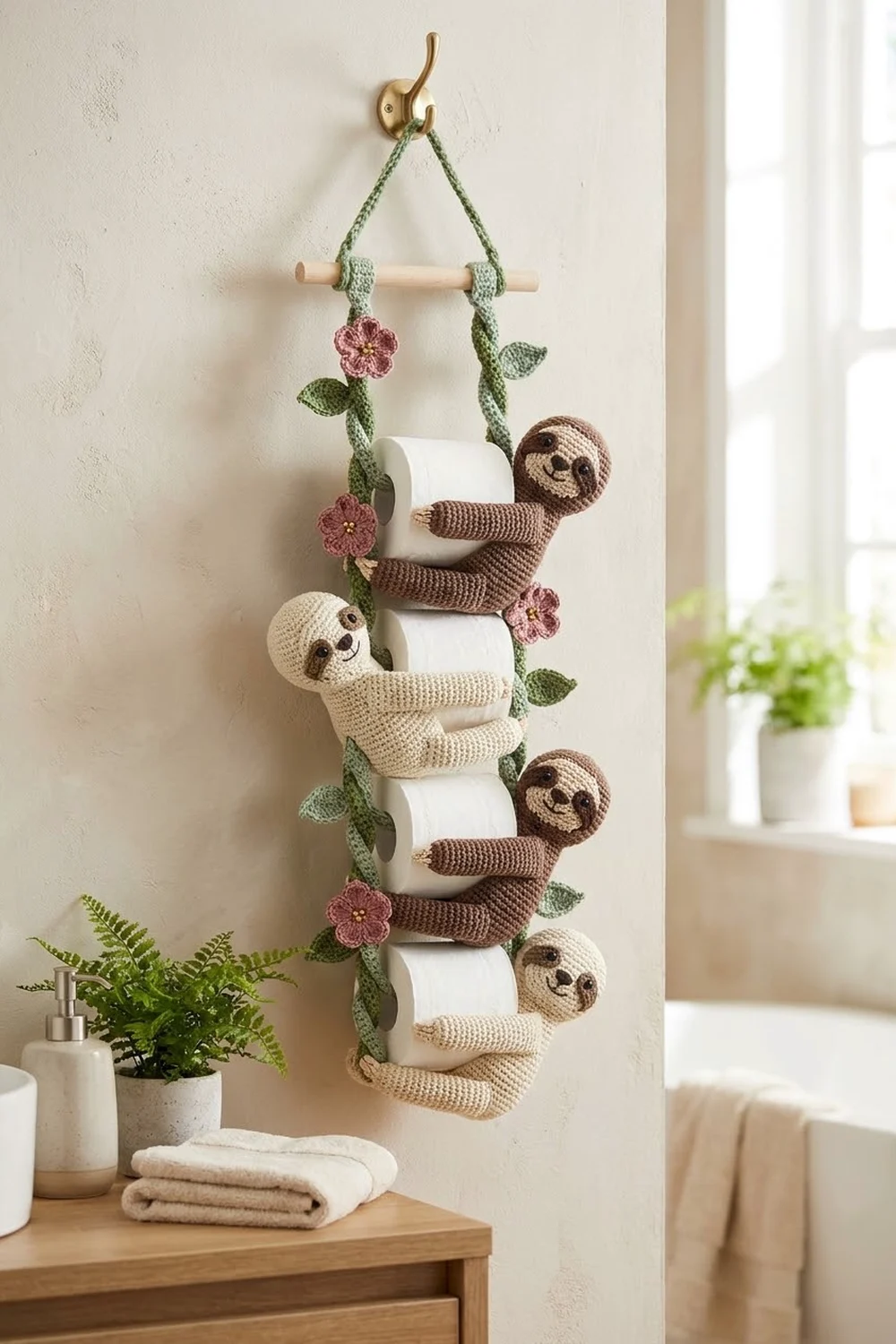
Four sleepy sloths hang along a pair of leafy vines, and each one hugs a spare roll of toilet paper. This wall hanging adds a bit of jungle to the bathroom and still does a real job: it holds four standard rolls in a column that takes up very little wall space.
The palette is soft and natural. Two sloths are medium brown and two are cream, and they alternate down the hanging. Each has a cream face mask, dark-brown eye patches and a small smile. The vines combine sage and moss green, and six dusty-pink flowers with gold bead centers add color. The style is cozy amigurumi: firm single crochet, smooth stuffed shapes and simple embroidery.
The pattern uses US crochet terms. The vine panel is 9 in (22.9 cm) wide and 27 in (68.6 cm) long below a 12 in (30.5 cm) dowel, or about 32 in (81.3 cm) tall including the hanger. Each sloth “bay” is 6.5 in (16.5 cm) tall and fits a roll up to 4.5 in (11.4 cm) wide.
Here is how it goes together. First you crochet the sloth parts in spiral rounds. Next you make two leafy vines, two plain twist cords, six flowers and a hanger. Then you sew each sloth onto the right vine and tack its legs to the left vine to make a shelf for the roll.
Finished Size and Construction
- Finished size: 9 x 27 in (22.9 x 68.6 cm) panel; 32 in (81.3 cm) total height with hanger
- Skill level: Intermediate
- Terminology: US
- Yarn weight: Worsted (#4), cotton or acrylic
- Hook: 3.5 mm (E-4)
- Number of pieces: 47 (36 sloth parts, 4 vine cords, 6 flowers, 1 hanger)
- Layout: 1 column of 4 bays, sloths alternating brown/cream from the top
- Piece size: each sloth is about 6.5 in (16.5 cm) tall, from the top of the head to the bottom of the body
- Size before border: the 4 bays stack to 26 in (66.0 cm)
- Border depth: the vine frame adds 1 in (2.5 cm) of clearance at the top and 1.5 in (3.8 cm) of leaves outside each vine
Materials
Choose a smooth worsted yarn with good stitch definition. Cotton keeps its shape well in a humid bathroom, and acrylic is softer and lighter. Use the same yarn for every color so the gauge stays even.
- Color A, medium brown: 85 g / 170 m
- Color B, cream: 95 g / 190 m
- Color C, dark brown: 15 g / 30 m
- Color D, sage green: 90 g / 180 m
- Color E, moss green: 20 g / 40 m
- Color F, dusty pink: 15 g / 30 m
All quantities include a margin of about 10 percent.
Tools and notions:
– 3.5 mm (E-4) hook
– 8 black safety eyes, 9 mm
– Black embroidery floss or scrap yarn
– 6 gold beads, 6 mm
– Polyester fiberfill, about 120 g
– 8 chenille stems (optional, for posable arms)
– Wooden dowel, 12 in (30.5 cm) long and 3/8 in (1.0 cm) thick
– Tapestry needle, stitch markers, pins, scissors
Abbreviations (US Terms)
- ch: chain
- sl st: slip stitch
- sc: single crochet
- hdc: half double crochet
- dc: double crochet
- inc: 2 sc in the same stitch
- dec: single crochet two together (invisible decrease recommended)
- MR: magic ring
- BLO: back loop only
- st(s): stitch(es)
Special technique: back-bump slip stitch. Turn the chain over and insert the hook under the bump on the back of each chain. This gives a neat, rounded cord.
Gauge and Checkpoints
Single crochet gauge: 9 sc and 10 rounds = 2 in (5.1 cm), worked in a spiral.
Chain gauge: 4 ch = 1 in (2.5 cm).
Make one head before anything else; it is the best gauge test.
- After head Round 7, laid flat: 2.75 in (7.0 cm) across.
- Finished head: about 3 in (7.6 cm) across.
- Finished body: 4 in (10.2 cm) long and 2.25 in (5.7 cm) wide.
- Arm: 6.4 in (16.3 cm). Leg: 5.2 in (13.2 cm).
- Vine cord: 28 in (71.1 cm).
If your head is bigger than 3 in (7.6 cm), go down a hook size, because large sloths will crowd the rolls. If it is smaller, go up a size. Fiberfill shows through if the stitches are loose, so keep the fabric firm.
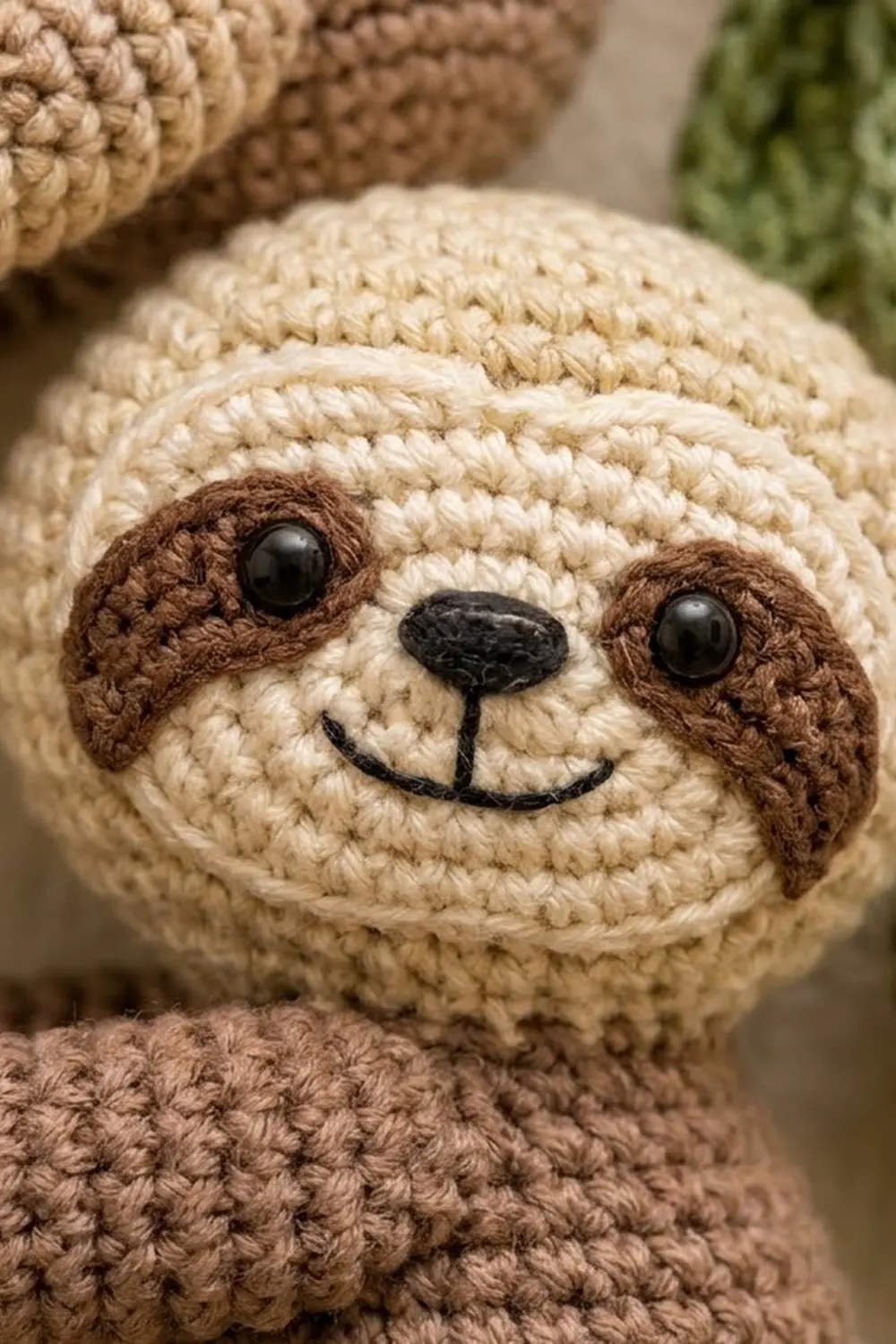
Sloth (Make 4: 2 in A, 2 in B)
Work in continuous spiral rounds and mark the first stitch of each round.
Head
Use A for the brown sloths and B for the cream sloths.
- Rnd 1: 6 sc in MR. (6)
- Rnd 2: inc in each st. (12)
- Rnd 3: (sc, inc) 6 times. (18)
- Rnd 4: (sc 2, inc) 6 times. (24)
- Rnd 5: (sc 3, inc) 6 times. (30)
- Rnd 6: (sc 4, inc) 6 times. (36)
- Rnd 7: (sc 5, inc) 6 times. (42)
- Rnds 8–15: sc in each st. (42)
- Rnd 16: (sc 5, dec) 6 times. (36)
- Rnd 17: (sc 4, dec) 6 times. (30)
- Rnd 18: (sc 3, dec) 6 times. (24) Attach the face (see Face Assembly), then stuff firmly.
- Rnd 19: (sc 2, dec) 6 times. (18)
- Rnd 20: (sc, dec) 6 times. (12)
- Rnd 21: dec 6 times. (6)
Fasten off and close the hole.
Face Mask
Use B for all four sloths. The mask is worked around both sides of a foundation chain.
- Rnd 1: Ch 9. Sc in the 2nd ch from the hook and in the next 6 ch, then 3 sc in the last ch. Working along the other side of the chain, sc 6, then 2 sc in the ch where you made the first sc. (18)
- Rnd 2: inc, sc 6, inc 3 times, sc 6, inc 2 times. (24)
- Rnd 3: sc, inc, sc 6, (sc, inc) 3 times, sc 6, (sc, inc) 2 times. (30)
Fasten off and leave a long tail. The mask measures 2.75 x 1.75 in (7.0 x 4.4 cm).
Cream sloths only: Using A, surface sl st once around the mask’s outer edge to give it the darker frame. That round is 30 sts (30 worked 1-per-stitch + 0 added).
Eye Patches (Make 2 per sloth)
Use C.
- Rnd 1: Ch 5. Sc in the 2nd ch from the hook and the next 2 ch, then 3 sc in the last ch. Working along the other side, sc 2, then 2 sc in the ch where you made the first sc. (10)
Each patch is 1.25 x 0.6 in (3.2 x 1.5 cm).
Face Assembly
- Push one safety eye through the narrow end of each eye patch.
- Place the patches on the mask, slanting downward toward the outside edges.
- Push the eyes through the mask and into the head between Rnds 10 and 11, about 7 sts apart. Fit the washers inside the head.
- Sew the mask edge down with its tail, and sew around each patch with C.
- Embroider a small triangle nose in black between the eyes and a shallow V-shaped smile below it.
Body
Use the same color as the head.
- Rnd 1: 6 sc in MR. (6)
- Rnd 2: inc in each st. (12)
- Rnd 3: (sc, inc) 6 times. (18)
- Rnd 4: (sc 2, inc) 6 times. (24)
- Rnd 5: (sc 3, inc) 6 times. (30)
- Rnds 6–17: sc in each st. (30)
- Rnd 18: (sc 3, dec) 6 times. (24)
- Rnd 19: (sc 2, dec) 6 times. (18) Stuff firmly.
- Rnd 20: (sc, dec) 6 times. (12)
- Rnd 21: dec 6 times. (6)
Fasten off. Sew the head to the Rnd 1 end of the body, overlapping by 0.5 in (1.3 cm). The finished sloth is 6.5 in (16.5 cm) tall.
Arms (Make 2 per sloth)
Use the same color as the body.
- Rnd 1: 5 sc in MR. (5)
- Rnd 2: inc in each st. (10)
- Rnds 3–32: sc in each st. (10)
Stuff firmly. If you are using a chenille stem, insert it now. Flatten the opening and sc 5 across through both layers to close it. Each arm is 32 rounds, or 6.4 in (16.3 cm).
Legs (Make 2 per sloth)
Work Rnds 1–2 as for the arms.
- Rnds 3–26: sc in each st. (10)
Stuff firmly, then close with 5 sc as for the arms. Each leg is 26 rounds, or 5.2 in (13.2 cm).
Sew both arms side by side to the left side of the body at Rnd 6, angled forward. Sew both legs side by side at Rnd 18, pointing straight left.
Vines, Flowers and Hanger
Leafy Vine (Make 2)
Use D.
Leaf (worked from the cord): Ch 7. Working back toward the cord, make 1 sl st, 1 sc, 1 hdc, 1 dc, 1 hdc and 1 sc in the next 6 ch. Ch 1 and rotate. Working in the remaining loops of the same 6 ch, make 1 sc, 1 hdc, 1 dc, 1 hdc, 1 sc and 1 sl st. Finish with a sl st into the cord chain at the leaf base. Each leaf is 12 sts and 1.5 in (3.8 cm) long.
- Ch 113.
- Sl st in the back bump of the 2nd ch from the hook and the next 5 ch, then make a leaf.
- Sl st in the back bumps of the next 6 ch, then make a leaf. Repeat from * 16 more times. You now have 18 leaves on 108 sl sts.
- Sl st in the last 4 ch to make the plain fold zone. (112 sl sts)
Flip the cord after each leaf so the leaves alternate sides, giving 9 leaves on each side.
Twist Cord (Make 2)
Use E. Ch 113, then sl st in the back bump of each ch from the 2nd ch from the hook. (112)
Wrap the twist cord loosely around its leafy vine about once every 2 in (5.1 cm), and tack the two cords together at both ends.
Flowers (Make 6)
Use F.
- Rnd 1: 10 sc in MR. (10)
- Rnd 2: (hdc, dc, hdc) in the next st, sl st in the next st. Repeat 5 times. (5 petals)
Fasten off and sew a gold bead to the center. Each flower is 1.25 in (3.2 cm) across.
Hanger
Use D. Ch 81, then sl st in the back bump of each ch from the 2nd ch from the hook. (80 sl sts, 20 in / 50.8 cm)
Make All Pieces
| Color | Pieces |
|---|---|
| A | 2 heads, 2 bodies, 4 arms, 4 legs; outlines for 2 cream-sloth masks |
| B | 2 heads, 2 bodies, 4 arms, 4 legs, 4 face masks |
| C | 8 eye patches |
| D | 2 leafy vines, 1 hanger |
| E | 2 twist cords |
| F | 6 flowers |
Layout grid (left vine | roll space | right vine with sloth):
=============== DOWEL 12 in ===============
 Vine L |   1 in clearance    | Vine R
 Vine L | [roll] <- arms  BROWN sloth   (Bay 1)
 Vine L | [roll] <- arms  CREAM sloth   (Bay 2)
 Vine L | [roll] <- arms  BROWN sloth   (Bay 3)
 Vine L | [roll] <- arms  CREAM sloth   (Bay 4)
Joining
Method: Whipstitch with matching yarn, catching only the back of the sloth and the slip stitch cord so nothing shows from the front.
Stitch-to-stitch logic:
- Fold the 4-st plain end of each vine over the dowel and sew it down. Space the vines 6 in (15.2 cm) apart, center to center.
- Each bay is 26 ch, or 6.5 in (16.5 cm), of vine. Bay 1 starts 4 ch, or 1 in (2.5 cm), below the dowel.
- In each bay, sew the back of the sloth’s head and body straight down the right vine, with the top of the head at the top of the bay.
- Tack both leg tips to the left vine 6.1 in (15.5 cm) below the top of the bay. This leaves 4.95 in (12.6 cm) of clear space for the roll.
- Leave the arms free so they can curve around the front of the roll.
Tension: Pull each stitch snug but not tight. Tight joins pucker the cords and shorten the vines.
Size checkpoint: Bay 4 should end 27 in (68.6 cm) below the dowel, which is 4 ch + 4 x 26 ch = 108 ch.
Vine Frame (Border)
In this design the leafy vines do the job of a border: they frame the panel on the left and right.
Border gauge: 4 ch = 1 in (2.5 cm).
- Right side: 112 sl sts in total = 4 fold sts + 18 leaves x 6 sts.
- Left side: 112 sl sts in total, the same as the right.
- Flowers: 3 per vine. Sew them at Bays 1, 2 and 4 on the left vine, and at Bays 1, 3 and 4 on the right vine.
- Hanger: tie the ends around the dowel just outside the vines so it forms a triangle.
Why the math works: 112 ch ÷ 4 = 28 in (71.1 cm) of vine. Take away 1 in (2.5 cm) folded over the dowel and 27 in (68.6 cm) hangs below it. That length is the 1 in (2.5 cm) clearance plus 4 bays x 6.5 in (16.5 cm). The leaves stick out 1.5 in (3.8 cm) beyond each vine, so the panel is 6 + 1.5 + 1.5 = 9 in (22.9 cm) wide.
Final Blocking
- Hang the panel from its hook.
- Mist the vines lightly with water.
- Straighten each leaf with your fingers and pin any curled tips to a towel if needed.
- Gently pull each vine to 27 in (68.6 cm) and let it dry while hanging.
- Do not steam the sloths. Shape the arms by hand around a roll instead.
Final Quality-Control Checklist
- [ ] Each head is 3 in (7.6 cm) across and each body 4 in (10.2 cm) long
- [ ] Arms are 6.4 in (16.3 cm) and legs 5.2 in (13.2 cm)
- [ ] Every safety-eye washer is fully seated
- [ ] Each vine has 18 leaves on 112 sl sts
- [ ] The vines are 6 in (15.2 cm) apart, center to center
- [ ] Sloths alternate brown, cream, brown, cream from the top
- [ ] Each bay is 6.5 in (16.5 cm) tall and holds a roll snugly
- [ ] All ends are woven in
Troubleshooting
- Rolls fall out: Tack the legs higher, or bend the arms more tightly around the roll.
- Vines are too short: Your chain is tight. Remake them with a hook one size larger.
- Stuffing shows through: Use a smaller hook and stuff a little less.
- Leaves curl: Wet-block them flat.
- Faces are crooked: Pin the mask in place before you fit the eyes.
- Panel pulls to the right: The sloths are heavier than the leaves. Add a second sew-down point at body Rnd 18.
Care
Spot clean with a damp cloth and mild soap, then air dry while hanging. Remove the rolls before cleaning, and do not machine wash the finished hanging.
Final Notes
Here is the measurement chain:
- Gauge: 9 sc = 2 in (5.1 cm) and 4 ch = 1 in (2.5 cm).
- Sloth: a 3 in (7.6 cm) head on a 4 in (10.2 cm) body gives a 6.5 in (16.5 cm) sloth.
- Bays: 4 bays of 6.5 in (16.5 cm) stack to 26 in (66.0 cm).
- Vines: 1 in (2.5 cm) of clearance plus the bays gives a 27 in (68.6 cm) panel, 9 in (22.9 cm) wide, on a 12 in (30.5 cm) dowel.
If you check each stage of this chain as you go, the rolls will fit and the sloths will hang straight.
Happy crocheting!