

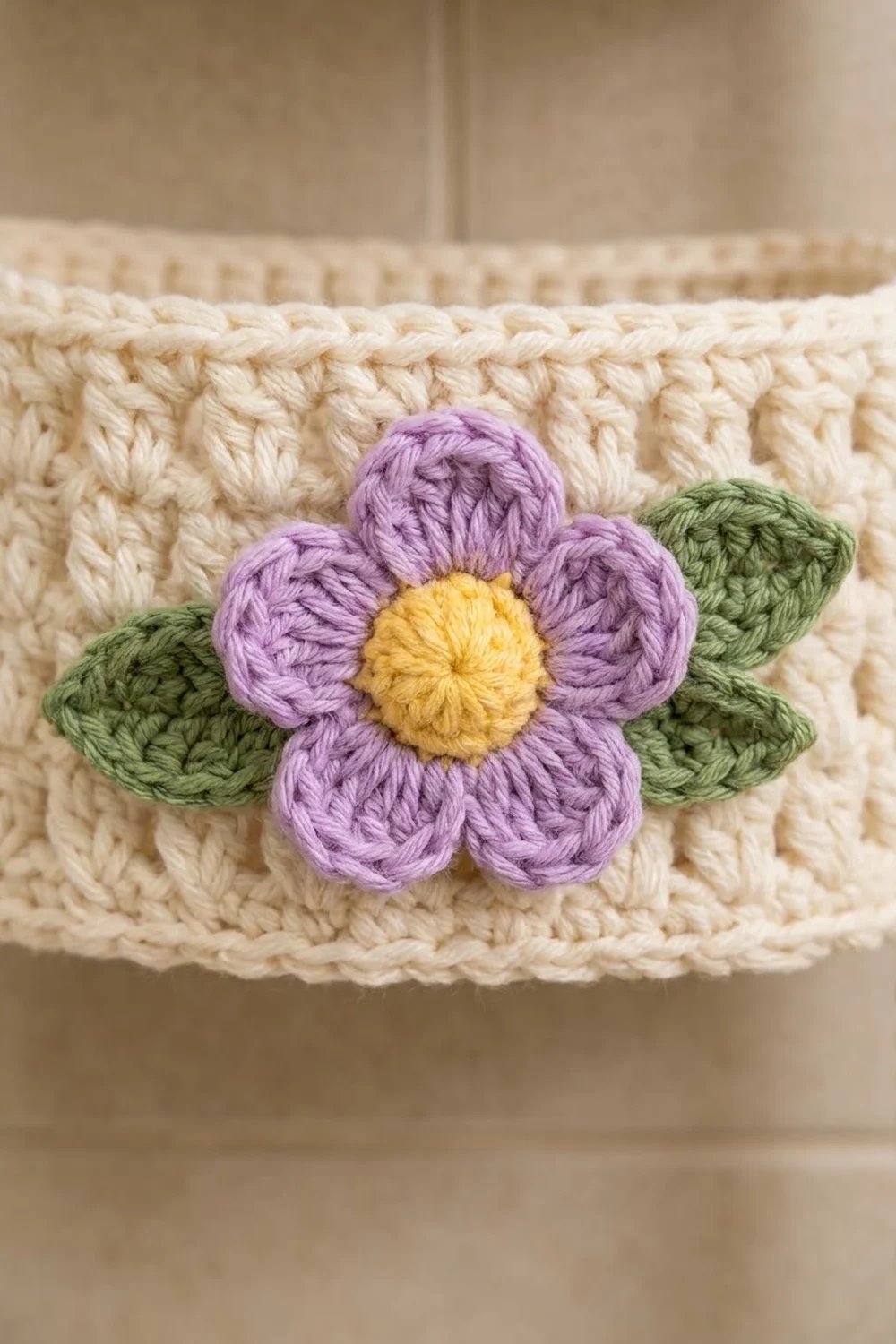
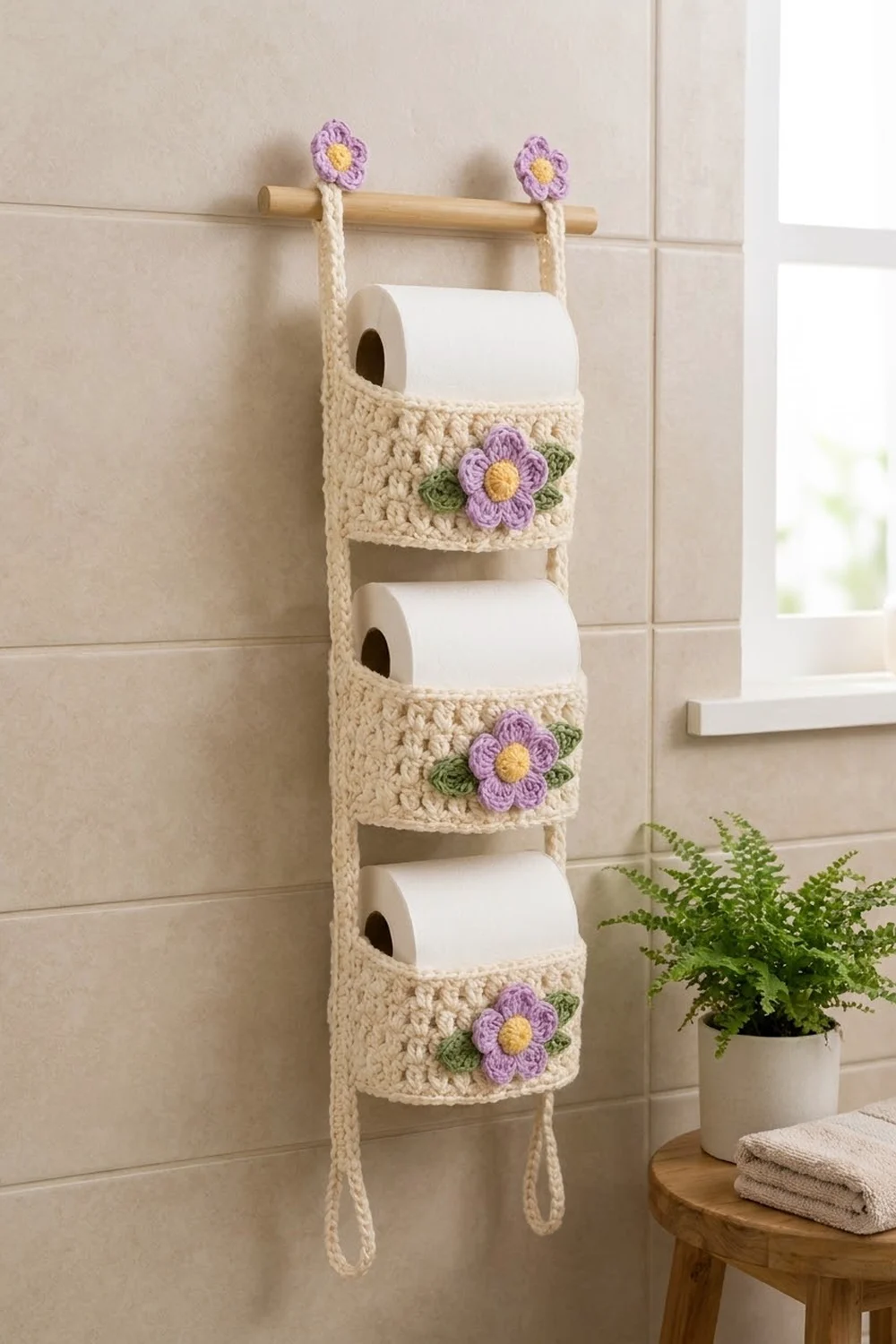
This hanging holder stores three rolls in a neat vertical column. Three cream pockets with a staggered shell texture are stitched to two slim straps that hang from a short wooden dowel. Every pocket has a lilac five-petal flower with a yellow center and two sage green leaves. Small matching flowers sit at the top of each strap.
The palette is soft and calm: cream for the structure, lilac and yellow for the flowers, and sage green for the leaves. The style is practical cottage-bathroom, with enough texture to look handmade and enough structure to hold its shape.
The pattern uses US crochet terms throughout. Each pocket is 4.75 in (12.1 cm) across and 4.25 in (10.8 cm) tall. The straps hang 22 in (55.9 cm) below a 10 in (25.4 cm) dowel, plus a 0.75 in (1.9 cm) loop at the bottom.
Construction is simple. You work each pocket wall flat in rows, seam it into a tube, add a single-crochet top rim, and join a round base with a single-crochet round. Then you make two straps, sew the pockets on, and finish with the flowers and leaves.
Finished Size and Construction
- Finished size: 10 in (25.4 cm) wide at the dowel × 22.75 in (57.8 cm) from dowel to bottom loop tip
- Skill level: Easy+ (shells, rounds, simple seaming)
- Terminology: US
- Yarn weight: Worsted (#4) cotton
- Hook: 5.0 mm (H-8)
- Number of pieces: 3 pocket walls, 3 bases, 2 straps, 3 large flowers, 6 leaves, 2 small flowers
- Layout: 3 pockets in 1 vertical column, 1.25 in (3.2 cm) apart
- Pocket size: 15 in (38.1 cm) around, 4.75 in (12.1 cm) across, 4.25 in (10.8 cm) tall
- Wall panel before seaming and rims: 15.25 in (38.7 cm) wide × 3.5 in (8.9 cm) tall
- Rim depth: top rim 0.5 in (1.3 cm); base joining round 0.25 in (0.6 cm)
Materials
Choose a smooth worsted-weight cotton or cotton blend. Cotton holds the pocket shape better than acrylic and copes with bathroom humidity. The lengths below assume about 1.6 m per gram.
- Cream: 200 g, about 320 m (walls, bases, rims, straps)
- Lilac: 25 g, about 40 m (large and small flowers)
- Yellow: 10 g, about 16 m (flower centers)
- Sage green: 10 g, about 16 m (leaves)
These quantities include a margin of about 15 percent for gauge swatches and tails.
Tools:
– 5.0 mm (H-8) crochet hook
– Tapestry needle
– 4 locking stitch markers
– Scissors
– Measuring tape
– Wooden dowel, 10 in (25.4 cm) long, 0.5 in (1.3 cm) thick
– Rust-proof pins for blocking
Abbreviations (US Terms)
- ch – chain
- sl st – slip stitch
- sc – single crochet
- hdc – half double crochet
- dc – double crochet
- sk – skip
- st(s) – stitch(es)
- MR – magic ring
- rep – repeat
Special stitch – shell: 3 dc in the same stitch.
Half shell: 2 dc in the same stitch (used at row edges).
Gauge and Checkpoints
Shell gauge: 4 shell repeats (16 sts) = 4 in (10.2 cm); 8 rows = 4 in (10.2 cm).
Single-crochet gauge: 16 sc = 4 in (10.2 cm); 4 sc rounds = 1 in (2.5 cm).
Make one complete pocket before starting the others. It is your real gauge swatch.
Checkpoints:
– After Row 1 of the wall: 61 sts, 15.25 in (38.7 cm) wide
– After Row 7: 3.5 in (8.9 cm) tall
– Base after Round 10: 4.75 in (12.1 cm) across
– Finished pocket: 15 in (38.1 cm) around, 4.25 in (10.8 cm) tall
If your piece is too big, go down to a 4.5 mm (7) hook. If it is too small, go up to a 5.5 mm (I-9) hook. Do not change the stitch counts. The wall and base must both stay at 60 working stitches so they match.
Pocket Wall (make 3)
With cream, ch 62.
Row 1: Sc in 2nd ch from hook, *sk 1 ch, shell in next ch, sk 1 ch, sc in next ch; rep from * across. Turn. (15 shells, 16 sc = 61 sts)
Row 2: Ch 3 (counts as dc), dc in first sc (half shell), *sc in center dc of next shell, shell in next sc; rep from * to last shell, sc in center dc of last shell, 2 dc in last sc. Turn. (2 + 15 sc + 14 shells × 3 + 2 = 61 sts)
Row 3: Ch 1, sc in first dc, shell in next sc, sc in center dc of next shell; rep from , ending with sc in top of turning ch-3 instead of a shell center. Turn. (16 sc + 15 shells × 3 = 61 sts)
Rows 4–7: Rep Rows 2 and 3 twice. (61 sts each row)
The shells in each row sit over the single crochets of the row below. This offset creates the staggered fan texture.
Checkpoint: 15.25 in (38.7 cm) wide × 3.5 in (8.9 cm) tall. Fasten off, leaving a 16 in (40.6 cm) tail.
Seam: Fold the panel with the right side out and the short edges together. Whipstitch the 7 row-ends together with the tail. The tube is now open at both ends. The seam marks the center back.
Pocket Base (make 3)
Work in continuous rounds with cream. Mark the first stitch of each round.
Round 1: 6 sc in MR. (6 sts)
Round 2: 2 sc in each st. (12 sts)
Round 3: Sc in next st, 2 sc in next; rep from * around. (18 sts)
Round 4: Sc in next 2 sts, 2 sc in next; rep. (24 sts)
Round 5: Sc in next 3, 2 sc in next; rep. (30 sts)
Round 6: Sc in next 4, 2 sc in next; rep. (36 sts)
Round 7: Sc in next 5, 2 sc in next; rep. (42 sts)
Round 8: Sc in next 6, 2 sc in next; rep. (48 sts)
Round 9: Sc in next 7, 2 sc in next; rep. (54 sts)
Round 10: Sc in next 8, 2 sc in next; rep. Sl st to next st. (60 sts)
Checkpoint: 4.75 in (12.1 cm) across, lying flat. Fasten off.
Straps (make 2)
With cream, ch 97.
Row 1: Sc in 2nd ch from hook and in each ch across. (96 sc, 24 in / 61.0 cm)
Bottom loop: Ch 6, sl st into the last sc made. (1 loop, 0.75 in / 1.9 cm long) Fasten off.
Count strap stitches from the loop end: stitch 1 is the sc next to the loop.
Flowers and Leaves
Large flower (make 3):
Round 1: With yellow, 10 sc in MR, sl st to first sc. (10 sts)
Round 2: Ch 1, 2 sc in each st, sl st to first sc. (20 sts) Fasten off.
Round 3: Join lilac in any st. Ch 1, sc in next st, (hdc, 3 dc) in next st, (3 dc, hdc) in next st, sc in next st; rep from * 4 more times, sl st to first sc. (5 petals, 50 sts)
Round 4:* Sl st in each st around. (50 sl sts) Fasten off, leaving a 12 in (30.5 cm) tail.
The yellow center stays raised because the lilac petals sit on its outer edge. The sl st round outlines each petal. Diameter: 2.75 in (7.0 cm).
Leaf (make 6): With green, ch 7. Sl st in 2nd ch from hook, sc in next ch, hdc in next, dc in next, hdc in next, sc in last ch, ch 1. Working along the opposite side of the chain: sc, hdc, dc, hdc, sc, sl st. (12 sts plus a ch-1 tip) Fasten off, leaving a tail. Length: 1.5 in (3.8 cm).
Small flower (make 2):
Round 1: With yellow, 5 sc in MR, sl st to first sc. (5 sts) Fasten off.
Round 2: Join lilac. *(Sl st, ch 2, 2 dc, ch 2, sl st) in next st; rep from * 4 more times. (5 petals) Fasten off. Diameter: 1.25 in (3.2 cm).
Make All Pieces
Totals:
– Cream: 3 walls, 3 bases, 2 straps
– Lilac and yellow: 3 large flowers, 2 small flowers
– Green: 6 leaves
Layout (front view):
 [sm flower]=========DOWEL=========[sm flower]
     |                                 |
     |          5.75 in drop           |
   [ ------- POCKET 3 (top) ------- ]
     |          1.25 in gap            |
   [ ------- POCKET 2 (middle) ---- ]
     |          1.25 in gap            |
   [ ------- POCKET 1 (bottom) ---- ]
     |           1 in tail             |
     o                                 o
  (loop)                            (loop)
Joining
Base to wall: Place the base inside the bottom of the tube, wrong sides together. Join cream at the seam. Work 1 sc through both layers in every stitch, catching one wall foundation loop and one base stitch each time. At the seam, work chain 1 and chain 61 together with one base stitch. That gives 59 matched stitches + 1 seam stitch = 60 sc. Sl st to the first sc and fasten off.
Keep your tension even. If it is too tight, the base cups upward; if it is too loose, the bottom flares.
Pockets to straps: Number the rim stitches 1 to 60, with stitch 1 at the seam. Stitch 31 is center front, and stitches 16 and 46 are the sides. Lay one strap vertically over each side column. Whipstitch both edges of the strap to the pocket along its full height, which is 17 strap stitches:
- Pocket 1 (bottom): strap sts 5–21 (1 to 5.25 in / 2.5 to 13.3 cm)
- Pocket 2: strap sts 27–43 (6.5 to 10.75 in / 16.5 to 27.3 cm)
- Pocket 3 (top): strap sts 49–65 (12 to 16.25 in / 30.5 to 41.3 cm)
Strap sts 66–88 form the 5.75 in (14.6 cm) drop to the dowel. Fold sts 89–96, which is 2 in (5.1 cm), over the dowel to the back and sew them down.
Size checkpoint: Each strap hangs 22 in (55.9 cm) from the dowel to stitch 1, plus the 0.75 in (1.9 cm) loop.
Border (Top Rim)
Border gauge: 16 sc = 4 in (10.2 cm); each round adds 0.25 in (0.6 cm).
Work the rim in the round along the top of Row 7 after seaming. Count stitches 16–45 as the front half and stitches 46–15 as the back half. That makes 2 sides of 30 sts each.
Round 1: Join cream at the seam. Work 1 sc through Row 7 stitches 1 and 61 together. Then work 1 sc in each of stitches 2–60. Sl st to the first sc. (1 + 59 = 60 sc: 30 front, 30 back)
Round 2: Ch 1, sc in each st around, sl st to first sc. (60 sc: 30 front, 30 back) Fasten off.
Why the math works: The wall has 15 repeats of 4 sts plus 1 closing stitch, for 61 sts. The seam merges the first and last stitches, leaving 15 × 4 = 60. The base ends at 6 × 10 = 60. At 16 sc per 4 in, 60 sts = 15 in (38.1 cm), which matches the wall. No extra stitches are added anywhere, so the top rim and the base round both lie flat.
Pocket height: 3.5 in (8.9 cm) shells + 0.5 in (1.3 cm) top rim + 0.25 in (0.6 cm) base round = 4.25 in (10.8 cm).
Flower Placement
Center a large flower on each pocket front over stitch 31, covering Rows 3–5. Tuck one leaf behind the left petals and one behind the right petals, with the tips angled slightly up. Sew the leaves on first, then the flower, using the lilac tail around the petal bases. Sew a small flower over each strap fold above the dowel.
Final Blocking
- Mist the assembled holder lightly with water.
- Slip a toilet roll into each pocket to set the round shape.
- Lay the holder flat on a towel and straighten both straps to 22 in (55.9 cm).
- Pin the flower petals open and flat.
- Let it dry completely, about 24 hours.
- Remove the pins and hang it.
Final Quality-Control Checklist
- Each wall row has 61 sts
- Each base has 60 sts and measures 4.75 in (12.1 cm)
- Both rim rounds and the base joining round have 60 sc
- Each pocket is 4.25 in (10.8 cm) tall
- Pocket seams face the wall
- Straps are sewn at stitches 16 and 46 of each pocket
- Gaps between pockets are 1.25 in (3.2 cm)
- Flowers are centered, and the leaves are symmetrical
- All tails are woven in securely
Troubleshooting
- Base cups or puckers: Rework the joining round with looser tension, or check that Round 10 has exactly 60 sts.
- Rim ruffles: You probably worked 61 sts in Round 1. Merge the two seam stitches.
- Pocket leans forward: The straps are not on opposite sides. Re-check stitches 16 and 46.
- Roll too loose: Change to a 4.5 mm (7) hook for the walls and base.
- Petals curl: Block them flat, and keep the Round 4 sl sts loose.
- Straps stretch: Add a second row of sl sts along the strap to firm it up.
Care
Remove the dowel, then hand wash in cool water with mild soap. Reshape and dry flat with rolls inside the pockets.
Final Notes
The measurement chain is simple. The 61 stitches of each shell row become 60 once the seam merges the two edge stitches. That 60 matches the 60-stitch base and both 60-stitch rim rounds, which gives a 15 in (38.1 cm) circumference and a 4.75 in (12.1 cm) pocket. Three 4.25 in (10.8 cm) pockets with 1.25 in (3.2 cm) gaps fit on 22 in (55.9 cm) straps. If you check your gauge at each step, the holder will hang straight and hold three rolls.
Happy crocheting!