

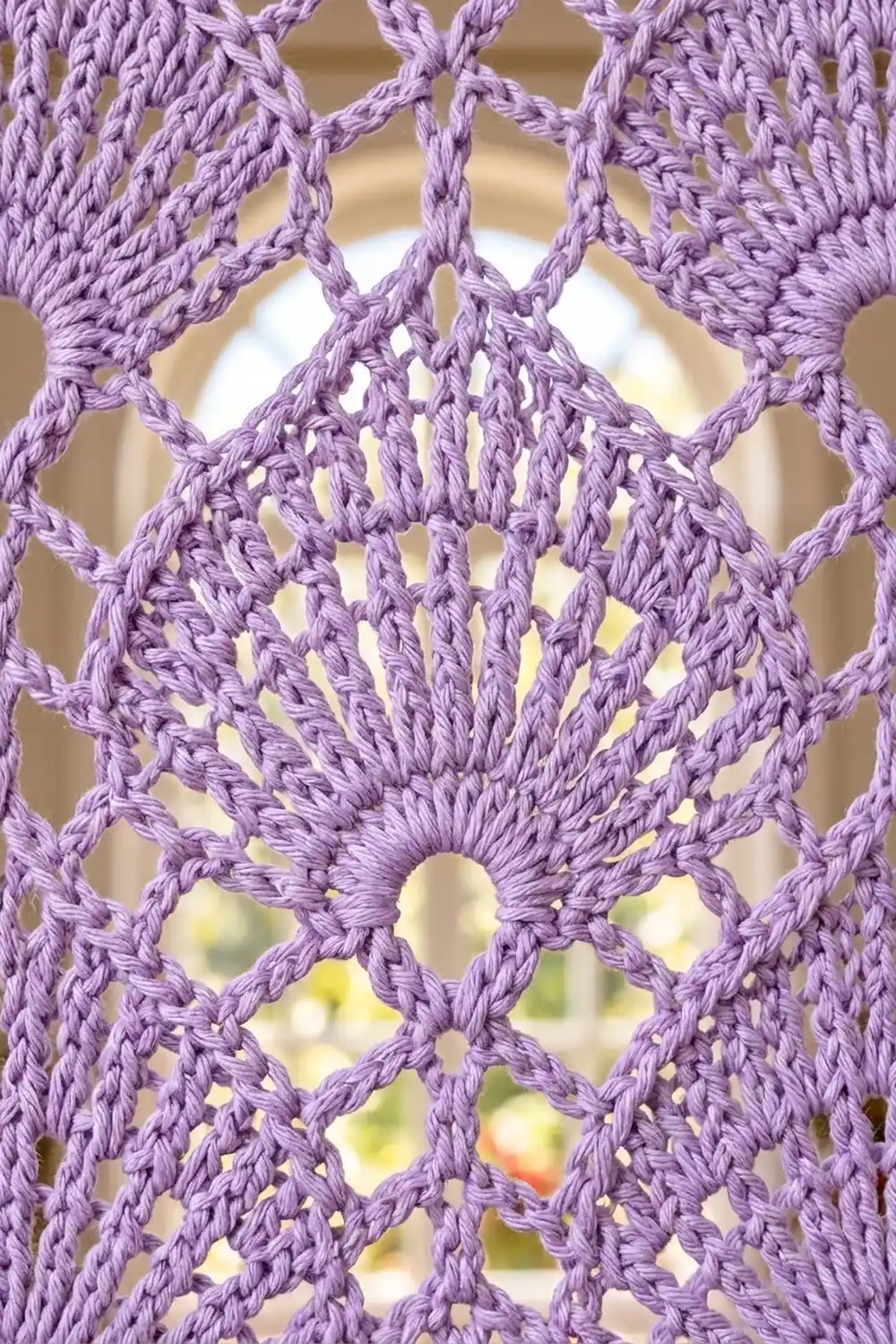
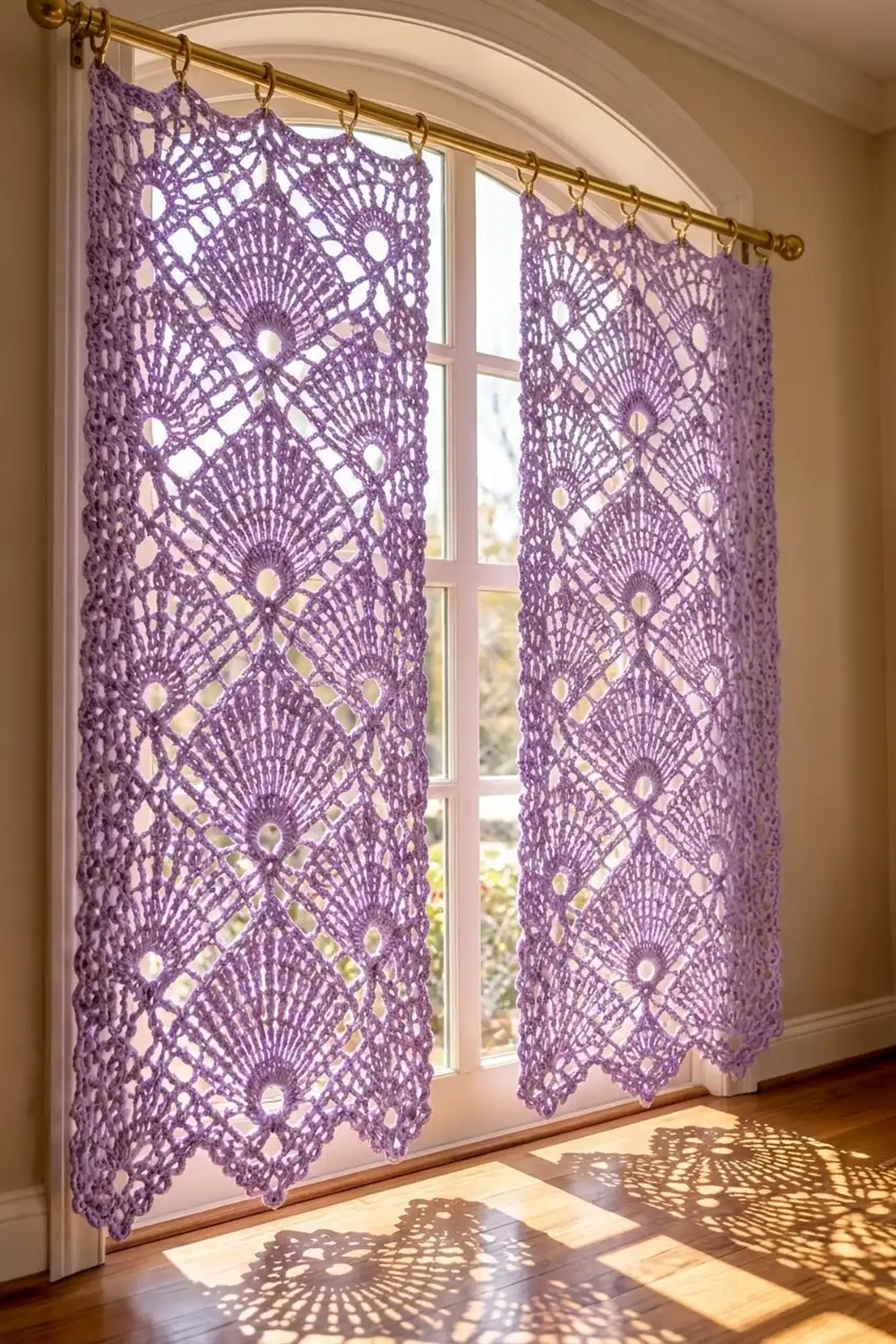
The Lilac Fanlight curtain panel is a tall, airy piece of fan-and-diamond lace. Each fan opens upward from a small chain ring. Diagonal chain lines frame the fans into diamonds, and the bottom edge ends in a row of soft points. When light comes through a window, the lace throws a pattern onto the floor.
The panel uses one color, a gentle lavender, so the stitch pattern does all the decorative work. The style is vintage pineapple lace with a clean, modern outline. The pattern uses US crochet terms throughout.
Each finished panel measures 21 in x 61.5 in (53.3 cm x 156.2 cm), including the pointed hem and side border. The photo shows a matching pair, so this pattern makes two identical panels. They are worked separately and are never joined.
You work each panel in one piece from the bottom up, starting from a foundation chain. After the lace body is done, you add a pointed edging along the foundation edge and a two-row border up the sides and across the top.
Finished Size and Construction
- Finished panel size: 21 in x 61.5 in (53.3 cm x 156.2 cm)
- Skill level: Intermediate
- Terminology: US
- Yarn weight: Worsted (#4), cotton or cotton blend
- Hook: 5.5 mm (I-9)
- Number of pieces: 2 identical panels, each worked in one piece, not joined
- Layout: Panels hang side by side on a rod
- Lace body per panel: 20 in x 58.5 in (50.8 cm x 148.6 cm)
- Size before border: 20 in (50.8 cm) wide; 61 in (154.9 cm) long including the points
- Border depth: 0.5 in (1.3 cm) on the sides and top; the points add 2.5 in (6.4 cm) at the bottom
Materials
Use a smooth, mercerized or combed cotton. Cotton holds the open lace crisp, blocks well, and doesn’t stretch out much under its own weight. Acrylic tends to sag over a long drop.
- Lavender: 600 g / 1,140 m (1,247 yd) per panel; 1,200 g / 2,280 m (2,493 yd) for the pair
These quantities include about a 10% margin for swatching and blocking.
Tools:
– 5.5 mm (I-9) crochet hook, plus a 6.0 mm (J-10) hook for the foundation chain
– Stitch markers
– Tapestry needle
– Rust-proof pins and a large blocking surface
– Spray bottle
– 8 curtain clip rings per panel
Abbreviations (US Terms)
- ch – chain
- sl st – slip stitch
- sc – single crochet
- dc – double crochet
- tr – treble crochet
- rev sc – reverse single crochet (crab stitch)
- sk – skip
- sp(s) – space(s)
- st(s) – stitch(es)
- rep – repeat
- RS / WS – right side / wrong side
Special terms:
– Ring: (sc, ch 3, sc) in the same stitch. The ch-3 sp becomes the base of a fan.
– Fan: 9 dc worked into a ring.
– Half fan: 5 dc worked into an edge ring.
– Fan top: 1 sc in each ch-2 sp of a fan, with ch 3 between. Each full fan top has 8 sc and 7 inner ch-3 sps, plus 1 flanking ch-3 sp on each side.
– Rev sc: Work single crochet from left to right (right-handers) without turning.
Gauge and Checkpoints
Gauge (blocked): One 12-st repeat = 5 in (12.7 cm) wide. Rows 1–5 = 3 in (7.6 cm). Each 8-row repeat (Rows 6–13) = 5 in (12.7 cm).
Border gauge: 4 sc = 1 in (2.5 cm).
Test swatch: Before starting a full panel, make one test piece. Ch 25 and work Rows 1–13 with 2 repeats across instead of 4. Wet block it. It should measure 10 in x 8 in (25.4 cm x 20.3 cm).
- Swatch too big: Go down to a 5.0 mm hook.
- Swatch too small: Go up to a 6.0 mm hook.
Lace relaxes when it’s off the pins, so always measure blocked fabric.
Checkpoints on the panel (blocked or gently stretched):
– After Row 5: 20 in (50.8 cm) wide, 3 in (7.6 cm) tall
– After Row 13: 8 in (20.3 cm) tall
– After Row 53: 33 in (83.8 cm) tall
– After Row 93: 58 in (147.3 cm) tall
– After Row 94: 58.5 in (148.6 cm) tall
Lace Body
Using the 6.0 mm hook, ch 49 loosely. Switch to the 5.5 mm hook.
Row 1 (RS): Sc in 2nd ch from hook, ch 5, sk 5 ch, ring in next ch, ch 5, sk 5 ch, sc in next ch; rep from * 3 more times. Turn.
(4 rings, 8 ch-5 sps, 13 sc)*
Row 2 (WS): Ch 5 (counts as dc + ch 2), sc in first ch-5 sp, fan in next ring, sc in next ch-5 sp, ch 5, sc in next ch-5 sp; rep from * across, ending the last rep at , ch 2, dc in last sc. Turn.
(4 fans = 36 dc, 3 ch-5 sps, 2 edge ch-2 sps)*
Row 3 (RS): Ch 1, sc in first dc, ch 3, [dc in next dc of fan, ch 1] 8 times, dc in next dc, ch 3, sc in next ch-5 sp, ch 3; rep from * across, ending the last rep at , ch 3, sc in 3rd ch of beg ch-5. Turn.
(4 fans of 9 dc with 8 ch-1 sps each, 5 sc, 8 ch-3 sps)*
Row 4 (WS): Ch 1, sc in first sc, ch 4, [dc in next dc, ch 2] 8 times, dc in next dc, ch 4, sc in next sc, ch 4; rep from * across, ending the last rep at , ch 4, sc in last sc. Turn.
(4 fans of 9 dc with 8 ch-2 sps each, 5 sc, 8 ch-4 sps)*
Row 5 (RS): Ch 4 (counts as sc + ch 3), sc in first sc (edge ring made), ch 3, sk ch-4 sp, fan top across fan, ch 3, sk ch-4 sp, ring in next sc; rep from * across, ending the last rep at , ring in last sc. Turn.
(5 rings: 3 interior + 2 edge; 4 fan tops)*
Band A (Rows 6–9): fans at the edges
Row 6 (WS): Ch 3 (counts as dc), 4 dc in edge ring (half fan made). Then work ch 3, sk flanking sp and first inner sp, sc in next inner sp, [ch 3, sc in next inner sp] 4 times, ch 3, sk last inner sp and flanking sp, fan in next ring; rep from * across, ending the last rep at , 5 dc in edge ring. Turn.
(2 half fans, 3 fans, 4 pineapples of 5 sc / 4 ch-3 loops, 8 ch-3 connectors)*
Row 7 (RS): Ch 4 (counts as dc + ch 1), dc in next dc, [ch 1, dc in next dc] 3 times. Then work ch 4, sk connector and first pineapple loop, sc in next loop, ch 3, sc in next loop, ch 4, sk last loop and connector, dc in next dc, [ch 1, dc in next dc] 8 times; rep from * across, ending the last rep at , [dc in next dc, ch 1] 4 times, dc in top of beg ch-3. Turn.
(half fans of 5 dc, fans of 9 dc, pineapples of 2 sc / 1 loop, 8 ch-4 sps)*
Row 8 (WS): Ch 5 (counts as dc + ch 2), dc in next dc, [ch 2, dc in next dc] 3 times. Then work ch 5, sk ch-4 sp, sc in pineapple ch-3 sp, ch 5, sk ch-4 sp, dc in next dc, [ch 2, dc in next dc] 8 times; rep from * across, ending the last rep at , [dc in next dc, ch 2] 4 times, dc in 3rd ch of beg ch-4. Turn.
(4 pineapple tip sc, 8 ch-5 sps)*
Row 9 (RS): Ch 1, sc in first dc, [ch 3, sc in next ch-2 sp] 4 times. Then work ch 3, sk ch-5 sp, ring in tip sc, ch 3, sk ch-5 sp, fan top across fan; rep from * across, ending the last rep at , [sc in next ch-2 sp, ch 3] 4 times, sc in 3rd ch of beg ch-5. Turn.
(4 rings, 3 full fan tops, 2 half fan tops of 5 sc / 4 loops)*
Band B (Rows 10–13): pineapples at the edges
Row 10 (WS): Ch 1, sc in first sc, [ch 3, sc in next ch-3 sp] twice, ch 4, sk next 2 ch-3 sps and flanking sp. Then work fan in next ring, ch 3, sk flanking sp and first inner sp, sc in next inner sp, [ch 3, sc in next inner sp] 4 times, ch 3, sk last inner sp and flanking sp; rep from * 2 more times. Finish with fan in last ring, ch 4, sk flanking sp and next 2 ch-3 sps, [sc in next ch-3 sp, ch 3] twice, sc in last sc. Turn.
(4 fans, 3 pineapples of 5 sc / 4 loops, 2 half pineapples of 3 sc / 2 loops)*
Row 11 (RS): Ch 1, sc in first sc, ch 3, sc in next loop, ch 4, sk next loop and ch-4 sp. Then work [dc in next dc, ch 1] 8 times, dc in next dc, ch 4, sk connector and first loop, sc in next loop, ch 3, sc in next loop, ch 4, sk last loop and connector; rep from * across, ending the last rep at , ch 4, sk ch-4 sp and next loop, sc in next loop, ch 3, sc in last sc. Turn.
(4 fans of 9 dc, pineapples and half pineapples of 2 sc / 1 loop, 8 ch-4 sps)*
Row 12 (WS): Ch 1, sc in first sc, ch 5, sk ch-3 sp and ch-4 sp. Then work dc in next dc, [ch 2, dc in next dc] 8 times, ch 5, sk ch-4 sp, sc in pineapple ch-3 sp, ch 5, sk ch-4 sp; rep from * across, ending the last rep at , ch 5, sk ch-4 sp and ch-3 sp, sc in last sc. Turn.
(5 tip sc: 3 interior + 2 edge, 8 ch-5 sps)*
Row 13 (RS): Ch 4 (counts as sc + ch 3), sc in first sc, ch 3, sk ch-5 sp, fan top across fan, ch 3, sk ch-5 sp, ring in next sc; rep from * across, ending the last rep at , ring in last sc. Turn.
(5 rings, 4 fan tops — the same layout as Row 5)*
Rep Rows 6–13 ten more times, for 11 repeats in total. You end on Row 93.
Row 94 (WS, top edge): Ch 1, sc in edge ring sp, 2 sc in each of the 9 ch-3 sps of the fan top, 2 sc in next ring sp; rep from * across, ending the last rep at , sc in last edge ring sp. Fasten off.
(80 sc: 1 + 4 × 18 + 3 × 2 + 1)*
Pointed Edging
Point Row 1 (RS): With RS facing, join yarn in the first free loop of the foundation ch. Ch 1, sc in same loop, ch 2, sk 2 loops, dc in next loop, ch 2, sk 2 loops, (tr, ch 5, tr) in next loop (under a ring), ch 2, sk 2 loops, dc in next loop, ch 2, sk 2 loops, sc in next loop; rep from * 3 more times. Turn.
(4 points; 5 sc, 8 dc, 8 tr, 16 ch-2 sps, 4 ch-5 tips)*
Point Row 2 (WS): Ch 1, sc in first sc, [ch 3, sc in next ch-2 sp] twice, ch 3, (sc, ch 5, sc) in ch-5 tip, [ch 3, sc in next ch-2 sp] twice, ch 3, sc in next sc; rep from * across. Fasten off.
(29 sc, 24 ch-3 sps, 4 ch-5 tips)*
Make the Second Panel
Repeat everything above for a second, identical panel, using 600 g / 1,140 m (1,247 yd) of lavender. The panels are not joined. Each one hangs independently from its own clip rings:
[ Panel A ]     (window)     [ Panel B ]
  21 in                         21 in
 53.3 cm                       53.3 cm
Border
The border runs up the right side, across the top, and down the left side. The bottom edge is already finished by the points. Border gauge is 4 sc = 1 in (2.5 cm).
Border Row 1 (RS): With RS facing, join yarn at the lower right corner. Work 236 sc evenly up the side:
– 1 sc in the end of each Point Row (2 sc)
– 12 sc across Rows 1–5
– 20 sc across each 8-row repeat (220 sc)
– 2 sc in the end of Row 94
Then work across the top: 3 sc in the first st of Row 94, 1 sc in each of the next 78 sts, and 3 sc in the last st. Work 236 sc down the left side in reverse order of the right side.
(556 sc)
The middle sc of each 3-sc group is a corner stitch. Counted corner to corner, the top has 82 sts, including both corner sts. Each side has 238 sts: 236 + 1 + the corner st.
Border Row 2 (RS, do not turn): Ch 1, rev sc in each sc back along the whole edge. Fasten off.
(556 rev sc: 238 per side, 82 across the top, with the corners shared)
Why the math works:
– Top: 80 sc ÷ 4 = 20 in (50.8 cm). That matches the 4 lace repeats at 5 in (12.7 cm) each.
– Sides: 236 sc ÷ 4 = 59 in (149.9 cm). That’s the 58.5 in (148.6 cm) body plus 0.5 in (1.3 cm) of point rows at the corner.
– No stitches are added along the edges, so the border lies flat without ruffling or pulling.
Final Blocking
- Weave in all ends along solid dc or sc lines.
- Soak the panel in cool water for 15 minutes. Press out the water without wringing, then roll it in towels.
- Lay it flat and pin the top edge straight at 21 in (53.3 cm) wide.
- Pin both sides straight down to 59.5 in (151.1 cm) at the corners: 59 in of side border plus 0.5 in of top border.
- Pin each point tip 2.5 in (6.4 cm) below the valleys. The finished length should be 61.5 in (156.2 cm).
- Open each ring and fan with your fingers, and line up the diamonds vertically.
- Let it dry completely before unpinning.
Final Quality-Control Checklist
- 4 points along the bottom, each centered under a fan
- Fans stagger in half-drop bands, with half fans and half pineapples alternating at the edges
- Top edge has 80 sc and lies straight
- Each side has 236 border sc and no ripples
- Panel is 21 in x 61.5 in (53.3 cm x 156.2 cm) blocked
- Both panels match within 0.5 in (1.3 cm)
Troubleshooting
- The bottom edge puckers: The foundation chain is too tight. Restart with a larger hook for the chain.
- Fans cup or ruffle: Check that each fan has exactly 9 dc. Tighten the ch-2 sps in the widest fan row.
- The edges are shorter than the center: Loosen the edge chains. Blocking also evens out small differences.
- Diamonds lean: Recount the pineapple loops. Each pineapple should go from 4 loops, to 1 loop, to a single tip sc.
- The border waves: Remove it and rework with fewer sc, keeping 20 per 8-row repeat.
Care
Hand wash in cool water with a mild detergent. Then dry flat and re-pin as needed. Keep the panels out of strong direct sun for long periods to protect the color.
Final Notes
The measurement chain is simple:
– One 12-st repeat is 5 in (12.7 cm), so 4 repeats make 20 in (50.8 cm).
– Rows 1–5 are 3 in (7.6 cm), and 11 eight-row repeats add 55 in (139.7 cm). With the top row, the body is 58.5 in (148.6 cm).
– The points add 2.5 in (6.4 cm), and the border adds 0.5 in (1.3 cm) on the sides and top.
– That gives 21 in x 61.5 in (53.3 cm x 156.2 cm) per panel.
Check your swatch, measure at every checkpoint, and both panels will match.
Happy crocheting!