

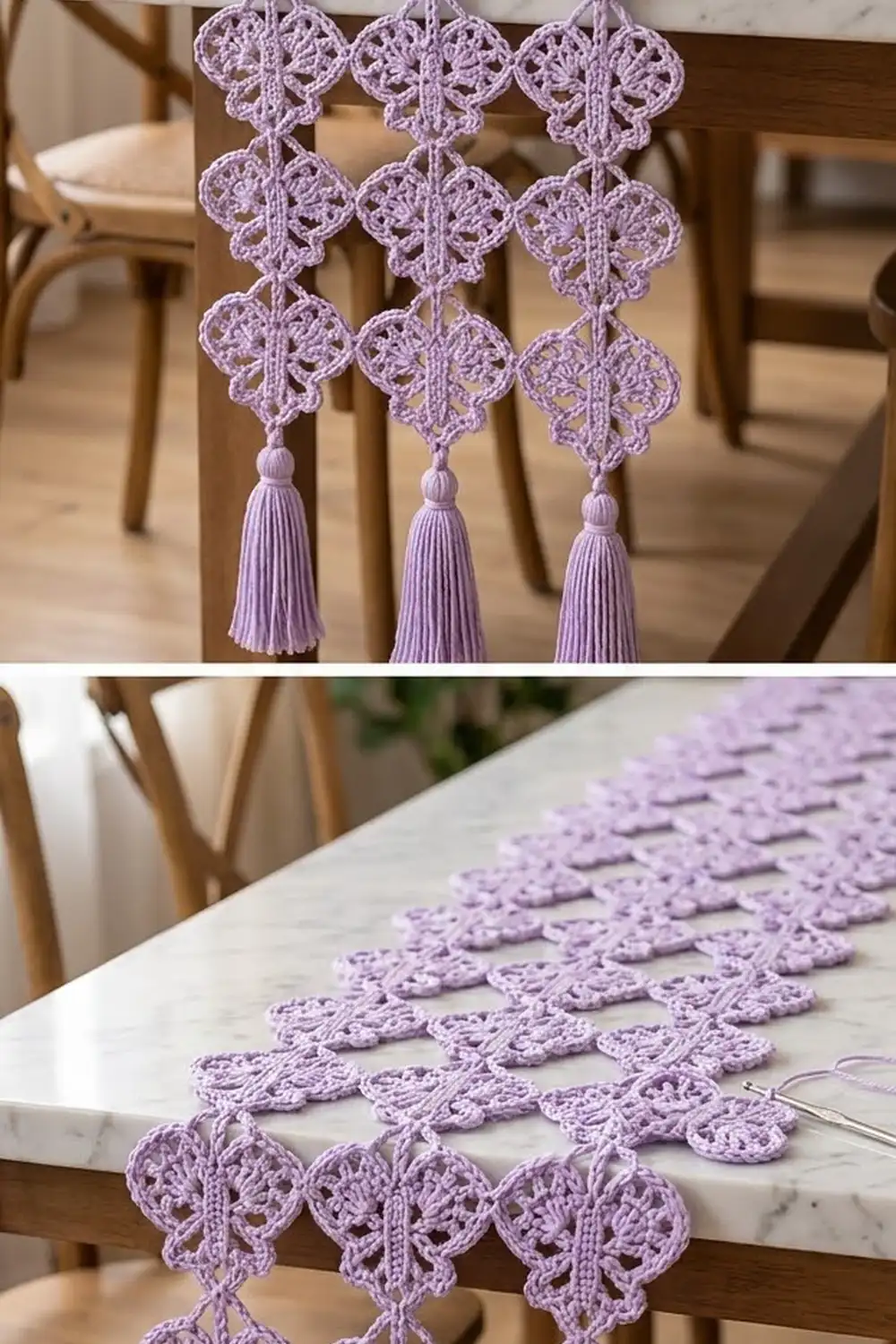
The Lilac Flutter runner is a light, lacy table runner made from 30 butterfly motifs joined as you go. Each butterfly has a solid single crochet body, fan-stitched wings and a smooth rope-like outline. That outline is what makes the scalloped edge along the runner.
It’s worked in one soft lavender cotton, so the stitch texture does all the work. It suits a spring table, a wedding setting or a calm winter centerpiece with silver and greenery. Three full tassels finish each short end.
This pattern uses US crochet terms. The blocked runner measures 13.5 in (34.3 cm) wide by 45 in (114.3 cm) long, not counting tassels. Each tassel adds 4 in (10.2 cm).
You’ll make the first butterfly in four rounds. You’ll make the other 29 the same way, joining each one to its neighbors on the last round. No separate seaming is needed. Tassels go on last.
Finished Size and Construction
- Finished size: 13.5 in x 45 in (34.3 cm x 114.3 cm), plus 4 in (10.2 cm) tassels
- Skill level: Intermediate
- Terminology: US crochet terms
- Yarn weight: DK (#3) cotton
- Hook: 3.5 mm (E/4)
- Number of pieces: 30 butterfly motifs, joined as you go
- Layout: 3 motifs wide x 10 motifs long
- Motif size (blocked): 4.5 in x 4.5 in (11.4 cm x 11.4 cm), tip to tip
- Size before border: 13.5 in x 45 in (34.3 cm x 114.3 cm). No border is added, so this is also the final size.
- Border depth: 0 in (0 cm). The motif outline round is the finished edge.
Materials
Yarn: Use a smooth DK-weight mercerized cotton or cotton blend. Mercerized cotton gives the crisp stitch definition and slight sheen that make the body column and the rope outline stand out. Avoid fuzzy yarns, because they blur the lace gaps.
- Lavender: 250 g, about 575 m (629 yd), based on 50 g per 115 m
Each motif uses about 5 g, and each tassel about 7 g. The quantity above includes a margin of roughly 25% for gauge swatches, joining tails and fuller tassels.
Tools:
- 3.5 mm (E/4) crochet hook
- Tapestry needle
- Scissors
- Stitch markers
- Stiff card cut to 4.5 in (11.4 cm) tall, for tassels
- Blocking mats, rust-proof pins and a spray bottle
Abbreviations (US Terms)
- ch: chain
- sl st: slip stitch
- sc: single crochet
- dc: double crochet
- tr: treble crochet
- st(s): stitch(es)
- sp: space
- rnd: round
Special stitches:
- Tip: a ch-2 point worked on Round 4. Each motif has 10 tips. They are the only places where motifs connect.
- Joining tip: ch 1, sl st into the matching ch-2 tip of the finished neighbor motif, ch 1. Work this in place of the plain ch-2.
Gauge and Checkpoints
Gauge: 5 sc = 1 in (2.5 cm) in Round 1.
Make one complete motif before you start the runner, then block it. It should measure 4.5 in (11.4 cm) from head tip to tail tip, and the same from side tips to side tips.
Checkpoints:
- After Round 1: the body is 2 in (5.1 cm) long and about 0.5 in (1.3 cm) wide.
- After Round 2: the motif is about 3.25 in (8.3 cm) across the upper wings.
- After Round 3: the motif is about 3.75 in (9.5 cm) across.
- After Round 4, unblocked: about 4.25 in (10.8 cm) square.
- After Round 4, blocked: 4.5 in (11.4 cm) square.
If your blocked motif is larger than 4.75 in (12.1 cm), go down to a 3.25 mm hook. If it is smaller than 4.25 in (10.8 cm), go up to a 3.75 mm hook. A 0.25 in (0.6 cm) difference per motif becomes 2.5 in (6.4 cm) over the runner’s length, so check carefully.
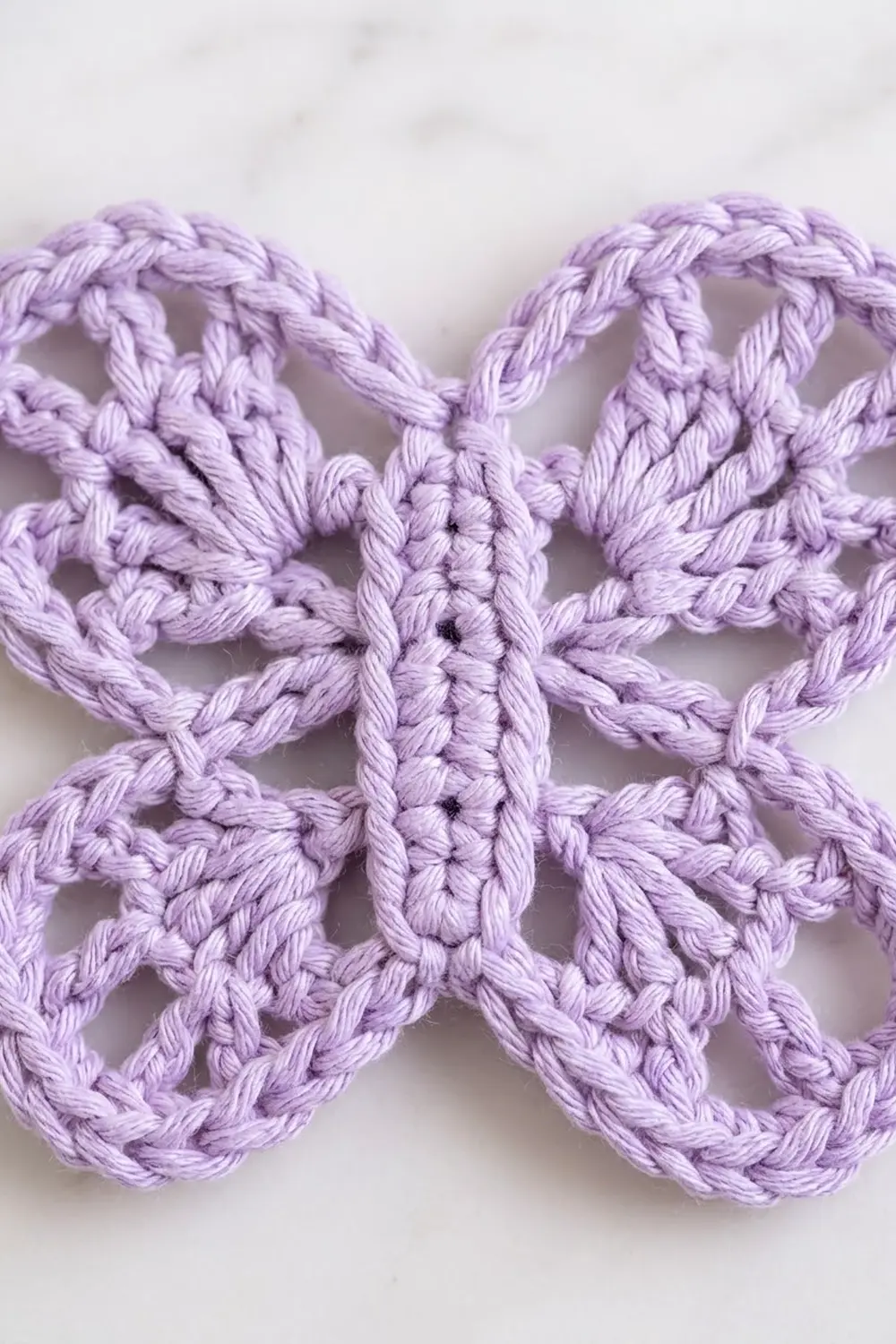
Butterfly Motif
Body (Round 1): Ch 11.
3 sc in 2nd ch from hook, sc in next 8 ch, 3 sc in last ch. Working along the opposite side of the foundation chain, sc in next 8 ch. Join with sl st to first sc. (22 sc)
For reference, number the stitches like this:
- Sts 1–3: the head end (st 2 is the head center)
- Sts 4–11: the right side
- Sts 12–14: the tail end (st 13 is the tail center)
- Sts 15–22: the left side
Turning the chain into a column of single crochet on both sides makes the solid, braided-looking body.
Wing fans (Round 2): Ch 1, sc in same st and in next 3 sts (sts 1–4).
- Upper right wing: [(tr, ch 2, tr) in next st, ch 2] twice, then (tr, ch 2, tr) in next st (sts 5–7). This gives 6 tr and 5 ch-2 sps.
- Right waist: sc in st 8.
- Lower right wing: [(dc, ch 2, dc) in next st, ch 2] twice, then (dc, ch 2, dc) in next st (sts 9–11). This gives 6 dc and 5 ch-2 sps.
- Tail: sc in sts 12–14.
- Lower left wing: same as the lower right wing, worked in sts 15–17.
- Left waist: sc in st 18.
- Upper left wing: same as the upper right wing, worked in sts 19–21.
- Finish: sc in st 22. Join to first sc.
Count: 10 sc, 12 tr, 12 dc and 20 ch-2 sps.
The treble fans make the larger upper wings and the double crochet fans make the smaller lower wings. The 5 sc at the head (sts 22, 1–4) and 3 sc at the tail keep the body showing between the wings.
Lace loops (Round 3): Sl st in next sc (the head center). Ch 1, sc in same st, ch 2.
- Upper right wing: sc in 1st ch-2 sp, [ch 5, sc in next ch-2 sp] 4 times. This gives 5 sc and 4 ch-5 loops.
- Right waist: ch 1, sc in waist sc, ch 1.
- Lower right wing: sc in 1st ch-2 sp, [ch 4, sc in next ch-2 sp] 4 times. This gives 5 sc and 4 ch-4 loops.
- Tail: ch 1, sc in tail center sc, ch 1.
- Lower left wing: same as the lower right wing.
- Left waist: ch 1, sc in waist sc, ch 1.
- Upper left wing: same as the upper right wing.
- Finish: ch 2, join to first sc.
Count: 24 sc, 8 ch-5 loops, 8 ch-4 loops, 6 ch-1 sps and 2 ch-2 sps.
Outline (Round 4): This is the rope-like scalloped edge. On each wing, loops are numbered in the order you reach them (L1 to L4).
Ch 1, (sc, ch 2, sc) in same st. This is the head tip. Then 2 sc in ch-2 sp.
- Upper right wing: sc in sc, (3 sc, ch 2, 3 sc) in L1 for the top tip, sc in sc, 7 sc in L2, sc in sc, (3 sc, ch 2, 3 sc) in L3 for the side tip, sc in sc, 7 sc in L4, sc in sc. (31 sc, 2 tips)
- Right waist: sc in ch-1 sp, sc in waist sc, sc in ch-1 sp. (3 sc)
- Lower right wing: sc in sc, 5 sc in L1, sc in sc, (2 sc, ch 2, 2 sc) in L2 for the side tip, sc in sc, 5 sc in L3, sc in sc, (2 sc, ch 2, 2 sc) in L4 for the bottom tip, sc in sc. (23 sc, 2 tips)
- Tail: sc in ch-1 sp, (sc, ch 2, sc) in tail sc for the tail tip, sc in ch-1 sp. (4 sc, 1 tip)
- Lower left wing: sc in sc, (2 sc, ch 2, 2 sc) in L1 for the bottom tip, sc in sc, 5 sc in L2, sc in sc, (2 sc, ch 2, 2 sc) in L3 for the side tip, sc in sc, 5 sc in L4, sc in sc. (23 sc, 2 tips)
- Left waist: as the right waist. (3 sc)
- Upper left wing: sc in sc, 7 sc in L1, sc in sc, (3 sc, ch 2, 3 sc) in L2 for the side tip, sc in sc, 7 sc in L3, sc in sc, (3 sc, ch 2, 3 sc) in L4 for the top tip, sc in sc. (31 sc, 2 tips)
- Finish: 2 sc in ch-2 sp, join to first sc. Fasten off.
Round 4 total: 6 head sc + 62 upper wing sc + 6 waist sc + 46 lower wing sc + 4 tail sc = 124 sc and 10 ch-2 tips.
Each side, from head tip to tail tip, has exactly 62 sc:
- Right side: 1 + 2 + 31 + 3 + 23 + 1 + 1 = 62
- Left side: the same, mirrored
Make All Pieces
You need 30 motifs in Lavender. Make Motif 1 in full. Make Motifs 2–30 through Round 3, then join them on Round 4.
Work row by row, left to right. Every butterfly faces the same way, with heads toward Row 1.
        Col A   Col B   Col C
Row 1:   1       2       3     <- tassel end
Row 2:   4       5       6
Row 3:   7       8       9
Row 4:  10      11      12
Row 5:  13      14      15
Row 6:  16      17      18
Row 7:  19      20      21
Row 8:  22      23      24
Row 9:  25      26      27
Row 10: 28      29      30     <- tassel end
Joining
Method: join-as-you-go on Round 4, connecting only at tips.
- Joining to the left neighbor: use a joining tip at this motif’s upper left side tip and lower left side tip. Connect them to the neighbor’s upper right side tip and lower right side tip. That is 2 join points.
- Joining to the motif above: use a joining tip at this motif’s head tip and both upper wing top tips. Connect them to the above motif’s tail tip and its two lower wing bottom tips. That is 3 join points.
Stitch-to-stitch logic: a joining tip (ch 1, sl st, ch 1) takes the place of a ch-2 tip, so every motif keeps exactly 124 sc. Tips only ever meet tip to tip. No stitches are added at any seam, and four motifs never share a single point.
Tension: keep the sl st loose. Before you sl st, lay both motifs flat with right sides up and check that nothing twists. A tight joining tip pulls the wing points into puckers.
Size checkpoint: after joining, the unblocked runner should measure roughly 12.75 in (32.4 cm) by 42.5 in (108.0 cm). Check the width after Row 2. It should be within 13–14 in (33.0–35.6 cm) after you pin it out.
Border: Built-In Edge and Tassels
Edge gauge: the outline round averages 5 sc per 1 in (2.5 cm) along its curves.
No added border: the runner has no separate border round. Its edge is the scalloped wing outline of the outer motifs. A border round would fill in the gaps between wings and hide the butterfly shapes.
Long side count: each long side is made of 10 motif sides of 62 sc each, so 10 x 62 = 620 sc. No stitches are added at the joins.
Why the math works: every side is exactly 62 sc from tip to tip, and every join replaces a ch-2 with ch 1, sl st, ch 1. So each motif’s footprint stays at 4.5 in (11.4 cm):
- Width: 3 x 4.5 in = 13.5 in (34.3 cm)
- Length: 10 x 4.5 in = 45 in (114.3 cm)
Tassels (make 6):
- Wrap yarn 40 times around the 4.5 in (11.4 cm) card.
- Slide a 12 in (30.5 cm) strand under the wraps at the top and tie it tightly.
- Cut the wraps at the bottom.
- Wrap a second strand 0.75 in (1.9 cm) below the top to form the head. Knot it and bury the ends inside the tassel.
- Trim the tassel evenly to 4 in (10.2 cm).
Attaching the tassels:
- Row 10 end: use the tie strand to attach one tassel to the tail tip of each Row 10 motif.
- Row 1 end: attach one tassel to the head tip of each Row 1 motif.
That gives 3 tassels on each short end. With tassels, the runner measures about 53 in (134.6 cm) end to end.
Final Blocking
- Weave in all ends along the outline stitches before blocking.
- Soak the runner in cool water for 10 minutes and gently press out the water. Don’t wring it.
- Lay it flat on the mats with right side up.
- Pin the 4 outer corners so the runner measures 13.5 in x 45 in (34.3 cm x 114.3 cm).
- Pin every tip, keeping head, tail and wing tips level across each row.
- Ease the wing outlines into smooth, rounded curves and straighten each body column.
- Leave the tassels unpinned. Comb out their strands.
- Let it dry completely, at least 24 hours.
Final Quality-Control Checklist
- 30 motifs, each with 124 sc and 10 tips
- Every butterfly faces the same direction
- 5 join points per interior motif, all lying flat and untwisted
- Width 13.5 in (34.3 cm) and length 45 in (114.3 cm)
- Body columns line up straight down each column
- 6 tassels, each 4 in (10.2 cm), evenly spaced
- No loose ends showing on the right side
Troubleshooting
- Wings cup or ruffle: your Round 4 tension is too loose, or you worked extra sc in the loops. Recount to 31 sc per upper wing and 23 sc per lower wing.
- Motif curls into a bowl: your Round 3 chains are too tight. Loosen your chain tension or go up a hook size for that round only.
- Runner skews diagonally: one join was made to the wrong tip. Check the side tip pairings first.
- Joins pucker: your sl st is too tight. Redo it with a looser loop.
- Body looks lumpy: make sure you worked into both sides of the foundation chain consistently.
Care
Hand wash in cool water with a mild detergent, then lay flat to dry and reshape the tips. Press with a warm iron through a cloth if needed. Never press the tassels.
Final Notes
The measurement chain is simple:
- 5 sc per 1 in (2.5 cm) gives a 2 in (5.1 cm) body.
- Four rounds give a 4.5 in (11.4 cm) blocked motif with 62 sc per side.
- 3 x 10 motifs give 13.5 in x 45 in (34.3 cm x 114.3 cm).
- Six 4 in (10.2 cm) tassels finish both ends.
Check your first motif, keep your joins relaxed, and the rest follows naturally.
Happy crocheting!