
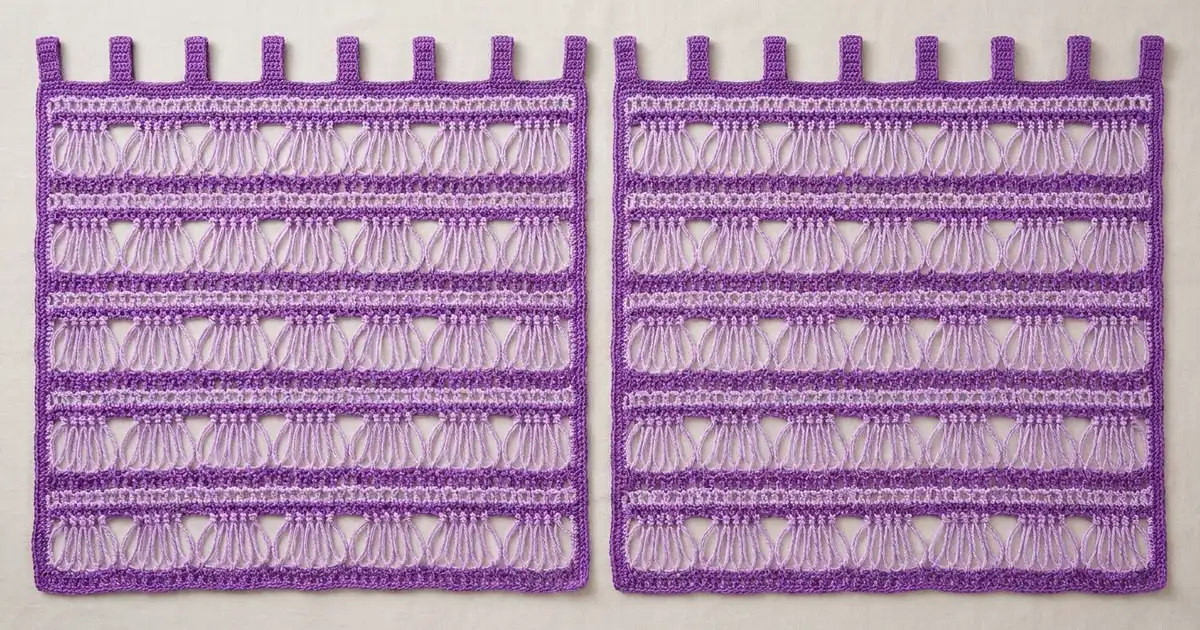
These curtain panels pair airy broomstick lace with crisp striped bands. Tall, light lavender loops gather into neat groups of five. Deep violet single crochet bands sit between them, along with narrow lavender mesh rows that let the light through.
The palette is just two shades of purple: a deep violet (Color A) and a soft lavender (Color B). On a window, the stripes look tidy and graphic, while the loops keep everything light and soft. The pattern uses US crochet terms throughout.
Each finished panel measures 31 in (78.7 cm) wide by 80 in (203.2 cm) long, not counting the hanging tabs. Seven tabs along the top slide straight onto a curtain rod. The photo shows a matching pair hung side by side.
Each panel is one rectangle worked in rows from the bottom up. It has a repeating five-row stripe sequence, a two-round single crochet border, and the tabs are worked straight off the top border. The two panels are never joined to each other.
Finished Size and Construction
- Finished panel size: 31 in (78.7 cm) wide x 80 in (203.2 cm) long, plus tabs
- Skill level: Intermediate (basic broomstick lace)
- Terminology: US crochet terms
- Yarn weight: Worsted (#4) cotton
- Hook: 5 mm (US H-8)
- Broomstick needle: 15 mm (US 19) knitting needle or dowel
- Number of pieces: 2 identical panels, each worked as one single piece
- Layout: Two panels hung side by side on one rod; not joined
- Panel body before border: 30 in (76.2 cm) x 79 in (200.7 cm)
- Border depth: 0.5 in (1.3 cm) on every side
- Tabs: 7 per panel, each 2 in (5.1 cm) wide, folded into a 2.5 in (6.4 cm) loop
Materials
Pick a smooth, mercerized or combed worsted cotton, about 190 m (208 yd) per 100 g. Cotton hangs straight, doesn’t pill much in sunlight, and shows the loops clearly. Stay away from very stretchy acrylics, because a long panel will keep growing as it hangs.
For one panel:
– Color A, deep violet: 380 g (722 m)
– Color B, light lavender: 290 g (551 m)
For the pair shown:
– Color A, deep violet: 760 g (1444 m)
– Color B, light lavender: 580 g (1102 m)
These quantities include a margin of about 15% for your swatch, tails and tension differences.
Tools:
– 5 mm (US H-8) crochet hook
– 15 mm (US 19) broomstick needle, large knitting needle or smooth dowel
– Tapestry needle
– Stitch markers
– Tape measure
– Rust-proof pins and a large blocking surface (a bed or clean floor works)
Abbreviations (US Terms)
- ch – chain
- sl st – slip stitch
- sc – single crochet
- dc – double crochet
- sk – skip
- st(s) – stitch(es)
- sp – space
- yo – yarn over
- RS / WS – right side / wrong side
Special stitch: Broomstick Lace Group (BLG). Put the hook through the next 5 loops on the needle together and slide them off the needle. Yo, pull a loop through all 5, yo, pull through both loops on the hook (first sc made). Then work 4 more sc into the center of the same group. Each BLG uses 5 loops and makes 5 sc.
Gauge and Checkpoints
Body gauge: 14 sc and 16 rows = 4 in (10.2 cm) with the 5 mm hook.
Stripe repeat: One five-row repeat measures 3 in (7.6 cm) tall. The heights are: mesh row 0.5 in (1.3 cm), each sc row 0.25 in (0.6 cm), and the loop row plus work-off row together 2 in (5.1 cm).
Make a test swatch before you start the panel. Chain 36, then work the foundation row (35 sc) and one full stripe repeat, using 7 BLG instead of 21. The swatch should measure 10 in (25.4 cm) wide and 3.25 in (8.3 cm) tall.
Checkpoints for the panel:
– After the foundation row: 30 in (76.2 cm) wide
– After 1 repeat: 3.25 in (8.3 cm) tall
– After 5 repeats: 15.25 in (38.7 cm) tall
– After 13 repeats: 39.25 in (99.7 cm) tall
– After 26 repeats: 78.25 in (198.8 cm) tall
– Finished body: 79 in (200.7 cm) tall
If your swatch is too big, go down half a hook size. If it’s too small, go up half a size. If only the broomstick band is off, change the needle size and leave the hook alone. A 12 mm needle gives shorter loops, and a 19 mm needle gives longer ones.
Panel Pattern
Work all rows flat. At every color change, cut the old color and leave a 6 in (15.2 cm) tail. Join the new color where the row tells you to. Weave all tails into the side edges, where the border will hide them.
Foundation (Row 1): With A, ch 106. Sc in the 2nd ch from the hook and in each ch across. (105 sc) Fasten off A.
The stitch count of 105 matters because it is both a multiple of 5, for the BLGs, and an odd number, for the mesh.
Stripe Repeat (Rows 2–6)
Row 2 (mesh, B): Join B in the first st. Ch 4 (counts as dc + ch 1), sk next st, dc in next st, ch 1, sk next st; repeat from * to the last st, dc in the last st. (53 dc + 52 ch-1 sps = 105 sts) Fasten off B.
Row 3 (sc, A): Join A in the first st. Ch 1, sc in each dc and in each ch-1 sp across. (105 sc) Fasten off A.
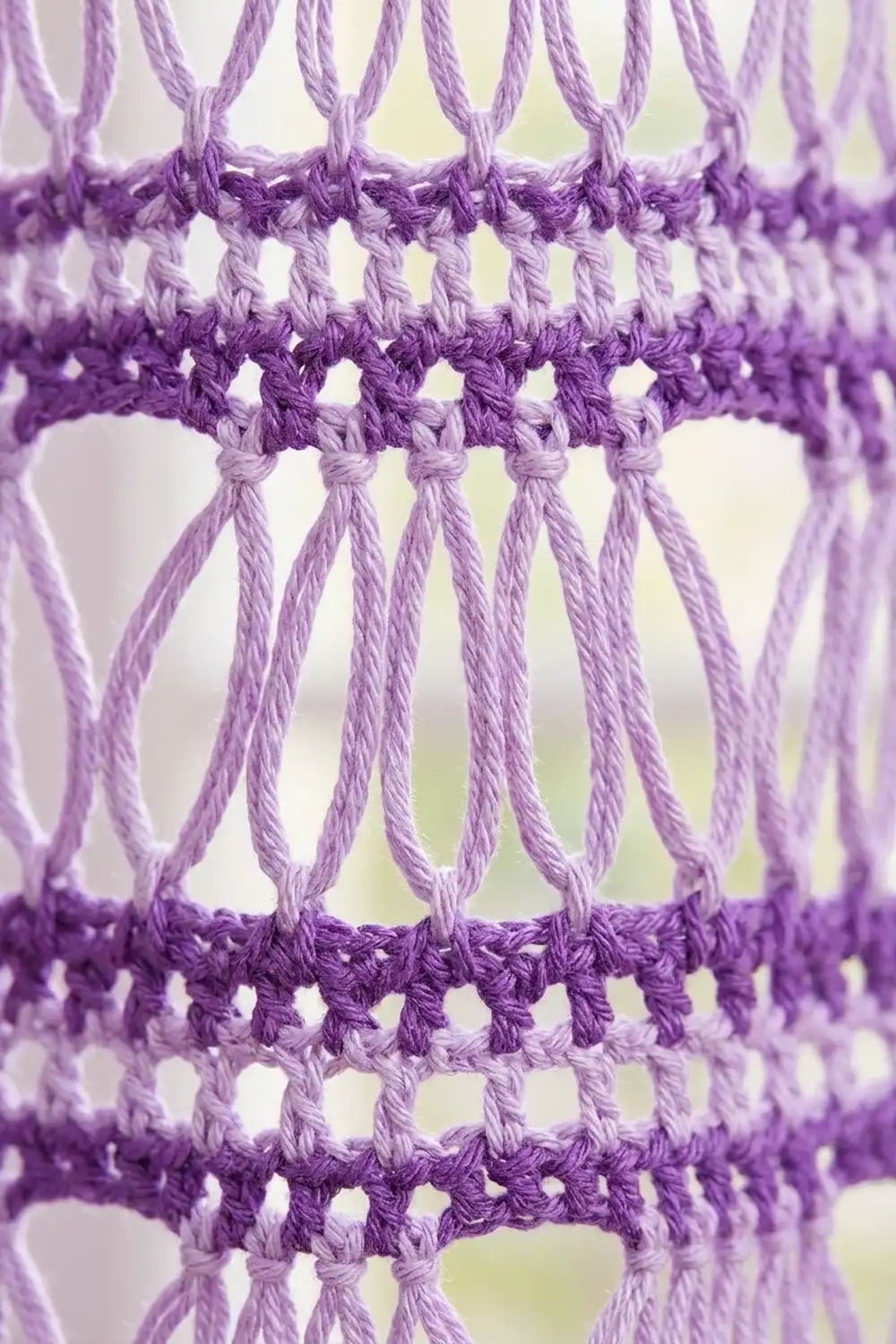
Row 4 (loop row, B): With RS facing, join B with a sl st in the first sc at the left edge. Pull up the loop on your hook and slide it onto the needle; this is loop 1. Working from left to right, insert the hook in the next sc, pull up a loop and slide it onto the needle; repeat across. (105 loops on the needle) Cut B, leaving the last loop on the needle.
Row 5 (work-off row, A): Keep the RS facing and don’t turn. Start at the right end, where the last loops were placed. Insert the hook through the first 5 loops together, slide them off the needle, pull up a loop of A, ch 1, and work 5 sc into the center of the group. BLG in the next 5 loops; repeat across to the left edge. (21 groups x 5 sc = 105 sc)
Each group of 5 lavender loops is now pulled together at the top by a violet band. This is what gives the teardrop clusters.
Row 6 (sc, A): Ch 1, turn. Sc in each sc across. (105 sc) Fasten off A.
Rows 2–6 make one stripe repeat, 3 in (7.6 cm) tall. Rows 5 and 6 together give the wider dark violet band above each lace row.
Rows 7–131: Repeat Rows 2–6 another 25 times, for 26 repeats in total. The panel is now 78.25 in (198.8 cm) tall.
Top Finish
Row 132 (mesh, B): Work as Row 2. (105 sts)
Row 133 (sc, A): Work as Row 3. (105 sc) Do not fasten off.
The body is now 133 rows and measures 30 in (76.2 cm) x 79 in (200.7 cm).
Make Both Panels
Work two panels, both exactly as written. Each one needs 380 g (722 m) of A and 290 g (551 m) of B. Before you border either panel, check that the two bodies are the same height to within 0.5 in (1.3 cm).
Hanging layout on the rod, as seen from the room:
[ Panel 1 ][ Panel 2 ]
 31 x 80 in  31 x 80 in
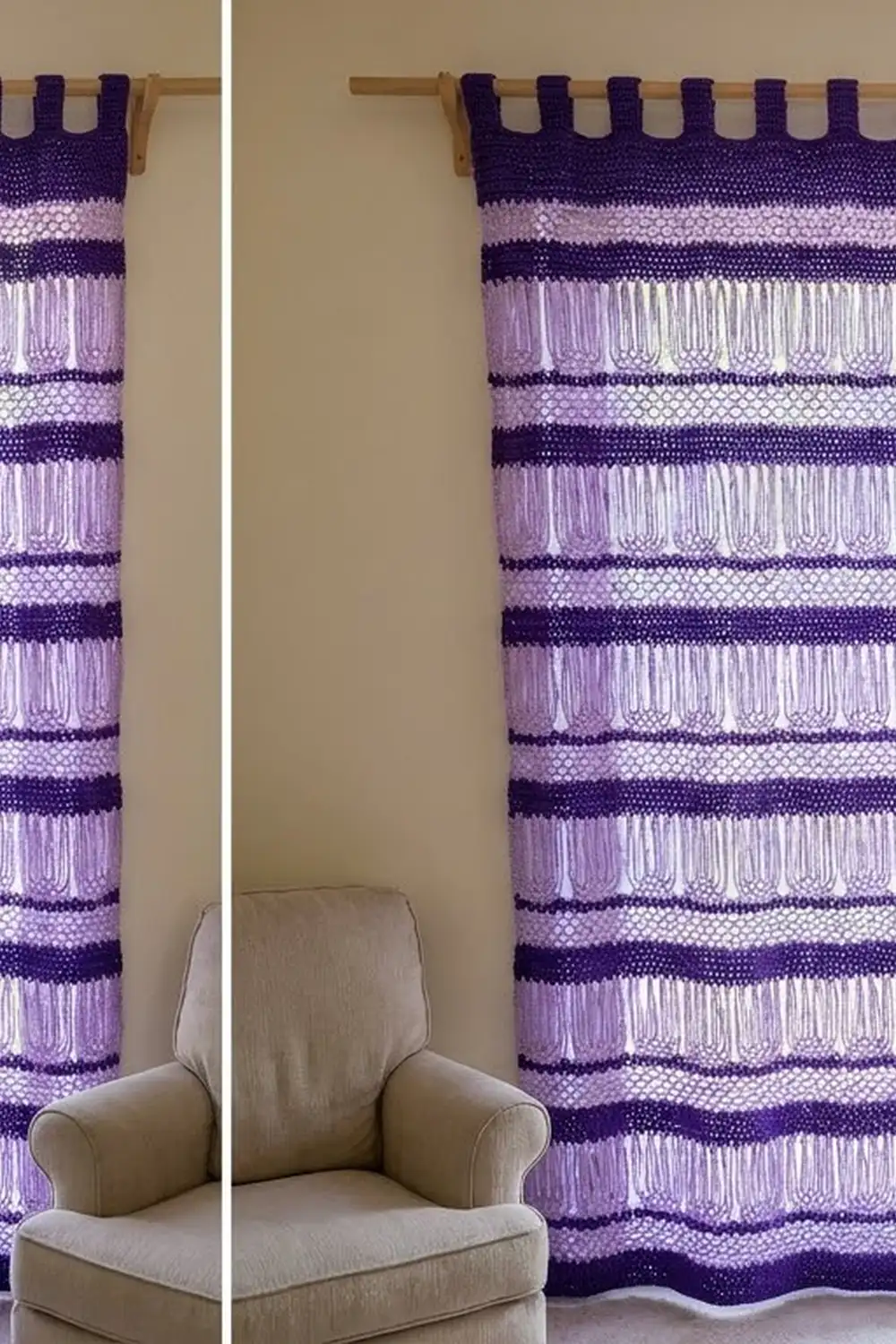
The panels are hung separately, not joined, so you can draw one aside on its own as shown.
Border
Border gauge: The top and bottom edges use 1 sc per st (3.5 sc per inch). The side edges use 10 sc per 3 in (7.6 cm) stripe repeat. That is a little firmer than the body gauge, and it keeps the long sides from stretching and rippling as the curtain hangs.
Side counts per row type:
– Each sc row end: 1 sc
– Each mesh row end: 2 sc
– Each broomstick band (Rows 4–5 together): 6 sc
So one repeat gets Row 2 mesh (2) + Row 3 sc (1) + Rows 4–5 band (6) + Row 6 sc (1) = 10 sc.
Each side then gets the foundation row (1) + 26 repeats (260) + Row 132 (2) + Row 133 (1) = 264 sc between the corners.
Corner rule: Work 3 sc into each corner st. The middle sc of the three is the corner stitch, and it counts in both sides it touches. All per-side counts below include both corner stitches.
Round 1 (A): Continuing from Row 133, ch 1, then work along the top edge: 3 sc in the first st, sc in the next 103 sts, 3 sc in the last st. Rotate and work 264 sc down the side edge. Along the bottom, work into the free loops of the foundation chain: 3 sc in the first ch, sc in the next 103 ch, 3 sc in the last ch. Work 264 sc up the second side. Join with a sl st to the first sc.
- Top and bottom: 107 sc each, including corners
- Sides: 268 sc each, including corners
- Round total: 746 sc
Check: 2 x 10⁷ + 2 x 268 − 4 shared corners = 746. Another way: 105 + 105 + 264 + 264 + (4 corners x 2 extra) = 746.
Round 2 (A): Ch 1, sc in each st around, working 3 sc in each corner st. Join.
- Top and bottom: 109 sc each, including corners
- Sides: 270 sc each, including corners
- Round total: 754 sc (746 + 4 corners x 2 extra)
Do not fasten off. The two rounds add 0.5 in (1.3 cm) on each side, so the panel becomes 31 in (78.7 cm) x 80 in (203.2 cm).
Hanging Tabs
There are 109 sts across the top of Round 2, counting both corner sts as st 1 and st 109. The layout is 7 tabs of 7 sts with 6 gaps of 10 sts: 7 x 7 + 6 x 10 = 49 + 60 = 109. Mark the tab positions: sts 1–7, 18–24, 35–41, 52–58, 69–75, 86–92 and 103–109.
Each tab: Join A in the first st of the tab. Ch 1, sc in the same st and in the next 6 sts. (7 sc) Turn. Work 19 more rows of 7 sc, for 20 rows in total, 5 in (12.7 cm). Fasten off and leave a 12 in (30.5 cm) tail. Fold the tab to the WS and whipstitch the last row to the base of the tab, along the top of Round 1. This makes a 2.5 in (6.4 cm) loop.
Each tab is 2 in (5.1 cm) wide, and the gaps between tabs are 10 sts wide.
Final Blocking
- Weave in every remaining tail along the side edges, under the border sts.
- Soak the panel in cool water with a little wool wash for 15 minutes.
- Press the water out gently. Don’t wring it, or the long loops will twist.
- Roll the panel in towels to take out most of the moisture.
- Lay it flat on the blocking surface and pin it to 31 in (78.7 cm) x 80 in (203.2 cm).
- Run your fingers down each lace band to straighten the loop groups so every cluster stands upright.
- Leave it to dry completely, then do the same for the second panel.
- Optional: hang the panels and let them settle for a day before you judge the final length.
Final Quality-Control Checklist
- [ ] Every row has 105 sts; every loop row has 105 loops and 21 groups
- [ ] 26 stripe repeats plus the top mesh and sc rows (133 rows)
- [ ] Body measures 30 in (76.2 cm) x 79 in (200.7 cm) before the border
- [ ] Border Round 1 = 746 sc; Round 2 = 754 sc
- [ ] Both side edges hang straight, with no waving or pulling
- [ ] 7 tabs per panel, evenly spaced and sewn securely
- [ ] Both panels match in length to within 0.5 in (1.3 cm)
- [ ] All tails hidden under the border
Troubleshooting
Loops lean or twist. You are probably pulling the loops up at different tensions. Snug each loop against the needle before you take the next one.
Wrong number of groups. Count the loops before you start the work-off row. You need exactly 105 for 21 groups.
Panel narrows at the lace bands. The BLG sc are too tight. Work them loosely into the center of each group, or use a 5.5 mm hook just for Row 5.
Side edges ripple. Too many border sts. Rip back and stick to 10 sc per repeat.
Side edges pull in. Too few border sts or too-tight sc. Check the count of 264 per side and relax your tension.
Panel too long after hanging. Cotton can drop a little. Take out one repeat before the top finish, which removes 3 in (7.6 cm), and reduce the side count by 10 sc.
Care
Hand wash or machine wash on a gentle cold cycle inside a large mesh laundry bag. Reshape and dry flat; don’t hang the panel while it’s wet.
Final Notes
The measurement chain is simple. 105 sc at 14 sc per 4 in gives a 30 in (76.2 cm) width. 26 repeats of 3 in (7.6 cm), plus 1 in (2.5 cm) of foundation and top rows, give a 79 in (200.7 cm) body. Two border rounds then bring it to 31 in (78.7 cm) x 80 in (203.2 cm), and seven tabs carry it on the rod. Check your swatch, count your loops, and the two panels will hang evenly side by side.
Happy crocheting!