

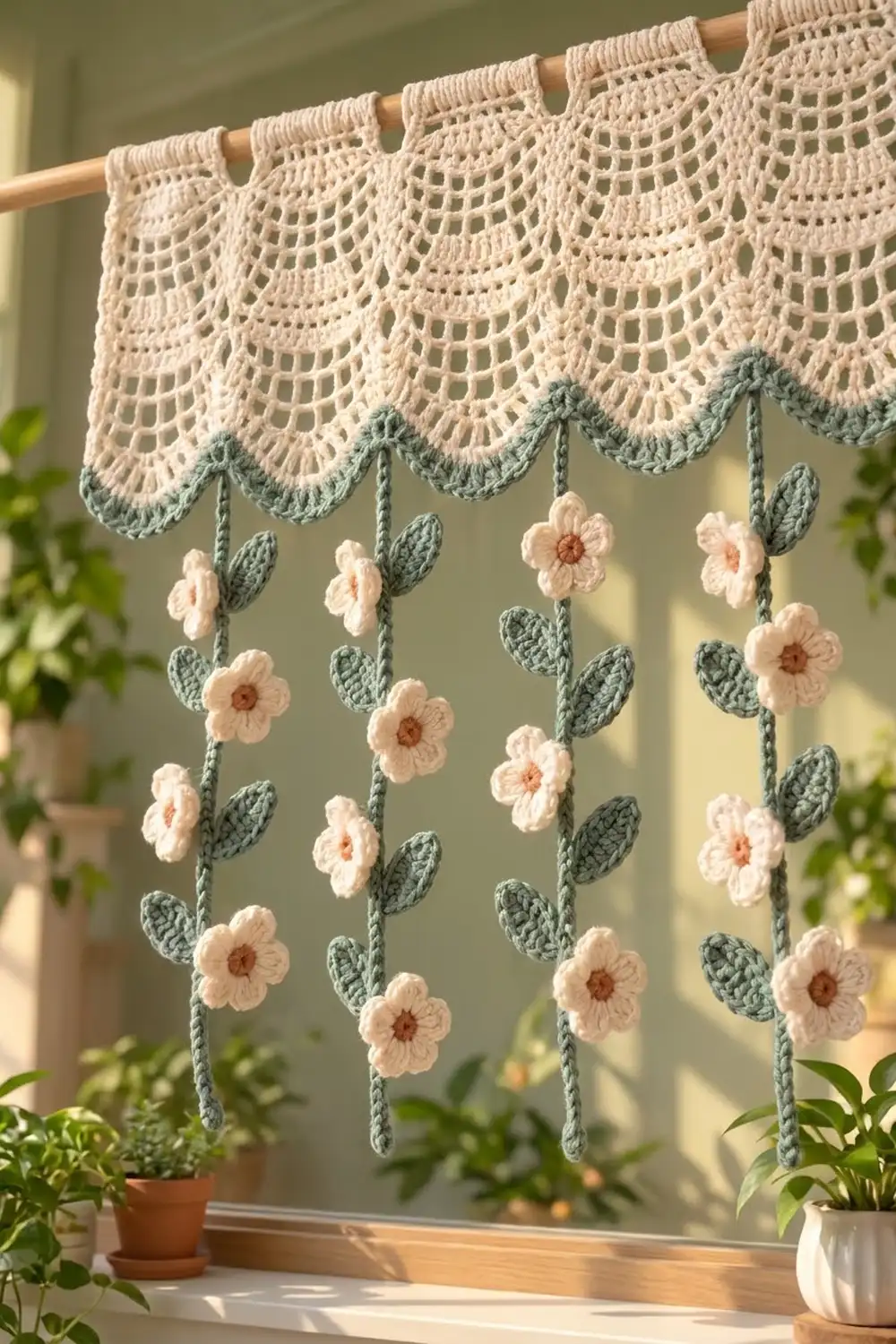
The Meadow Vine Lace Valance is a cream lace window topper with a scalloped sage hem and six trailing flower vines. It has a mesh grid, seven lace fans, and soft vines that move with the air.
The colors are calm and garden-like: cream cotton for the lace and petals, sage green for the hem, stems, and leaves, and a little terracotta for the flower centers. The style is cottage and vintage.
This pattern uses US crochet terms. The finished panel measures 28 in (71.1 cm) wide and 8.5 in (21.6 cm) deep at the scallop centers. Each vine hangs 17 in (43.2 cm) below the hem.
You work the panel flat in rows from the top down and shape the scallops in the last two rows. Then you add a 3-row sage border and rod tabs. Finally, you make the stems, leaves, and flowers and sew everything in place.
Finished Size and Construction
- Finished size: 28 in (71.1 cm) wide x 8.5 in (21.6 cm) deep at scallop centers, plus tabs and vines
- Skill level: Intermediate
- Terminology: US crochet terms
- Yarn weight: Sport (#2) cotton
- Hook: 3.0 mm (US C/2 or D/3)
- Number of pieces: 1 panel, 6 stems, 30 leaves, 24 flowers
- Layout: 7 fan repeats across, 8 tabs on top, 6 vines hanging from the scallop junctions
- Piece size (one repeat): 24 sts = 4 in (10.2 cm) wide
- Size before border: 28 in (71.1 cm) x 8 in (20.3 cm) at scallop centers, 7 in (17.8 cm) at junctions
- Border depth: 0.5 in (1.3 cm)
- Vine length: 18 in (45.7 cm) per stem, 17 in (43.2 cm) visible
Materials
Use a smooth mercerized or combed sport-weight cotton, about 150 m (164 yd) per 50 g. Cotton shows lace clearly and holds its shape after blocking.
- Cream: 150 g, about 450 m (panel, tabs, flower petals)
- Sage green: 50 g, about 150 m (border, stems, leaves)
- Terracotta: 10 g, about 30 m (flower centers)
Tools:
- 3.0 mm crochet hook
- Tapestry needle and scissors
- Stitch markers (at least 8)
- Measuring tape
- Blocking mats and rust-proof pins
- Wooden rod or dowel up to 5/8 in (1.6 cm) in diameter
All quantities include a margin of about 30 percent for your swatch and for tension differences.
Abbreviations (US Terms)
- ch – chain
- sl st – slip stitch
- sc – single crochet
- hdc – half double crochet
- dc – double crochet
- tr – treble crochet
- sk – skip
- sp – space
- st(s) – stitch(es)
- rep – repeat
- RS / WS – right side / wrong side
- rev sc – reverse single crochet
Special stitch – rev sc (crab stitch): With RS facing, work from left to right. Insert your hook in the next st to the right, yo, pull up a loop, yo, and pull through both loops. This makes the twisted, rope-like texture on the sage hem.
Counting rule: Each dc and each ch counts as 1 st. A ch-1 sp counts as 1 st, and a ch-3 sp counts as 3 sts. The beginning ch-4 counts as 1 dc plus 1 ch.
Gauge and Checkpoints
Gauge: 24 dc and 9 dc rows = 4 in (10.2 cm) square with a 3.0 mm hook.
Test one repeat first. Ch 26 and work Rows 1–17 over 25 sts (one repeat plus the edge st). Across the 24 repeat sts, the swatch should measure 4 in (10.2 cm).
Checkpoints for the full panel:
- After Row 1: 28 in (71.1 cm) wide.
- After Row 4: 1.5 in (3.8 cm) deep.
- After Row 15: 6.5 in (16.5 cm) deep.
- After Row 17: 7 in (17.8 cm) at junctions, 8 in (20.3 cm) at scallop centers.
- After the border: 8.5 in (21.6 cm) at scallop centers.
If your swatch is too big, go down 0.5 mm in hook size. If it is too small, go up 0.5 mm. Don’t change the stitch count, because the 24-st repeat sets the scallop, tab, and vine positions.
Panel
Use cream. Work in rows, and turn at the end of every row.
Foundation: Ch 170.
Row 1 (RS): Sc in 2nd ch from hook and in each ch across. (169 sc)
That is 7 repeats of 24 sts plus 1 edge st. Place markers in sts 1, 25, 49, 73, 97, 121, 145, and 169. These are the junction points.
Mesh Band
Row 2: Ch 4 (counts as dc + ch 1 here and throughout), sk next sc, dc in next sc, *ch 1, sk next sc, dc in next sc; rep from * across. (85 dc + 84 ch-1 sps = 169 sts)
Rows 3–4: Ch 4, dc in next dc, *ch 1, dc in next dc; rep from * across. (169 sts)
Fan Section
Row 5: Ch 4, dc in next dc, ch 1, dc in next dc, *ch 7, sk next 3 dc and 4 ch-1 sps, dc in next dc, ch 7, sk next 3 dc and 4 ch-1 sps, dc in next dc, [ch 1, dc in next dc] 4 times; rep from * 5 more times, ch 7, sk next 3 dc and 4 ch-1 sps, dc in next dc, ch 7, sk next 3 dc and 4 ch-1 sps, dc in next dc, [ch 1, dc in next dc] 2 times. (169 sts; 24 per repeat)
Row 6: Ch 4, dc in next dc, ch 1, dc in next dc, *7 dc in ch-7 sp, dc in next dc, 7 dc in next ch-7 sp, dc in next dc, [ch 1, dc in next dc] 4 times; rep from * 5 more times, 7 dc in ch-7 sp, dc in next dc, 7 dc in next ch-7 sp, dc in next dc, [ch 1, dc in next dc] 2 times. (169 sts; each repeat = 17-dc fan block + 7 mesh sts)
Row 7 (spoke row A): Ch 4, dc in next dc, ch 1, dc in next dc, *[ch 3, sk next 3 dc, dc in next dc] 4 times, [ch 1, dc in next dc] 4 times; rep from * 5 more times, [ch 3, sk next 3 dc, dc in next dc] 4 times, [ch 1, dc in next dc] 2 times. (169 sts; 5 spokes per fan)
Row 8 (spoke row B): Ch 4, dc in next dc, ch 1, dc in next dc, *[ch 3, dc in next dc] 4 times, [ch 1, dc in next dc] 4 times; rep from * 5 more times, [ch 3, dc in next dc] 4 times, [ch 1, dc in next dc] 2 times. (169 sts)
Row 9 (band row): Ch 4, dc in next dc, ch 1, dc in next dc, *[3 dc in ch-3 sp, dc in next dc] 4 times, [ch 1, dc in next dc] 4 times; rep from * 5 more times, [3 dc in ch-3 sp, dc in next dc] 4 times, [ch 1, dc in next dc] 2 times. (169 sts; 17-dc band per fan)
Rows 10–15: Work Row 7, Row 8, Row 9, Row 7, Row 8, and Row 9. (169 sts each)
The panel now measures 6.5 in (16.5 cm) deep.
Scallop Shaping
Work 1 st into each dc and each ch-1 sp.
Row 16: Ch 1, *sc in next 3 sts, hdc in next 3 sts, dc in next 3 sts, tr in next 7 sts, dc in next 3 sts, hdc in next 3 sts, sc in next 2 sts; rep from * 6 more times, sc in last st. (24 sts per repeat x 7 + 1 = 169 sts)
Row 17: Rep Row 16. (169 sts)
The sequence is symmetrical, so it lines up when worked from either direction. The short sc sit at the junctions and the tall tr sit at the scallop centers. Fasten off.
Rod Tabs
With RS facing, work into the free loops of the foundation chain. Each tab is 5 sts wide, about 0.8 in (2.0 cm).
Tab positions are sts 1–5, 23–27, 47–51, 71–75, 95–99, 119–123, 143–147, and 165–169. The six middle tabs are centered on the junction markers.
For each tab: Join cream in the first st of the tab. Ch 1, sc in the same st and in the next 4 sts. (5 sc) Work 13 more rows of 5 sc, for 14 rows total, about 2.8 in (7.1 cm). Fasten off, leaving a 10 in (25.4 cm) tail. Fold the tab to the WS and sew the last row to the top of Row 1. Each loop stands about 1.4 in (3.6 cm) tall.
Vines, Leaves, and Flowers
Stem (make 6)
With sage, ch 109.
Row 1: Sc in 2nd ch from hook and in each ch across. (108 sc, 18 in / 45.7 cm) Fasten off, leaving a 12 in (30.5 cm) tail at the top end.
Leaf (make 30)
With sage, ch 9.
Rnd 1: Sc in 2nd ch from hook, hdc in next ch, dc in next 4 ch, hdc in next ch, (sc, ch 2, sc) in last ch for the tip. Rotate and work along the opposite side of the chain: hdc in next ch, dc in next 4 ch, hdc in next ch, sc in last ch. Sl st to first sc. (16 sts + ch-2 tip)
The leaf is a pointed oval about 1.8 in (4.6 cm) long and 0.9 in (2.3 cm) wide, with a center vein. Fasten off, leaving an 8 in (20.3 cm) tail.
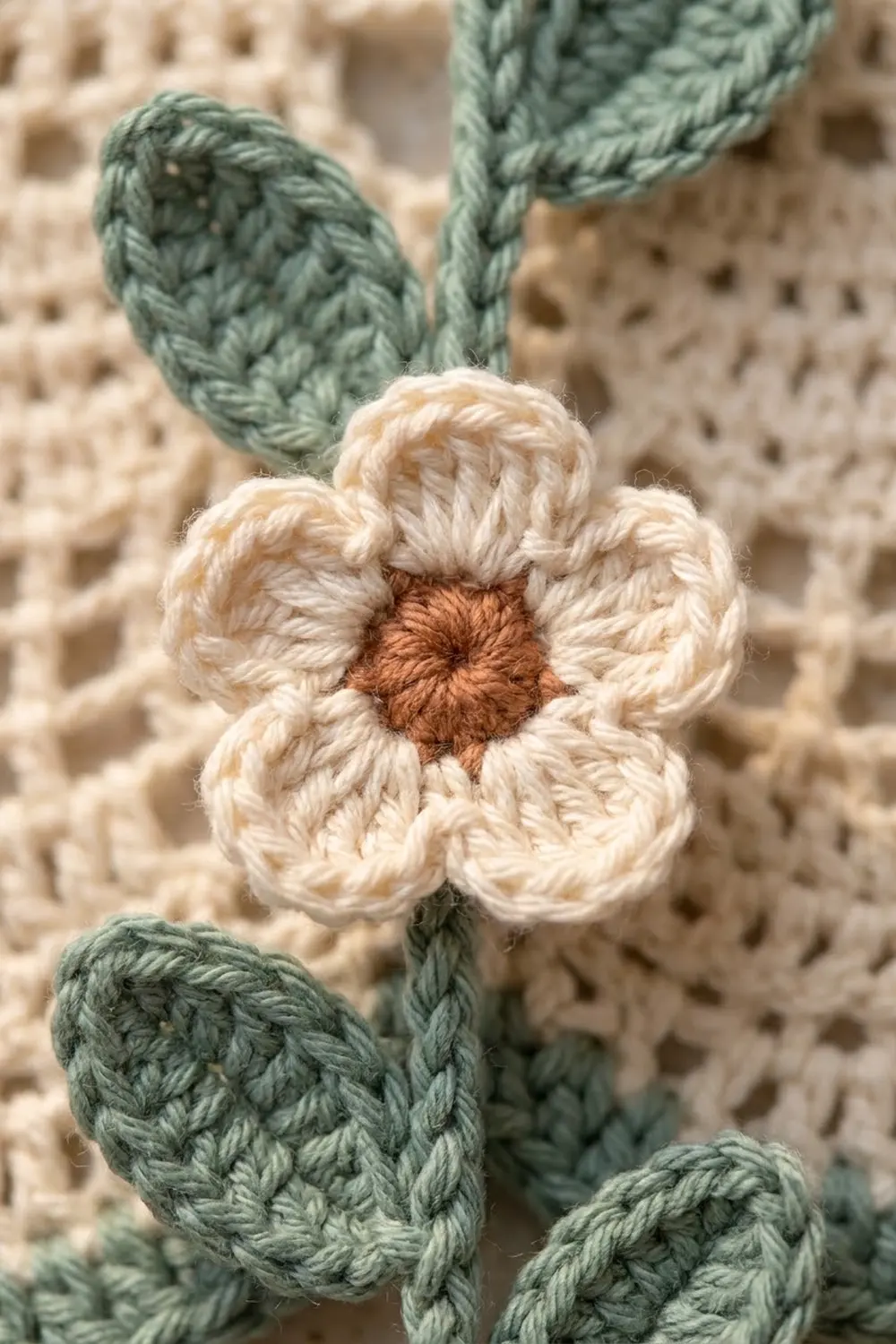
Flower (make 24)
Rnd 1 (terracotta): Make a magic ring and work 10 sc in the ring. Pull the ring closed and sl st to the first sc. (10 sc) Fasten off.
Rnd 2 (cream): Join cream in any st. *Sc in next st, (hdc, 3 dc, hdc) in next st; rep from * 4 more times. Sl st to first sc. (5 petals, 30 sts)
Each flower is about 1.5 in (3.8 cm) across. Leave an 8 in (20.3 cm) cream tail.
Make All Pieces
Quantities per color:
- Cream: 1 panel with 8 tabs, plus petals for 24 flowers
- Sage: panel border, 6 stems, 30 leaves
- Terracotta: centers for 24 flowers
Panel layout, left to right (T = tab, S = scallop, V = vine):
TOP:      T    T    T    T    T    T    T    T
HEM:        S1   S2   S3   S4   S5   S6   S7
VINES:         V1   V2   V3   V4   V5   V6
Each stem, top to bottom (stem sc numbers):
sc 1-6:  overlap behind border
sc 12:   LEAF left
sc 24:   FLOWER
sc 36:   LEAF right
sc 48:   FLOWER
sc 60:   LEAF left
sc 72:   FLOWER
sc 84:   LEAF right
sc 96:   FLOWER
sc 108:  END LEAF pointing down
Each stem gets 5 leaves and 4 flowers, so the 6 stems need 30 leaves and 24 flowers.
Joining
Sew all pieces with whipstitch, using each piece’s own tail.
Leaves to stems: Sew the base of each leaf to the stem sc listed above, angled upward and outward at about 45 degrees. Measured from the top of the stem, the leaves sit at 2 in (5.1 cm), 6 in (15.2 cm), 10 in (25.4 cm), and 14 in (35.6 cm). Sew the end leaf to sc 108 so it continues the line of the stem.
Flowers to stems: Center each flower on the front of the stem at 4 in (10.2 cm), 8 in (20.3 cm), 12 in (30.5 cm), and 16 in (40.6 cm). Sew through the terracotta center only, so the petals stay free.
Stems to panel: Each stem hangs from one of the six inner junction markers (sts 25, 49, 73, 97, 121, and 145). On the WS, lay sc 1–6 of the stem behind the border, centered under the marker. That is a 1 in (2.5 cm) overlap. Sew through all 3 border rows.
Tension advice: Keep your sewing snug but not tight. If you pull too hard, the scallops will pucker or the stems will twist.
Size checkpoint: Lay the valance flat. The panel should still measure 28 in (71.1 cm) wide, and each vine should hang 17 in (43.2 cm) below the hem.
Border
Work the border before you sew on the stems. Use sage, and work across the bottom edge only, into the 169 sts of Row 17.
Border gauge: 6 sc = 1 in (2.5 cm), the same as the panel.
Border Row 1 (RS): With RS facing, join sage in the first st of Row 17. Ch 1, sc in each st across. (169 sc: 24 per scallop x 7 + 1) Turn.
Border Row 2 (WS): Ch 1, hdc in each st across. (169 hdc) Turn.
Border Row 3 (RS): Ch 1, rev sc in each st across, working left to right. (169 rev sc) Fasten off.
Why the math works: Every panel and border row has 169 sts, which is 7 repeats of 24 plus 1 edge st. Each scallop gets exactly 24 border sts. The junctions fall on sts 25, 49, 73, 97, 121, and 145, so the six vines line up under the six middle tabs. Working 1 st into each st keeps the border the same length as the edge.
Final Blocking
- Weave in all remaining ends through stitches of the same color.
- Soak the valance in cool water for 10 minutes. Roll it in a towel to press out the water; do not wring.
- On blocking mats, pin the panel to 28 in (71.1 cm) wide with the top edge straight.
- Pin each scallop tip so the center depth is 8.5 in (21.6 cm).
- Open the fan spokes evenly and keep the mesh squares square.
- Lay each vine straight at 17 in (43.2 cm) and spread out the leaves and petals.
- Let the valance dry completely, then remove the pins.
Final Quality-Control Checklist
- The panel is 28 in (71.1 cm) wide.
- All seven scallops are the same size, 8.5 in (21.6 cm) deep at the center.
- All eight tabs are evenly spaced and securely sewn.
- There are six vines, one at each inner junction.
- Each vine has 5 leaves and 4 flowers in the listed order, with the leaves alternating sides.
- The rev sc hem is even, with no skipped stitches.
- No tails show on the RS.
Troubleshooting
Panel is wider than 28 in (71.1 cm): Your foundation chain is too loose. Recheck your gauge, or use a smaller hook for the chain only.
Fans lean to one side: You probably skipped the wrong number of stitches. Count 24 sts per repeat on Rows 5, 7, and 9.
Scallops look flat: Check that the 7 tr sit at the center of each repeat, then pin each scallop tip during blocking.
Border ruffles or pulls in: Go down or up 0.5 mm for the border rows.
Stems curl: Steam them lightly and let them dry hanging, with a small weight at each tip.
Care
Hand wash in cool water with mild soap. Press out the water, then dry flat, reshaping the scallops and vines.
Final Notes
The measurement chain is short. Check that 24 sts = 4 in (10.2 cm); seven repeats then give 28 in (71.1 cm). Fifteen rows bring the panel to 6.5 in (16.5 cm). The shaping rows make it 8 in (20.3 cm) deep at the scallop centers, and the border finishes it at 8.5 in (21.6 cm).
Six stems of 108 sc each hang 17 in (43.2 cm) below the hem and carry 30 leaves and 24 flowers.
Happy crocheting!