

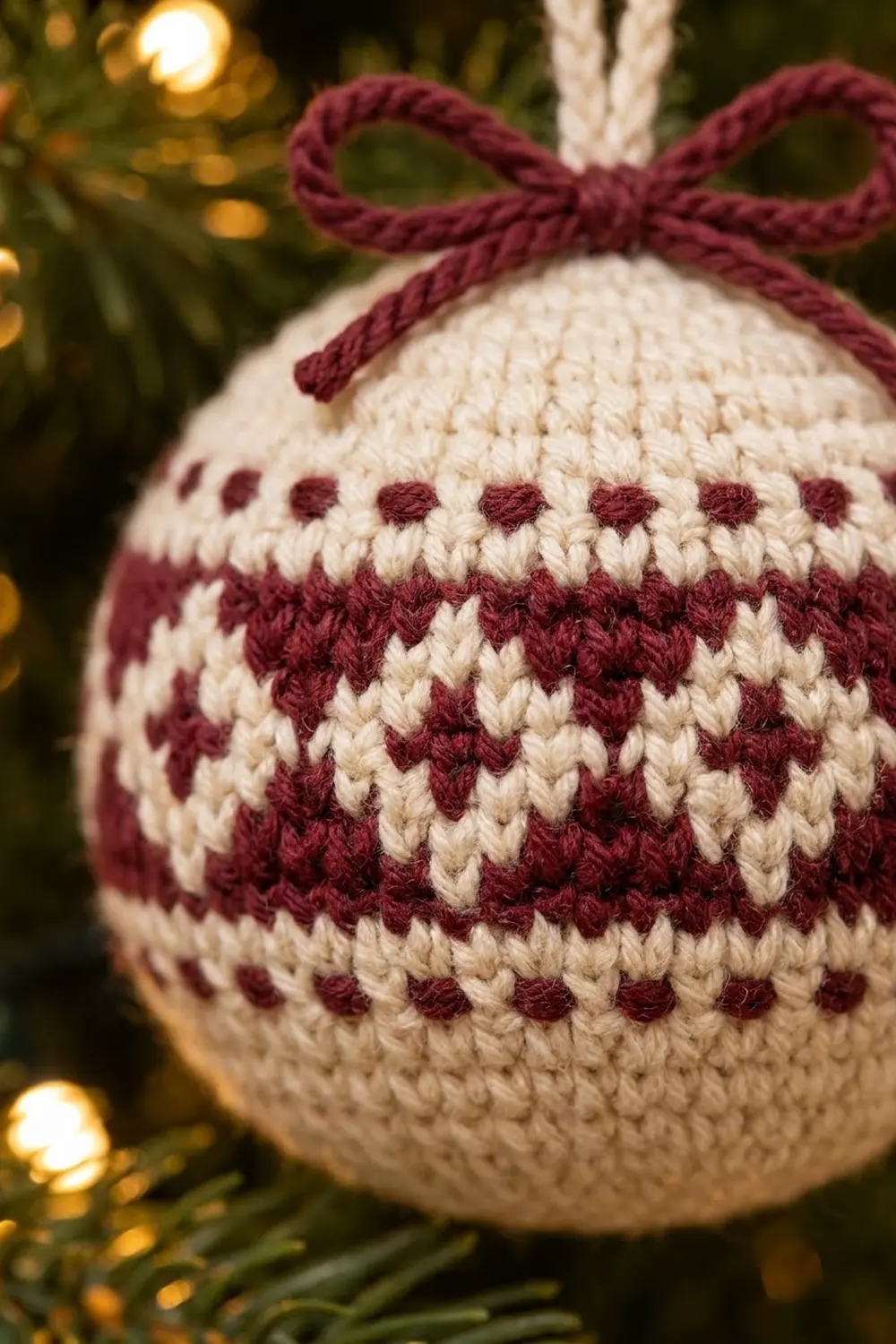
The Nordic Diamond Christmas Ball is a small stuffed ornament with a classic Fair Isle look. A cream ball carries a wide burgundy band of cream diamonds, and each diamond has a single burgundy stitch in its center. Rings of tiny burgundy dots sit above and below the band. A cream hanging loop and a burgundy bow finish the top.
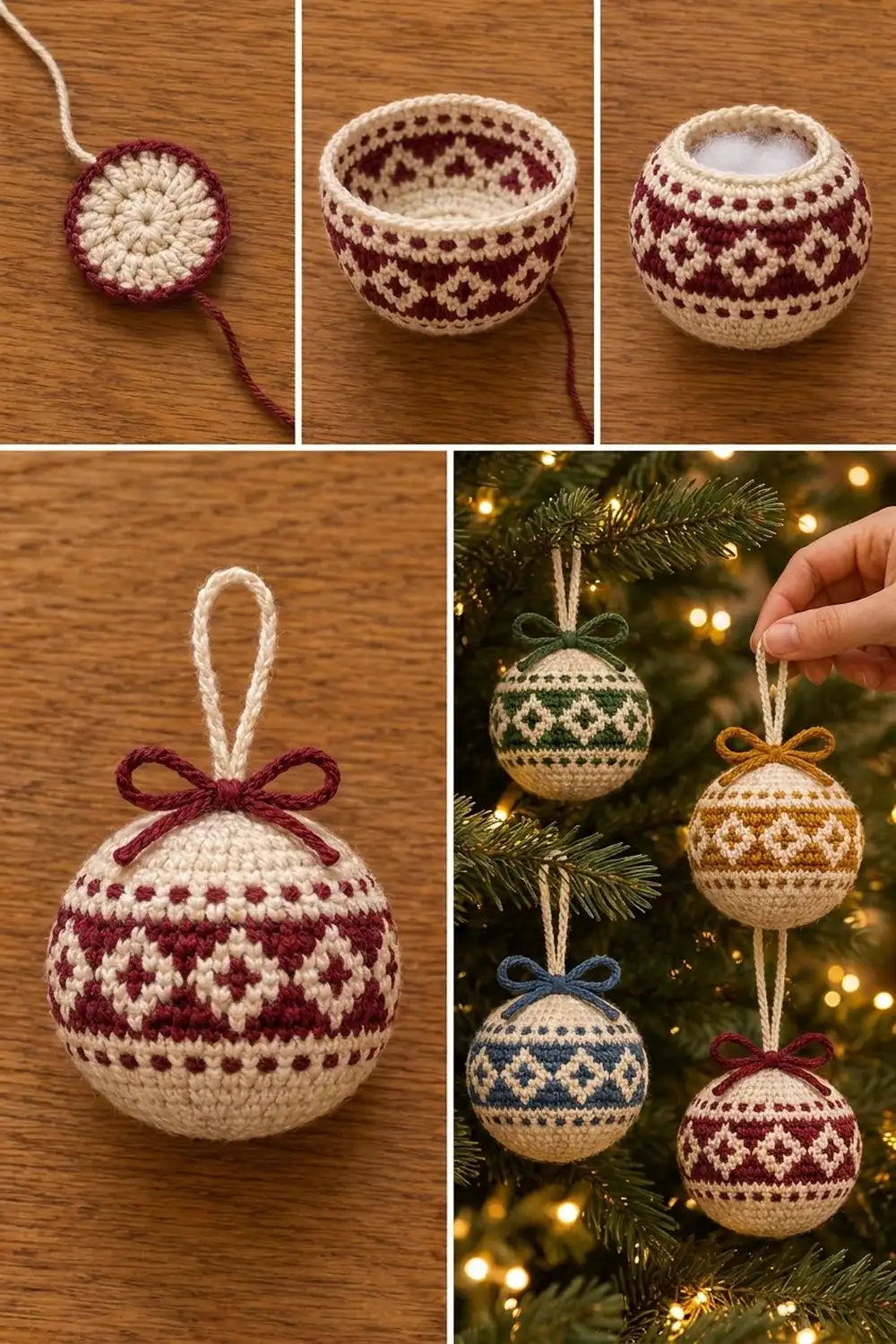
The style is cozy and traditional, like a holiday sweater made small enough to hang on a branch. The pattern uses two colors, cream and burgundy. You can easily swap the burgundy for forest green, mustard gold, or denim blue to make a matching set.
The pattern uses US crochet terms. The finished ball measures about 3 in (7.6 cm) across. With the hanging loop it stands about 5 in (12.7 cm) tall.
Construction is simple. You work the ball in continuous single crochet rounds from the bottom up. First you increase to make a flat disc. Next you work straight colorwork rounds that build the sides. Then you decrease and stuff as you close the top. The hanging loop and bow are short cords that you make separately and attach at the end.
Finished Size and Construction
- Finished size: 3 in (7.6 cm) across; 5 in (12.7 cm) tall including the loop
- Skill level: Easy-intermediate (basic amigurumi plus simple tapestry colorwork)
- Terminology: US crochet terms
- Yarn weight: DK (light worsted, #3)
- Hook: 3.25 mm (US D/3)
- Number of pieces: 1 ball, plus 2 small cords (hanging loop and bow)
- Layout: One stand-alone ornament, no joining
- Piece size: 48 stitches around at the widest point, 26 rounds tall
- Size before border: 3 in (7.6 cm) stuffed ball, before the trim
- Border depth: No border; the finishing trim is the 2 in (5.1 cm) loop and the bow
Materials
Pick a smooth, firm DK yarn. Mercerized cotton or a cotton blend shows the diamonds crisply. Acrylic also works and gives a softer ball. Avoid fuzzy or brushed yarns, because they blur the single-stitch dots.
- Cream (Main Color, MC): 10 g, about 23 m
- Burgundy (Contrast Color, CC): 6 g, about 14 m (includes the bow)
These amounts include a margin of about 20%.
Tools:
- 3.25 mm (US D/3) crochet hook
- Locking stitch marker
- Polyester fiberfill, about 8 g
- Tapestry needle
- Scissors
- Tape measure
Abbreviations (US Terms)
- MC – main color (cream)
- CC – contrast color (burgundy)
- ch – chain
- sl st – slip stitch
- sc – single crochet
- inc – 2 sc in the same stitch
- sc2tog – single crochet 2 together, worked as an invisible decrease: insert the hook in the front loop only of the next 2 stitches, yarn over, pull through both front loops, yarn over, pull through 2 loops
- st(s) – stitch(es)
- rnd – round
Special technique: tapestry color change. Work the last sc before a color change until 2 loops remain on the hook. Drop the old color, yarn over with the new color, and pull through. Lay the unused color along the tops of the stitches and work over it so it travels inside the ball. Keep the carried strand loose, not tight.
Gauge and Checkpoints
Gauge: 5 sc and 5.5 rnds = 1 in (2.5 cm) in continuous single crochet rounds.
Tight gauge matters here, because stuffing should not show between the stitches. At 5 sts per inch, 48 stitches around give a circumference of 9.6 in (24.4 cm), which makes a ball 3 in (7.6 cm) across.
Test piece: Work Rounds 1–6 in MC and lay the disc flat.
Checkpoints:
- After Rnd 6 (36 sts): the flat disc measures about 2.2 in (5.6 cm) across.
- After Rnd 8 (48 sts): the edge starts to curve up; pressed flat, it measures about 2.9 in (7.4 cm) across.
- During Rnds 11–17: the relaxed circumference is about 9.6 in (24.4 cm).
- Main band: the 7 band rnds measure about 1.25 in (3.2 cm) tall.
- Finished stuffed ball: 3 in (7.6 cm) across.
If the disc is too big, go down to a 3.0 mm hook. If it is too small, go up to a 3.5 mm (US E/4) hook. If the disc ripples, your gauge is loose. If it curves up before Rnd 7, your gauge is tight.
Ball Pattern
Work in continuous spiral rounds. Do not join or turn. Place the marker in the first st of each round and move it up as you go.
Base (MC only)
Rnd 1: With MC, make a magic ring and work 6 sc into the ring. Pull the ring closed. (6 sts)
Rnd 2: Inc in each st around. (12 sts)
Rnd 3: Sc 1, inc 6 times. (18 sts)
Rnd 4: Sc 2, inc 6 times. (24 sts)
Rnd 5: Sc 3, inc 6 times. (30 sts)
Rnd 6: Sc 4, inc 6 times. (36 sts)
Check the 2.2 in (5.6 cm) checkpoint.
Rnd 7: Sc 5, inc 6 times. (42 sts)
Rnd 8: Sc 6, inc 6 times. (48 sts)
This is the widest round. From here, every colorwork round has exactly 48 sts. The dots use 16 repeats of 3 sts and the diamonds use 8 repeats of 6 sts, so both fit evenly.
Colorwork Section (48 sts every round)
Join CC by working a color change on the last st of Rnd 8. Carry the unused color through Rnds 9–19.
Rnd 9 (lower dots): 1 sc CC, 2 sc MC 16 times. (48 sts: 16 CC, 32 MC)
Rnd 10: Sc in MC around. (48 sts)
Rnd 11 (top edge of band): Sc in CC around. (48 sts)
Rnd 12: 3 sc CC, 1 sc MC, 2 sc CC 8 times. (48 sts)
Rnd 13: 2 sc CC, 3 sc MC, 1 sc CC 8 times. (48 sts)
Rnd 14 (diamond centers): 1 sc CC, 2 sc MC, 1 sc CC, 2 sc MC 8 times. (48 sts)
Rnd 15: Repeat Rnd 13. (48 sts)
Rnd 16: Repeat Rnd 12. (48 sts)
Rnd 17 (bottom edge of band): Sc in CC around. (48 sts)
Rnd 18: Sc in MC around. (48 sts)
Rnd 19 (upper dots): 1 sc CC, 2 sc MC 16 times. (48 sts: 16 CC, 32 MC)
In each 6-st repeat, the diamond grows from 1 cream stitch to 3, then 5 with a burgundy center, then back to 3 and 1. One burgundy stitch separates neighboring diamonds at the widest round. The dots fall on stitches 1 and 4 of each 6-st repeat. That puts one dot in line with each diamond center and one between diamonds.
Cut CC after Rnd 19, leaving a 4 in (10.2 cm) tail to weave in inside the ball. Continue in MC only.
Top Shaping (MC only)
Rnd 20: Sc 5, sc2tog 6 times. (42 sts)
Rnd 21: Sc 4, sc2tog 6 times. (36 sts)
Rnd 22: Sc 3, sc2tog 6 times. (30 sts)
Weave in the color tails on the inside now. Stuff the ball firmly and shape it round with your fingers.
Rnd 23: Sc 2, sc2tog 6 times. (24 sts)
Rnd 24: Sc 1, sc2tog 6 times. (18 sts)
Add more stuffing, packing it into the top.
Rnd 25: Sc2tog 6 times. (12 sts)
Rnd 26: Sc2tog 6 times. (6 sts)
Fasten off, leaving a 6 in (15.2 cm) tail. Thread it onto the needle and pass it through the front loop of each of the 6 remaining sts. Pull to close the hole. Push the needle down through the ball and out the bottom, then trim the tail flush.
Round count check: 8 increase rounds + 11 straight rounds + 7 decrease rounds = 26 rounds. At 5.5 rnds per inch, that gives about 4.7 in (11.9 cm) of fabric from top to bottom. Half of the 9.6 in (24.4 cm) circumference is 4.8 in (12.2 cm), so the fabric length is very close to what a true sphere needs. That is why the ball comes out round, not oval.
Finishing Trim: Hanging Loop and Bow
This ornament has no edging border. The finishing trim is two slip-stitch cords.
Cord gauge: 6 ch = 1 in (2.5 cm) with the 3.25 mm hook. Working slip stitches back along the chain does not change its length.
Hanging Loop (MC)
Row 1: With MC, ch 25. Sl st in the back bump of the 2nd ch from the hook and in each ch across. (24 sl sts)
The cord measures 4 in (10.2 cm). Fold it in half to make a 2 in (5.1 cm) loop. Sew both ends to the center of the closed top, over Rnd 26, with 3 or 4 small stitches through the fabric. Weave the tails into the ball.
Bow (CC)
Row 1: With CC, ch 61. Sl st in the back bump of the 2nd ch from the hook and in each ch across. (60 sl sts)
The cord measures 10 in (25.4 cm). Wrap the middle of the cord once around the base of the hanging loop, right at the top of the ball. Tie a bow with two loops about 0.75 in (1.9 cm) long and two tails about 1 in (2.5 cm) long. Make one small stitch through the knot with CC yarn to hold the bow in place.
Why the math works: 24 sl sts ÷ 6 per inch = 4 in (10.2 cm), which folds to a 2 in (5.1 cm) loop. The 3 in (7.6 cm) ball plus the 2 in (5.1 cm) loop gives a total height of 5 in (12.7 cm). For the bow, 60 sl sts ÷ 6 per inch = 10 in (25.4 cm). That covers about 1.5 in (3.8 cm) of cord for each loop and 1 in (2.5 cm) for each tail. The rest goes into the wrap and the knot.
Final Blocking
- Roll the ball gently between your palms to even out the stuffing.
- Check it from all sides. If any spot looks flat, push a little fiberfill in through the stitches with the tip of your hook.
- Hold the ball over a steaming kettle or iron for a few seconds without touching it. With acrylic yarn, use only light steam and never press.
- While the yarn is warm, roll the ball again and nudge any slanted diamonds back into line with your fingertips.
- Straighten the hanging loop and fluff out the bow loops.
- Let the ornament cool and dry completely before hanging it.
Final Quality-Control Checklist
- The widest round has exactly 48 sts.
- There are 8 evenly spaced diamonds, with a ring of 16 dots above them and another 16 below.
- Each diamond has one burgundy center stitch.
- No stuffing shows between stitches.
- The ball measures about 3 in (7.6 cm) across.
- The top and bottom close tightly with no holes.
- The hanging loop is sewn securely at the center top and stands 2 in (5.1 cm) tall.
- The bow is stitched in place and looks even on both sides.
- All tails are hidden inside the ball.
Troubleshooting
Diamonds lean to one side: This is normal for spiral single crochet. Steam blocking and nudging with your fingers reduce it. Working the sc with a yarn-under instead of a yarn-over also helps keep the diamonds straighter.
Carried color shows through: Your stitches are too loose or the carried strand is too tight. Go down a hook size and keep the carried strand slack.
Fabric puckers in the band: The carried strand is pulling. Every few stitches, spread the stitches out along the hook to loosen it.
Visible step at the start of the round: Spiral rounds always step up slightly where they start. Keep the marker at the back of the ornament so the step faces the tree.
Ball looks oval: Check that you worked exactly 11 straight rounds. Add stuffing through the sides so it is firmer.
Hole at the bottom: Pull the magic ring tighter and tie off the tail with a knot inside the ball.
Care
Spot clean with a damp cloth and mild soap, then let it air dry in shape. Store it in a box with room to spare so the ball and bow keep their shape.
Final Notes
The measurements build on each other and are easy to check. At 5 sts per inch, 48 sts give a 9.6 in (24.4 cm) circumference and a 3 in (7.6 cm) ball. At 5.5 rnds per inch, 26 rounds give about 4.7 in (11.9 cm) from top to bottom, which keeps the shape round. The 6-st diamond repeat and the 3-st dot repeat both divide evenly into 48. At 6 ch per inch, the 24-st cord folds into a 2 in (5.1 cm) loop, bringing the ornament to 5 in (12.7 cm) tall.
Make one in burgundy, then try green, gold, and blue for a full set.
Happy crocheting!