

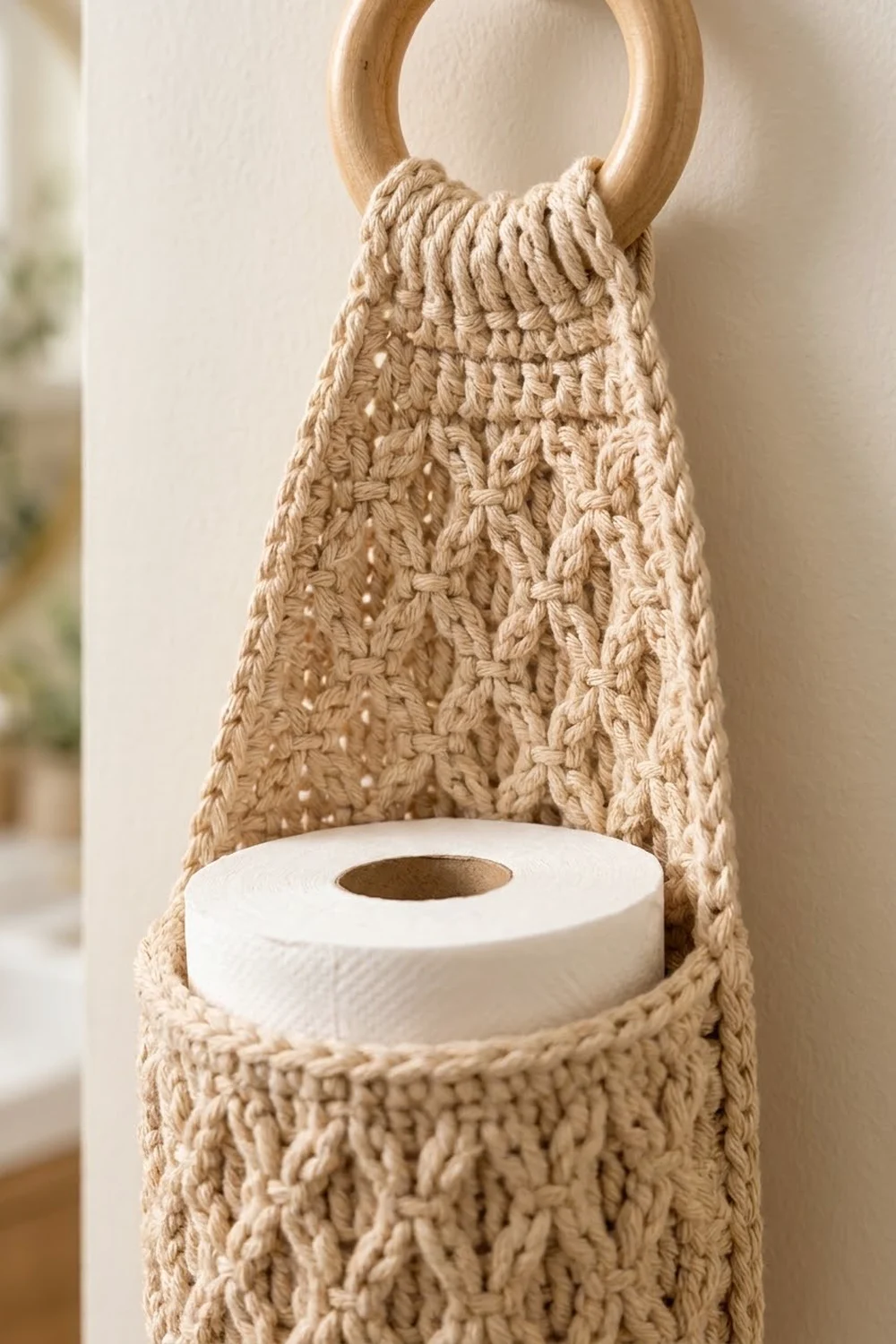
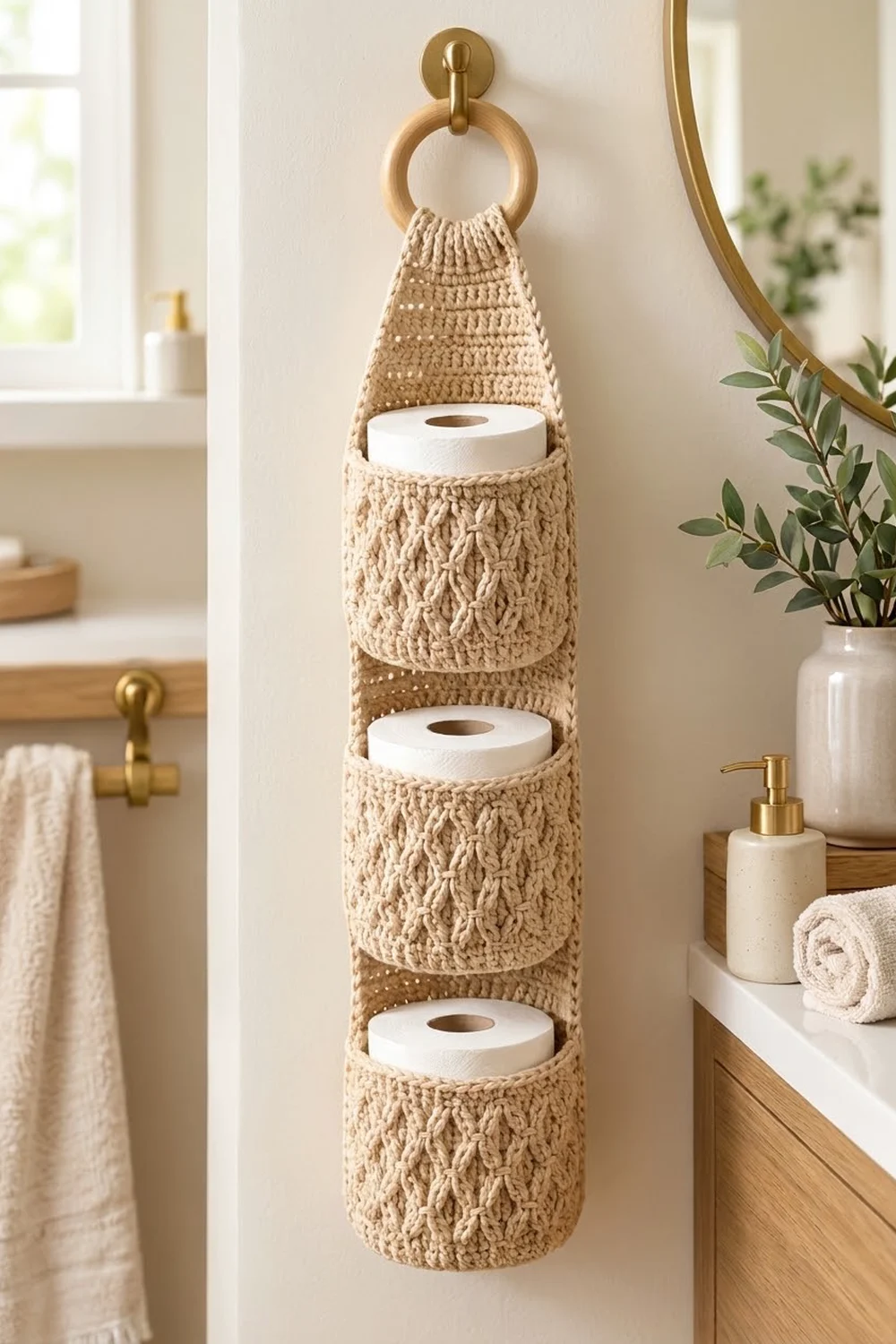
This hanging toilet paper holder is one long textured panel with three round pockets stacked down the front. Each pocket holds one standard roll, with the top of the roll showing above the rim. The panel narrows at the top into a short strap that wraps around a wooden ring, so the holder hangs from a towel hook or a wall knob.
The whole piece uses one warm oatmeal-beige cotton. The texture is a raised diamond lattice made from front post treble crochet (FPtr) stitches over a single crochet background. It looks a lot like cabled knitting and suits a calm, natural bathroom. Every pocket ends with a corded reverse single crochet rim, and the same edge runs around the whole panel.
This pattern uses US crochet terms. After the border, the flat panel measures 6.25 in (15.9 cm) wide and 26.75 in (67.9 cm) long. Once the strap is folded over the ring, the holder hangs about 24.5 in (62.2 cm) from the bottom edge to the ring. Each pocket is 5.25 in (13.3 cm) across and 3.5 in (8.9 cm) deep.
Construction is simple. You work the panel flat in rows, starting at the bottom, and then shape the taper and strap. Next you make three pockets in joined rounds, each with a flat base and lattice walls. You sew the pockets to the panel stitch-to-stitch, add a two-round border, and fold the strap over the ring.
Finished Size and Construction
- Finished size: 6.25 x 26.75 in (15.9 x 67.9 cm) flat; hangs about 24.5 in (62.2 cm) below the ring
- Skill level: Intermediate (post stitches and reverse single crochet)
- Terminology: US
- Yarn weight: Worsted (#4) cotton
- Hook: 5.0 mm (H-8)
- Number of pieces: 4 (1 back panel and 3 pockets)
- Layout: 3 pockets in a vertical column on the panel
- Pocket size: 5.25 in (13.3 cm) diameter x 3.5 in (8.9 cm) deep
- Panel size before border: 5.5 x 26 in (14.0 x 66.0 cm)
- Border depth: 0.375 in (1.0 cm) per edge
Materials
Yarn: Use a smooth worsted-weight cotton or cotton blend with about 170 m per 100 g. Cotton holds the lattice crisp and doesn’t stretch much under the weight of the rolls. Choose a light color so the post-stitch shadows show up.
- Oatmeal beige: 350 g (about 595 m / 651 yd)
This amount includes a margin of roughly 13% above what the project uses (about 310 g), so you have yarn for a gauge swatch and for sewing.
Tools:
- 5.0 mm (H-8) crochet hook
- One 3 in (7.6 cm) wooden ring (macramé ring)
- Tapestry needle
- 6 locking stitch markers
- Rustproof pins
- Measuring tape
- Scissors
- Spray bottle and blocking mat
Abbreviations (US Terms)
- ch – chain
- sl st – slip stitch
- sc – single crochet
- sc2tog – single crochet 2 together
- BLO – back loop only
- st(s) – stitch(es)
- rep – repeat
- RS / WS – right side / wrong side
- rnd(s) – round(s)
FPtr (front post treble crochet): Yarn over twice. Insert the hook from front to back to front around the post of the stitch named (two rows below), yarn over and pull up a loop, then [yarn over, pull through 2 loops] 3 times. Always skip the stitch on the current row that sits behind the FPtr, so the count stays the same.
Reverse sc (crab stitch): Work single crochet from left to right (right-handed). Insert the hook into the next stitch to the right, pull up a loop, yarn over, pull through both loops.
Lattice positions: Each 6-stitch repeat has positions p1 to p6. Lattice FPtrs move one position per pattern row to form diamonds.
Gauge and Checkpoints
Gauge: 16 sts and 18 rows = 4 in (10.2 cm) in the lattice pattern over sc.
Make one pocket first, since it is your swatch. After Rnd 6 (36 sts), the flat circle should be about 2.875 in (7.3 cm) across. After Rnd 11 (66 sts), it should be 5.25 in (13.3 cm) across. The finished pocket should stand 3.5 in (8.9 cm) tall.
On the panel, measure after Row 10. The width should be 5.5 in (14.0 cm), and the 10 rows should measure about 2.2 in (5.6 cm).
If your piece is too big, go down 0.5 mm in hook size. If it is too small, go up 0.5 mm. Don’t add or remove stitches, because the 6-stitch repeat and the stitch-to-stitch joining both depend on these counts.
Back Panel
Work in rows. Ch 1 at the start of each row doesn’t count as a stitch. Odd rows are RS.
Row 1 (RS): Ch 23, sc in 2nd ch from hook and in each ch across, turn. (22 sts)
Row 2 (WS): Ch 1, sc in each st across, turn. (22 sts)
All even rows through Row 90: Work as Row 2. Sc into the top of each FPtr, not the hidden st behind it. (22 sts)
Edge stitches 1–2 and 21–22 are always plain sc. Sts 3–20 hold 3 lattice repeats.
Row 3 (RS, set-up): Ch 1, sc in first 2 sts, *sc in next 2 sts (p1–p2), FPtr around the Row 1 sc below each of the next 2 sts (p3–p4), sc in next 2 sts (p5–p6); rep from * 2 more times, sc in last 2 sts, turn. (22 sts: 6 FPtr + 16 sc)
Row 5 (B): Ch 1, sc in first 2 sts, *sc in p1, FPtr around the FPtr at p3 so it lands at p2, sc in p3–p4, FPtr around the FPtr at p4 so it lands at p5, sc in p6; rep from * 2 more times, sc in last 2 sts. (22 sts)
Row 7 (C): Ch 1, sc in first 2 sts, *FPtr around the FPtr at p2 (lands at p1), sc in p2–p5, FPtr around the FPtr at p5 (lands at p6); rep from * 2 more times, sc in last 2 sts. (22 sts)
Here neighboring repeats meet at p6 and p1, which closes the side points of the diamonds.
Row 9 (D): Ch 1, sc in first 2 sts, *sc in p1, FPtr around the FPtr at p1 (lands at p2), sc in p3–p4, FPtr around the FPtr at p6 (lands at p5), sc in p6; rep from * 2 more times, sc in last 2 sts. (22 sts)
Row 11 (A): Ch 1, sc in first 2 sts, *sc in p1–p2, FPtr around the FPtr at p2 (lands at p3), FPtr around the FPtr at p5 (lands at p4), sc in p5–p6; rep from * 2 more times, sc in last 2 sts. (22 sts)
Rows 13–84: Rep Rows 5–12 nine more times (10 repeats in total from Row 5). (22 sts)
Rows 85–90: Ch 1, sc in each st across. (22 sts)
Checkpoint: the panel body is 5.5 x 20 in (14.0 x 50.8 cm).
Taper:
Row 91 (RS): Ch 1, sc BLO in each st across. (22 sts)
Rows 92–104: Work sc BLO, and sc2tog over the first 2 and last 2 sts on Rows 92, 95, 98, 101 and 104. Counts: Row 92 = 20, Row 95 = 18, Row 98 = 16, Row 101 = 14, Row 104 = 12.
Rows 105–108: Ch 1, sc BLO in each st. (12 sts)
The taper measures 4 in (10.2 cm).
Strap, Rows 109–117: Ch 1, sc in each st. (12 sts)
Fasten off. The strap is 2 in (5.1 cm) long, and the panel is now 5.5 x 26 in (14.0 x 66.0 cm).
Pockets (Make 3)
Work in joined rnds with the RS facing. Don’t turn. Join with sl st to the first st, then ch 1 (doesn’t count).
Rnd 1: 6 sc in a magic ring. (6)
Rnd 2: 2 sc in each st. (12)
Rnd 3: Sc in next st, 2 sc in next st; rep from * around. (18)
Rnd 4: Sc in next 2 sts, 2 sc in next; rep around. (24)
Rnd 5: Sc in next 3, 2 sc in next; rep around. (30)
Rnd 6: Sc in next 4, 2 sc in next; rep around. (36)
Rnd 7: Sc in next 5, 2 sc in next; rep around. (42)
Rnd 8: Sc in next 6, 2 sc in next; rep around. (48)
Rnd 9: Sc in next 7, 2 sc in next; rep around. (54)
Rnd 10: Sc in next 8, 2 sc in next; rep around. (60)
Rnd 11: *Sc in next 9, 2 sc in next; rep around. (66)
Rnd 12: Sc BLO in each st. (66) This makes the base ridge.
Rnd 13: Sc in each st. (66)
Rnd 14 (set-up A): *Sc in next 2 sts, FPtr around the Rnd 12 sc below each of the next 2 sts, sc in next 2 sts; rep from * 10 more times. (66 sts: 22 FPtr + 44 sc)
Rnds 15, 17, 19, 21, 23: Sc in each st. (66)
Rnd 16: Work Row 5 (B) over 11 repeats, without edge sts. (66)
Rnd 18: Work Row 7 (C) over 11 repeats. (66)
Rnd 20: Work Row 9 (D) over 11 repeats. (66)
Rnd 22: Work Row 11 (A) over 11 repeats. (66)
Rnds 24–26: Sc in each st. (66)
Rnd 27: Reverse sc in each st. (66)
Fasten off, leaving a 36 in (91.4 cm) tail. The wall (Rnds 12–27) is 16 rnds tall, or 3.5 in (8.9 cm).
Make All Pieces
- Back panel: 1 piece, about 130 g (221 m)
- Pockets: 3 pieces, about 60 g (102 m) each, 180 g in total
- Total: about 310 g of oatmeal beige, out of the 350 g you bought
Layout on the panel, top to bottom (rows are panel rows):
[ ring + strap      Rows 109-117 ]
[ taper             Rows 91-108  ]
[ plain panel       Rows 77-90   ]
[ POCKET 3          Rows 61-76   ]
[ gap               Rows 47-60   ]
[ POCKET 2          Rows 31-46   ]
[ gap               Rows 17-30   ]
[ POCKET 1          Rows 1-16    ]
Each pocket covers 16 panel rows, which matches its 16 wall rnds. Each gap is 14 rows, about 3.1 in (7.9 cm), so there’s room to slide a roll in.
Joining
Method: Whipstitch with the yarn tail.
Stitch-to-stitch logic: Flatten the back of each pocket. Place a marker in st 1 and st 22 of Rnd 27 so the join seam sits at the back. Those 22 rim sts match the 22 sts of one panel row exactly, since both span 5.5 in (14.0 cm).
- Lay the panel RS up. For Pocket 1, pin the 22 unworked front loops left by Rnd 12 (the base ridge) to the 22 sts of Row 1, one to one.
- Whipstitch across. Then pin the 22 marked rim sts of Rnd 27 to the 22 sts of Row 16 and whipstitch them, one to one.
- Sew Pocket 2 to Rows 31 and 46, and Pocket 3 to Rows 61 and 76, in the same way.
The 44 front sts of each pocket stay free and bow outward into a D shape about 4 in (10.2 cm) deep.
Tension: Pull each whipstitch just snug. If you pull too hard, the panel puckers across its width.
Checkpoint: The panel should still lie at 5.5 in (14.0 cm) wide at every seam.
Border
Border gauge is 4 sc per 1 in (2.5 cm), the same as the body. Work the border on the panel edges only. The pockets don’t touch the edges, so they stay out of the way.
Rnd 1: With the RS facing, join yarn at the bottom right corner.
- Bottom: 3 sc in the first foundation ch, sc in the next 20 ch, then 3 sc in the last ch.
- Left side: Work along the 117 row-ends with [sc in each of the next 8 row-ends, skip 1] 13 times. (104 sc)
- Top (strap): 3 sc in the first st, sc in the next 10, 3 sc in the last st.
- Right side: Work as the left side. (104 sc)
Join. Total: 20 + 104 + 10 + 104 + (4 corners x 3) = 250 sts.
Rnd 2: Ch 1, reverse sc in each st around. (250) Join and fasten off.
Why the math works: The rows are 0.222 in (0.6 cm) tall and a sc is 0.25 in (0.6 cm) wide, so 8 sc per 9 row-ends keeps the side edges flat. 117 row-ends ÷ 9 x 8 = 104 sc. That’s 4 sc per inch over 26 in (66.0 cm), which matches the 16 sts / 4 in gauge. Across the bottom, 20 sc plus 2 corner groups cover the original 22 sts, and across the top, 10 plus 2 corner groups cover 12. The border adds 0.375 in (1.0 cm) on each edge, so the panel ends at 6.25 x 26.75 in (15.9 x 67.9 cm).
Final Blocking
- Mist the panel and pockets until they are damp but not soaked.
- Pin the panel flat to 6.25 x 26.75 in (15.9 x 67.9 cm). Keep the side edges straight.
- Fill each pocket with a roll, or with a rolled towel 4.5 in (11.4 cm) across, to set the curve.
- Pat the diamonds square with your fingers. Don’t press them flat.
- Let everything dry completely for about 24 hours.
- Slip the strap through the ring from front to back. Fold it down 2 in (5.1 cm) onto the WS and whipstitch its top edge across Row 105.
Final Quality-Control Checklist
- Every panel row has 22 sts, and the strap has 12.
- Every pocket rnd has 66 sts.
- The diamonds close at p3/p4 and at p6/p1 with no gaps.
- All 3 pockets are centered, level and sewn one to one.
- Border Rnd 1 has 250 sts, with 104 on each side.
- The flat panel measures 6.25 x 26.75 in (15.9 x 67.9 cm).
- The strap is secure around the ring and every tail is woven in.
Troubleshooting
- Stitch count grows: You worked into the st behind an FPtr. Skip it every time.
- Diamonds look lopsided: An FPtr went around the wrong post. Count positions from the edge sts.
- Panel curls: Your FPtrs are too tight. Pull up the first loop to full height.
- Pocket is too tight for the roll: Your gauge is too firm. Go up a hook size and remake the pocket.
- Border ruffles: Skip one more row-end per side, spaced evenly.
- Holder sags: Use a stiffer cotton, or tack the pocket sides to the panel.
Care
Hand wash in cool water with mild soap and lay flat to dry. Reshape the pockets around a roll while they’re damp.
Final Notes
The measurement chain runs like this. A gauge of 16 sts and 18 rows per 4 in (10.2 cm) gives a 22-st panel that is 5.5 in (14.0 cm) wide and 26 in (66.0 cm) long over 117 rows. The 66-st pockets are 5.25 in (13.3 cm) across and 16 rnds, or 3.5 in (8.9 cm), deep. Each pocket’s 22 back sts match one 22-st panel row. A 250-st border brings the panel to 6.25 x 26.75 in (15.9 x 67.9 cm).
Happy crocheting!