

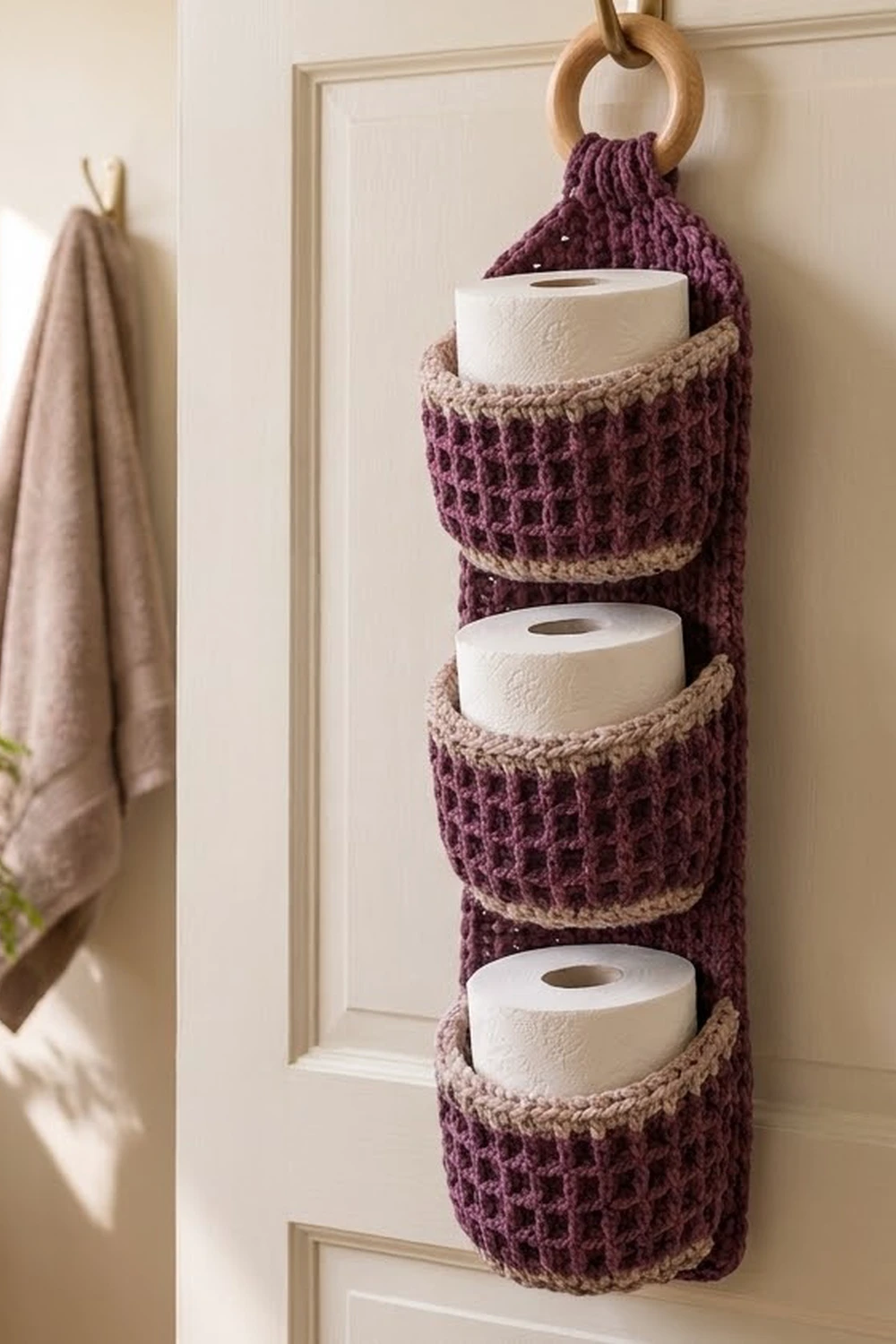
This hanging holder keeps three spare rolls tidy and within reach. It has a long plum back panel worked in a waffle grid and three cup-shaped pockets with taupe trim, and it hangs from a simple wooden ring.
The colors are deep plum for the panel and pocket bodies, plus a soft taupe for the bands at the bottom and rim of each pocket. Waffle stitch gives a thick, structured fabric, so the pockets keep their shape and the panel doesn’t sag once it’s loaded.
The pattern uses US crochet terms. The finished holder is about 6.2 in (15.7 cm) wide and hangs about 29 in (73.7 cm) long, not counting the ring. Each pocket fits a standard roll up to about 4.25 in (10.8 cm) across.
You’ll crochet the back panel flat in rows, decrease it into a tab, and work three pockets in joined rounds from a flat base. Then you sew the pockets to the panel, add a single crochet border, and fold the tab around the ring.
Finished Size and Construction
- Finished size: 6.2 in (15.7 cm) wide × about 29 in (73.7 cm) hanging length
- Skill level: Intermediate (post stitches, working in rounds, sewing)
- Terminology: US
- Yarn weight: Worsted (#4), cotton or cotton blend
- Hooks: 5.0 mm (H-8) for the main pieces; 4.5 mm (G-7) for the border
- Number of pieces: 4 (1 back panel + 3 pockets)
- Layout: 3 pockets stacked in a single column, 16 rows apart
- Panel size before border: 5.7 in (14.5 cm) × 31.1 in (79.0 cm) flat, including the tab
- Pocket size: base 4.5 in (11.4 cm) across; height 3.5 in (8.9 cm)
- Border depth: 0.25 in (0.6 cm) per side
Materials
Cotton holds its shape well and washes easily, which makes it a good fit for a bathroom. Choose a smooth worsted cotton of about 170 m per 100 g. Your two colors should be the same fiber and weight.
- Color A, plum: 200 g / 340 m
- Color B, taupe: 75 g / 128 m
These amounts include roughly a 15–20% margin for swatching and sewing.
Tools:
– 5.0 mm (H-8) and 4.5 mm (G-7) crochet hooks
– 1 wooden ring, about 3 in (7.6 cm) outside diameter
– Tapestry needle
– 6–8 locking stitch markers
– Rust-proof pins and a tape measure
Abbreviations (US Terms)
- ch: chain
- sl st: slip stitch
- sc: single crochet
- dc: double crochet
- dc2tog: double crochet 2 together
- BLO: back loop only
- st(s): stitch(es)
- rnd: round
Special stitch: FPdc (front post double crochet). Yarn over and insert the hook from front to back to front around the post of the stitch below. Yarn over, pull up a loop, then [yarn over, draw through 2] twice.
The ch-2 at the start of a row or round never counts as a stitch.
Gauge and Checkpoints
- Waffle stitch (5.0 mm): 14 sts and 9 rows = 4 in (10.2 cm)
- Single crochet base (5.0 mm): 16 sc = 4 in (10.2 cm)
- Border single crochet (4.5 mm): 18 sc = 4 in (10.2 cm)
Test one piece first. Make one pocket before you start the panel, because it tests all three gauges in about an hour.
- After Rnd 10, the base should lie flat and measure 4.5 in (11.4 cm) across.
- After Rnd 17, the pocket should measure about 2.7 in (6.9 cm) from the base fold.
- The finished pocket should stand 3.5 in (8.9 cm) tall.
On the panel:
– After Row 1, the width should be 5.7 in (14.5 cm).
– After Row 54, the length should be 24 in (61.0 cm).
If your piece is too big, go down half a hook size. If it’s too small, go up half a size. Don’t change the stitch counts, because the border and pocket placement depend on them.
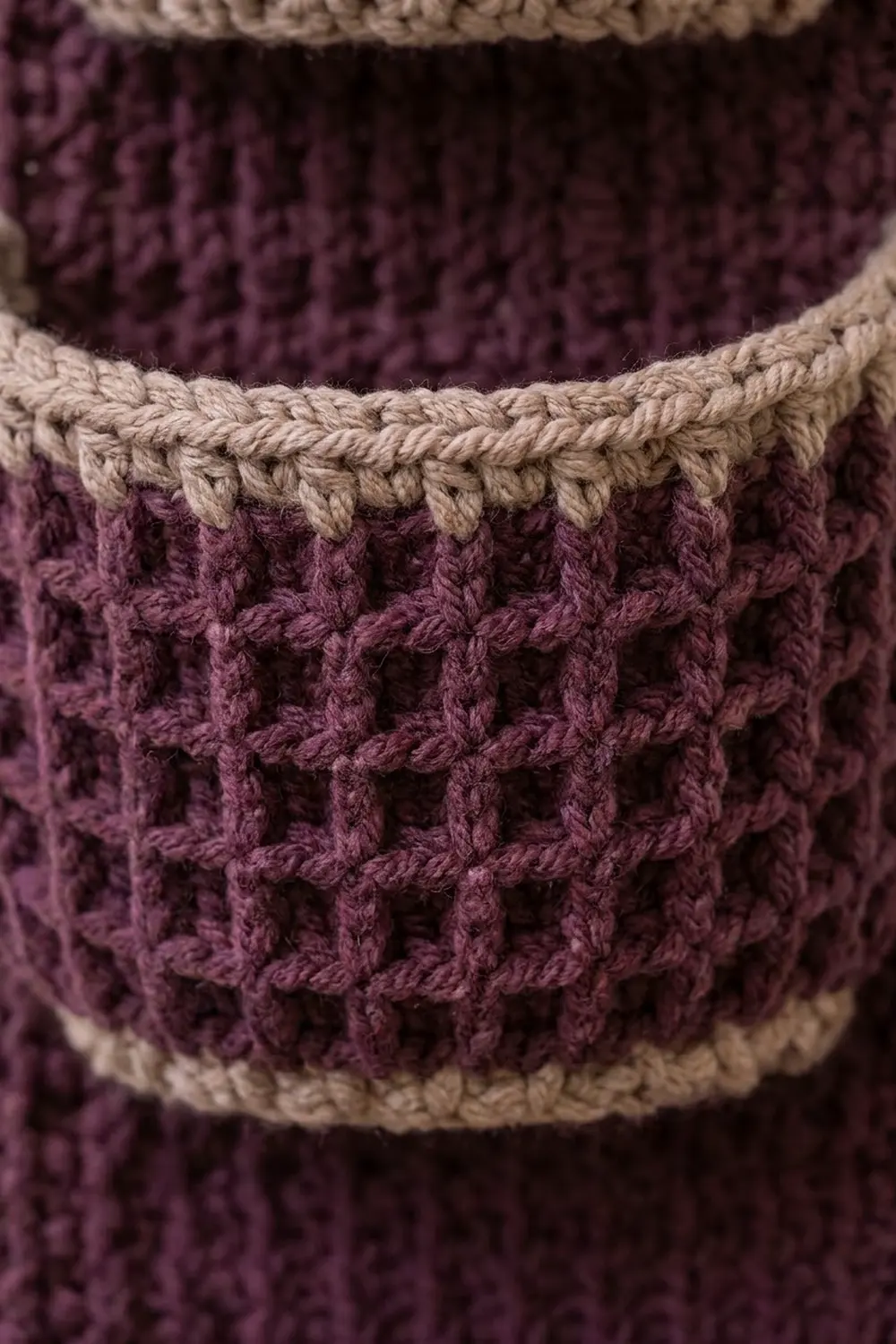
Back Panel
With plum and the 5.0 mm hook, ch 22.
Row 1 (foundation): Dc in the 3rd ch from the hook and in each ch across, turn. (20 dc)
Row 2: Ch 2, dc in the first st, FPdc around the next st, dc in the next 2 sts; repeat from * 6 times total, dc in the last st, turn. (20 sts)
Row 3: Ch 2, dc in the first st, FPdc around the next 2 sts, dc in the next st; repeat from * 6 times total, dc in the last st, turn. (20 sts)
In each row, you work a dc into each FPdc from the row below and an FPdc around each dc from the row below. That alternation creates the grid.
Rows 4–54: Work even-numbered rows as Row 2 and odd-numbered rows as Row 3. Row 54 is a Row 2 repeat. (20 sts per row)
Checkpoint: the panel should measure 5.7 in × 24 in (14.5 cm × 61.0 cm).
Taper
For each taper row: ch 2, dc2tog over the first 2 sts, work in pattern to the last 2 sts, dc2tog, turn. Keep each FPdc stacked over the column it belongs to. If a partial repeat lands at an edge, work it as plain dc.
- Row 55: 18 sts
- Row 56: 16 sts
- Row 57: 14 sts
- Row 58: 12 sts
- Row 59: 10 sts
- Row 60: 8 sts
You remove 6 sts from each side, which is two full repeats. That means the center 8 sts line up with the original grid.
Checkpoint: the taper should measure 2.7 in (6.9 cm).
Tab
Rows 61–70: Ch 2, dc in the first st, then work 2 waffle repeats as set, dc in the last st, turn. Odd rows follow Row 3 and even rows follow Row 2. (8 sts per row)
Fasten off. The tab measures 2.3 in × 4.4 in (5.8 cm × 11.2 cm).
Pocket (Make 3)
Base
Use taupe and the 5.0 mm hook. At the end of every round, join with a sl st to the first st.
- Rnd 1: Magic ring, ch 1, 6 sc in the ring. (6)
- Rnd 2: Ch 1, 2 sc in each st. (12)
- Rnd 3: Ch 1, sc in the next st, 2 sc in the next st; repeat 6 times. (18)
- Rnd 4: Ch 1, sc in the next 2 sts, 2 sc in the next st; repeat 6 times. (24)
- Rnds 5–9: Ch 1, and add 1 more plain sc before each increase in every round. Totals: Rnd 5 = 30, Rnd 6 = 36, Rnd 7 = 42, Rnd 8 = 48, Rnd 9 = 54.
- Rnd 10 (trim round): Ch 1, sc in the next 17 sts, 2 sc in the next st; repeat 3 times. This is 54 sts worked once each plus 3 added sts. (57)
Checkpoint: the base should measure 4.5 in (11.4 cm) across, or 14.25 in (36.2 cm) around.
Bottom Band
- Rnd 11: Ch 1, sc in the BLO of each st. (57) The front loops left behind make a crisp fold where the sides turn up.
- Rnd 12: Ch 1, sc in each st. (57) Fasten off taupe.
Plum Waffle
Switch to plum.
- Rnd 13: Join plum, ch 2, dc in each st. (57)
- Rnd 14: Ch 2, FPdc around the next st, dc in the next 2 sts; repeat 19 times. (57)
- Rnd 15: Ch 2, dc in the next st, FPdc around the next 2 sts; repeat 19 times. (57)
- Rnd 16: Repeat Rnd 14. (57)
- Rnd 17: Repeat Rnd 15. (57)
Fasten off plum.
Because you never turn, every post sits on the right side, and the grid matches the panel. The waffle fabric is wider than the sc base, so the cup flares gently to about 5.2 in (13.2 cm) across, or 16.3 in (41.4 cm) around. The flare is intentional and makes rolls easier to drop in.
Top Band
- Rnds 18–20: Join taupe, ch 1, sc in each st. (57 per round)
Fasten off and leave an 18 in (45.7 cm) plum tail? No: instead, cut an 18 in (45.7 cm) length of plum for sewing. Weave in the taupe ends.
Pocket height: 0.5 in (1.3 cm) bottom band + 2.2 in (5.6 cm) waffle + 0.75 in (1.9 cm) top band = about 3.5 in (8.9 cm).
Make All Pieces
| Piece | Qty | Plum | Taupe |
|---|---|---|---|
| Back panel | 1 | Rows 1–70 + border | — |
| 3 | Rnds 13–17 | Rnds 1–12, 18–20 |
Layout grid (front view, top to bottom):
        [ ring ]
       [ tab 61–70 ]
     [ taper 55–60 ]
   [ open rows 45–54 ]
   [ POCKET 3  37–44 ]
   [ open rows 29–36 ]
   [ POCKET 2  21–28 ]
   [ open rows 13–20 ]
   [ POCKET 1   5–12 ]
   [ open rows  1–4  ]
Joining
Method: Whipstitch with plum and a tapestry needle.
Placement. Each pocket’s fold line (Rnd 11) sits on top of a panel row:
- Pocket 1: on top of Row 4, 1.8 in (4.6 cm) from the bottom
- Pocket 2: on top of Row 20, 8.9 in (22.6 cm) from the bottom
- Pocket 3: on top of Row 36, 16.0 in (40.6 cm) from the bottom
The pockets are spaced 16 rows apart, which is 7.1 in (18.0 cm).
Stitch-to-stitch logic:
- Turn the pocket so its join sits at the center back.
- Count 11 sts on each side of the join stitch. Together with the join stitch, that marks 23 back sts on Rnd 11. Mark both ends. The other 34 sts form the front, which bulges out.
- Sew the 23 back sts across the 20 sts of the panel row. Match the stitches one to one, except at panel sts 4, 10, and 17, where you catch 2 pocket sts in one panel st (20 + 3 = 23).
- Repeat at the rim: sew the 23 back sts of Rnd 20 across the panel row 8 rows higher, using the same easing.
- To square the cup’s sides, tack each marked edge to the panel with 4 whipstitches running up between the two seams.
Tension: Pull each stitch just until it’s snug. Overtightened seams pucker the waffle grid.
Checkpoint: Lay the holder flat. The panel should still measure 5.7 in (14.5 cm) wide at every pocket.
Border
Use plum and the 4.5 mm hook. Border gauge: 18 sc = 4 in (10.2 cm), which is 4.5 sc per inch.
Rnd 1: With the right side facing, join at the top-right corner of the tab and work around the panel edge in this order.
- Top of the tab: 3 sc in the first st, then sc in the next 2 sts, 2 sc in the next st twice, then 3 sc in the last st. (14 sc, including both corner groups)
- Left side, going down: These counts are row-end stitches only.
- Tab, Rows 70–61: 2 sc in each row-end. (20)
- Taper, Rows 60–55: 2 sc in each row-end, plus 1 extra sc in every other row-end. (15)
- Body, Rows 54–1: 2 sc in each row-end. (108)
- Side total: 143 sc
- Bottom edge: Work into the foundation loops. 3 sc in the first st, then sc in the next 2 sts, 2 sc in the next st 6 times, then 3 sc in the last st. (30 sc, including both corner groups)
- Right side, going up: Work it the same way as the left side. (143)
- Join with a sl st. Total: 14 + 143 + 30 + 143 = 330 sc.
Corner groups are counted only on the top and bottom edges, never on the sides.
Rnd 2: Sl st loosely in each sc around. (330) Fasten off.
Why the math works:
- Body sides: 108 sc over 24 in = 4.5 sc per inch, which matches the border gauge exactly.
- Bottom edge: 26 sc between the corner centers ÷ 4.5 = 5.78 in, against an edge of 5.7 in.
- Top of the tab: 10 sc ÷ 4.5 = 2.2 in, against a tab of 2.3 in.
- Taper: each taper row-end runs on a diagonal of about 0.53 in, which needs about 2.4 sc. The pattern gives 2.5 per row-end.
After the border, the panel measures 6.2 in × 31.6 in (15.7 cm × 80.3 cm) flat.
Hanging the holder: Slip the tab through the ring. Fold Rows 66–70 to the back so the fold falls at Row 65, and whipstitch them securely to the back of the taper. The hanging length is now about 29 in (73.7 cm).
Final Blocking
- Before you sew the tab down, mist the whole holder with water until it’s damp.
- Pin the panel flat to 6.2 in (15.7 cm) wide. Check the length at 24.5 in (62.2 cm), measured from the bottom edge to the top of Row 54 including the border.
- Stuff each pocket with a roll wrapped in a plastic bag so it dries round.
- Leave it to dry completely, which takes about 24 hours.
- Unpin, then fold and sew the tab around the ring.
Final Quality-Control Checklist
- The panel is 6.2 in (15.7 cm) wide along its full length.
- All three pockets are centered and level, with fold lines on top of Rows 4, 20, and 36.
- Every pocket rim is sewn across 23 sts with no gaps.
- The border lies flat, with no ruffling on the sides and no cupping at the corners.
- The tab seam is hidden on the back and the ring sits straight.
- All ends are woven in at least 2 in (5.1 cm) and trimmed.
Troubleshooting
- The grid looks like ribbing: you’re working an FPdc around an FPdc. Alternate the columns every row or round.
- The pocket base cups: your sc is too tight. Go up half a hook size for Rnds 1–12.
- The pocket base ruffles: your sc is too loose. Go down half a hook size.
- The panel sides ruffle after the border: you have more than 2 sc per row-end. Recount, aiming for 143 per side.
- The holder tilts on the ring: the tab fold is off center. Re-sew it so the fold sits exactly at Row 65.
- A roll won’t fit: block the pocket over a slightly larger roll, or add one more plain sc round to Rnd 10 next time. That round must add a multiple of 3 sts to keep the waffle repeat.
Care
Hand wash or machine wash on gentle in cool water, then reshape and dry flat. Don’t tumble dry, because cotton waffle stitch can shrink.
Final Notes
Each measurement in this pattern depends on the one before it:
- Waffle gauge of 14 sts × 9 rows = 4 in (10.2 cm) sets a 5.7 in (14.5 cm) by 24 in (61.0 cm) panel body.
- The 57-st pockets sit 16 rows apart, at 7.1 in (18.0 cm) intervals.
- At 4.5 sc per inch, the 330-st border takes the panel to 6.2 in (15.7 cm) wide.
- The folded tab brings the hanging length to about 29 in (73.7 cm).
Check each stage before you move on, and the finished holder will hang straight and hold three rolls.
Happy crocheting!