

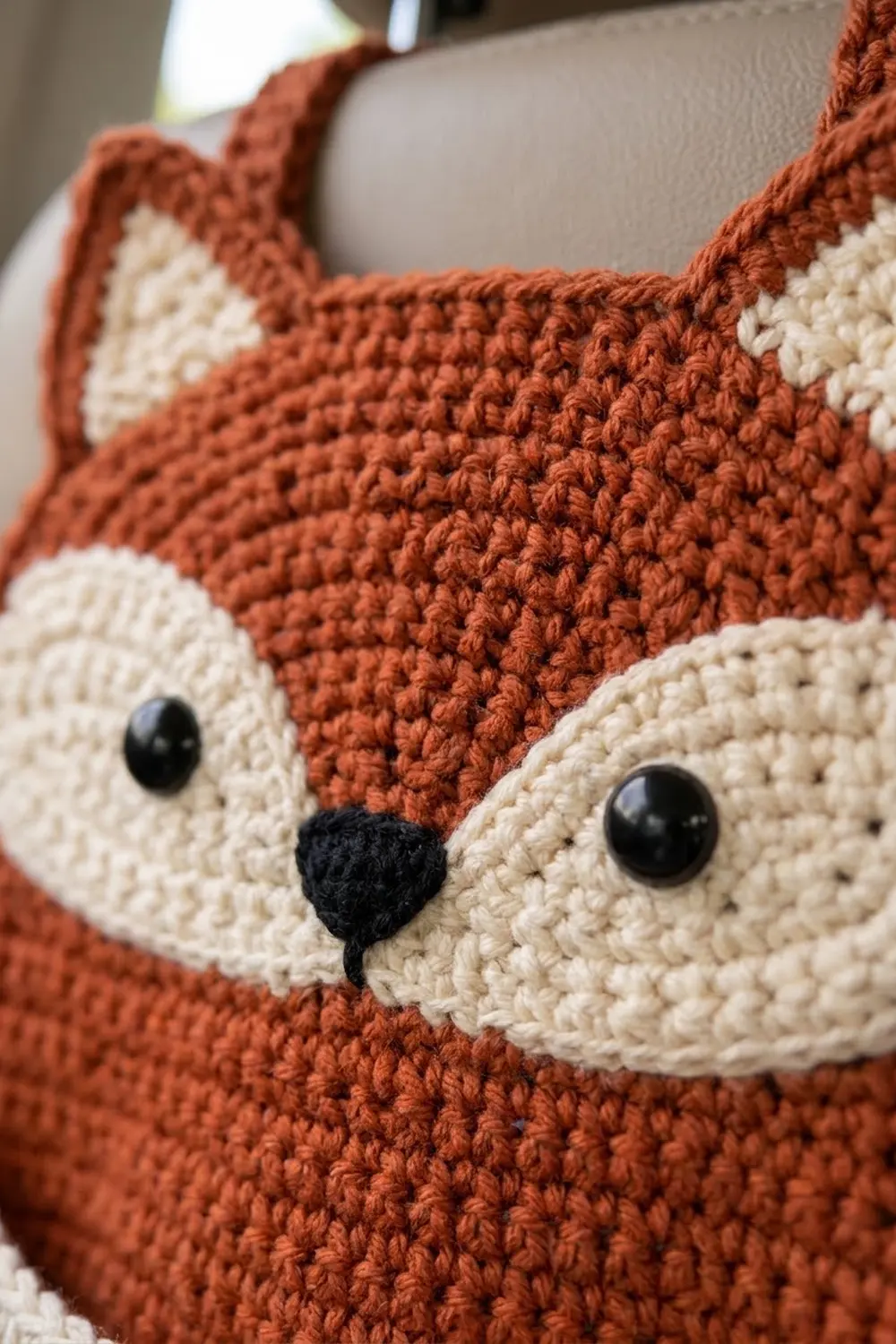
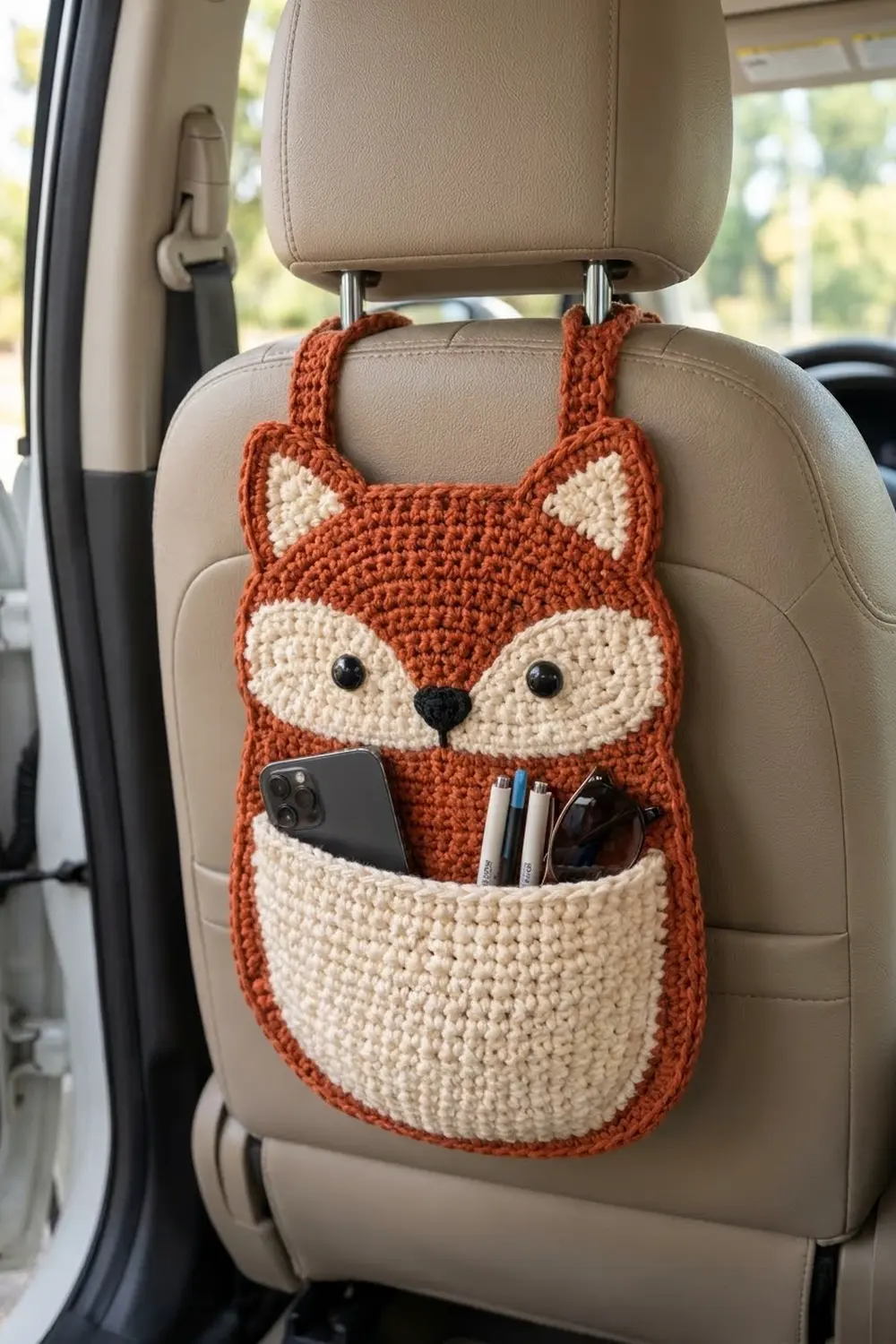
This cheerful fox hangs on the back of a car seat and keeps a phone, pens, sunglasses and snacks within easy reach. A warm rust back panel forms the fox’s head and body. A roomy cream pocket covers the lower half, and a cream face mask, inner ears and a little black nose finish the look.
The design uses three colors: rust for the panel, border and straps, cream for the pocket and face, and black for the nose. Dense single crochet keeps the fabric firm enough to carry a phone without sagging. A reverse single crochet edge gives it a neat corded outline.
This pattern uses US crochet terms. The finished organizer is 11 in (27.9 cm) wide and 16.75 in (42.5 cm) tall from the bottom edge to the ear tips, not counting the straps.
You make the back panel in rows from the bottom up, with the ears shaped at the top. Next you make the pocket in rows, and the face pieces in rows and rounds. You sew on the face pieces, then work the first border round through both the pocket and the panel so the pocket is attached by the border itself. Button straps go on last, so you can fit the organizer without taking the headrest off.
Finished Size and Construction
- Finished size: 11 in x 16.75 in (27.9 cm x 42.5 cm) including ears; body height 14.5 in (36.8 cm)
- Skill level: Easy-intermediate
- Terminology: US crochet terms
- Yarn weight: Worsted (#4), cotton or cotton blend
- Hook: 5.0 mm (H-8)
- Number of pieces: 9 (1 back panel, 1 pocket, 2 cheek ovals, 2 inner ears, 1 nose, 2 straps)
- Layout: Pocket over the lower 7 in (17.8 cm) of the panel; face mask above the pocket; ears at the top corners
- Panel size before border: 10 in x 13.5 in (25.4 cm x 34.3 cm) body; 15.75 in (40.0 cm) to the ear tips
- Border depth: 2 rounds, 0.5 in (1.3 cm)
Materials
Use a smooth worsted-weight cotton or cotton blend. Cotton holds its shape, resists stretching under a phone’s weight and handles sun in a car well. The amounts below assume about 190 m per 100 g.
- Rust: 150 g (285 m), for the panel, border and straps
- Cream: 80 g (152 m), for the pocket, cheek ovals and inner ears
- Black: 5 g (10 m), for the nose
All quantities include a margin of about 25% for your gauge swatch and small differences in tension.
Tools
– 5.0 mm (H-8) crochet hook
– Two 12 mm black safety eyes
– Two 5/8 in (1.6 cm) buttons
– Tapestry needle
– Stitch markers
– Rust-proof pins
– Blocking mat and spray bottle
– Measuring tape
Abbreviations (US Terms)
- ch – chain
- sc – single crochet
- sc2tog – single crochet 2 together (decrease)
- sc3tog – single crochet 3 together (double decrease)
- inc – 2 sc in the same stitch
- sk – skip
- sl st – slip stitch
- st(s) – stitch(es)
- sp – space
- rev sc – reverse single crochet
Special stitch – reverse single crochet (rev sc): Work from left to right (right to left if you crochet left-handed). Insert the hook into the next stitch to the right, yarn over, pull up a loop, yarn over and draw through both loops. This makes a twisted, corded edge.
Gauge and Checkpoints
Gauge: 14 sc and 16 rows = 4 in (10.2 cm) in sc worked in rows. That works out to 3.5 sts and 4 rows per inch.
Make the pocket first. It is the quickest large piece, and it shows you right away whether your gauge is on target.
Checkpoints:
– Pocket after Row 7: 11.1 in (28.2 cm) wide
– Pocket after Row 28: 7 in (17.8 cm) tall
– Panel after Row 6: 10 in (25.4 cm) wide
– Panel after Row 50: 12.5 in (31.8 cm) tall
– Panel after Row 54: 13.5 in (34.3 cm) tall
– Each ear: 2.25 in (5.7 cm) tall, 2.6 in (6.6 cm) wide at the base
– Cheek oval: 4.9 in x 2.25 in (12.4 cm x 5.7 cm)
– Strap: 1.4 in x 10 in (3.6 cm x 25.4 cm)
If your pieces are too big, go down a hook size. If they are too small, go up a hook size. Always change the hook, never the stitch counts, because the border and pocket math depends on the counts staying the same.
Back Panel (Rust)
The panel is worked in rows from the bottom edge up. Ch 1 at the start of each row does not count as a stitch.
Row 1: Ch 26, sc in the 2nd ch from the hook and in each ch across, turn. (25 sts)
Row 2: Ch 1, inc in the first st, sc in each st across to the last st, inc in the last st, turn. (27 sts)
Rows 3–6: Repeat Row 2. (29, 31, 33, 35 sts) The bottom corners are now rounded.
Checkpoint: 10 in (25.4 cm) wide.
Rows 7–50: Ch 1, sc in each st across, turn. (35 sts per row, 44 rows)
Checkpoint: 12.5 in (31.8 cm) tall.
Row 51: Ch 1, sc2tog, sc in the next 31 sts, sc2tog, turn. (33 sts)
Row 52: Ch 1, sc2tog, sc in the next 29 sts, sc2tog, turn. (31 sts)
Row 53: Ch 1, sc2tog, sc in the next 27 sts, sc2tog, turn. (29 sts)
Row 54: Ch 1, sc2tog, sc in the next 25 sts, sc2tog, turn. (27 sts)
Checkpoint: 13.5 in (34.3 cm) tall.
First Ear
Ear Row 1: Ch 1, sc in the first 9 sts, turn. Leave the remaining 18 sts unworked. (9 sts)
Ear Row 2: Ch 1, sc in each st across, turn. (9 sts)
Ear Row 3: Ch 1, sc2tog, sc in the next 5 sts, sc2tog, turn. (7 sts)
Ear Row 4: Ch 1, sc across, turn. (7 sts)
Ear Row 5: Ch 1, sc2tog, sc in the next 3 sts, sc2tog, turn. (5 sts)
Ear Row 6: Ch 1, sc across, turn. (5 sts)
Ear Row 7: Ch 1, sc2tog, sc in the next st, sc2tog, turn. (3 sts)
Ear Row 8: Ch 1, sc across, turn. (3 sts)
Ear Row 9: Ch 1, sc3tog. (1 st) Fasten off.
Second Ear
Skip the next 9 unworked sts of Row 54. These form the flat top of the head. Join rust in the next st, so 9 sts remain to the end of the row. Work Ear Rows 1–9 the same as the first ear over these 9 sts. Fasten off.
Check: 9 + 9 + 9 = 27 sts, which matches Row 54.
Checkpoint: 15.75 in (40.0 cm) from the bottom edge to the ear tips.
Do not border the panel yet.
Pocket (Cream)
Row 1: Ch 28, sc in the 2nd ch from the hook and in each ch across, turn. (27 sts)
Row 2: Ch 1, inc in the first st, sc across to the last st, inc in the last st, turn. (29 sts)
Rows 3–7: Repeat Row 2. (31, 33, 35, 37, 39 sts)
Checkpoint: 11.1 in (28.2 cm) wide.
Rows 8–27: Ch 1, sc in each st across, turn. (39 sts per row, 20 rows)
Row 28: Ch 1, rev sc in each st across. (39 sts) Fasten off.
Checkpoint: 7 in (17.8 cm) tall, 28 row ends on each side.
The pocket is 4 sts wider than the panel’s 35 sts. Once the sides are attached, that extra 1.1 in (2.8 cm) lets the top edge bulge outward and gives the pocket depth.
Face Pieces
Cheek Ovals (Cream, make 2)
These are worked in continuous rounds around a chain. Mark the first st of each round.
Rnd 1: Ch 11. Sc in the 2nd ch from the hook, sc in the next 8 ch, 3 sc in the last ch. Working along the opposite side of the chain, sc in the next 8 ch, 2 sc in the same ch as the first sc. (22 sts)
Rnd 2: Inc in the first st, sc in the next 8 sts, inc in each of the next 3 sts, sc in the next 8 sts, inc in each of the last 2 sts. (28 sts)
Rnd 3: Sc in the first st, inc in the next st, sc in the next 8 sts, [inc, sc in the next st] 3 times, sc in the next 8 sts, [inc, sc in the next st] 2 times. (34 sts)
Rnd 4: Sc in the first 2 sts, inc in the next st, sc in the next 8 sts, [inc, sc in the next 2 sts] 3 times, sc in the next 8 sts, [inc, sc in the next 2 sts] 2 times. (40 sts)
Sl st in the next st and fasten off, leaving a 16 in (40.6 cm) tail for sewing.
Checkpoint: 4.9 in x 2.25 in (12.4 cm x 5.7 cm).
Push a 12 mm safety eye through the center row of each oval, about 1 in (2.5 cm) from one narrow end, and snap the washer on the back. That end becomes the inner end that sits next to the nose. The washer ends up hidden between the oval and the panel.
Inner Ears (Cream, make 2)
Row 1: Ch 6, sc in the 2nd ch from the hook and in each ch across, turn. (5 sts)
Row 2: Ch 1, sc across, turn. (5 sts)
Row 3: Ch 1, sc2tog, sc in the next st, sc2tog, turn. (3 sts)
Row 4: Ch 1, sc across, turn. (3 sts)
Row 5: Ch 1, sc3tog. (1 st) Fasten off, leaving a long tail.
Checkpoint: 1.4 in (3.6 cm) wide, 1.25 in (3.2 cm) tall.
Nose (Black, make 1)
Row 1: Ch 4, sc in the 2nd ch from the hook and in each ch across, turn. (3 sts)
Row 2: Ch 1, sc across, turn. (3 sts)
Row 3: Ch 1, sc3tog. (1 st) Fasten off, leaving a long tail.
Checkpoint: about 0.9 in (2.3 cm) wide.
Straps (Rust, make 2)
Row 1: Ch 6, sc in the 2nd ch from the hook and in each ch across, turn. (5 sts)
Rows 2–37: Ch 1, sc across, turn. (5 sts)
Row 38 (buttonhole): Ch 1, sc in the first st, ch 2, sk 2 sts, sc in the last 2 sts, turn. (3 sc + 1 ch-2 sp = 5 sts)
Row 39: Ch 1, sc in the first 2 sts, 2 sc in the ch-2 sp, sc in the last st, turn. (5 sts)
Row 40: Ch 1, sc across. (5 sts) Fasten off, leaving a 12 in (30.5 cm) tail.
Checkpoint: 1.4 in x 10 in (3.6 cm x 25.4 cm).
Make All Pieces
- Rust: 1 back panel, 2 straps
- Cream: 1 pocket, 2 cheek ovals, 2 inner ears
- Black: 1 nose
Layout (front view, top to bottom):
   [strap]                 [strap]
  /ear+inner\  head top  /ear+inner\
  |      [cheek]  ▼  [cheek]       |
  |   eye        nose        eye   |
  |--------------------------------|
  |         POCKET (cream)         |
  |       panel rows 1–28          |
  \________________________________/
Joining and Assembly
1. Face. Lay the panel right side up. Place the cheek ovals with their eye ends toward the center so they meet just above the panel’s center line, around Rows 38–40. Tilt each oval so its outer end sits about 0.75 in (1.9 cm) higher than its inner end. The tops of the outer ends should land around Row 46. Pin, then whipstitch around each oval’s edge through the back loops of Rnd 4, catching only the front layer of panel fabric.
2. Nose. Center the nose point-down where the two ovals meet and whipstitch around it.
3. Inner ears. Center each inner ear on Ear Rows 2–7 of its ear, point up, and whipstitch it in place.
4. Pocket placement. Lay the pocket over the panel so that pocket Row 1 lines up with panel Row 1, and the 28 row ends on each pocket side line up with panel Rows 1–28. Pin every few rows. The extra pocket width will lift away from the panel at the top. That bulge is meant to be there.
Tension advice: whipstitch the appliqués snugly but not tightly. If the panel puckers around a cheek, the stitches are pulled too firm.
Size checkpoint: the panel should still measure 10 in (25.4 cm) wide after the appliqués go on.
Border
Border gauge: each border round adds about 0.25 in (0.6 cm). Two rounds add 0.5 in (1.3 cm) on every edge.
Rnd 1 (rust, sc, joins the pocket): With the right side facing, join rust at the right end of the bottom edge. Work each section below, going through both the pocket and the panel wherever they overlap:
- Bottom: Working into the 25 foundation loops of the panel and the 27 foundation loops of the pocket together, work 2 sc in the first st, 1 sc in each of the next 23 sts, and 2 sc in the last st. (27 sts) Each sc goes through one pocket foundation loop, and the panel’s 2 extra corner sts take up the pocket’s 2 extra sts.
- Left side: 1 sc in each row end of Rows 1–54. Rows 1–28 go through both layers. (54 sts)
- First ear: 1 sc in each of the 9 outer row ends, 3 sc in the tip st, and 1 sc in each of the 9 inner row ends. (21 sts)
- Head top: 1 sc in each of the 9 skipped sts. (9 sts)
- Second ear: 9 sc, 3 sc in the tip, 9 sc. (21 sts)
- Right side: 1 sc in each row end of Rows 54–1. Rows 28–1 go through both layers. (54 sts)
Join with a sl st to the first sc. Total: 27 + 54 + 21 + 9 + 21 + 54 = 186 sts.
Rnd 2: Ch 1, rev sc in each st around. (186 sts) Join and fasten off.
Why the math works: The panel has 54 rows, so each side gets exactly 54 row-end stitches. The pocket’s 28 rows match panel Rows 1–28 one for one, so the pocket sides go on flat. The 4 extra pocket stitches are only in the width, where they become the bulge. The 2 bottom corner increases bring the panel’s 25 foundation stitches up to the pocket’s 27, so every pocket stitch gets attached. Each ear has 9 rows on each edge, and the 9 stitches skipped between the ears close the top. Rnd 2 is a straight 1-to-1 conversion of all 186 stitches, so it adds depth without changing the count.
Checkpoint: 11 in (27.9 cm) wide, 14.5 in (36.8 cm) body height, 16.75 in (42.5 cm) to the ear tips.
Straps: Center each strap behind an ear on the wrong side, with Row 1 at panel Row 45. Strap Rows 1–6, which is 1.5 in (3.8 cm), sit flat against the back up to Row 50, and the rest extends above the head. The straps are 18 sts apart, about 5.1 in (13.0 cm) center to center. Whipstitch all 4 edges of that overlap through the back layer only. On the outside face of each strap, sew a button at Row 10. To hang, loop the strap around the headrest post and button Row 38 onto Row 10.
Final Blocking
- Weave in all ends securely, then trim.
- Mist the organizer evenly until it is damp, not soaked.
- Lay it face up on a blocking mat.
- Pin it to 11 in x 16.75 in (27.9 cm x 42.5 cm), with the sides straight and the ear tips sharp.
- Stuff a folded towel into the pocket so it keeps its rounded bulge.
- Smooth the cheek ovals flat with your fingers.
- Leave it until completely dry, about 24 hours.
- Unpin it and check the measurements again.
Final Quality-Control Checklist
- Panel stitch counts are 25, then 35, then 27 at Row 54
- Pocket is 39 sts wide and 28 rows tall
- Cheek ovals have 40 sts each and the eyes are locked
- Border Rnd 1 has exactly 186 sts
- Pocket is attached along the bottom and both sides with no gaps
- Pocket top is open and bulges evenly
- Ears are symmetrical and the inner ears are centered
- Straps are anchored firmly and the buttons fit the buttonholes
- Finished size is 11 in x 16.75 in (27.9 cm x 42.5 cm)
Troubleshooting
Side border ruffles: Your row-end stitches are too loose. Redo Rnd 1 with a hook 0.5 mm smaller, keeping the same count.
Side border pulls in: Go up 0.5 mm for Rnd 1 only.
Pocket lies flat with no bulge: Check that the pocket really has 39 sts. Count again before you redo the border.
Puckers where the ears meet the head top: Ease the stitches at the inside corner, and steam-block that spot firmly.
Panel sags under weight: Your gauge is too loose. Remake the panel with a smaller hook so it meets gauge.
Buttonhole too tight: Change Row 38 to ch 3 over 2 skipped sts.
Care
Hand wash in cool water with mild soap, press out the water in a towel, and lay flat to dry. Take out heavy items before washing.
Final Notes
The measurement chain is simple. At 14 sc and 16 rows per 4 in (10.2 cm), the 35-stitch, 54-row panel measures 10 in x 13.5 in (25.4 cm x 34.3 cm), and the ears bring it to 15.75 in (40.0 cm). The 39-stitch pocket covers panel Rows 1–28 with built-in ease. A 186-stitch border joins the pocket and adds 0.5 in (1.3 cm) on every edge, for a finished 11 in x 16.75 in (27.9 cm x 42.5 cm) fox. Check each stage as you go and the finished piece will come out right.
Happy crocheting!