

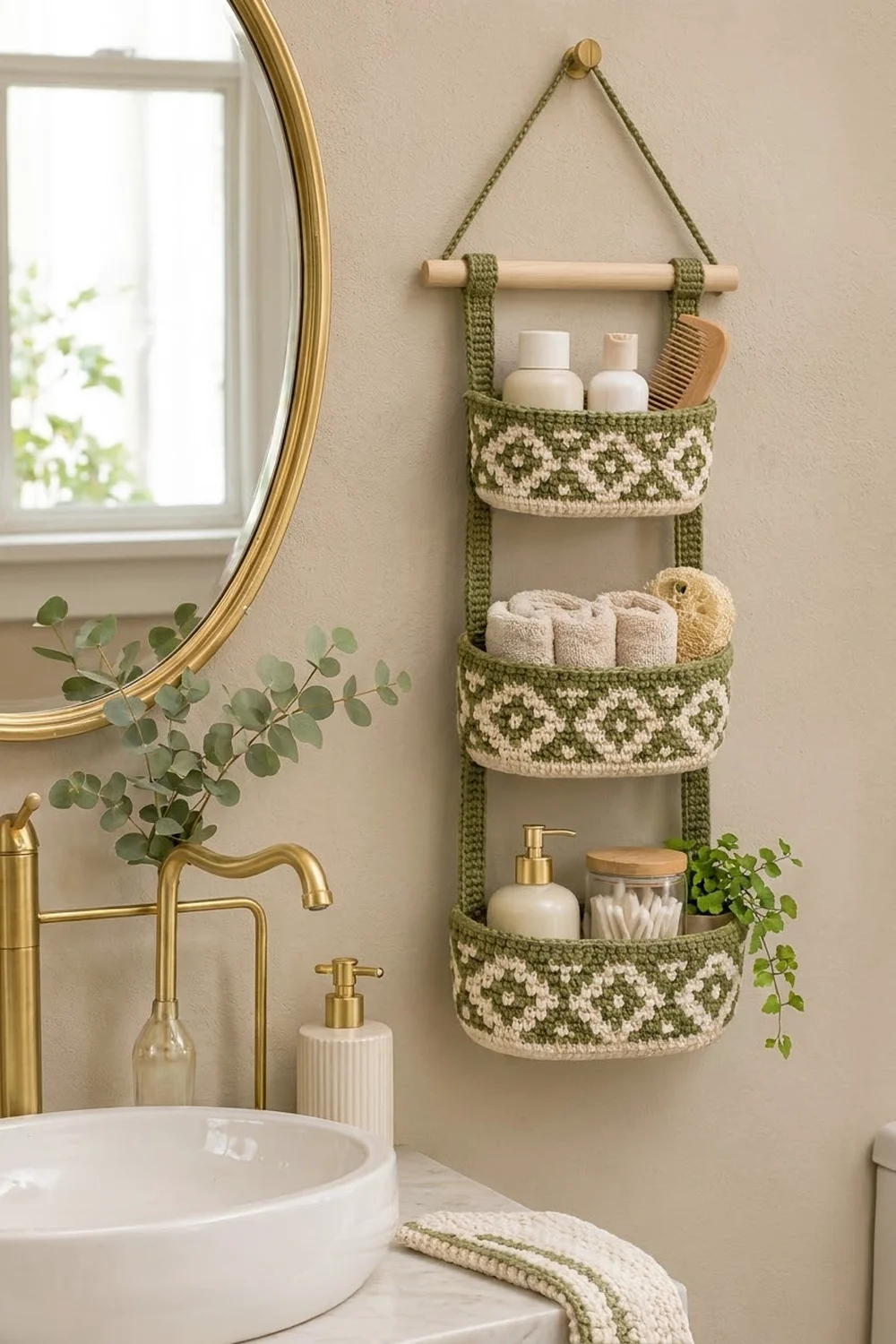
This hanging organizer has three oval baskets stacked on two green straps and hung from a wooden dowel. Each basket has a soft cream base, a band of sage green diamonds in tapestry crochet, and a solid green rim that gives the top edge a neat finish.
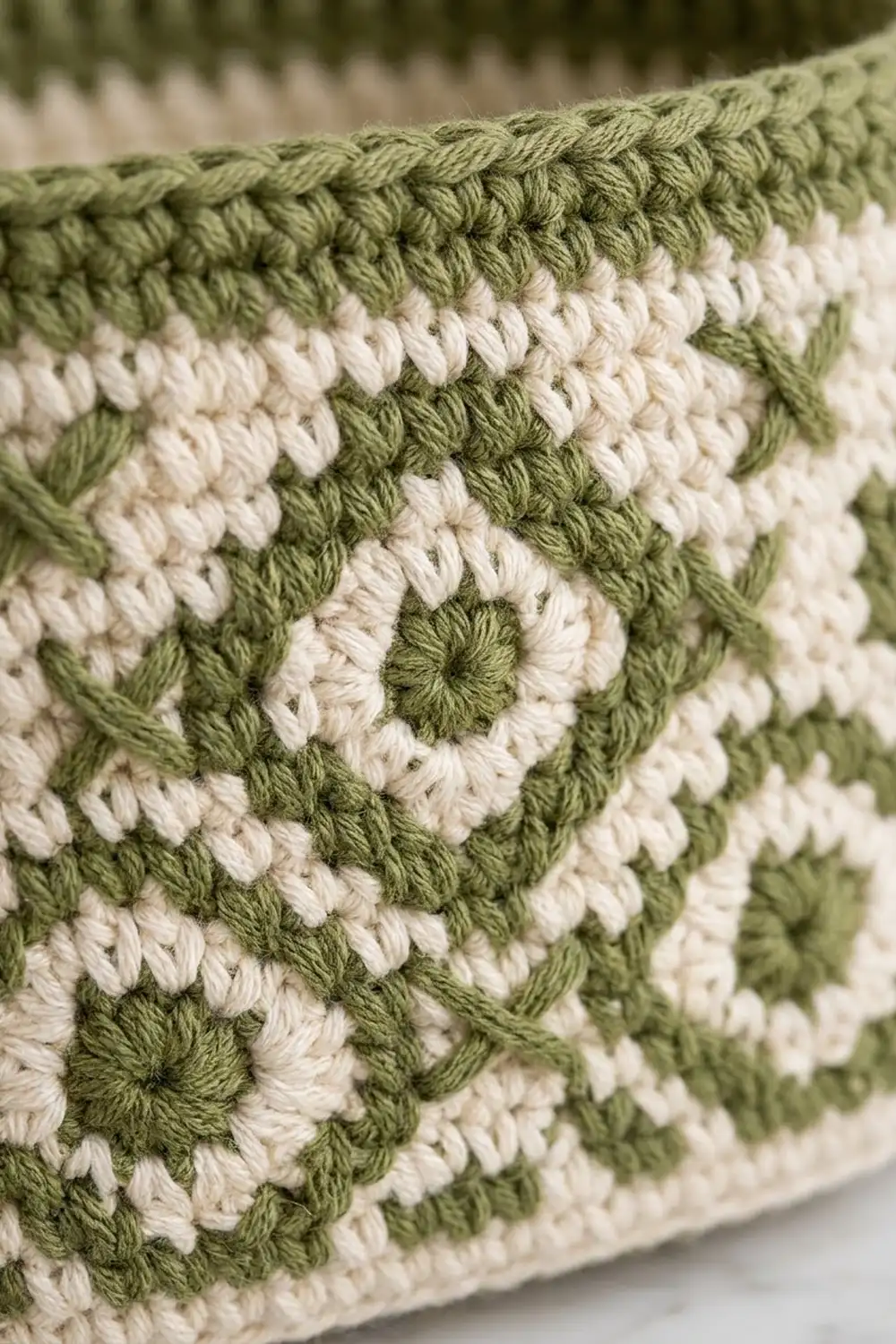
The colors are calm: warm cream with a muted olive-sage green. The diamond band has a green outline, a cream ring and a green center dot. Green X-shapes form where neighboring diamonds meet. The organizer works well in a bathroom, nursery or entryway.
The pattern uses US crochet terms. When finished, the organizer measures 21 in (53.3 cm) from the dowel to the bottom of the lowest basket. It hangs from a 14 in (35.6 cm) dowel. The baskets are 7.75 in (19.7 cm), 9.75 in (24.8 cm) and 11.75 in (29.8 cm) long. All three are 4 in (10.2 cm) deep and 4 in (10.2 cm) tall.
Here’s how it’s built. You work each basket base as a flat oval in joined rounds. Then you turn up the wall with a back-loop round and work straight up, adding the diamond band and the green rim. You crochet the straps lengthwise, fold them over the dowel, and whip-stitch them to the back of each basket. A slip-stitch cord tied to the dowel ends lets you hang it.
Finished Size and Construction
- Finished size: 21 in (53.3 cm) from dowel to bottom; 14 in (35.6 cm) wide at the dowel
- Skill level: Intermediate (tapestry crochet)
- Terminology: US
- Yarn weight: Worsted (#4) cotton
- Hook: 4.0 mm (G-6)
- Number of pieces: 6 crocheted (3 baskets, 2 straps, 1 cord) plus 1 dowel
- Layout: 1 column of 3 baskets, smallest at top
- Piece sizes: Small 7.75 × 4 × 4 in (19.7 × 10.2 × 10.2 cm); Medium 9.75 × 4 × 4 in (24.8 × 10.2 × 10.2 cm); Large 11.75 × 4 × 4 in (29.8 × 10.2 × 10.2 cm)
- Wall height before rim: about 3.1 in (7.9 cm)
- Rim (border) depth: about 0.9 in (2.3 cm), 4 rounds
Materials
Use a smooth, firm worsted-weight cotton or cotton blend. Cotton holds its shape under the weight of bottles and towels, and the diamonds show up crisply in it. Avoid soft acrylics, which tend to sag. The amounts below assume about 170 m per 100 g.
- Cream: 140 g / 240 m
- Sage green: 90 g / 155 m
The quantities include a margin of about 15% for gauge swatching and tails.
Tools:
– 4.0 mm (G-6) hook
– Tapestry needle
– 8 stitch markers
– Wooden dowel, 3/8 in (1.0 cm) diameter, 14 in (35.6 cm) long
– Scissors, tape measure
– Optional: spray starch for blocking
Abbreviations (US Terms)
- ch – chain
- sc – single crochet
- sl st – slip stitch
- BLO – back loop only
- st(s) – stitch(es)
- rnd(s) – round(s)
- rep – repeat
- C – cream
- G – green
Tapestry single crochet: Work sc as usual while you hold the unused color along the top of the previous round, so it’s enclosed inside each stitch. To change color, work the last yarn-over of the stitch before the color change with the new color. Keep the carried strand relaxed, not tight.
Gauge and Checkpoints
Gauge: 16 sc and 18 rnds = 4 in (10.2 cm) in tapestry sc worked in the round.
Make the small basket first as your test piece. If it matches the checkpoints, the other two will match as well.
- After Rnd 1: The base is about 3.75 in (9.5 cm) [5.75 in (14.6 cm), 7.75 in (19.7 cm)] long.
- After Rnd 9: The base is 7.75 × 4 in (19.7 × 10.2 cm) [9.75 × 4 in (24.8 × 10.2 cm), 11.75 × 4 in (29.8 × 10.2 cm)]. Its perimeter is 20 in (50.8 cm) [24 in (61.0 cm), 28 in (71.1 cm)].
- After Rnd 13: The wall is about 0.9 in (2.3 cm) tall.
- After Rnd 20: The wall is about 2.4 in (6.1 cm) tall.
- After Rnd 23: The wall is about 3.1 in (7.9 cm) tall.
- After Rnd 27: The wall is 4 in (10.2 cm) tall.
If the small base is too big: Go down 0.25–0.5 mm in hook size. If it’s too small: Go up the same amount. Don’t change the stitch counts, because every round count is a multiple of 8 so the diamond repeat fits.
Baskets (Make 3)
Sizes are written Small [Medium, Large]. Work in joined rounds: join each round with a sl st to the first sc, then ch 1 (the ch 1 doesn’t count as a stitch).
Base (Cream)
Ch 16 [24, 32].
Rnd 1: Work 3 sc in 2nd ch from hook (End A). Sc in next 13 [21, 29] ch. Work 3 sc in last ch (End B). Working into the bottom loops of the foundation ch, sc in next 13 [21, 29] ch. Join. — 32 [48, 64] sts (3 at each end and 13 [21, 29] along each side)
Rnd 2: Ch 1. Work 2 sc in each of next 3 sts, sc in next 13 [21, 29] sts, 2 sc in each of next 3 sts, sc in next 13 [21, 29] sts. Join. — 38 [54, 70] sts
Rnd 3: Ch 1. (Sc in next st, 2 sc in next st) 3 times, sc in next 13 [21, 29] sts; rep from * once more. Join. — 44 [60, 76] sts*
Rnd 4: Ch 1. (Sc in next 2 sts, 2 sc in next st) 3 times, sc in next 13 [21, 29] sts; rep from * once more. Join. — 50 [66, 82] sts*
Rnds 5–9: Keep increasing the same way. In each round, add 1 more sc before each increase at the ends. In Rnd 5 that’s (sc in next 3, 2 sc in next) 3 times. By Rnd 9 it’s (sc in next 7, 2 sc in next) 3 times. The straight sides stay at 13 [21, 29] sts.
| Rnd | Small | Medium | Large |
|---|---|---|---|
| 5 | 56 | 72 | 88 |
| 6 | 62 | 78 | 94 |
| 7 | 68 | 84 | 100 |
| 8 | 74 | 90 | 106 |
| 9 | 80 | 96 | 112 |
After Rnd 9, each end group has 27 sts and each straight side has 13 [21, 29] sts: 27 + 13 + 27 + 13 = 80 [96, 112]. The base increases by exactly 6 sts per round.
Wall
Rnd 10 (turning round): Ch 1, sc in BLO of each st around. Join. — 80 [96, 112] sts. The unused front loops leave a crisp fold where the wall stands up.
Rnds 11–13: Ch 1, sc in each st around. Join. — 80 [96, 112] sts
Rnds 14–20 (diamond band): Join G and carry it from here on. Each round has 10 [12, 14] repeats of 8 sts.
- Rnd 14: *3 C, 1 G, 1 C, 1 G, 2 C; rep from * around.
- Rnd 15: *2 C, 1 G, 1 C, 1 G, 1 C, 1 G, 1 C; rep from * around.
- Rnd 16: *1 C, 1 G; rep from * around.
- Rnd 17: *1 G, 1 C; rep from * around.
- Rnd 18: Rep Rnd 16.
- Rnd 19: Rep Rnd 15.
- Rnd 20: Rep Rnd 14.
Every chart round stays at 80 [96, 112] sts. Together these rounds build a concentric diamond: a green outer outline, a cream ring, a green inner ring and a green center dot. The outer outlines of neighboring diamonds touch at stitch 1 of each repeat, which forms the green X-shapes between them. Cut G after Rnd 20.
Rnds 21–23: With C only, ch 1, sc in each st around. Join. — 80 [96, 112] sts. Cut C.
Continue with the rim (see Border).
Straps (Make 2, Green)
Ch 93.
Row 1: Sc in 2nd ch from hook and in each ch across. — 92 sts
Rows 2–5: Ch 1, turn. Sc in BLO of each st across. — 92 sts
Fasten off. Each strap measures 23 × 1.1 in (58.4 × 2.8 cm). Working in BLO gives the lengthwise ridges.
Mark each strap from one end (the top):
– Sts 1–8: dowel fold, 2 in (5.1 cm)
– Sts 9–20: gap, 3 in (7.6 cm)
– Sts 21–36: small basket, 4 in (10.2 cm)
– Sts 37–48: gap
– Sts 49–64: medium basket
– Sts 65–76: gap
– Sts 77–92: large basket
Check: 8 + 12 + 16 + 12 + 16 + 12 + 16 = 92.
Hanging Cord (Make 1, Green)
Ch 101. Sl st in the back bump of the 2nd ch from hook and in each ch across. — 100 sl sts, about 24 in (61.0 cm). Fasten off and leave 4 in (10.2 cm) tails.
Make All Pieces
- Cream: 3 bases plus the cream wall rounds (Rnds 10–13 and 21–23) and the cream stitches of the diamond band
- Green: the diamond-band stitches and 3 rims, 2 straps, 1 cord
Layout (front view):
        /\        <- cord
  ==|========|==  <- dowel, straps 6.5 in apart
    |  [S]   |    <- small basket
    |        |
   [   M    ]     <- medium basket
    |        |
  [    L     ]    <- large basket
Joining
Method: Whip stitch with green yarn on a tapestry needle.
- Find the back center of each basket. The back straight side is the last 13 [21, 29] sts of each round, and its middle stitch is the back center. Count 13 sts left and 13 sts right of it and place markers. The markers are the strap centers, 26 sts or 6.5 in (16.5 cm) apart. On the small basket they sit just where the curves begin, so the straps frame its ends. On the larger baskets the straps fall on the flat back.
- Sew the dowel loops. Fold strap sts 1–8 over the dowel to the back and whip-stitch the end to the back of the strap. Do this for both straps, 6.5 in (16.5 cm) apart and centered on the dowel.
- Attach the baskets. Lay the strap centered over a marker, with the basket’s rim level with the first stitch of its section. Whip-stitch both long edges of the strap to the wall, from rim down to the Rnd 10 fold. Make one whip stitch per basket round. Each basket has 18 wall rounds but only 16 strap sts, so pass through the same strap stitch twice after every 8 strap sts. That gives you 18 stitches over 16.
Tension: Snug enough to close gaps, but not so tight it puckers the wall. Keep the stitches the same length on both edges.
Size checkpoint: The distance from the dowel to the bottom of the large basket should be 21 in (53.3 cm), with 3 in (7.6 cm) gaps between the baskets.
Thread the cord tails through the dowel ends, 0.5 in (1.3 cm) from each tip. Knot twice and weave in the tails.
Border (Green Rim)
Border gauge: Same as the body, 16 sc and 18 rnds = 4 in (10.2 cm). The 4 rim rounds add about 0.9 in (2.3 cm).
After Rnd 23, join G at the first stitch (the start of End A).
Rnds 24–27: Ch 1, sc in each st around. Join. For each round:
- End A: 27 sts
- Front straight: 13 [21, 29] sts
- End B: 27 sts
- Back straight: 13 [21, 29] sts
- Total: 80 [96, 112] sts
After Rnd 27, fasten off with an invisible join.
Why the math works: Each wall round has 1 sc in each stitch of Rnd 9, so the rim count is the same as the base count: 2 × 27 + 2 × 13 [21, 29]. With no increases or decreases, the wall rises straight with no flaring or pulling in. At 16 sts per 4 in, 80 [96, 112] sts measure 20 [24, 28] in (50.8 [61.0, 71.1] cm) around, which matches the base perimeter exactly. Every count is divisible by 8, so the diamonds close seamlessly.
Final Blocking
- Weave in all ends inside the walls, through the carried strands.
- Lightly spritz each basket with water or spray starch.
- Slip each basket over a box or container of matching size so the walls stand straight and the oval base sits flat.
- Press the green rims into an even line with your fingers.
- Pin the straps straight and flat on a towel, then mist them.
- Let everything dry completely (12–24 hours) before you hang the organizer.
Final Quality-Control Checklist
- [ ] Rnd 9 counts: 80 [96, 112]
- [ ] Bases lie flat with no cupping
- [ ] All diamonds are complete, with green X-shapes where they meet
- [ ] Carried strands don’t show between stitches
- [ ] Walls are 4 in (10.2 cm) tall all around
- [ ] Straps are 6.5 in (16.5 cm) apart on every basket
- [ ] Baskets hang level, with 3 in (7.6 cm) gaps
- [ ] Cord knots are secure and the dowel hangs level
Troubleshooting
- The base ruffles: Your tension is too loose at the ends. Go down a hook size for the base only.
- The base cups: You’ve likely missed an increase. Recount: the base should grow by 6 sts per round.
- The base ends look pointy: Stacked increases can look angular. Stagger them by working the “2 sc” at the start of the repeat on alternate rounds, but keep the counts the same.
- The other color shows through: Carry the unused strand loosely and work over it from behind. A tighter stitch hides it better.
- The walls lean out: Your tapestry rounds are looser than your plain rounds. Tug the yarn snug after each color change.
- The diamonds drift: Check that every round has 10 [12, 14] full repeats of 8 sts.
- A basket tilts: Re-sew the straps so both are level with the rim.
Care
Hand wash in cool water with mild soap. Reshape over a container and dry flat. Don’t put it in the dryer.
Final Notes
The measurement chain is simple. A 16-st gauge gives an 80 [96, 112] st base. Those counts carry up 18 straight rounds to a 4 in (10.2 cm) wall. Then two 92-st straps hold the three baskets with 3 in (7.6 cm) gaps, for a 21 in (53.3 cm) organizer. If each checkpoint matches, the finished piece will too.
Happy crocheting!