

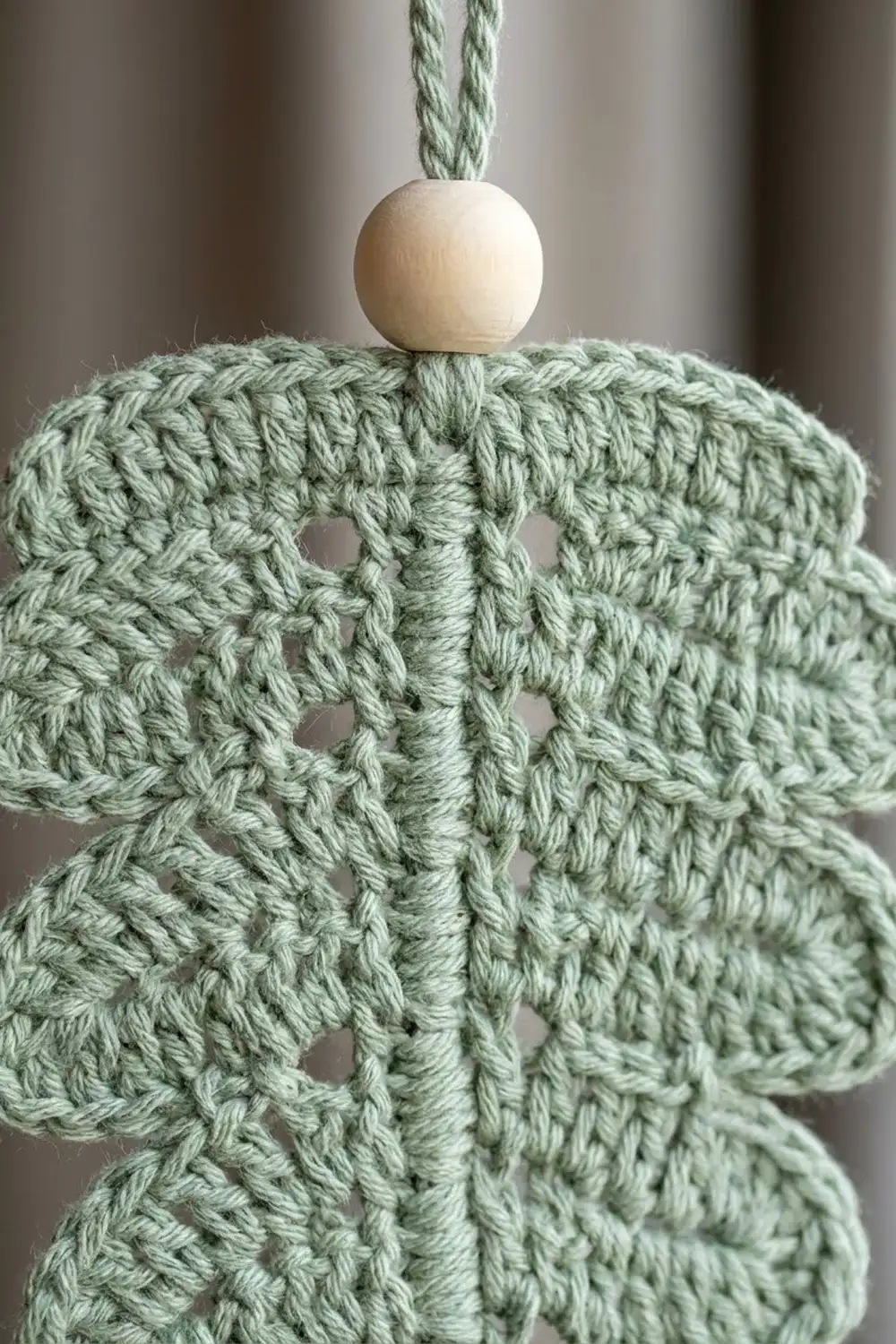
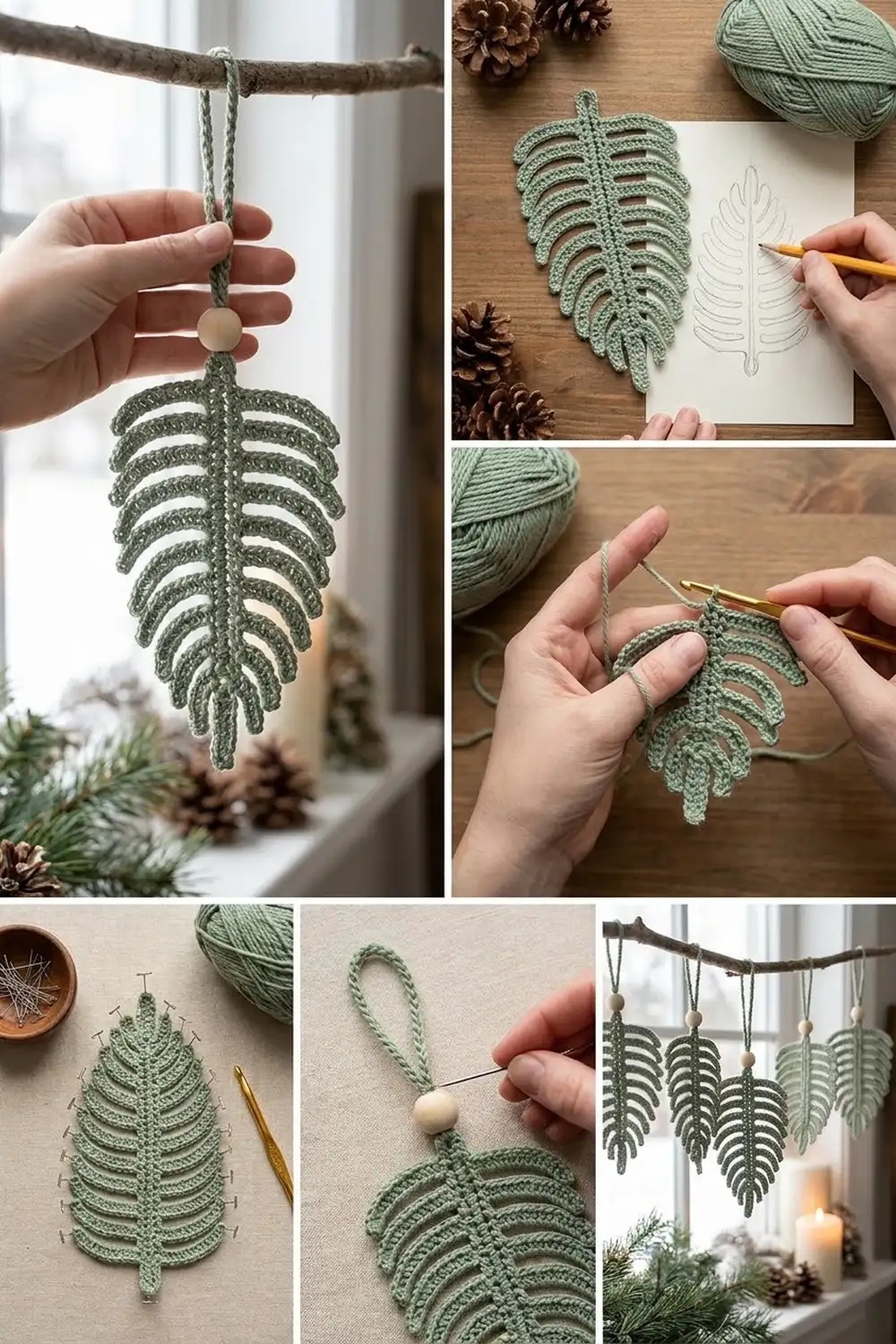
This little fern leaf is a quick, lacy ornament for a branch, a window, or a gift box. It is a single flat piece in soft sage green, finished with a wooden bead and a twisted loop at the top.
The leaf has a solid central spine and nine pairs of slim, pointed fronds. Each frond has a thin solid edge and a row of tiny open windows, so light shows through when it hangs. The fronds are longest near the top and get shorter toward the pointed tip, which gives the classic fern outline. The muted green and natural wood give it a calm, Scandinavian winter look.
The pattern uses US crochet terms. The finished leaf measures about 6 in (15.2 cm) long and 2.75 in (7.0 cm) wide. With the bead and hanging loop, the ornament hangs about 8.5 in (21.6 cm) long.
Construction is simple and seamless. You chain the spine, work down one side making fronds as you go, turn around the tip, and work back up the other side of the same chain. A short twisted cord and a bead finish the top. There is nothing to sew together except the loop.
Finished Size and Construction
- Finished leaf size: 6 in (15.2 cm) long x 2.75 in (7.0 cm) wide, after blocking
- Total hanging length: 8.5 in (21.6 cm), including the bead and loop
- Skill level: Easy-intermediate
- Terminology: US crochet terms
- Yarn weight: Sport (#2), cotton
- Hook: 2.5 mm (US B/1 or C/2)
- Number of pieces: 1
- Layout: One vertical leaf, hung from the top
- Piece size: 6 in (15.2 cm) x 2.75 in (7.0 cm)
- Size before border: Same as finished; there is no separate border round
- Border depth: None added; the frond edge is built into the main pattern
Materials
Choose a smooth, matte cotton or cotton blend in sport weight. Cotton holds the pointed frond tips well after blocking. Avoid fuzzy or very stretchy yarn, because the small open windows will blur.
- Sage green: 5 g, about 15 m. This covers the leaf, the twisted loop, and the tails.
- Tools:
- 2.5 mm crochet hook
- One 12 mm round natural wooden bead with a 4–5 mm hole
- 2 locking stitch markers
- Tapestry needle
- Scissors
- Rust-proof pins and a blocking mat or folded towel
- Optional: spray starch
The yarn quantity includes a small safety margin for a test frond and longer tails.
Abbreviations (US Terms)
- ch – chain
- sl st – slip stitch
- sc – single crochet
- hdc – half double crochet
- dc – double crochet
- sk – skip
- sp(s) – space(s)
- st(s) – stitch(es)
- pos – position (a numbered chain in the spine)
Special stitch – Frond (n): Ch (4 + 2n). Sl st in 2nd ch from hook, sc in next ch, hdc in next ch, [ch 1, sk next ch, dc in next ch] n times. The last dc lands in the first ch of the frond chain, right next to the spine. Each frond has 1 sl st, 1 sc, 1 hdc, n dc, and n ch-1 spaces. The ch-1 spaces make the open “ladder” windows, and the short stitches at the end make the pointed tip.
Tip spike: Ch 4, sl st in 2nd ch from hook, sc in next ch, hdc in next ch.
Gauge and Checkpoints
Gauge: 7 sc = 1 in (2.5 cm), worked along the foundation chain.
Gauge matters less here than it does for a garment, but it controls the final size and how crisp the windows look. Make one test frond before you start the full leaf.
Test frond: Ch 12. Sl st in 2nd ch from hook, sc in next ch, hdc in next ch, [ch 1, sk next ch, dc in next ch] 4 times. You should have 4 open windows. Lay it flat without stretching. It should measure about 1.5 in (3.8 cm) long.
Checkpoints:
- Foundation: Ch 41, slightly relaxed, should measure about 5.75 in (14.6 cm).
- After Side A: The spine plus the tip measures about 6 in (15.2 cm). The longest frond (Frond 2) is about 1.5 in (3.8 cm).
- After Side B: Unblocked width is about 2.5 in (6.4 cm).
- After blocking: 6 in (15.2 cm) x 2.75 in (7.0 cm).
If your leaf is too big: go down to a 2.25 mm hook, or make your chains tighter. If it is too small: go up to a 2.75 mm hook. Keep every chain count the same so the frond spacing stays correct.
Pattern
Working Tips
- Chain loosely and evenly. The frond chains are both the solid edge and the base for the windows, so tight chains will make the fronds curl.
- Always make the frond’s ch-1 by wrapping the yarn once, not by pulling a long loop.
- Count each frond chain twice before you work back along it. One extra chain shifts every window.
- Every frond is worked out and then back toward the spine. It always finishes right next to the sc it started from.
Foundation (Spine Chain)
Make a slip knot, leaving a 6 in (15.2 cm) tail. This tail sits at the bottom tip.
Ch 41. Your hook is now at the top of the leaf.
The chains are numbered from the top. The ch right next to the hook is skipped and acts as the turning chain. The next 40 chains are pos 1 (top) through pos 40 (bottom, the first chain you made). Place a marker in pos 40 so the tip is easy to find.
Frond Sizes
Both sides use the same nine fronds. On Side A, you make them from top to bottom. On Side B, you make them in reverse order, from bottom to top.
| Frond | n | Chain length | dc | ch-1 sps |
|---|---|---|---|---|
| 1 | 3 | ch 10 | 3 | 3 |
| 2 | 4 | ch 12 | 4 | 4 |
| 3 | 4 | ch 12 | 4 | 4 |
| 4 | 3 | ch 10 | 3 | 3 |
| 5 | 3 | ch 10 | 3 | 3 |
| 6 | 2 | ch 8 | 2 | 2 |
| 7 | 2 | ch 8 | 2 | 2 |
| 8 | 1 | ch 6 | 1 | 1 |
| 9 | 1 | ch 6 | 1 | 1 |
Each side has 82 frond chains, 23 dc, and 23 ch-1 spaces.
Side A (Top to Bottom)
Sc in 2nd ch from hook (pos 1), sc in next ch (pos 2). Work Frond 1 (n = 3).
Sc in next 4 ch, work the next frond in the table. Repeat from * 7 more times to make Fronds 2 through 9. Frond 9 is attached at pos 34.
Sc in next 5 ch (pos 35–39).
Spine count for Side A: 39 sc (pos 1–39) and 9 fronds. The fronds sit at pos 2, 6, 10, 14, 18, 22, 26, 30, and 34.
Bottom Tip
Work all of these in pos 40 (the marked ch): sc, tip spike, sc.
Tip count: 2 sc plus 1 tip spike (1 sl st, 1 sc, 1 hdc). The spike gives the leaf its pointed lower end.
Rotate the work so you can work along the other side of the foundation chain.
Side B (Bottom to Top)
Work into the free loops on the opposite side of the foundation chain. These sit right under the Side A stitches, so each sc lines up with its partner.
Sc in pos 39, 38, 37, 36, 35, and 34. Work Frond 9 (n = 1).
Sc in next 4 ch, work the next frond, moving backward through the table. Repeat from * 7 more times to make Fronds 8 through 1. Frond 1 is attached at pos 2.
Sc in pos 1. Sl st in the skipped turning ch at the top.
Fasten off, leaving a 6 in (15.2 cm) tail.
Spine count for Side B: 39 sc (pos 39–1) and 9 fronds, attached at the same positions as on Side A. Each frond sits directly opposite its partner.
Whole-leaf count: 78 spine sc, 18 fronds, 46 dc, 46 ch-1 spaces, and 1 tip.
Twisted Loop and Bead
- Cut a 24 in (61.0 cm) strand of sage green.
- Fold it in half and anchor the fold on a hook or doorknob. Twist the two strands together firmly in one direction until they start to kink.
- Hold the middle, bring the ends up to the fold, and let go. The cord will twist back on itself. Knot the ends.
- Fold this cord in half to make a loop 2 in (5.1 cm) tall. Thread both cord ends together through the wooden bead.
- Slide the bead down so it sits on top of the spine. Using the tapestry needle, stitch the cord ends firmly into the top 3–4 sc of the spine, front and back.
- Weave in all tails along the spine, where the solid stitches hide them.
Border
This design has no separate border round. The fronds form the outline, which keeps the leaf delicate and open.
Border gauge: The edge follows the spine gauge, 7 sc = 1 in (2.5 cm), with one frond every 4 sc.
Edge counts per side:
- Side A: 39 sc and 9 fronds, top to bottom.
- Bottom tip: 2 sc and 1 tip spike.
- Side B: 39 sc and 9 fronds, bottom to top.
Why the math works: The foundation has 40 working chains. Each side uses pos 1–39, which is 39 sc. Pos 40 holds the tip, so it is not counted on either side. The fronds start at pos 2 and repeat every 4 chains: 2 + (8 x 4) = 34, which puts Frond 9 at pos 34. That leaves pos 35–39 (5 sc) as a short stem above the tip. Both sides use the same positions, so the frond pairs line up exactly across the spine.
Final Blocking
- Soak the leaf in cool water for 5 minutes. Press out the water gently in a towel. Do not wring it.
- Lay it flat on a blocking mat. Pin the top and the bottom tip so the spine is straight and measures 6 in (15.2 cm).
- Pin each frond tip, starting with Frond 2 on both sides. Angle each frond slightly downward and curve its tip outward.
- Check that the widest point, at Fronds 2 and 3, measures 2.75 in (7.0 cm) across.
- Use a pin tip to open any ch-1 windows that look closed.
- Spray lightly with starch if you want a crisper leaf.
- Let it dry completely before you remove the pins.
Final Quality-Control Checklist
- The spine is straight and measures 6 in (15.2 cm).
- The widest point measures 2.75 in (7.0 cm).
- There are nine fronds on each side, directly opposite each other.
- Frond sizes step down smoothly from Frond 2 to Frond 9.
- Every ch-1 window is open and evenly spaced.
- The tip spike is pointed and centered.
- The bead sits snugly on top of the spine.
- The hanging loop is 2 in (5.1 cm) tall and evenly twisted.
- All tails are woven in and trimmed.
Troubleshooting
Fronds twist or flip over. The frond chain is too tight. Chain more loosely, or use a hook one size larger for the frond chains only.
Fronds on the two sides don’t line up. Count the spine sc again. Each side needs exactly 4 sc between fronds and 5 sc at the bottom.
Windows close up. Make sure you skip one chain before each dc. Pinning during blocking will reopen small gaps.
The spine curves. Side B was worked tighter than Side A. Relax your tension, then pin the spine straight while blocking.
The bead won’t fit over the cord. Use a bead with a larger hole, or pass the cord ends through one at a time with the tapestry needle.
The tip is blunt. Work the tip spike a little tighter, then pin the point while it dries.
Care
Hand wash in cool water and lay flat to dry, pinning the fronds back into shape if needed. Store flat or hanging, away from heavy items that could crush the fronds.
Final Notes
The measurement chain is short and easy to follow. A 41-chain foundation gives a spine of about 5.75 in (14.6 cm), and the tip brings the leaf to 6 in (15.2 cm). The longest fronds, about 1.5 in (3.8 cm) each, give a blocked width of 2.75 in (7.0 cm). The bead and the 2 in (5.1 cm) loop bring the total hanging length to 8.5 in (21.6 cm).
Make one leaf and check it against the checkpoints. Then make as many separate leaves as you like for your branch, window, or gift wrap.
Happy crocheting!