

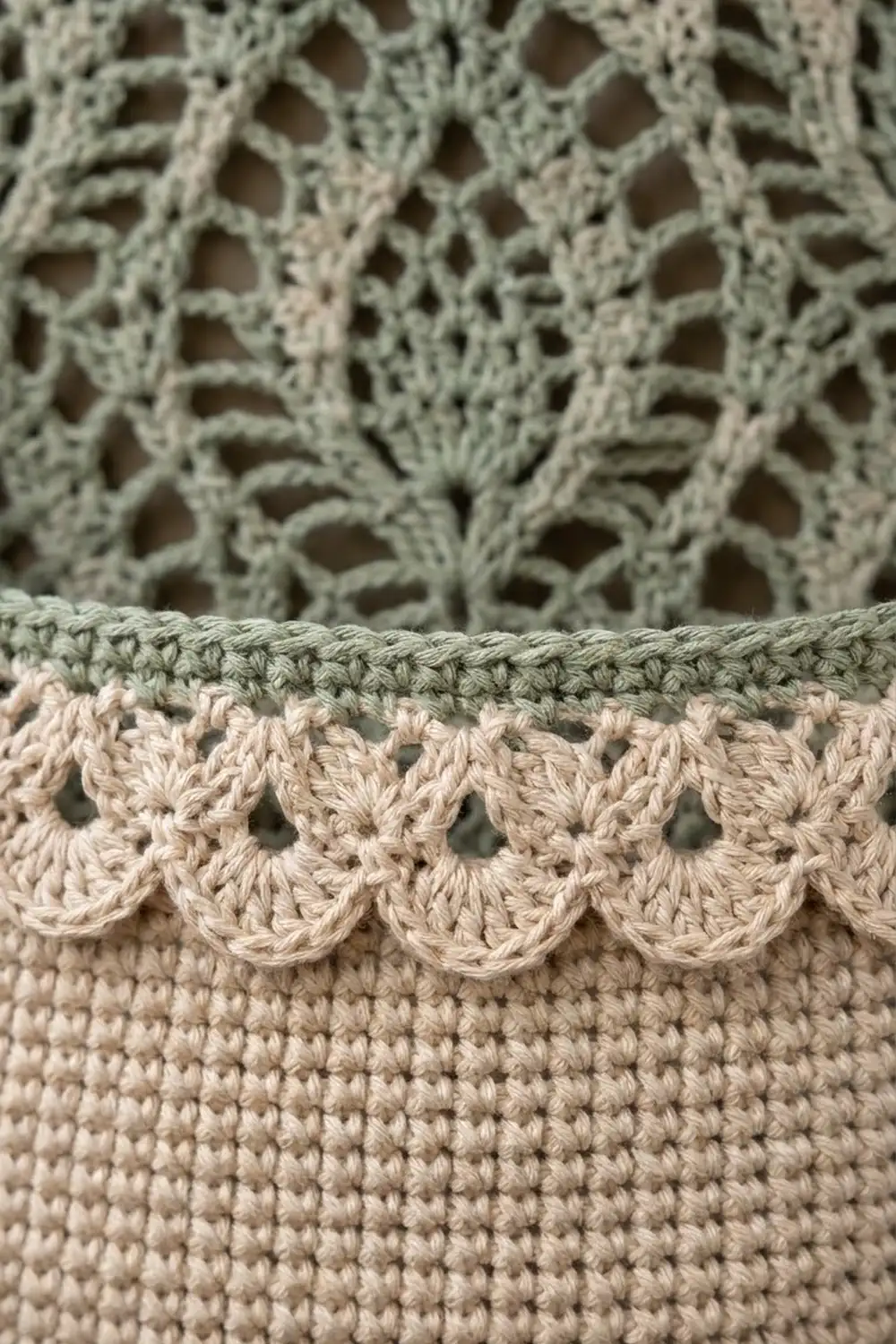
The Sage Grove organizer is a tall sage-green oval of leaf lace that hangs from a car headrest. Columns of pointed leaves run up the panel between slim double crochet spines. The panel is framed in green and edged with cream picot scallops.
Across the lower part sits a dense cream pocket with a curved bottom. Its top has a band of lacy cream shells between green stripes. Two green straps loop around the headrest posts and fasten with brass snaps.
The pattern uses US terms. The finished organizer measures 13.5 in wide × 20 in tall (34.3 × 50.8 cm), not counting the straps.
You make four pieces: a lace panel worked in rows and shaped at both ends, a matching single crochet pocket and two straps. The pocket is crocheted onto the panel during the second frame round. Two cream rounds then finish the edge.
Finished Size and Construction
- Finished size: 13.5 × 20 in (34.3 × 50.8 cm)
- Skill level: Intermediate
- Terminology: US
- Yarn weight: Sport (#2) cotton
- Hook: 3.5 mm (E-4)
- Number of pieces: 4 (panel, pocket, 2 straps)
- Layout: the pocket covers the lower 7.5 in (19.1 cm) of the panel; the straps sit on the top curve
- Piece sizes:
- Panel: 12 × 18.5 in (30.5 × 47.0 cm)
- Pocket: 12 × 7.5 in (30.5 × 19.1 cm)
- Each strap: 1.25 × 9 in (3.2 × 22.9 cm)
- Size before border: 12 × 18.5 in (30.5 × 47.0 cm)
- Border depth: 0.75 in (1.9 cm), made of a 0.25 in (0.6 cm) green frame and 0.5 in (1.3 cm) of cream scallops
Materials
Use a smooth sport-weight cotton with about 140 m per 50 g. Cotton shows lace clearly and holds up to heat in a car.
- Sage green: 120 g (336 m). Used for the panel, frame, pocket stripes and straps.
- Cream: 70 g (196 m). Used for the pocket body, shell band and outer border.
Both amounts include a margin of about 15%.
Tools:
– 3.5 mm hook
– Tapestry needle
– Two 15 mm antique-brass sew-on snaps, plus matching thread
– Locking stitch markers
– Rustproof pins and a blocking mat
Abbreviations (US Terms)
ch (chain), sl st (slip stitch), sc (single crochet), dc (double crochet), sk (skip), sp (space), st(s) (stitch/es), rep (repeat), RS/WS (right side/wrong side).
fdc (foundation double crochet): Yo, insert hook into the base of the last st, yo, pull up a loop, yo, pull through 1 loop (this makes the “chain”), [yo, pull through 2] twice. To make the next fdc, work into the chain of the one just made.
Picot: Ch 3, sl st into the top of the sc just made.
Counting rules:
– Every ch counts as 1 st.
– A beginning ch-3 counts as 1 dc.
Gauge and Checkpoints
- Leaf lace: 24 sts (2 repeats) and 8 rows = 4 in (10.2 cm) square
- Sc: 24 sc and 26 rows = 4 in (10.2 cm) square
Test the sc gauge with a strap. Make one strap first. Its 6 sc should measure 1 in (2.5 cm) across.
Test the lace gauge with a swatch:
1. Ch 27.
2. Work panel Row 1.
3. Work Lace Rows 1–4 twice over the 25 sts.
The swatch should measure about 4.2 in (10.7 cm) wide and 4.5 in (11.4 cm) tall.
Checkpoints:
– Panel after Row 9: 12 in (30.5 cm) wide and 4.5 in (11.4 cm) tall
– Panel after Row 29: 14.5 in (36.8 cm) tall
– Panel after Row 37: 18.5 in (47.0 cm) tall
– Pocket after Row 29: 12 in (30.5 cm) wide
– Pocket after Row 46: 7.5 in (19.1 cm) tall
– After the border: 13.5 × 20 in (34.3 × 50.8 cm)
If your swatch is too big, use a hook 0.25 mm smaller. If it is too small, use a hook 0.25 mm larger. Width matters most, because the frame counts depend on it.
Lace Panel (Green)
Leaf Lace (multiple of 12 sts + 1)
Work these rows over the center “lace sts” only.
Lace Row 1 (leaf base): Dc in first st (spine), ch 2, sk next 5 sts, 7 dc in next st or ch-1 sp, ch 2, sk next 5 sts, dc in next st (spine); rep from * across. Each repeat = 2 + 7 + 2 + 1 = 12 sts.
Lace Row 2 (leaf opens): Dc in spine, ch 2, dc in first dc of shell, (ch 1, sk next dc, dc in next dc) 3 times, ch 2, dc in next spine; rep from * across. Each repeat = 2 + 7 + 2 + 1 = 12 sts.
Lace Row 3 (leaf narrows): Dc in spine, ch 3, sk ch-2 sp and next dc, (dc in next ch-1 sp, ch 1) twice, dc in next ch-1 sp, ch 3, sk next dc and ch-2 sp, dc in next spine; rep from * across. Each repeat = 3 + 5 + 3 + 1 = 12 sts.
Lace Row 4 (leaf tip): Dc in spine, ch 4, sk ch-3 sp and next dc, sc in next ch-1 sp, ch 1, sk next dc, sc in next ch-1 sp, ch 4, sk next dc and ch-3 sp, dc in next spine; rep from * across. Each repeat = 4 + 3 + 4 + 1 = 12 sts.
In the next Lace Row 1, each shell goes into the ch-1 sp at a leaf tip. This stacks the leaves into straight columns.
Shaping
- Add n sts at the start of a row: Ch n + 2, then dc in 4th ch from hook and in each remaining ch. The 3 skipped ch count as 1 st. Then dc in the first st of the row.
- Add n sts at the end of a row: Work n fdc.
- Remove n sts at the start of a row: Sl st in each of the first n + 1 sts, then ch 3.
- Remove n sts at the end of a row: Leave the last n sts unworked.
Each row is worked as edge dc, then Leaf Lace over the centered lace sts, then edge dc. For the edge dc, work 1 dc in each st and ch below, plus any sts you added. When the edge count is 0, the starting ch-3 is the first spine. Turn at the end of every row.
Instructions
Ch 27.
Row 1 (RS): Dc in 4th ch from hook and in each ch across. (25 sts)
| Row | Lace Row | Shaping at each end | Total sts | Edge dc each side | Repeats |
|---|---|---|---|---|---|
| 2 | 1 | add 5 | 35 | 5 | 2 |
| 3 | 2 | add 4 | 43 | 9 | 2 |
| 4 | 3 | add 4 | 51 | 13 | 2 |
| 5 | 4 | add 3 | 57 | 16 | 2 |
| 6 | 1 | add 3 | 63 | 7 | 4 |
| 7 | 2 | add 2 | 67 | 9 | 4 |
| 8 | 3 | add 2 | 71 | 11 | 4 |
| 9 | 4 | add 1 | 73 | 12 | 4 |
| 10–29 | 1–4, 5 times | none | 73 | 0 | 6 |
| 30 | 1 | remove 1 | 71 | 11 | 4 |
| 31 | 2 | remove 2 | 67 | 9 | 4 |
| 32 | 3 | remove 2 | 63 | 7 | 4 |
| 33 | 4 | remove 3 | 57 | 4 | 4 |
| 34 | 1 | remove 3 | 51 | 13 | 2 |
| 35 | 2 | remove 4 | 43 | 9 | 2 |
| 36 | 3 | remove 4 | 35 | 5 | 2 |
| 37 | 4 | remove 5 | 25 | 0 | 2 |
Checking the table:
– Every row’s total = 2 × edge + (12 × repeats + 1). For example, Row 6 = 2 × 7 + 49 = 63.
– The increases total 5 + 4 + 4 + 3 + 3 + 2 + 2 + 1 = 24 per side, so 25 + 48 = 73.
– The decreases mirror the increases, which brings the panel back to 25.
– The lace stays centered whether it has 2, 4 or 6 repeats, so the columns line up all the way up the panel.
Fasten off.
Pocket (Cream and Green)
With cream, ch 26.
Row 1 (RS): Sc in 2nd ch from hook and in each ch across. Turn. (25)
Rows 2–5: Ch 1, 2 sc in each of the first 2 sts, sc to the last 2 sts, 2 sc in each of the last 2 sts. Turn. (Row 2: 29, Row 3: 33, Row 4: 37, Row 5: 41)
Rows 6–13: Ch 1, 2 sc in first st, sc to the last st, 2 sc in last st. Turn. (Row 13: 57)
Rows 14–29:
– Even rows: increase as in Row 6.
– Odd rows: ch 1, sc across.
Turn at the end of each row. (Row 29: 73)
Rows 30–41: Ch 1, sc across. Turn. (73; the pocket is about 6.25 in / 15.9 cm tall)
Row 42 (green): Ch 1, sc across. Turn. (73)
Row 43 (cream, shells): Ch 1, sc in first st, sk 2, 5 dc in next st, sk 2, sc in next st; rep from * 12 times. Turn. Count: 12 × (5 dc + 1 sc) + 1 sc = 73.
Row 44 (cream): Ch 3, ch 2, sc in center dc of shell, ch 2, dc in next sc; rep from * 12 times. Turn. Count: 1 + 12 × 6 = 73.
Row 45 (green): Ch 1, sc in each dc and sc, 2 sc in each ch-2 sp. Turn. (73)
Row 46 (green): Ch 1, sc across. Fasten off. (73)
Pocket edging (green): With RS facing, join green at the top right corner.
1. Work 58 sc evenly down the side, about 5 sc for every 6 row ends and step sts.
2. Work 25 sc across the foundation.
3. Work 58 sc up the other side.
Fasten off. (141 sc)
Straps (Make 2, Green)
Ch 7.
Row 1: Sc in 2nd ch from hook and in each ch across. Turn. (6)
Rows 2–57: Ch 1, sc across. Turn. (6)
Edging round:
1. Work 57 sc down the long side, 1 per row end.
2. On the short end, work 3 sc in the first st, sc in the next 4 sts and 3 sc in the last st (10 sc).
3. Repeat steps 1 and 2 on the other long side and short end.
Join. (134 sc)
Make All Pieces
- Green: 1 panel, 2 straps, pocket stripes and edging, Border Rnds 1–2
- Cream: pocket body and shells, Border Rnds 3–4
     [strap]        [strap]
   (     lace panel top     )
  (       leaf columns       )
  |-------- shell band ------|
  (        cream pocket      )
   (________________________)
Joining
The pocket is joined during Border Rnd 2.
- Work Border Rnd 1 on the panel.
- Lay the pocket RS up on the panel RS with the bottom edges matching.
- The pocket’s 25 bottom sts sit over the panel’s 25 bottom sts.
- Each 58-st pocket side sits over the 40 bottom-curve sts plus the first 18 straight sts on that side.
- The top of the pocket reaches the top of panel Row 15.
- Clip the layers together every 10 sts.
- Work Border Rnd 2. Across the pocket’s 141 sts, put the hook through 1 pocket st and 1 frame st for each sc. This joins the pieces 1 to 1, with no extra sts at the pocket corners.
Keep your tension relaxed so the pocket stays flat. Slide the stitches along the hook often.
Straps: Attach the straps after blocking.
1. Sew the end of each strap to the WS of the panel, with 1.5 in (3.8 cm) of strap overlapping the panel. Center each strap 3 in (7.6 cm) from the panel’s center line.
2. Sew the cap half of a snap to the outer side of the strap tip.
3. Sew the matching half to the front of the panel, about 2 in (5.1 cm) below the top edge.
Border
Border gauge: 6 sc = 1 in (2.5 cm). The panel’s outline is about 54 in (137.2 cm), and 54 × 6 = 324 sts.
Rnd 1 (green): With RS facing, join in the first foundation st. Work in this order:
– Bottom: 25 sc, 1 in each foundation st.
– First side: 40 sc evenly around the bottom curve (Rows 1–9), then 60 sc along Rows 10–29 (3 per row end), then 37 sc evenly around the top curve (Rows 30–37). Total 137.
– Top: 25 sc across Row 37.
– Second side: 37 + 60 + 40 = 137.
Join. (25 + 137 + 25 + 137 = 324 sc)
Rnd 2 (green, joining): Ch 1, sc in each st around, working through both layers along the pocket. Join. (324, the same count per side as Rnd 1)
Rnd 3 (cream, scallops): Ch 1, sc in next st, sk 2, 5 dc in next st, sk 2; rep from * 54 times. Join. Count: 54 × (1 sc + 5 dc) = 324.
Rnd 4 (cream, picots): Sl st in sc, sc in next 2 dc, sc in next dc and make a picot, sc in next 2 dc; rep from * 54 times. Join and fasten off. (324 sts + 54 picots)
Why the math works:
– The oval has no corners, so the scallops run around it without a break. The total only has to divide by 6, and 324 ÷ 6 = 54.
– The 141 pocket sts are joined onto 141 frame sts, so the join adds nothing to the count.
– The straight section is 10 in (25.4 cm) long and gets 60 sc, which is 6 sc per inch. That matches the border gauge.
Final Blocking
- Weave in all ends inside the frame or the pocket stripes.
- Soak the organizer in cool water for 10 minutes, then roll it in a towel to remove the water.
- Mark a 13.5 × 20 in (34.3 × 50.8 cm) oval on the mat.
- Pin the frame to the outline.
- Pin out each scallop. Open the leaf columns so the spines run straight.
- Smooth the pocket flat and the shell band level.
- Let it dry completely, then attach the straps.
Final Quality-Control Checklist
- [ ] Before the border, the panel measures 12 × 18.5 in (30.5 × 47.0 cm).
- [ ] The leaf columns are straight and every leaf ends in a point.
- [ ] Border Rnds 1 and 2 each have 324 sc.
- [ ] Rnd 3 has 54 scallops.
- [ ] The pocket edges sit flush with the frame, with no gaps at the corners.
- [ ] The straps are placed evenly and sewn securely.
- [ ] The snaps line up and close easily.
Troubleshooting
- Leaves lean to one side: You missed a ch when counting. Recount, counting every ch as 1 st.
- The ends look square: A shaping row was skipped. Check each row against the table.
- The frame ruffles: Space your stitches more widely around the curves, but keep the total at 324.
- The frame cups: Use a larger hook or loosen your tension.
- The pocket gapes at the top: Work Rows 45–46 more tightly.
- The straps stretch: Sew cotton tape to the back of each strap.
Care
Hand wash in cool water, reshape and dry flat. Keep it out of strong sun to stop the sage from fading.

Final Notes
Everything depends on gauge:
– 24 lace sts measure 4 in (10.2 cm), so the 73-st panel is 12 in (30.5 cm) wide.
– The panel’s 37 rows make it 18.5 in (47.0 cm) tall.
– The pocket’s 73 sc match the panel’s width, and its 141 edging sts join the frame one to one.
– The 324-st border gives 54 scallops and adds 0.75 in (1.9 cm) on every side, for a finished size of 13.5 × 20 in (34.3 × 50.8 cm).
Happy crocheting!