

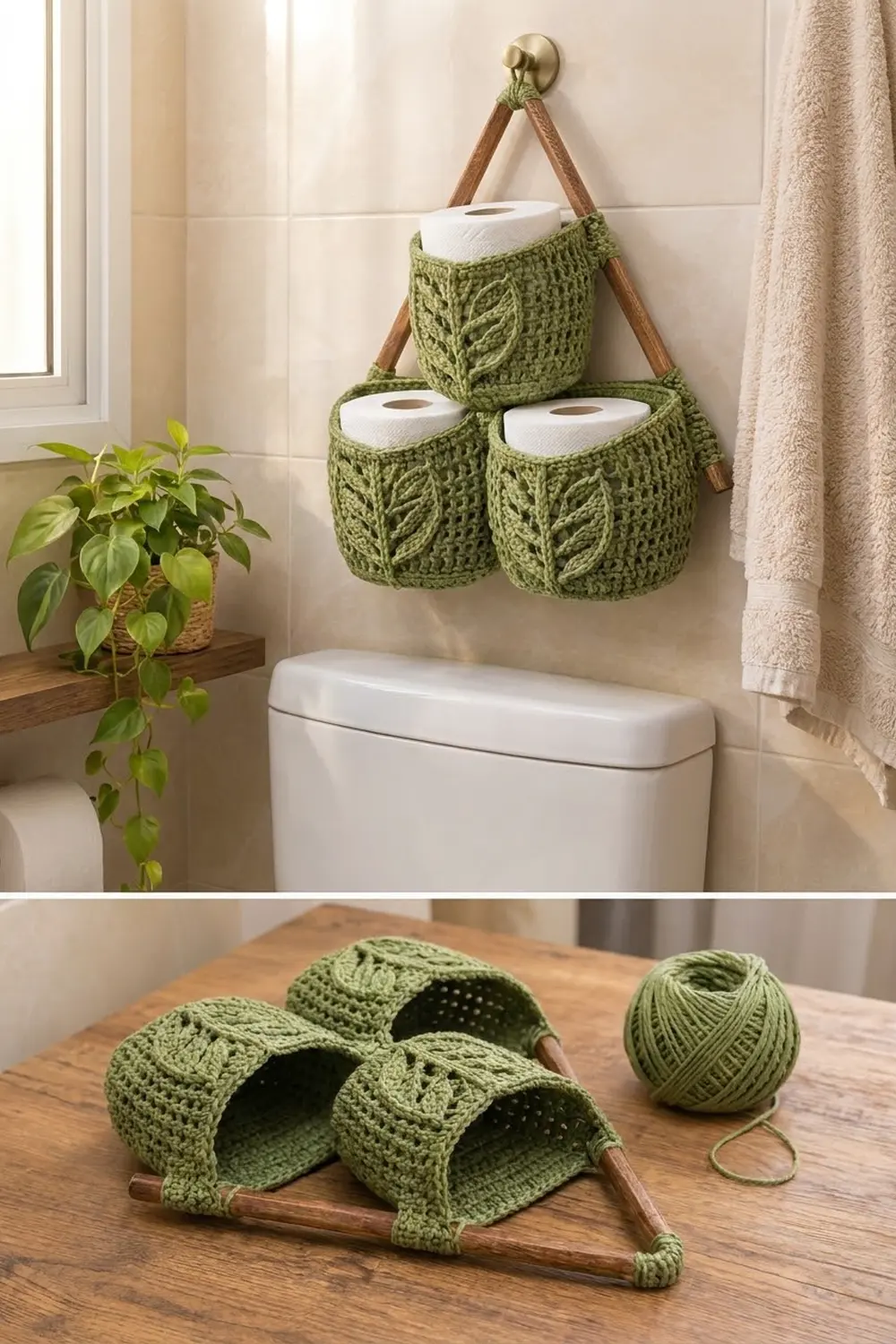
This hanging holder stacks three oval crochet baskets in a small pyramid: one on top, two side by side below. Each basket holds one standard toilet paper roll. The whole set hangs from a simple A-frame made of two wooden dowels. It turns spare rolls into part of the bathroom decor.
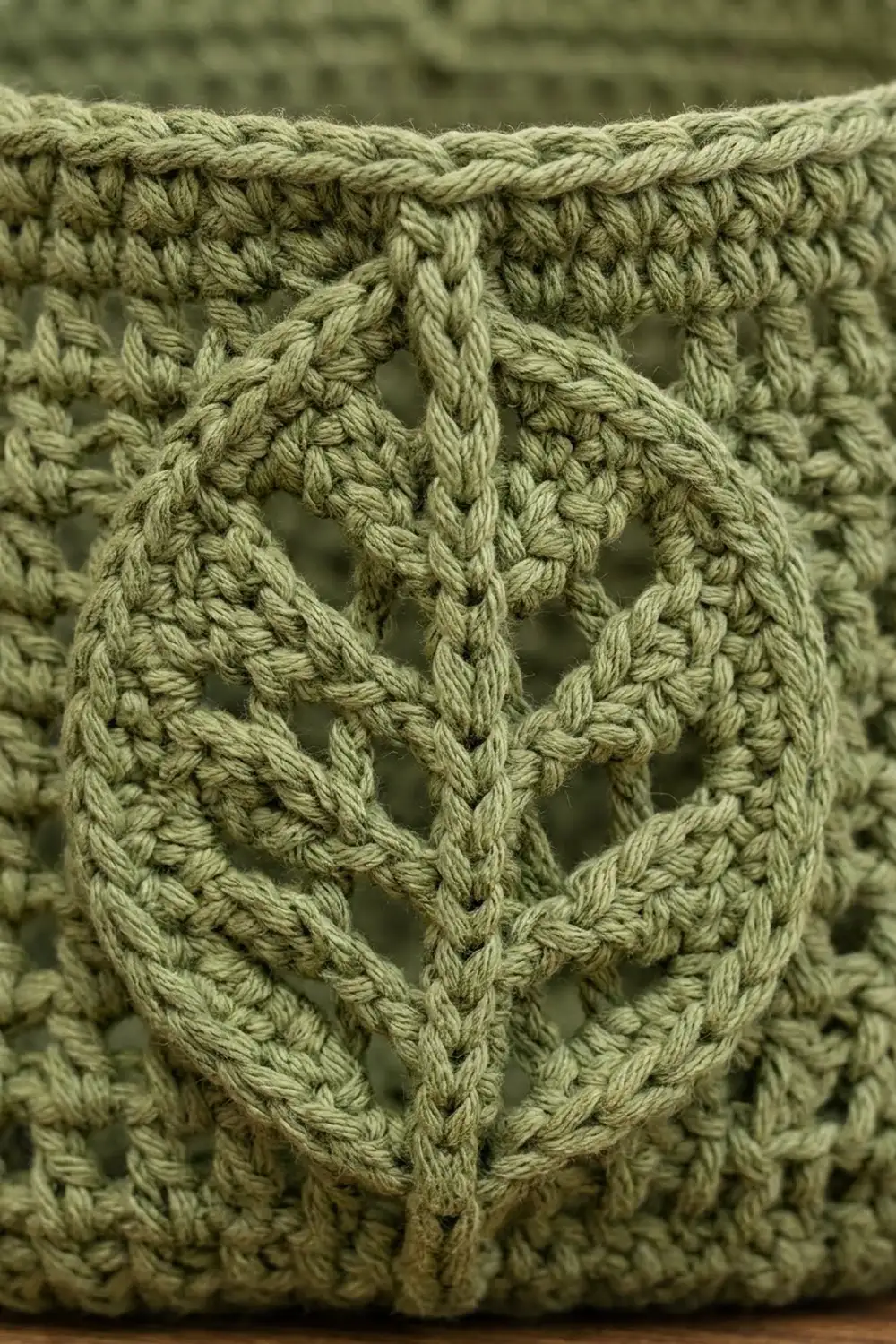
Everything is worked in one sage green cotton. The texture comes from the stitches: solid double crochet rounds alternate with open mesh rounds to make a soft grid, and a raised leaf appliqué with a center spine and openwork eyelets sits on the front of each basket. A reverse single crochet rim gives each basket a firm, rope-like top edge.
The pattern uses US crochet terms. Each basket is 5.75 in (14.6 cm) wide, 4 in (10.2 cm) deep and 4.25 in (10.8 cm) tall. The joined set of three is about 13 in (33.0 cm) wide and 8.5 in (21.6 cm) tall, including the side tabs.
For each basket you work an oval single crochet base, then the sides in the round, then a two-round rim. Next you make three leaves and sew one to each basket. You then join the baskets, add four dowel tabs, and finish with a band and loop that wrap the crossed dowels at the top.
Finished Size and Construction
- Finished size (assembled): 13 in (33.0 cm) wide x 8.5 in (21.6 cm) tall
- Skill level: Intermediate
- Terminology: US
- Yarn weight: Worsted (#4), cotton or cotton blend
- Hook: 5.0 mm (H-8)
- Number of pieces: 11 (3 baskets, 3 leaves, 4 tabs, 1 hanger band)
- Layout: pyramid, with 1 basket on top and 2 below
- Single basket size: 5.75 in (14.6 cm) wide x 4 in (10.2 cm) deep x 4.25 in (10.8 cm) tall
- Basket height before rim: 3.75 in (9.5 cm)
- Rim depth: 0.5 in (1.3 cm)
Materials
Pick a smooth worsted-weight cotton. Cotton holds its shape when loaded, does not stretch much under the weight of a roll, and copes with bathroom humidity. Acrylic also works but makes softer walls.
- Sage green: 200 g (about 340 m)
- 5.0 mm (H-8) crochet hook
- Tapestry needle
- 6 stitch markers
- Scissors
- 2 wooden dowels, 0.75 in (1.9 cm) in diameter and 16 in (40.6 cm) long
- About 1 m of jute twine to lash the dowels together
- 1 wall hook
The yarn amount allows about 15% extra for the gauge swatch and small tension differences.
Abbreviations (US Terms)
- ch – chain
- sl st – slip stitch
- sc – single crochet
- hdc – half double crochet
- dc – double crochet
- rev sc – reverse single crochet
- BLO – back loop only
- sk – skip
- sp – space
- inc – 2 sc in the same stitch
- st(s) – stitch(es)
Reverse single crochet (rev sc): Keep the right side facing you and work from left to right (left-handers work right to left). Insert the hook into the next stitch to the right, yarn over, pull up a loop, yarn over and pull through both loops. The result is a twisted, corded edge.
Gauge and Checkpoints
- Single crochet: 14 sts and 16 rows = 4 in (10.2 cm)
- Double crochet in the round: 14 sts and 8 rounds = 4 in (10.2 cm)
Make one complete basket before starting the others. It doubles as your gauge test.
Checkpoints:
- After Rnd 4: the base measures about 3.75 x 2 in (9.5 x 5.1 cm).
- After Rnd 8: the base measures 5.75 x 4 in (14.6 x 10.2 cm).
- After Rnd 16: the side wall is 3.75 in (9.5 cm) tall.
- After Rnd 18: the side wall is 4.25 in (10.8 cm) tall, and a roll drops in easily.
If the base comes out too big, go down to a 4.5 mm hook. If it is too small, or the roll will not fit, go up to a 5.5 mm hook. Change hook size rather than stitch counts, because the joining relies on the 60-stitch round.
Basket (Make 3)
The base is worked in joined rounds. At the end of each round, sl st to the first sc. Begin each round with ch 1, which does not count as a stitch.
Each base round has two straight sections of 6 sts. All increases go at the two curved ends.
Rnd 1: Ch 9. Sc in 2nd ch from hook, sc in next 6 ch, 3 sc in last ch. Working along the other side of the chain, sc in next 6 ch, 2 sc in the same ch as the first sc. Join. (18 sts)
Rnd 2: 2 sc in first st, sc in next 6, 2 sc in each of next 3, sc in next 6, 2 sc in each of last 2. Join. (24 sts)
Rnds 3–8: In these rounds, k is the round number minus 2, so Rnd 3 uses k = 1 and Rnd 8 uses k = 6.
Sc in first k sts, inc, sc in next 6, (sc in next k, inc) 3 times, sc in next 6, (sc in next k, inc) 2 times. Join.
- Rnd 3: (30 sts)
- Rnd 4: (36 sts)
- Rnd 5: (42 sts)
- Rnd 6: (48 sts)
- Rnd 7: (54 sts)
- Rnd 8: (60 sts)
Lay the base flat. Put a marker in the center stitch of each curved end; these are the side points. There are 30 sts on each side between them. One half is the front and the other is the back.
Rnd 9 (turning ridge): Ch 1, sc in BLO of each st around. Join. (60 sts) The unused front loops make a ridge that turns the base up into a wall.
Rnd 10 (solid): Ch 3 (counts as dc), dc in each st around. Join to top of ch-3. (60 dc)
Rnd 11 (mesh): Ch 4 (counts as dc + ch 1), sk next st, dc in next st, ch 1, sk next st 29 times. Join to 3rd ch of ch-4. (30 dc + 30 ch-1 sps = 60 sts)
Rnd 12 (solid): Ch 3, dc in each ch-1 sp and each dc around. Join. (60 dc)
Rnds 13–16: Repeat Rnds 11–12 twice. (60 sts each round)
This gives 4 solid rounds (10, 12, 14, 16) and 3 mesh rounds (11, 13, 15), which together make the grid texture. Check that the wall is 3.75 in (9.5 cm) tall. Move the side point markers up to Rnd 16 so they stay in line with the base.
The rim is worked next, in the Border section. Do it on each basket before joining.
Leaf Appliqué (Make 3)
The leaf is worked around both sides of a foundation chain. The dc posts form angled vein ribs, and each ch-1 space leaves an eyelet between two ribs.
Rnd 1: Ch 13. Sl st in 2nd ch from hook, sc in next ch, hdc in next ch, (ch 1, sk next ch, dc in next ch) 3 times, ch 1, sk next ch, hdc in next ch, 5 sc in last ch.
Working along the other side of the chain: hdc in next ch, (ch 1, sk next ch, dc in next ch) 3 times, ch 1, sk next ch, hdc in next ch, sc in next ch, ch 2 (leaf tip), sl st in first sl st.
(18 sts + 8 ch-1 sps + 1 ch-2 tip)
Rnd 2 (edging, conversion round): Ch 1. Sc in each st and each ch-1 sp around. At the base, work 2 sc in each of the 3 middle sc of the 5-sc group. Work (sc, ch 2, sc) in the ch-2 tip. Join.
(26 sc worked 1 per st/sp + 3 base increases + 2 tip sc = 31 sc + 1 ch-2 tip)
Spine: Join yarn at the base. Surface sl st up the center foundation chain to the tip, one sl st per ch (12 sl sts). Fasten off and leave a 12 in (30.5 cm) tail for sewing.
The finished leaf is 3.5 in (8.9 cm) long and 1.75 in (4.4 cm) wide.
Tabs (Make 4)
Row 1: Ch 6, sc in 2nd ch from hook and in each ch across. (5 sts)
Rows 2–14: Ch 1, turn, sc in each st across. (5 sts)
Fasten off with a long tail. Each tab is 3.5 x 1.5 in (8.9 x 3.8 cm).
Hanger Band (Make 1)
Row 1: Ch 5, sc in 2nd ch from hook and in each ch across. (4 sts)
Rows 2–16: Ch 1, turn, sc in each st across. (4 sts)
The band is 4 x 1.25 in (10.2 x 3.2 cm). Do not fasten off.
Loop: Ch 12 and sl st back into the last st of Row 16. Work 18 sc into the loop and sl st to the band. The loop is about 1.5 in (3.8 cm) tall. Fasten off with a long tail.
Make All Pieces
All pieces are in sage green:
- Baskets: 3
- Leaves: 3
- Tabs: 4
- Hanger band: 1
Layout, viewed from the front:
        [ Basket C ]
[ Basket A ][ Basket B ]
Basket A gets a tab at its left side point, and Basket B gets one at its right side point. Basket C gets tabs at both side points.
Joining
Leaves first. Center a leaf on the front half of each basket, with the base just above Rnd 10 and the tip just below Rnd 17, pointing up. Whipstitch all around the Rnd 2 edging, going through the outer loop of the leaf and a dc post of the basket. Keep the eyelets clear of thread.
Bottom pair. Set Baskets A and B side by side with their backs in a straight line. Basket A’s right side point should touch Basket B’s left side point. Match the side point stitch on each basket plus 3 rim sts on either side of it, so 7 sts on each basket. Whipstitch these together one to one through both loops. Then mattress-stitch the touching wall columns for 3 in (7.6 cm) below the rim.
Top basket. Each bottom basket has 30 back rim sts. Count the 6 nearest the seam on each one, for 12 sts in total. On Basket C, find the 12 center back sts of Rnd 9. That is the 6-st straight section plus 3 sts on each side of it. Sew those 12 sts to the 12 bottom rim sts, one to one. Basket C now sits centered on top with its base resting on the rims below.
Tension. Pull every stitch snug but not tight. The seam should be as flexible as the crochet around it. Too much pull makes a pucker, and too little lets the top basket tip forward.
Size check: The bottom pair measures 11.5 in (29.2 cm) across, and the stack is 8.5 in (21.6 cm) tall.
Frame. Cross the dowels about 1 in (2.5 cm) below their tops and lash them with twine. Spread the bottom ends 12 in (30.5 cm) apart. Wrap the hanger band around the crossed point and sew its short ends together at the back. Sew one end of each tab inside the rim at its side point, wrap the tab around the dowel and sew the other end to the outside of the rim.
Border
The border is the two-round rim on each basket. Work it after Rnd 16 and before any joining.
Border gauge: 14 sc = 4 in (10.2 cm), and each round adds 0.25 in (0.6 cm).
Rnd 17: Ch 1, sc in each st around. Join. (60 sts: 30 front + 30 back, with the side point sts included in these counts)
Rnd 18: Ch 1, rev sc in each st around. Join and fasten off. (60 sts: 30 front + 30 back)
Why the math works: Rnd 16 has 60 sts, and the rim works exactly one stitch into each of them, so the top edge neither flares nor pulls in. At 14 sts per 4 in, 60 sts gives a 17.1 in (43.4 cm) circumference. That is more than the 14.1 in (35.8 cm) circumference of a 4.5 in (11.4 cm) wide roll, so the roll goes in easily without rattling. Because each side has 30 sts, both side points sit exactly opposite each other, which keeps the tabs and seams level.
Final Blocking
- Weave in all remaining ends.
- Spritz each basket with water until damp, not soaked.
- Push a toilet roll wrapped in plastic into each basket to fill the walls out evenly.
- Pinch along the turning ridge so the base sits flat and the walls stand straight.
- Pin each leaf flat and open the eyelets with a fingertip.
- Let everything dry for 24 hours before hanging, then remove the wrapped rolls.
Final Quality-Control Checklist
- Every basket has 60 sts in Rnds 8 through 18.
- The wall is 4.25 in (10.8 cm) tall on all three baskets.
- The mesh rounds line up in clear vertical columns.
- Each leaf is centered, points up, and has 4 open eyelets on each side.
- The 7-stitch bottom seam and the 3 in (7.6 cm) wall seam are tight and even.
- The 12-stitch top seam keeps Basket C level.
- All four tabs are wrapped firmly around the dowels.
- The hanger loop holds the full weight with three rolls loaded.
Troubleshooting
- Base is cupping: Your sc is tight. Go up half a hook size for the base only.
- Base is rippling: Check that each round increases by exactly 6. Go down half a hook size if needed.
- Walls are leaning out: The BLO ridge in Rnd 9 was skipped or worked too loosely. Redo Rnd 9 in BLO.
- Mesh count is off: Count 30 dc in each mesh round. An extra dc usually comes from working into the ch-4 at the start.
- Leaf is curling: Block it flat. If you left out the 3 base increases in Rnd 2, add them.
- Top basket is tipping: Add a second line of stitches through the 12-stitch seam.
Care
Take the baskets off the dowels before washing. Hand wash in cool water and lay flat to dry.
Final Notes
The measurement chain is simple. Gauge sets the 60-stitch base at 5.75 x 4 in (14.6 x 10.2 cm). The walls reach 3.75 in (9.5 cm) by Rnd 16, and the rim brings them to 4.25 in (10.8 cm). Two baskets side by side make 11.5 in (29.2 cm), the stacked set is 8.5 in (21.6 cm) tall, and the tabs take the full width to 13 in (33.0 cm). If you check each stage as you go, the three baskets will fit together.
Happy crocheting!