

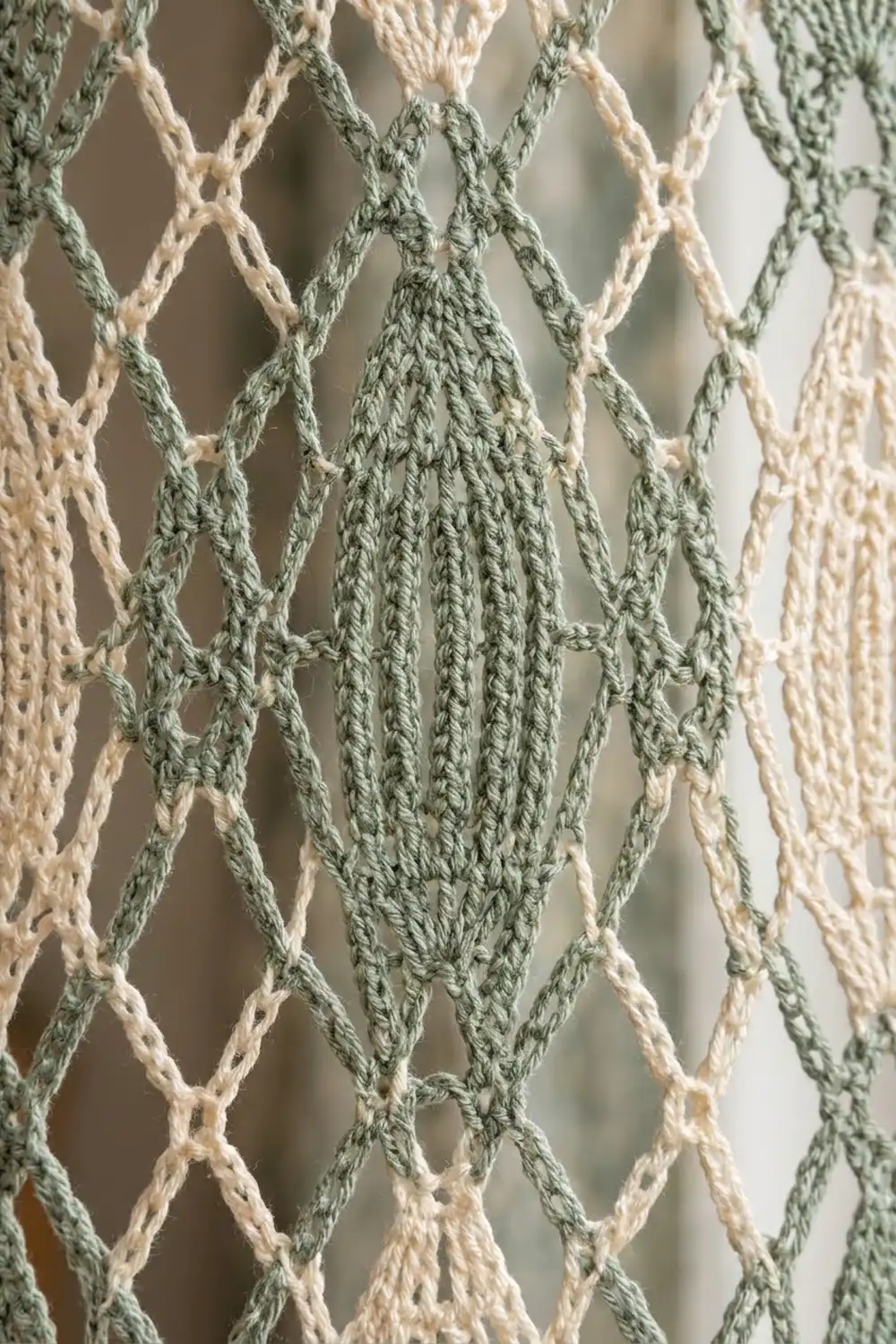
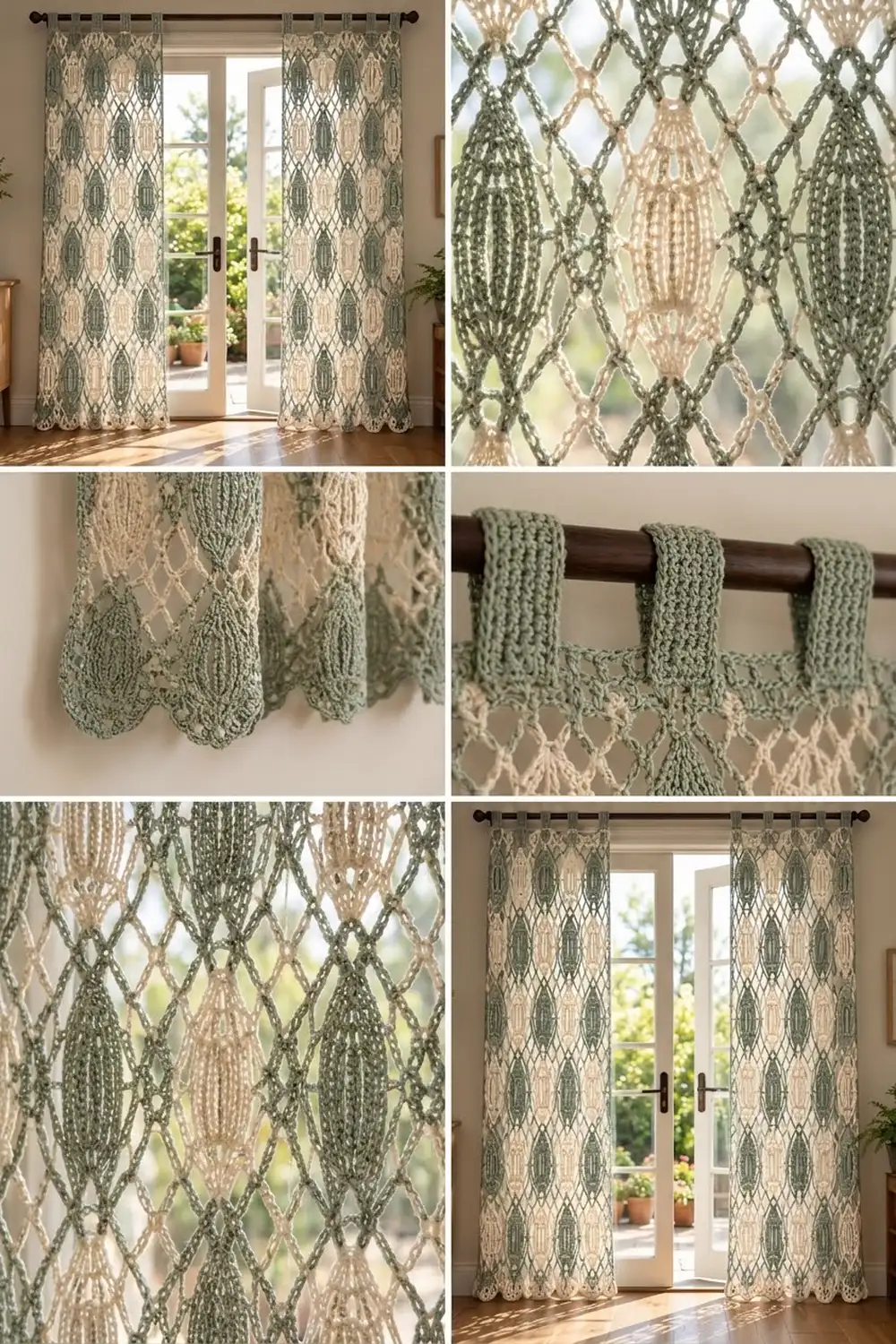
These tall lace curtain panels mix an open diamond mesh with columns of pointed, ribbed oval motifs. The ovals alternate between soft sage green and warm cream, and each band sits half a step over from the one below. The result looks woven, almost like a trellis with leaves caught in it, and it filters sunlight beautifully.
The palette is two colors: a muted sage green and a creamy off-white. A scalloped cream edge finishes the bottom, and ribbed sage tabs at the top slide straight onto a curtain rod.
This pattern uses US crochet terms. Each finished panel measures 37 in (94.0 cm) wide and 81.25 in (206.4 cm) long, not counting the tabs. The tab loops add about 3.5 in (8.9 cm) above the top edge.
Each panel is worked in one piece, from the bottom up, in flat rows. You work a foundation, then 13 alternating motif bands, then a top row. A two-round border goes around the edges, and the tabs are worked straight off the top. The pair is two identical panels that are not joined to each other.
Finished Size and Construction
- Finished panel size: 37 x 81.25 in (94.0 x 206.4 cm), plus tabs
- Skill level: Intermediate
- Terminology: US
- Yarn weight: DK (light worsted / 3), cotton or cotton blend
- Hook: 4.0 mm (G-6)
- Number of pieces: 2 identical panels, each made in one piece
- Layout: two separate panels hung side by side on one rod
- Body size before border: 36 x 79.25 in (91.4 x 201.3 cm)
- Border depth: 0.5 in (1.3 cm) on the top and sides; 1.5 in (3.8 cm) on the bottom, including the scallops
Materials
Pick a smooth mercerized or matte cotton in DK weight. Cotton holds the lace open, keeps the motif points crisp, and won’t sag much when it hangs. Avoid fuzzy yarns, because they blur the mesh.
The amounts below are for both panels. They assume 50 g balls of about 110 m each.
- Sage green: 550 g (about 1,210 m), for the sage bands, the Top Row, and the tabs
- Cream: 550 g (about 1,210 m), for the foundation, the cream bands, and the border
Each panel uses about 250 g of each color. These amounts include a margin of about 10% for swatching and differences in gauge.
Tools:
– 4.0 mm (G-6) crochet hook
– Tapestry needle
– Stitch markers
– Measuring tape
– Rustproof pins and a large blocking surface (foam mats, a bed, or a clean carpet covered with a sheet)
– Spray bottle
Abbreviations (US Terms)
- ch – chain
- sc – single crochet
- dc – double crochet
- sl st – slip stitch
- sp(s) – space(s)
- sk – skip
- tch – turning chain
- BLO – back loop only
- RS – right side
- rep – repeat
- st(s) – stitch(es)
Special stitches:
– V-st: (dc, ch 3, dc) in the same stitch.
– Fan: (dc, ch 1) 6 times, dc, all in the same space. This makes 7 dc.
– dc7tog: [yo, insert hook in next dc, yo, pull up a loop, yo, draw through 2 loops] 7 times, yo, draw through all 8 loops on hook. Skip the ch-1 sps between those dc.
Gauge and Checkpoints
Gauge: One 12-st pattern repeat (4 ch-5 loops) = 3 in (7.6 cm) wide. One 8-row motif band = 6 in (15.2 cm) tall. Each mesh or motif row is about 0.75 in (1.9 cm) tall, and each sc row is about 0.25 in (0.6 cm).
Make a test swatch before starting a panel. Ch 26, then work Row 1 (25 sc), Row 2 (8 loops), and one Band A, repeating it for 2 motifs. Block the swatch. It should measure 6 in (15.2 cm) wide and 7 in (17.8 cm) tall.
Checkpoints on the panel:
– After Row 2: 36 in (91.4 cm) wide, 1 in (2.5 cm) tall
– After each band: 6 in (15.2 cm) taller
– After Band 13: 79 in (200.7 cm) tall
– After the Top Row: 79.25 in (201.3 cm) tall
If the swatch is too big, go down 0.5 mm. If it’s too small, go up 0.5 mm. If the width is right but the bands come out short, pull your loops up a little taller instead of changing hooks.
Panel Pattern
Turn at the end of every row. When a row starts with ch 5, that ch 5 counts as dc + ch 2. Rows that end with “ch 2, dc in last sc” have half loops at both edges, which keeps the sides straight.
Each band is 8 rows, so every band starts on the same edge. Carry the unused color loosely up that side; the border will cover it.
Foundation (Cream)
Row 1: Ch 146, sc in 2nd ch from hook and in each ch across. (145 sc)
Row 2: Ch 1, sc in first sc, ch 5, sk 2 sc, sc in next sc; rep from * across. (48 ch-5 loops, 49 sc)*
Number the 49 sc from 0 to 48 and think of them as nodes. Band A motifs sit on nodes 2, 6, 10 … 46 (12 motifs). Band B motifs sit on nodes 4, 8 … 44 (11 motifs), which places them between the Band A motifs.
Band A (Sage) – 12 motifs
Row 1: Ch 5, sc in first loop, ch 5, sc in next loop, ch 2, V-st in next sc, ch 2, sc in next loop, ch 5, sc in next loop, ch 5, sc in next loop; rep from * 11 more times, ending last rep at , ch 2, dc in last sc. (12 V-sts)*
Row 2: Ch 1, sc in first dc, ch 5, sc in next ch-5 loop, ch 3, Fan in ch-3 sp of next V-st, ch 3, sc in next ch-5 loop, (ch 5, sc in next ch-5 loop) twice; rep from * 11 more times, ending last rep at , ch 5, sc in 3rd ch of tch. (12 fans, 84 dc)*
Row 3: Ch 5, sc in first ch-5 loop, ch 3, (dc in next dc, ch 2) 6 times, dc in next dc, ch 3, sc in next ch-5 loop, ch 5, sc in next ch-5 loop, ch 3; rep from * 11 more times, ending last rep at , ch 2, dc in last sc. (7 dc per motif, 84 dc)*
The ch-2 spacing spreads the ribs out to the widest part of the motif.
Row 4: Ch 1, sc in first dc, ch 4, (dc in next dc, ch 2) 6 times, dc in next dc, ch 4, sc in next ch-5 loop, ch 4; rep from * 11 more times, ending last rep at , sc in 3rd ch of tch. (84 dc)*
Row 5: Ch 5, sc in first ch-4 sp, ch 3, (dc in next dc, ch 1) 6 times, dc in next dc, ch 3, sc in next ch-4 sp, ch 5, sc in next ch-4 sp, ch 3; rep from * 11 more times, ending last rep at , ch 2, dc in last sc. (84 dc)*
The ch-1 spacing starts to pull the ribs back in.
Row 6: Ch 1, sc in first dc, ch 5, sc in next ch-3 sp, ch 5, dc7tog over next 7 dc, ch 5, sc in next ch-3 sp, ch 5, sc in next ch-5 loop, ch 5, sc in next ch-3 sp, ch 5; rep from * 11 more times, ending last rep at , ch 5, sc in 3rd ch of tch. (12 clusters, 48 ch-5 loops)*
Each dc7tog pulls the ribs together into a point and closes the oval.
Row 7: Ch 5, sc in first loop, ch 5, sc in next loop; rep from * across to last sc, ch 2, dc in last sc. (47 ch-5 loops plus 2 half loops)*
Row 8: Ch 1, sc in first dc, ch 5, sc in next ch-5 loop; rep from * across, ch 5, sc in 3rd ch of tch. (48 ch-5 loops)*
Band B (Cream) – 11 motifs
The sections between motifs match Band A exactly; only the edges are different. In Rows 3–6, use the Band A repeat for all 11 motifs.
Row 1: Ch 5, sc in first loop, (ch 5, sc in next loop) 3 times, ch 2, V-st in next sc, ch 2, sc in next loop, (ch 5, sc in next loop) 3 times; rep from * 10 more times, ch 2, dc in last sc. (11 V-sts)*
Row 2: Ch 1, sc in first dc, (ch 5, sc in next ch-5 loop) 3 times. Work from * of Band A Row 2, repeating it 10 more times and ending the last rep at *. Then (ch 5, sc in next ch-5 loop) twice, ch 5, sc in 3rd ch of tch. (11 fans, 77 dc)*
Row 3: Ch 5, sc in first ch-5 loop, (ch 5, sc in next ch-5 loop) twice, ch 3, then work as Band A Row 3. Finish with ch 3, sc in next ch-5 loop, (ch 5, sc in next ch-5 loop) twice, ch 2, dc in last sc. (77 dc)
Row 4: Ch 1, sc in first dc, (ch 5, sc in next ch-5 loop) twice, ch 4, then work as Band A Row 4. Finish with ch 4, (sc in next ch-5 loop, ch 5) twice, sc in 3rd ch of tch. (77 dc)
Row 5: Ch 5, (sc in next ch-5 loop, ch 5) twice, sc in next ch-4 sp, ch 3, then work as Band A Row 5. Finish with ch 3, sc in next ch-4 sp, (ch 5, sc in next ch-5 loop) twice, ch 2, dc in last sc. (77 dc)
Row 6: Ch 1, sc in first dc, (ch 5, sc in next ch-5 loop) twice, ch 5, sc in next ch-3 sp, ch 5, then work as Band A Row 6. Finish with ch 5, sc in next ch-3 sp, (ch 5, sc in next ch-5 loop) twice, ch 5, sc in 3rd ch of tch. (11 clusters, 48 ch-5 loops)
Rows 7–8: Work as Band A Rows 7–8. (48 ch-5 loops)
Body Sequence
Work 13 bands, alternating A, B, A, and so on, so that Band 13 is a Band A. That gives 7 sage bands and 6 cream bands. The body now measures 79 in (200.7 cm) tall.
Top Row (Sage): Ch 1, sc in first sc, 2 sc in next ch-5 loop, sc in next sc; rep from * across. (1 + 48 x 3 = 145 sc)*
This matches the 145 sc of Row 1, so the top and bottom edges are the same width. Fasten off.
Make Both Panels
Make 2 identical panels. Each panel has the cream foundation, 7 sage bands, 6 cream bands, and the sage Top Row.
[ Panel 1 ]   (opening)   [ Panel 2 ]
   37 in                     37 in
The panels are not joined; each one hangs on its own.
Border
Border gauge: 4 sc = 1 in (2.5 cm). This matches the body: 145 sts across the 36 in width, and 3 sc for each 0.75 in row end along the sides.
Round 1 (Cream): With RS facing, join cream in the first sc of the Top Row.
– Top: (sc, ch 2, sc) in first st, sc in next 143 sts, (sc, ch 2, sc) in last st.
– Side: 3 sc in the end of each of the 105 mesh and motif rows. Skip the ends of the 2 sc rows; the corners already cover them.
– Bottom: Work into the free loops of the foundation chain the same way as the top.
– Second side: Work like the first side. Join with a sl st to the first sc.
Counts per side, including that side’s corner sc: top 1 + 143 + 1 = 145; each side 1 + 315 + 1 = 317; bottom 145. Total: 924 sc plus 4 ch-2 corner sps.
Why the math works: 317 sc ÷ 4 per inch = 79.25 in, which is exactly the body length. 145 sc ÷ 4 per inch is about 36 in, the body width. The edges won’t ruffle or pull in.
Round 2 (Cream): Sl st into the next corner sp.
– Top: (sc, ch 2, sc) in corner sp, sc in each of 145 sc, (sc, ch 2, sc) in next corner sp.
– Sides: sc in each of 317 sc.
– Bottom: sc in corner sp, sc in first st, *sk 2, 7 dc in next st, sk 2, sc in next st; rep from * 23 more times, sc in next corner sp.
– Join and fasten off.
Bottom check: 1 + (24 x 6) = 145 sts, so the scallops use up the bottom exactly. You get 24 scallops, each 1.5 in (3.8 cm) wide, which works out to two per motif repeat.
Tabs (Sage)
You’ll make 8 tabs across the 145 straight top sc. Each tab is 12 sts wide, with 7 sts between tabs: (8 x 12) + (7 x 7) = 145.
Row 1: Join sage in the first of the 145 top sc, ch 1, sc in same st and in next 11 sts. (12 sc)
Rows 2–28: Ch 1, turn, sc BLO in each st. (12 sc)
Fasten off, leaving a long tail. Skip 7 sts and make the next tab. Each tab measures 3 x 7 in (7.6 x 17.8 cm). Fold each tab to the wrong side and whipstitch the last row to the base of the tab. This makes a loop about 3.5 in (8.9 cm) tall.
Final Blocking
- Weave in all ends along the dense ribs or inside the border.
- Soak the panel in cool water with a little wool wash for 15 minutes.
- Press the water out gently without wringing, then roll the panel in towels.
- Lay the panel flat and pin it to 37 x 81.25 in (94.0 x 206.4 cm).
- Pin each scallop point and the top and bottom tip of every motif to open up the diamonds.
- Mist the tabs and smooth them flat.
- Let the panel dry completely, for at least 24 hours.
Final Quality-Control Checklist
- The body is 36 in (91.4 cm) wide at the top, middle, and bottom
- Each band has the right number of motifs: 12 in Band A, 11 in Band B
- Every motif has 7 ribs that close to a single point
- The side edges are straight, with half loops on every other row
- Border Round 1 counts are 145 / 317 / 145 / 317
- There are 24 even scallops
- There are 8 tabs, evenly spaced and securely sewn
- The two panels are within 0.5 in (1.3 cm) of each other in length
Troubleshooting
- The panel narrows as you go: Your ch-5 loops are too tight. Chain more loosely, or use a larger hook for the chains only.
- The motifs pucker: The dc7tog is too tight. Pull each loop up to full dc height before closing it.
- Wrong motif count: Count the nodes in Row 1 of each band before you place the V-sts.
- The sides wave after the border: Make sure you worked 3 sc per row end, not 4.
- The panels hang at different lengths: Re-block the shorter panel and stretch it lengthwise to match.
Care
Hand wash, or machine wash cool on a delicate cycle inside a mesh laundry bag. Lay flat to dry and re-pin to size if needed.
Final Notes
Here is the measurement chain. 12 sts = 3 in, so 145 sts = 36 in. Thirteen 6-in bands plus the 1-in foundation make 79 in, and the Top Row brings the body to 79.25 in. The 4-sc-per-inch border then frames each panel to 37 x 81.25 in (94.0 x 206.4 cm), and the 3.5 in (8.9 cm) tabs carry it to the rod. Check your swatch, measure after every band, and both panels will hang straight and match.
Happy crocheting!