

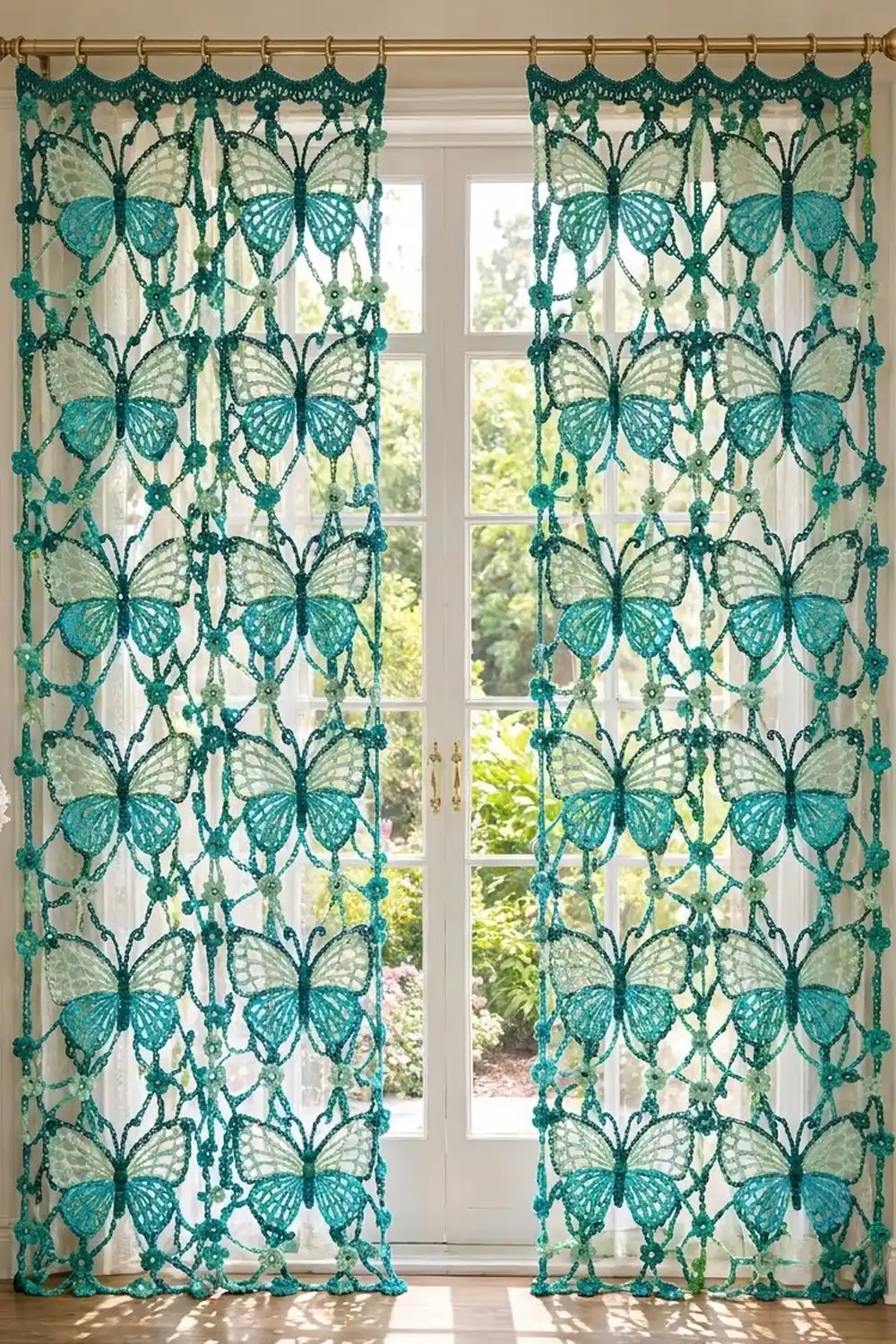
These airy curtain panels are filled with lace butterflies that seem to drift across an open chain mesh. Each butterfly has pale mint upper wings and bright turquoise lower wings, and a deep teal outline gives every wing a crisp edge against the light.
The palette is cool and coastal: mint, turquoise, medium teal and dark teal. Little five-petal flowers sit where the mesh lines cross. A scalloped dark teal header with hanging loops finishes the top edge.
This pattern uses US crochet terms. Each finished panel measures 16.8 in (42.7 cm) wide and 74.5 in (189.2 cm) long, not counting the hanging loops. You will make two panels.
Each butterfly is made from four wings and a bobble body. It then gets a two-round square mesh frame, which turns it into an 8 in (20.3 cm) block. You join the blocks as you go, 2 across and 9 down, then add a narrow border, the scalloped header and the flowers.
Finished Size and Construction
- Finished panel size: 16.8 in x 74.5 in (42.7 cm x 189.2 cm), plus loops of about 2 in (5.1 cm)
- Skill level: Intermediate
- Terminology: US
- Yarn weight: #2 fine/sport, mercerized cotton
- Hook: 3.25 mm (US D-3)
- Number of pieces: 18 butterfly blocks and 27 flowers per panel (36 blocks and 54 flowers total)
- Layout: 2 blocks across x 9 blocks down per panel
- Block size: 8 in x 8 in (20.3 cm x 20.3 cm), blocked
- Size before border: 16 in x 72 in (40.6 cm x 182.9 cm)
- Border depth: 0.4 in (1.0 cm) on the sides, bottom and top, plus a 1.7 in (4.3 cm) header
Materials
Use a smooth mercerized cotton, about 180 yd (165 m) per 50 g. Cotton holds the open lace shape and blocks crisply. Avoid fuzzy yarns, because they hide the wing veins.
- Color A, dark teal: 350 g / 1,155 m (outlines, bodies, mesh, border, header, flowers)
- Color B, pale mint: 150 g / 495 m (upper wings, flowers)
- Color C, bright turquoise: 100 g / 330 m (lower wings)
- Color D, medium teal: 50 g / 165 m (flowers)
Tools: 3.25 mm (US D-3) hook, tapestry needle, rust-proof pins, blocking mats, a spray bottle, 12 curtain rings, and 54 pearl beads of 6 mm with matching sewing thread (optional, for the flower centers).
All quantities include a margin of about 15 percent.
Abbreviations (US Terms)
- ch – chain
- sl st – slip stitch
- sc – single crochet
- hdc – half double crochet
- dc – double crochet
- tr – treble crochet
- sk – skip
- sp(s) – space(s)
- st(s) – stitch(es)
- RS – right side
Bobble: (Yarn over, insert hook in st, pull up a loop, yarn over, pull through 2 loops) 5 times in the same st, then yarn over and pull through all 6 loops on the hook.
Gauge and Checkpoints
Make one complete block before you start production.
- Chain gauge: 10 ch = 2 in (5.1 cm).
- Upper wing, outlined: 3 in (7.6 cm) from the ring to the center of the outer curve.
- Lower wing, outlined: 2.25 in (5.7 cm).
- Butterfly: about 6 in (15.2 cm) wide x 5 in (12.7 cm) tall, not counting the antennae.
- Block, unblocked: about 7.25 in (18.4 cm) square. Blocked: 8 in (20.3 cm) square.
- Flower: 1.25 in (3.2 cm) across.
If your wings come out too big, go down a half size in hook. If they come out too small, go up a half size. If only the mesh is off, change the hook size for the frame rounds only.
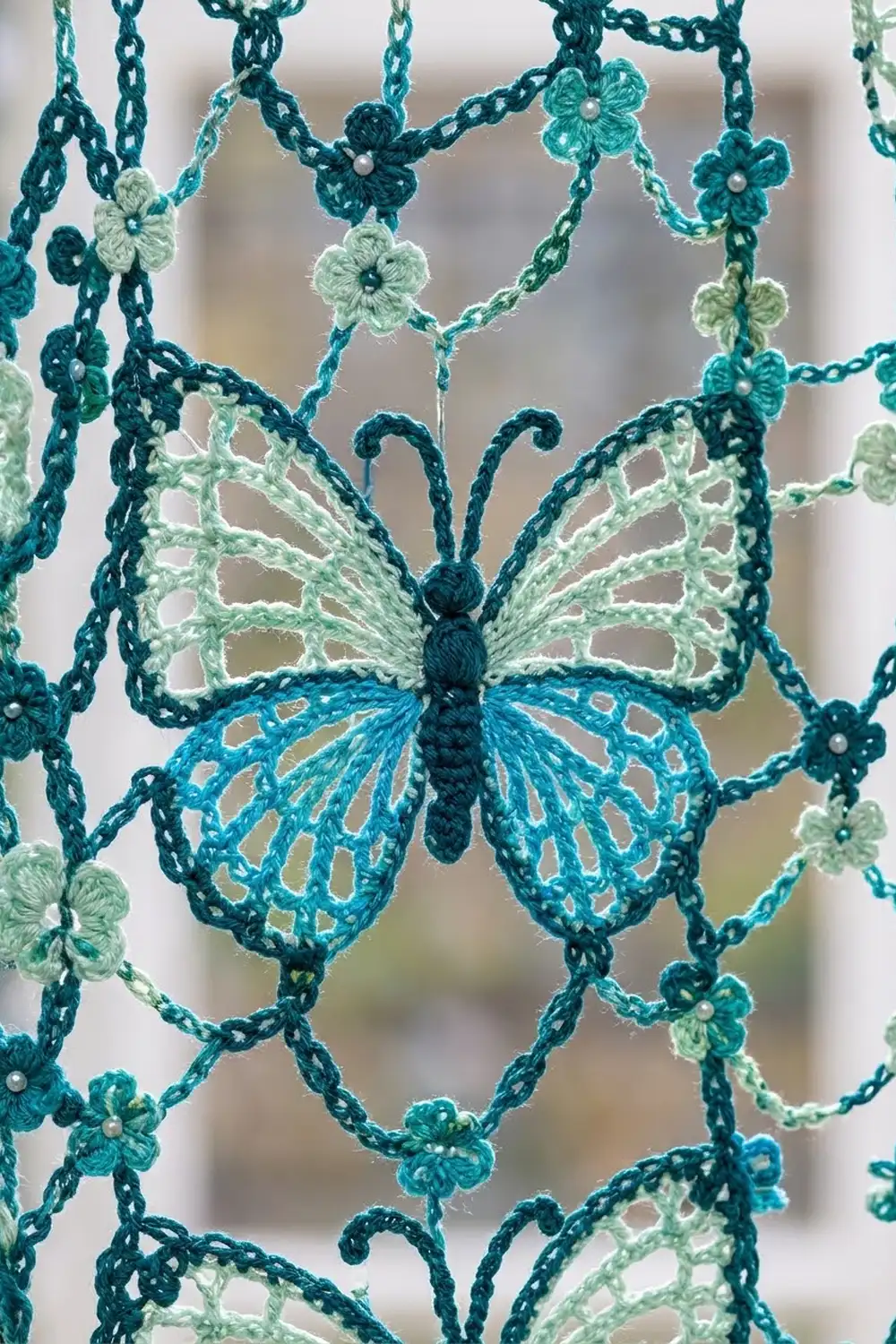
Butterfly
Upper Wing (make 2 per butterfly, Color B)
Ch 4 and sl st to the first ch to form a ring.
Row 1 (RS): Ch 4 (counts as tr), (ch 2, tr) 6 times in the ring. Turn. (7 tr, 6 ch-2 sps)
Row 2: Ch 6 (counts as tr + ch 2). Tr in the next ch-2 sp, ch 2, tr in the next tr. Work ch 2 between each pair of tr and repeat from * across. Turn. (13 tr, 12 ch-2 sps)
Row 3: Ch 1, sc in the first tr, (ch 4, sc in the next tr) across. (13 sc, 12 ch-4 loops) Fasten off.
Outline (Color A): With RS facing, join with sc in the first sc of Row 3. Work 4 sc in each ch-4 loop and 1 sc in each sc across. Next, work 7 sc down the straight side to the ring (3 sc per tr row end and 1 sc in the sc row end), then 7 sc up the other side. Sl st to the first sc. (48 + 13 + 14 = 75 sc) Leave a 10 in (25.4 cm) tail for sewing.
Lower Wing (make 2 per butterfly, Color C)
Ch 4 and sl st to form a ring.
Row 1 (RS): Ch 4 (counts as tr), (ch 2, tr) 4 times in the ring. Turn. (5 tr, 4 ch-2 sps)
Row 2: Work as for Upper Wing Row 2. (9 tr, 8 ch-2 sps)
Row 3: Work as for Upper Wing Row 3. (9 sc, 8 ch-4 loops) Fasten off.
Outline (Color A): Work as for the Upper Wing. (32 + 9 + 14 = 55 sc) Leave a tail for sewing.
Body and Antennae (Color A)
Ch 13. Bobble in the 4th ch from the hook, then (sc in the next ch, bobble in the next ch) 4 times, and sc in the last ch. (5 bobbles, 5 sc) The bobbles pop out on the back of the strip, so use that side as the front. Fasten off.
Antennae: Join at the top of the end bobble. Ch 12, 3 sc in the 2nd ch from the hook, 2 sc in the next ch, and sl st in each of the remaining 9 ch. Sl st into the head again. Repeat once for the second antenna. The increases make the tips curl. Fasten off.
Assembly
Lay the body vertically. Slide the ring ends of the upper wings under the top half of the body so they point diagonally up and out. Tuck the lower wings under the lower half of the body so they point diagonally down and out. Let the upper wing outlines overlap the lower wings by about 0.25 in (0.6 cm). Whipstitch through the outlines and body only, and weave in the ends.
Mesh Frame (Color A)
The frame squares off the butterfly. The 4 wing tips (the center sc of each outer curve) become the corners. The head, the tail and the 2 waists (where the upper and lower outlines meet) become the side midpoints.
Rnd 1: Join with sc at the upper-right wing tip. Ch 9, sc at the next anchor. Repeat from * clockwise around the right waist, lower-right tip, tail, lower-left tip, left waist, upper-left tip and head. Ch 9 and sl st to the first sc. (8 sc, 8 ch-9 loops)
Rnd 2: Ch 1. (Sc, ch 7, sc) in the same sc (corner). Ch 7, sc in the next ch-9 loop, ch 7, sc in the next sc, ch 7, sc in the next ch-9 loop, ch 7, then work (sc, ch 7, sc) in the next corner sc. Repeat from * around, but leave out the last corner and sl st to the first sc. (20 sc, 20 ch-7 sps)
Each side now has 6 ch-7 sps: 1 corner sp at each end and 4 sps between them. The 4 corner sps are shared by two sides each, so 4 x 6 − 4 = 20.
Make All Pieces
For both panels, make:
- 36 butterflies: 72 upper wings in B, 72 lower wings in C, and 36 bodies in A
- 54 flowers: 18 in A, 18 in B, 18 in D (pattern below)
Layout for each panel (B = block):
B1  B2
B3  B4
B5  B6
B7  B8
B9  B10
B11 B12
B13 B14
B15 B16
B17 B18
Joining
Work Rnd 2 of the frame in full on Block 1 only. On every later block, join as you go while working Rnd 2.
Joined side sp: Instead of ch 7, ch 3, sl st into the matching ch-7 sp of the neighbor block, then ch 3.
Joined corner sp: Ch 3, sl st into the neighbor’s corner sp, then ch 3. If a corner already holds a join, sl st into that join sl st, so 4 blocks meet at one point.
The sps match one to one: corner, 4 side sps, corner on each block. No stitches are added at the seams. Keep the ch 3 segments the same tension as the ch 7s so the diamonds stay even.
Checkpoint: Pin each finished row of 2 blocks flat. It should measure 16 in (40.6 cm) across. The finished panel should measure 16 in x 72 in (40.6 cm x 182.9 cm) after a light pinning.
Flowers
With the flower color, make a magic ring.
Rnd 1: Ch 1, 10 sc in the ring, sl st to the first sc. (10 sc)
Rnd 2: (Ch 2, 2 dc, ch 2, sl st) in the next sc, sl st in the next sc. Repeat from * 4 more times. (5 petals) Fasten off.
If you are using beads, sew one into each center. The flowers are attached after the border (see Final Blocking).
Border
Border gauge: 15 sc = 4 in (10.2 cm). This matches the mesh, because each block side takes 30 sc over 8 in (20.3 cm).
Starting count: Top and bottom: 2 blocks x 6 sps = 12 sps each. Sides: 9 blocks x 6 sps = 54 sps each. The panel corner sps are included in these counts.
Rnd 1 (conversion round, Color A, RS): Join in any non-corner sp.
- In each of the 4 panel corner sps, work (3 sc, ch 2, 3 sc).
- In each seam corner sp (where two block corners meet along the edge), work 3 sc.
- In every other ch-7 sp, work 6 sc.
Sl st to the first sc.
- Top and bottom: (8 middle sps x 6 sc = 48) + (4 corner-type sps x 3 sc = 12) = 60 sc each
- Sides: (36 middle sps x 6 sc = 216) + (18 corner-type sps x 3 sc = 54) = 270 sc each
- Total: 660 sc, plus 4 ch-2 corners
Rnd 2: Ch 1. Sc in each sc, and work (sc, ch 2, sc) in each corner sp. Sl st to the first sc. (Top and bottom 62 sc each, sides 272 sc each, total 668 sc)
Why the math works: Each block side holds 4 full sps (24 sc) and 2 half-corners (3 sc each), for 30 sc. Then 2 x 30 = 60, and 9 x 30 = 270. Both work out to 3.75 sc per inch, so nothing ruffles or pulls.
Header (top edge only)
Row 1 (RS): Join in the top-right corner ch-2 sp. Ch 3 (counts as dc), dc in each of the 62 sc, then dc in the next corner sp. Turn. (64 dc)
Row 2: Ch 1, sc in the first dc, (ch 5, sk 2 dc, sc in the next dc) 21 times. Turn. (22 sc, 21 ch-5 loops)
Row 3: Ch 1. In each ch-5 loop, work (sc, hdc, 3 dc, hdc, sc). Turn. (21 scallops, 147 sts)
Row 4 (tabs): Ch 1 and sl st in each of the first 3 sts. Tab: In the next st (the center dc), ch 16, sl st in the same st, work 22 sc over the loop, then sl st in the same st again. After that, sl st in each of the next 27 sts, then work a Tab in the next st. Repeat from * 4 more times (6 tabs), then sl st in each of the last 3 sts. Fasten off.
The tabs sit on scallops 1, 5, 9, 13, 17 and 21.
Final Blocking
- Weave in all ends. Run each tail through at least 1 in (2.5 cm) of solid stitches.
- Soak the panel in cool water, press out the water in a towel, and lay it flat on the mats.
- Pin the corners to 16.8 in x 74.5 in (42.7 cm x 189.2 cm).
- Pin each block corner join on an 8 in (20.3 cm) grid.
- Open each wing fan and pin the outlines into smooth curves.
- Shape the antennae curls with your fingers.
- Let the panel dry completely.
- Sew a flower centered over every block-corner join and every outer edge point, leaving out the 3 points on the top edge. That is 3 x 10 − 3 = 27 per panel. Mix the colors evenly.
Final Quality-Control Checklist
- 18 blocks per panel, each 8 in (20.3 cm) square
- Every wing outline lies flat, with no cupping
- Upper wings overlap the lower wings evenly on every butterfly
- Border counts: 60 / 270 sc (Rnd 1) and 62 / 272 sc (Rnd 2)
- 21 scallops and 6 evenly spaced tabs
- 27 flowers sewn on, all ends secured
Troubleshooting
- Wings cup: The outline is too tight. Redo it with a larger hook.
- Wings ruffle: Work 3 sc instead of 4 in every third ch-4 loop.
- Mesh diamonds are uneven: Check that each ch 3 + sl st + ch 3 matches the length of a ch-7.
- Side edge waves: Recount 6 sc per middle sp and 3 per seam corner sp.
- Panel too short: Block it more firmly lengthwise. Cotton will stretch a little.
Care
Hand wash in cool water with mild soap. Reshape and dry flat. Do not hang the panels while they are wet.
Final Notes
The measurement chain runs like this: the 3 in (7.6 cm) upper wing builds a 6 in (15.2 cm) butterfly, which frames into an 8 in (20.3 cm) block. Blocks join into a 16 in x 72 in (40.6 cm x 182.9 cm) panel. The border and header bring each panel to 16.8 in x 74.5 in (42.7 cm x 189.2 cm). If you check each link of that chain as you go, both curtains will hang straight and match.
Happy crocheting!