

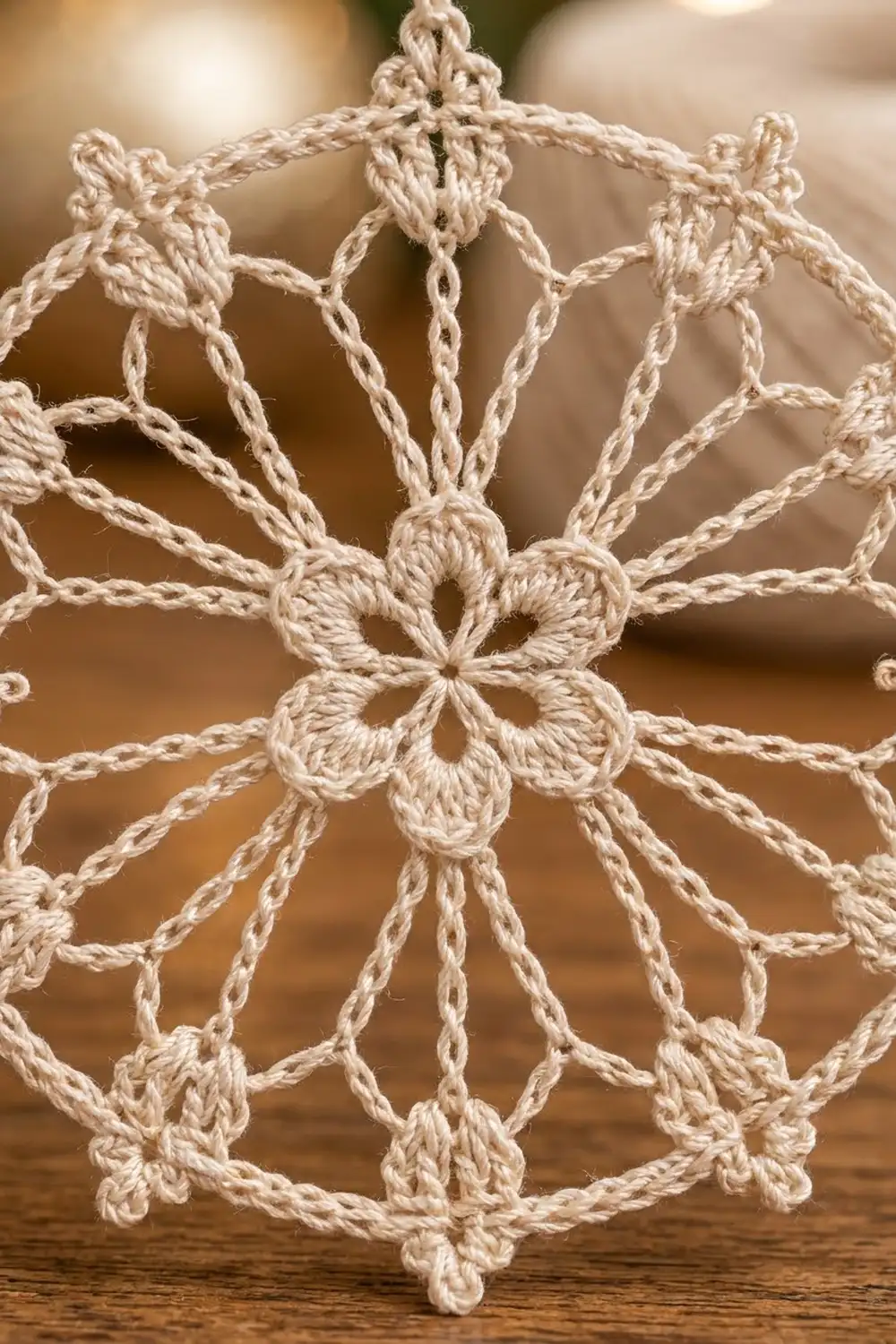
This Starlit Wheel ornament is a lacy round snowflake in fine cotton thread. A small five-petal flower sits in the middle, long chain spokes fan out from it in V-shaped pairs, and a thin round rim holds everything together. Twelve tiny three-picot trefoils run around the rim, and a slim chain loop at the top lets it hang from a branch.
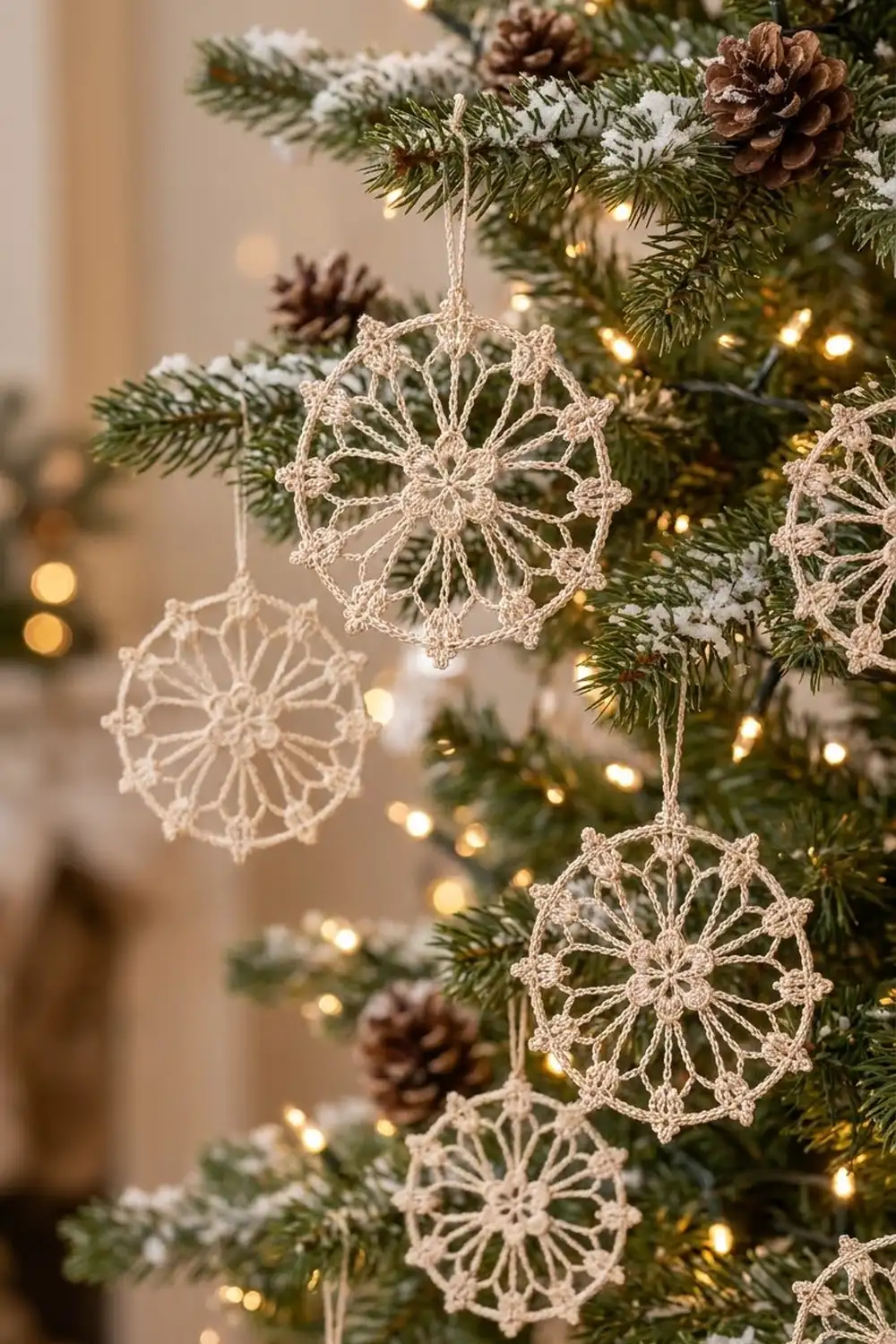
The sample is in a single soft cream/ecru shade, so it looks like old-fashioned lace against green branches and warm lights. It also works in white, silver-gray, or pale gold. It’s light, quick, and meant for gifting or for filling a tree with a matching set.
This pattern uses US crochet terms. The finished ornament measures 4 in (10.2 cm) across, including the trefoils. The rim alone is 3.75 in (9.5 cm). The hanging loop adds about 2 in (5.1 cm), so the total hanging height is about 6 in (15.2 cm).
You work the whole ornament as one piece, in the round, from the center out. First you make the flower on the front loops of a small ring. Next, a flat base sits behind it on the back loops. Then come twelve long chain loops for the spokes, a rim round that links the tips of those loops, and an edging round that adds the trefoils. You finish with the hanging loop and a light starch blocking.
Finished Size and Construction
- Finished size: 4 in (10.2 cm) across including the trefoils; about 6 in (15.2 cm) tall including the hanging loop
- Skill level: Intermediate (fine thread, long chains)
- Terminology: US crochet terms
- Yarn weight: Lace (0), size 10 crochet cotton thread
- Hook: 1.5 mm (US steel 8)
- Number of pieces: 1 (a single standalone motif)
- Layout: Round wheel: center flower, 12 spoke loops, rim, trefoil edging
- Piece size: 4 in (10.2 cm) across
- Size before edging (after Round 6): 3.75 in (9.5 cm) across
- Edging depth: about 0.125 in (0.3 cm) beyond the rim all the way around
Materials
Thread: Use mercerized size 10 cotton crochet thread. It holds a crisp shape after starching, and the stitch definition stays clear. Avoid fuzzy or acrylic threads, because they won’t hold the long spokes straight. A tightly twisted thread also shows each chain clearly, which is what gives the spokes their fine, rope-like look.
- Cream / ecru: 5 g, about 40 m (44 yd) per ornament
Each ornament uses about 3 g. The quantity above includes a margin for your gauge test, the hanging loop, and weaving in ends. For a set of six, plan on 30 g, about 240 m (262 yd).
Tools:
- 1.5 mm (US steel 8) crochet hook
- Fine tapestry needle or size 22 embroidery needle
- Small sharp scissors
- Stitch marker or a scrap of contrasting thread
- Fabric stiffener, liquid starch, or a 1:1 mix of white glue and water
- Foam blocking board, rustproof pins, and a printed 3.75 in (9.5 cm) circle template
- Plastic wrap to cover the template
Abbreviations (US Terms)
- ch – chain
- sl st – slip stitch
- sc – single crochet
- hdc – half double crochet
- dc – double crochet
- st(s) – stitch(es)
- sp – space
- sk – skip
- FLO – front loop only
- BLO – back loop only
- beg – beginning
Special stitches
- Petal: (hdc, 3 dc, hdc) all in the same stitch.
- Dc group: 3 dc in the same stitch.
- Trefoil: In the same stitch, work (sc, ch 3, sc, ch 4, sc, ch 3, sc). That makes 4 sc and 3 picot loops: a ch-3 on each side and a slightly longer ch-4 pointing straight out.
Gauge and Checkpoints
Gauge doesn’t have to be exact for an ornament, but it controls the size and how flat the piece lies. Make one complete ornament first and measure it after blocking before you make a full set.
Chain gauge: 12 ch = 1 in (2.5 cm), measured relaxed.
Checkpoints:
- After Round 1: the ring of 10 sc is about 0.5 in (1.3 cm) across.
- After Round 2: the flower is about 0.75 in (1.9 cm) across.
- After Round 4: the flat center disk is about 1 in (2.5 cm) across.
- After Round 5: each loop, laid flat and pinched at its center chain, reaches about 1.25 in (3.2 cm) out from the disk.
- After Round 6: the rim is about 3.75 in (9.5 cm) across when blocked.
- After Round 7: about 4 in (10.2 cm) across, from trefoil tip to trefoil tip.
If it’s too big: go down to a 1.25 mm (US steel 10) hook, or chain more tightly. The spokes are where the size grows fastest.
If it’s too small or cupping: go up to a 1.75 mm (US steel 6) hook. You can also loosen your chains so that 12 ch measure a full 1 in (2.5 cm).
Pattern
Before you start: Leave a 4 in (10.2 cm) tail at the magic ring. Hold the thread with a little more tension than you would for yarn, and keep every chain the same size. Count chains in groups of five so the long loops stay accurate.
Center Flower
Round 1: Make a magic ring. Ch 1, work 10 sc into the ring, then sl st to the first sc. Pull the ring tight. (10 sc)
Round 2 (FLO): Working in the front loops only, sl st in the next st, Petal in the next st. Repeat from * 4 more times, then sl st to the first sl st. (5 petals: 25 petal sts + 5 sl st = 30 sts)
The back loops of Round 1 stay free for the next round, and the petals sit on top like a small raised flower.
Center Disk
Round 3 (BLO of Round 1): Fold the petals toward you. Sl st into the BLO of the first Round 1 st. Ch 1, then work 2 sc in the BLO of each of the 10 sts, and sl st to the first sc. (20 sc)
Round 4: Ch 1. Sc in the next 4 sts, 2 sc in the next st; repeat from * 3 more times, then sl st to the first sc. (24 sc)
The disk should lie flat behind the flower and show as a thin outline around the petals. Checkpoint: 1 in (2.5 cm).
Spokes
Round 5: Ch 1, sc in the first st. Ch 31, sk the next st, sc in the next st; repeat from * 10 more times. Ch 31, sk the last st, and sl st to the first sc. (12 sc, 12 ch-31 loops)
Each loop leaves and returns to the disk two stitches apart. When you pull the 16th chain of a loop out to the rim, its two 15-chain legs form a V. That gives 24 spoke lines that meet in pairs at 12 points. These meeting points are where the trefoils will sit.
Keep the loops untwisted. Before you start Round 6, lay the piece flat and check that each loop lies open.
Rim
Round 6: Sl st in each of the first 15 ch of the first loop, then sl st in the 16th (center) ch. Ch 3 (counts as dc), then work 2 dc in the same ch to finish the first Dc group. Ch 9, Dc group in the 16th ch of the next loop; repeat from * 10 more times. Ch 9, then sl st to the top of the beg ch-3. (12 Dc groups = 36 dc; 12 ch-9 sps)
The ch-9 segments make the thin round rim, and each Dc group pulls a pair of spokes up to the rim. Checkpoint: 3.75 in (9.5 cm) across, slightly relaxed.
Border (Trefoil Edging)
The edging is the border of this single round piece. A circle has no corners or sides, so the counts here are given per section. One section runs from one Dc group to the next, and there are 12 sections.
Border gauge: 1 sc per chain, so 9 sc fill 0.75 in (1.9 cm) of rim.
Round 7: Sl st in the next dc (the center dc of the first group). Ch 1. Trefoil in the center dc, sc in the next dc, 9 sc in the ch-9 sp, sc in the first dc of the next group. Repeat from * 11 more times; the last repeat ends with sc in the first dc of the first group. Sl st to the first sc and fasten off. (180 sc and 36 picots: 12 trefoils)
Count per section: 4 sc (trefoil) + 1 sc + 9 sc + 1 sc = 15 sc, plus 3 picots.
Check: 12 sections × 15 sc = 180 sc. 12 sections × 3 picots = 36 picots.
Why the math works: Round 6 has 12 × (3 dc + 9 ch) = 144 base sts. Round 7 works 1 sc into each of the 9 chains and 1 sc into each outer dc, so the rim length stays the same and the piece doesn’t ruffle or cup. All 4 sc of each trefoil go into a single center dc. They bunch into a knot instead of adding length, and that knot is the raised cluster you see at each spoke tip. Each section works 12 base sts (3 dc + 9 ch) and adds 3 sc in the trefoil, for 12 + 3 = 15 sc.
Hanging Loop
Choose the trefoil that will be the top. Join the thread with a sl st in its ch-4 picot. Ch 48, then sl st in the same picot. Fasten off. (48-ch loop)
At 12 ch per inch, 48 ch is 4 in (10.2 cm) around, so the loop hangs about 2 in (5.1 cm) above the ornament.
Weave in all ends along the rim sc and the disk. Don’t weave through the spokes, because tails will show there.
Final Blocking
- Draw or print a 3.75 in (9.5 cm) circle and mark 12 evenly spaced points on it, one every 30 degrees. Cover it with plastic wrap and set it on the foam board.
- Soak the ornament in stiffener and squeeze it out gently in a towel. It should feel damp, not dripping.
- Lay it face up and center the flower on the template.
- Pin each Dc group to one of the 12 points. Start at the top and pin opposite pairs: top, bottom, left, right, then the points in between.
- Straighten each pair of spokes so both legs of every V are even and taut.
- Pin out the ch-4 tip of each trefoil, then the two ch-3 side picots.
- Shape the petals with a fingertip so they sit evenly around the center.
- Lay the hanging loop straight up from the top trefoil, with its two strands side by side.
- Let it dry completely, usually 12–24 hours, then unpin.
Final Quality-Control Checklist
- Diameter: 4 in (10.2 cm) tip to tip; rim 3.75 in (9.5 cm)
- 5 even petals and a closed center hole
- 24 spoke legs, all straight, with no twisted loops
- 12 Dc groups evenly spaced on the rim
- 12 trefoils, each with 3 picots (36 in total)
- Rim lies flat with no ruffles or cupping
- Hanging loop centered over a trefoil, about 2 in (5.1 cm) long
- No visible tails, and the ornament is stiff and keeps its shape
Troubleshooting
The ornament cups like a bowl: Either the spokes are too short or the rim chains are too tight. Remake Round 5 with looser chains. Or add 1 ch to every ch-9 rim segment and 1 sc to every section of Round 7, so each section has 16 sc and the total is 192 sc.
The rim ruffles: The rim chains are too loose. Go down a hook size for Rounds 6–7 only.
The spokes look uneven: One loop probably has a miscounted chain. Count each ch-31 loop before you start the next one.
A loop is twisted: Undo the work back to the twisted loop. Because there’s so much chain in this round, lay the work flat after every 3 loops to check.
The petals flop: Starch them a second time and press them flat while they’re damp.
The center hole is open: Pull the magic ring tighter before you weave in that tail.
Care
Dust it gently, or rinse it in cool water and re-block it with fresh stiffener. Store it flat in a box between layers of tissue so the spokes don’t bend.
Final Notes
Here’s the measurement chain. A 0.5 in (1.3 cm) ring grows into a 0.75 in (1.9 cm) flower and then a 1 in (2.5 cm) disk. Twelve ch-31 loops carry the spokes 1.25 in (3.2 cm) out to a 3.75 in (9.5 cm) rim. The trefoil edging brings the ornament to 4 in (10.2 cm), and a 2 in (5.1 cm) loop sits on top. If each checkpoint matches, the next round will fall into place. Make one, block it, check it against the template, and then make the rest.
Happy crocheting!