

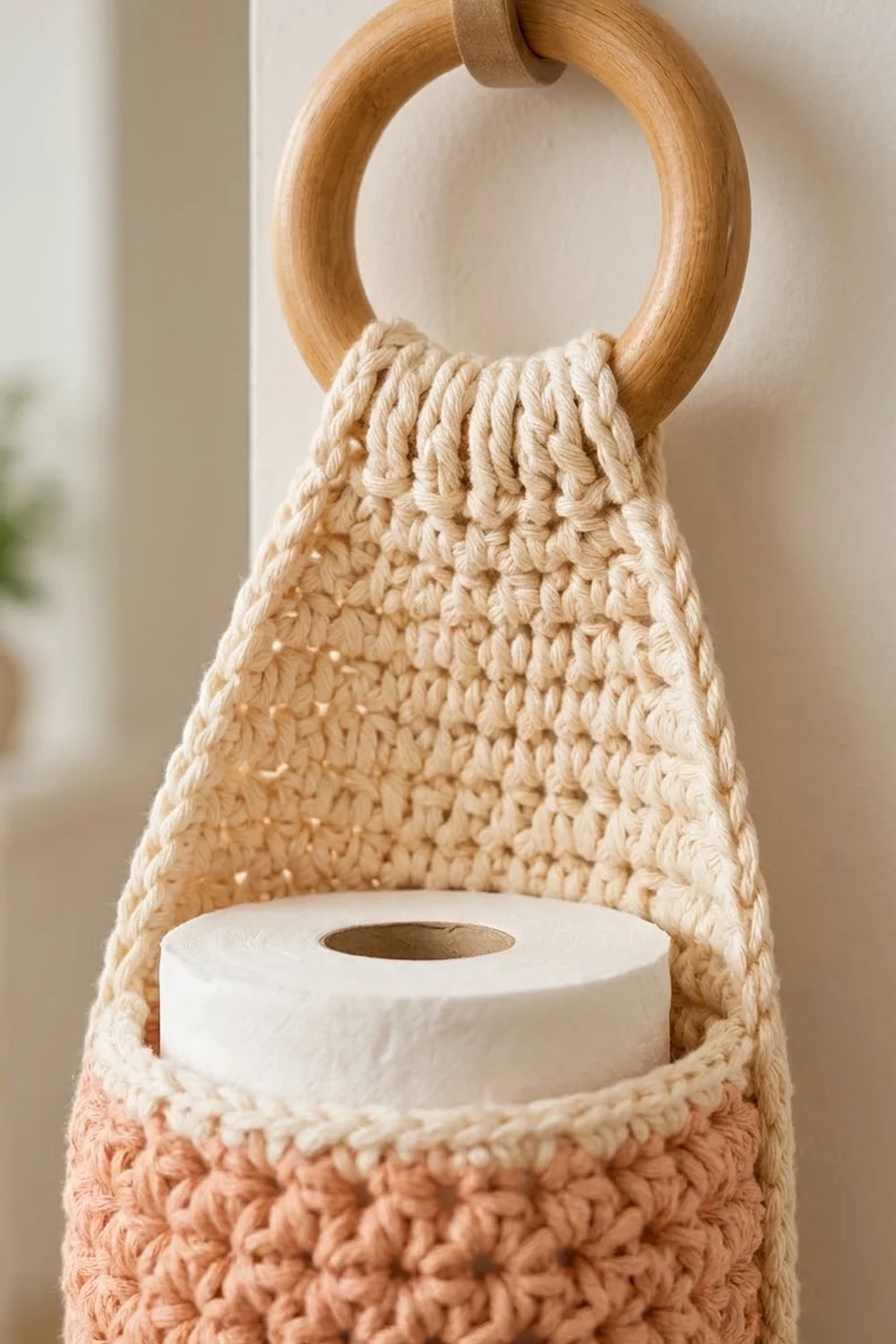
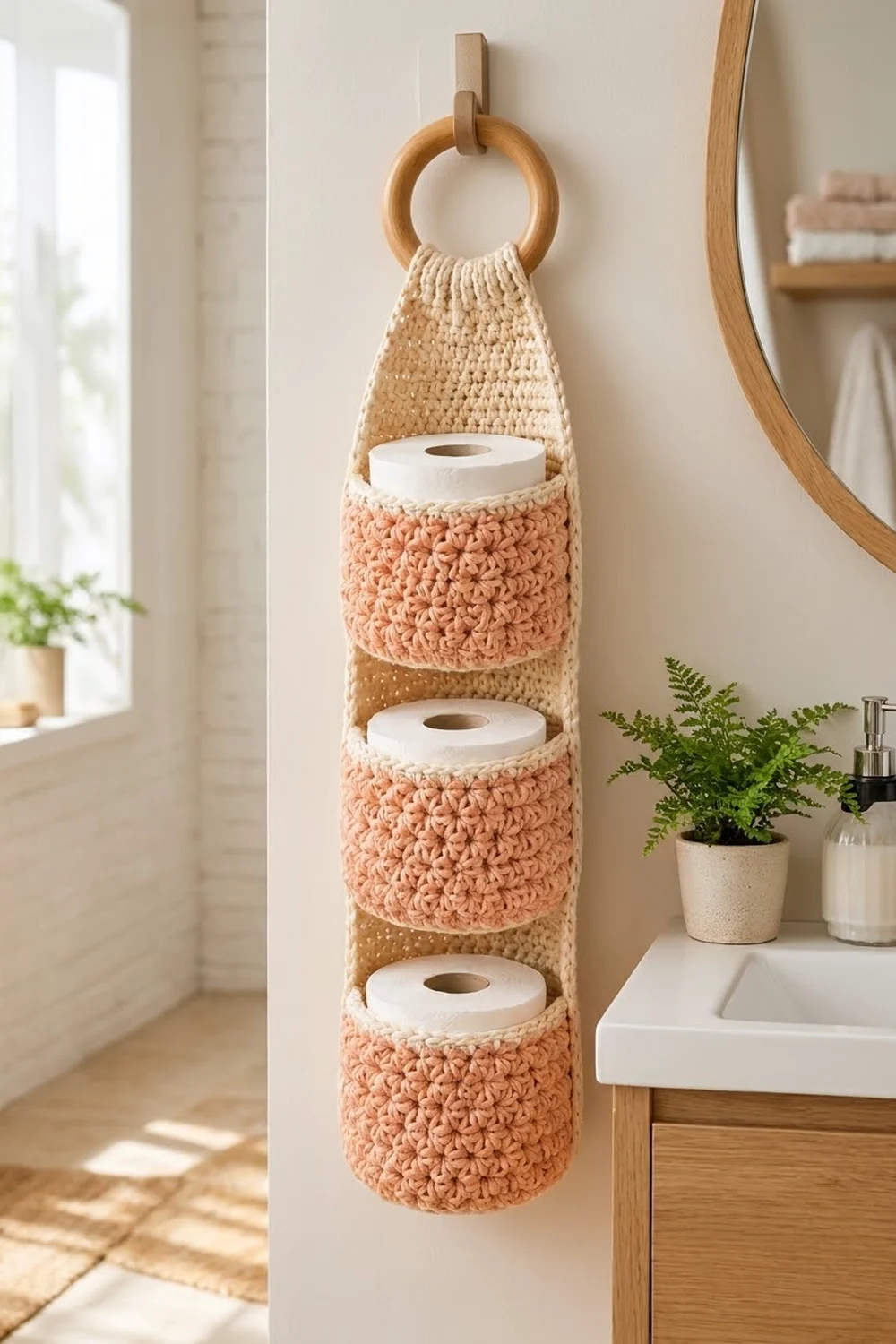
This hanging toilet paper holder keeps three spare rolls tidy, visible, and off the floor. A long cream back panel tapers at the top into a short strap that wraps around a natural wooden ring. Three round peach pockets are stacked down the front, and each one holds a standard roll.
The look is soft and modern. A smooth cream single-crochet panel with a rolled crab-stitch edge is paired with peach pockets in a bumpy, star-like (sc, dc) texture. Each pocket has a cream rim that matches the panel edging, so the two colors tie together cleanly.
The pattern uses US crochet terms. The finished holder is about 7 in (17.8 cm) wide and 26 1/2 in (67.3 cm) long from the bottom edge to the top of the strap fold, not counting the ring. Each pocket is about 5 1/2 in (14.0 cm) across and 3 1/2 in (8.9 cm) tall.
Construction is simple. You crochet one back panel in rows and three pockets as small round-bottomed baskets. Then you sew the pockets onto the panel, work a two-row border, and fold the strap over the ring.
Finished Size and Construction
- Finished size: 7 in (17.8 cm) wide x 26 1/2 in (67.3 cm) long, not counting the ring
- Skill level: Easy to intermediate
- Terminology: US crochet terms
- Yarn weight: Worsted (#4), cotton or cotton blend
- Hook: US H-8 (5.0 mm)
- Number of pieces: 4 (1 back panel + 3 pockets)
- Layout: 1 column of 3 pockets, stacked vertically
- Piece size: Panel 6 in (15.2 cm) wide x 27 in (68.6 cm) long laid flat, including the strap. Each pocket is 5 1/2 in (14.0 cm) in diameter x 3 1/2 in (8.9 cm) tall.
- Size before border: 6 in (15.2 cm) wide
- Border depth: 1/2 in (1.3 cm) on each side and along the bottom
Materials
Choose a smooth worsted-weight cotton. Cotton holds the pocket shape, doesn’t stretch much under the weight of the rolls, and copes well with bathroom humidity. Avoid very drapey acrylics, which let the pockets sag.
- Cream: 170 g, about 289 m (316 yd), for the back panel, border, and pocket rims
- Peach: 180 g, about 306 m (335 yd), for the pocket bases and walls
These amounts assume cotton with about 170 m (186 yd) per 100 g. They include a margin of about 15%.
Tools:
- US H-8 (5.0 mm) crochet hook
- Wooden ring, 3 in (7.6 cm) outer diameter
- Tapestry needle
- 6 locking stitch markers
- Measuring tape
- Rustproof pins and a blocking surface
- Scissors
Abbreviations (US Terms)
- ch: chain
- sc: single crochet
- dc: double crochet
- sl st: slip stitch
- sk: skip
- st(s): stitch(es)
- blo: back loop only
- sc2tog: single crochet 2 together
- rev sc: reverse single crochet (crab stitch)
- RS: right side
Special stitch – Star pair: Work (sc, dc) in the same st, then sk the next st. One star pair uses 2 sts of the previous round and makes 2 new sts, so the stitch count never changes.
Rev sc: Work from left to right (if you are right-handed). Insert the hook into the next st to the right, yarn over, and pull up a loop. Yarn over again and pull through both loops.
Gauge and Checkpoints
- Sc in rows: 14 sts and 16 rows = 4 in (10.2 cm)
- Star-pair texture in rounds: 14 sts and 12 rounds = 4 in (10.2 cm)
Make one pocket first. It is the best gauge test because it uses both stitch patterns, and it shows right away whether a roll fits.
Checkpoints:
- Pocket base after Round 10: 5 1/2 in (14.0 cm) across, lying flat
- Finished pocket: 3 1/2 in (8.9 cm) tall. A standard roll, about 4 1/2 in (11.4 cm) across, should drop in easily.
- Panel after Row 12: 6 in (15.2 cm) wide x 3 in (7.6 cm) tall
- Panel after Row 72: 18 in (45.7 cm) tall
- Panel after Row 100: 25 in (63.5 cm) tall and 2 in (5.1 cm) wide at the top
If your pieces are too big, go down one hook size. If they are too small, go up one hook size. If the base ruffles, your tension is tightening on the increase rounds. Relax your tension rather than removing increases.
Back Panel
With cream, ch 22.
Row 1 (RS): Sc in the 2nd ch from the hook and in each ch across, turn. (21 sts)
Rows 2–72: Ch 1 (does not count as a st here or anywhere in this pattern), sc in each st across, turn. (21 sts)
Checkpoint: 6 in (15.2 cm) wide x 18 in (45.7 cm) tall.
Taper
Rows 73–75: Ch 1, sc in each st across, turn. (21 sts)
Row 76 (decrease row): Ch 1, sc2tog, sc in each st to the last 2 sts, sc2tog, turn. (19 sts)
Rows 77–100: Repeat Rows 73–76 six more times (3 plain rows, then 1 decrease row each time). Each plain row has the same count as the row before it. The decrease rows give these totals:
- Row 80: 17 sts
- Row 84: 15 sts
- Row 88: 13 sts
- Row 92: 11 sts
- Row 96: 9 sts
- Row 100: 7 sts
Checkpoint: 25 in (63.5 cm) tall, with a top edge 2 in (5.1 cm) wide. Each sloped edge is about 7 1/4 in (18.4 cm) long.
Strap
Rows 101–108: Ch 1, sc in each st across, turn. (7 sts)
Fasten off and leave a 12 in (30.5 cm) tail for sewing the strap. Laid flat, the panel now measures 27 in (68.6 cm).
Pockets (Make 3)
Work in joined rounds without turning. Join each round with a sl st to the first st, then ch 1.
Base
With peach, make a magic ring.
Round 1: 6 sc in the ring, join. (6 sts)
Round 2: 2 sc in each st, join. (12 sts)
Round 3: (Sc in next st, 2 sc in next st) 6 times, join. (18 sts)
Round 4: (Sc in next 2 sts, 2 sc in next st) 6 times, join. (24 sts)
Round 5: (Sc in next 3 sts, 2 sc in next st) 6 times, join. (30 sts)
Round 6: (Sc in next 4 sts, 2 sc in next st) 6 times, join. (36 sts)
Round 7: (Sc in next 5 sts, 2 sc in next st) 6 times, join. (42 sts)
Round 8: (Sc in next 6 sts, 2 sc in next st) 6 times, join. (48 sts)
Round 9: (Sc in next 7 sts, 2 sc in next st) 6 times, join. (54 sts)
Round 10: (Sc in next 8 sts, 2 sc in next st) 6 times, join. (60 sts)
Checkpoint: the base lies flat at 5 1/2 in (14.0 cm) across, with a circumference of about 17 in (43.2 cm).
Walls
Round 11: Sc blo in each st, join. (60 sts) The unused front loops form a crisp fold, and the work turns upward.
Round 12: *Star pair in the next st (skipping the following st); repeat from * 29 more times, join. (30 star pairs = 60 sts)
Rounds 13–19: *Star pair worked into the sc of the next pair (sk the dc); repeat from * 29 more times, join. (60 sts each round)
Offsetting the pairs this way stacks the clusters into the knobbly, star-like texture. Fasten off peach.
Rim
Round 20: Join cream in any st. Sc in each st, join. (60 sts)
Round 21: Ch 1, rev sc in each st, join. (60 sts)
Fasten off and leave a 24 in (61.0 cm) tail. The walls are 11 rounds tall, about 3 1/2 in (8.9 cm) in total:
- Round 11: about 1/4 in (0.6 cm)
- Textured rounds: about 2 2/3 in (6.8 cm)
- Rim: about 1/2 in (1.3 cm)
Make All Pieces
- Cream: 1 back panel and the rims on all 3 pockets
- Peach: 3 pocket bases and walls
Layout (front view):
        [ring]
        [strap]
       / taper \
      |  panel  |
      |  [P3]   |  rows 49–62
      |         |
      |  [P2]   |  rows 25–38
      |         |
      |  [P1]   |  rows 1–14
      +---------+
Each pocket covers 14 panel rows, or 3 1/2 in (8.9 cm). There are 10 open rows, or 2 1/2 in (6.4 cm), between pockets. Above Pocket 3 there are 10 plain rows before the taper begins.
Joining
Pockets to Panel
Lay the panel RS up. Place markers in panel columns 2 and 20 (the 2nd st in from each edge) at Rows 1, 25, and 49. Columns 1 and 21 stay free for the border.
On one pocket, count 19 sts along the last base round (Round 10) and mark the 1st and 19th. This 19-st section becomes the flat back. The remaining 41 sts curve out in front to hold the roll.
- Base seam: With the cream tail, whipstitch the 19 marked base sts to panel sts 2–20 of the target row, 1 st to 1 st. Sew through the spare front loops from Round 11 for a neat seam.
- Side seams: Whipstitch straight up from each marked base st. Join the edge of each wall round to panel column 2 on the left and column 20 on the right. There are 11 rounds against 14 rows, so catch 1 extra panel row after every 4th round (3 extra rows in total).
- Rim tack: At the top, sew the marked rim sts securely to the pocket’s top row (Row 14, 38, or 62) at columns 2 and 20.
Keep the seams snug but not tight. The panel should stay flat, with no puckering. Repeat for Pockets 2 and 3.
Size checkpoint: the panel is still 6 in (15.2 cm) wide. Each pocket projects about 4 1/2 in (11.4 cm) forward.
Ring
Fold the strap (Rows 101–108) over the wooden ring to the back. On the wrong side, sew the 7 sts of Row 108 to the 7 sts of Row 100, 1 st to 1 st. The strap gathers slightly around the ring, which gives the soft pleated look at the top.
Border
Work the border in cream around the sides and bottom of the panel, from the top of one taper down and around to the top of the other. The strap is not bordered.
Border gauge: 14 sts = 4 in (10.2 cm), the same as the panel. Sc rows are shorter than sc sts are wide (16 rows vs. 14 sts per 4 in / 10.2 cm), so you work 7 sc for every 8 row ends.
Border Row 1 (RS): Join cream at the top of the left-hand taper, at the edge of Row 100.
- Taper (left): (Sc in each of the next 13 row ends, sk 1 row end) twice = 26 sc over 28 row ends
- Body (left): (Sc in each of the next 7 row ends, sk 1 row end) 9 times = 63 sc over 72 row ends
- Bottom: Work into the free loops of the foundation ch: 3 sc in the first ch, sc in each of the next 19 chs, 3 sc in the last ch. That is 21 sts worked + 4 extra = 25 sc.
- Body (right): 63 sc, worked as for the left side
- Taper (right): 26 sc, worked as for the left side
Total: 26 + 63 + 25 + 63 + 26 = 203 sts.
Border Row 2: Do not turn. Ch 1, rev sc in each st back along the edge. (203 sts) Fasten off.
Why the math works:
- 63 sc at 3.5 sts per inch is 18 in (45.7 cm), exactly the body height.
- The sloped taper edge is about 7 1/4 in (18.4 cm). 26 sc covers about 7 1/2 in (19.1 cm), which gives a little ease for the angle.
- The 4 extra corner sts turn the bottom corners without cupping.
- The 2 border rows add 1/2 in (1.3 cm) per side, so the 6 in (15.2 cm) panel finishes at 7 in (17.8 cm).
Final Blocking
- Weave in all ends along the seams or inside the border.
- Lightly mist the panel and pockets with water.
- Pin the panel flat to 7 in (17.8 cm) wide. Keep the side edges straight and the taper symmetrical.
- Fill each pocket with a toilet roll or a rolled towel so it dries round.
- Let everything dry completely, about 12–24 hours.
- Unpin, hang the holder on a hook, and load it with rolls.
Final Quality-Control Checklist
- Panel is 7 in (17.8 cm) wide, with straight, parallel sides.
- Length is 26 1/2 in (67.3 cm) from the bottom edge to the strap fold.
- Each pocket is 5 1/2 in (14.0 cm) across and 3 1/2 in (8.9 cm) tall.
- Pockets sit level and centered, starting at Rows 1, 25, and 49.
- Each pocket round has exactly 60 sts, and the texture lines up with no gaps at the joins.
- Border has 203 sts in 2 even rows, and the corners lie flat.
- Strap seam is secure and hidden at the back.
- All ends are woven in and can’t be seen from the front.
Troubleshooting
Base ruffles: Your tension loosens on the increases. Go down a hook size for the base only, or redo Rounds 9–10 more firmly.
Base cups before Round 11: You are crocheting too tightly. Go up a hook size.
Roll won’t fit: Check that the base circumference is 17 in (43.2 cm). If you need more room, add one more increase round (66 sts) and work 33 star pairs per round.
Star texture slants: Make sure each pair goes into the sc of the previous pair, not the dc.
Panel sides wave: You worked too many border sts. Recheck that you have 7 sc for every 8 row ends.
Panel sags under the rolls: Add a few tacking stitches at the rim corners, and use cotton rather than acrylic.
Strap is too loose on the ring: Sew Row 106 to Row 100 instead of Row 108.
Care
Hand wash in cool water with mild soap, then press the water out in a towel. Dry flat with the pockets stuffed into shape, and avoid the dryer, which can shrink cotton unevenly.
Final Notes
Everything depends on a short chain of measurements:
- A 21-st panel at 14 sts per 4 in (10.2 cm) gives 6 in (15.2 cm), and the border brings it to 7 in (17.8 cm).
- A 60-st base gives a 5 1/2 in (14.0 cm) pocket that fits a standard roll.
- 11 wall rounds match 14 panel rows, or 3 1/2 in (8.9 cm).
Check each measurement as you go, and the pockets will sit straight and hold their rolls neatly.
Happy crocheting!