
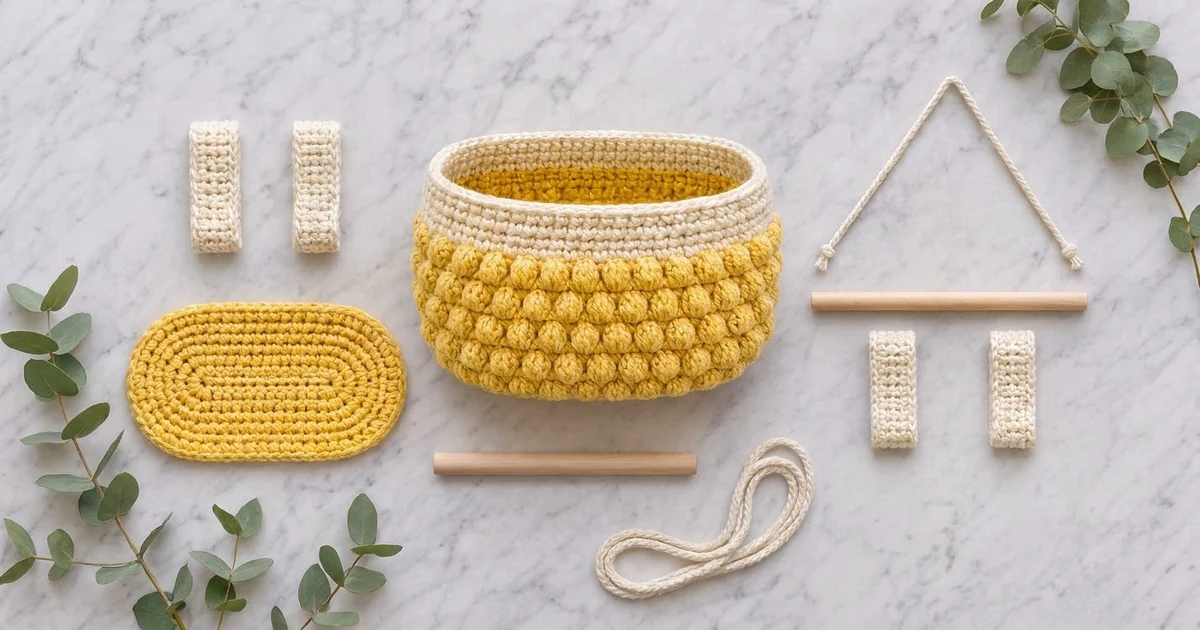
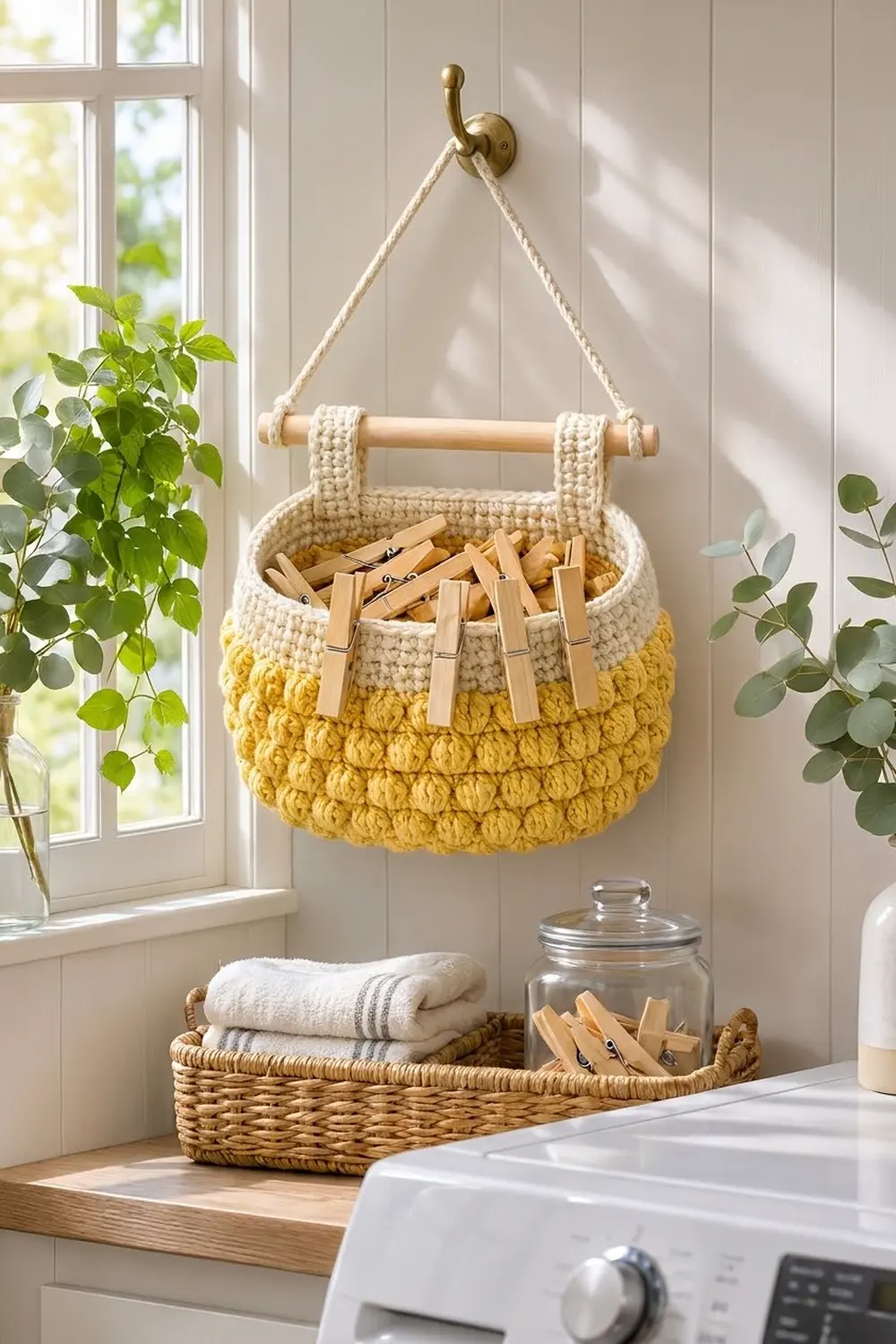
This cheerful hanging basket keeps clothespins within reach and looks good on a laundry-room wall. It has a mustard-yellow oval base, a band of chunky staggered bobbles and a clean cream rim. Two cream tabs hold a wooden dowel, and a twisted cream cord hangs it from a hook.
The style is simple farmhouse with a soft, textured finish. Cotton yarn gives crisp stitch definition and keeps the basket firm, so it holds its shape even when empty.
This pattern uses US crochet terms. The finished basket measures about 10.25 in (26.0 cm) long, 4.5 in (11.4 cm) deep front to back and 5.5 in (14.0 cm) tall, not counting the tabs and cord.
You start with an oval base worked in joined rounds of single crochet. From the base you work upward into a bobble section, then change to cream for the rim. Last, you make two small tabs, sew them to the back wall, slide in the dowel and add the twisted cord.
Finished Size and Construction
- Finished size: 10.25 in (26.0 cm) long x 4.5 in (11.4 cm) deep x 5.5 in (14.0 cm) tall
- Skill level: Intermediate (bobbles, oval base, joined and turned rounds)
- Terminology: US crochet terms
- Yarn weight: Worsted weight (#4) cotton
- Hook: 5.0 mm (H-8)
- Number of pieces: 3 crocheted pieces (1 basket, 2 tabs), plus 1 twisted cord
- Layout: Tabs sewn side by side on the back wall, dowel threaded through both tabs, cord knotted to the dowel ends
- Base size: 10.25 in x 4.5 in (26.0 cm x 11.4 cm), 100 stitches around
- Size before rim: 3.5 in (8.9 cm) of wall height
- Rim depth: 2 in (5.1 cm)
- Tab size: 1.25 in x 4 in (3.2 cm x 10.2 cm) before folding
Materials
Choose a smooth worsted-weight 100% cotton or a cotton blend. Cotton keeps the bobbles round and the walls upright. Acrylic works too, but the basket will be softer and floppier.
- Mustard yellow: about 120 g / 200 m (base and bobble section)
- Cream: about 60 g / 100 m (rim, tabs and twisted cord)
These quantities include a safety margin of roughly 10–15%.
Tools:
- 5.0 mm (H-8) crochet hook
- Wooden dowel, 12 in (30.5 cm) long and 0.5 in (1.3 cm) in diameter
- Tapestry needle
- 2 stitch markers
- Scissors
- Measuring tape
- Pins and a small spray bottle for blocking
Abbreviations (US Terms)
- ch – chain
- sc – single crochet
- dc – double crochet
- sl st – slip stitch
- st(s) – stitch(es)
- BLO – back loop only
- inc – 2 sc in the same st
- RS / WS – right side / wrong side
- yo – yarn over
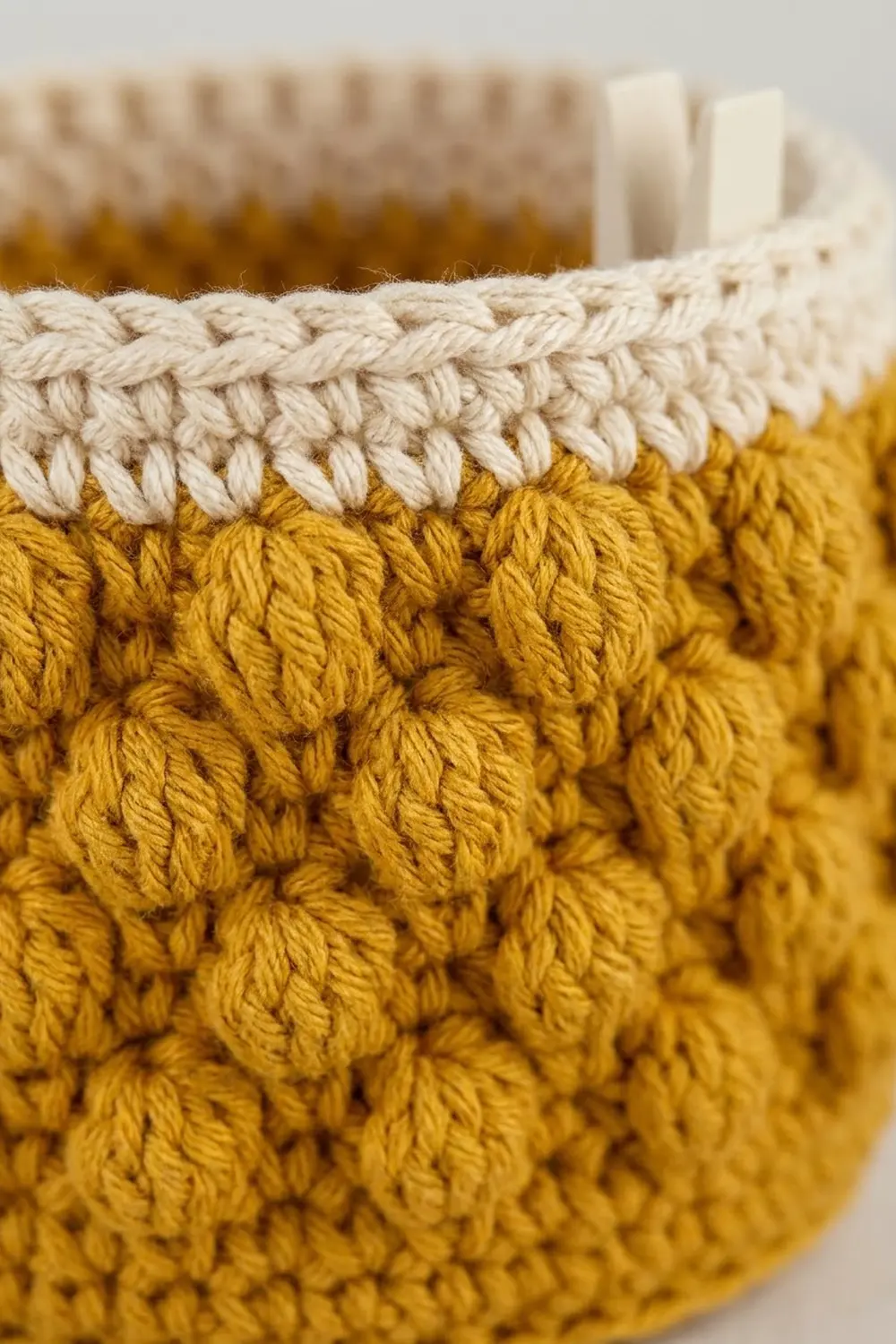
Bobble (5-dc bobble): (Yo, insert hook in the st, yo and pull up a loop, yo and draw through 2 loops) 5 times in the same st. You now have 6 loops on the hook. Yo and draw through all 6 loops. A bobble counts as 1 st.
Bobbles bulge away from you. That is why every bobble round is worked with the WS (the inside of the basket) facing you, so the bobbles pop to the outside.
Gauge and Checkpoints
Gauge: 16 sc and 17 rounds = 4 in (10.2 cm) in single crochet with a 5.0 mm hook.
Make one tab first (see below) as your test piece. Its 5 sts should measure 1.25 in (3.2 cm) across. If it matches, your base will come out right.
Checkpoints:
- After Rnd 1: about 6.25 in (15.9 cm) long
- After Rnd 5: about 8.25 in x 2.5 in (21.0 cm x 6.4 cm)
- After Rnd 9: 10.25 in x 4.5 in (26.0 cm x 11.4 cm), with a perimeter of about 25 in (63.5 cm)
- After Rnd 21: walls about 3.5 in (8.9 cm) tall from the turning ridge
- After Rnd 30: walls about 5.5 in (14.0 cm) tall
Too big? Go down one hook size (4.5 mm). Too small? Go up one size (5.5 mm). Keep your stitch counts the same and only change the hook. If the base ripples, you are increasing too much for your tension, so go down a hook size. If it cups, go up a size.
Basket Base
Use mustard yellow. Join every round with a sl st to the first sc. Begin each round with ch 1 (this does not count as a st), then work the first sc in the same st as the join.
The oval has two straight sides of 23 sts each and two curved ends, called End A and End B. All increases go into the ends.
Foundation: Ch 26.
Rnd 1: 3 sc in 2nd ch from hook (End A), sc in next 23 ch, 3 sc in last ch (End B). Rotate and work along the opposite side of the foundation chain: sc in next 23 ch. Join. (52 sts)
Rnd 2: 2 sc in each of next 3 sts, sc in next 23 sts; repeat once more. Join. (58 sts: 6 + 23 + 6 + 23)
Rnd 3: (Sc in next st, inc) 3 times, sc in next 23 sts; repeat once more. Join. (64 sts: 9 + 23 + 9 + 23)
Rnd 4: (Sc in next 2 sts, inc) 3 times, sc in next 23 sts; repeat once more. Join. (70 sts)
Rnd 5: (Sc in next 3 sts, inc) 3 times, sc in next 23 sts; repeat once more. Join. (76 sts)
Rnd 6: (Sc in next 4 sts, inc) 3 times, sc in next 23 sts; repeat once more. Join. (82 sts)
Rnd 7: (Sc in next 5 sts, inc) 3 times, sc in next 23 sts; repeat once more. Join. (88 sts)
Rnd 8: (Sc in next 6 sts, inc) 3 times, sc in next 23 sts; repeat once more. Join. (94 sts)
Rnd 9: (Sc in next 7 sts, inc) 3 times, sc in next 23 sts; repeat once more. Join. (100 sts: 27 + 23 + 27 + 23)
Each end gains 3 sts per round (6 sts per round in total), while the sides stay at 23. If your ends start to look pointy, you can move the increase within each repeat (for example, inc first, then the sc’s). The count does not change.
Lay the base flat and check it against the Rnd 9 checkpoint.
Basket Walls: Bobble Section
Keep using mustard yellow. Do not increase from here on. The walls stay at 100 sts.
Rnd 10 (turning ridge): Ch 1, sc in BLO of each st around. Join. (100 sts) The unused front loops form a neat ridge where the base turns up into the wall.
Rnd 11: Ch 1, sc in each st around. Join. (100 sts)
From Rnd 12 on, ch 1 and turn at the start of every round. Even-numbered rounds are worked with the WS (the inside) facing you. Odd-numbered rounds are worked with the RS (the outside) facing you.
Rnd 12 (WS, bobble round A): Ch 1, turn. Bobble in next st, sc in next st; repeat from * 49 more times. Join. (100 sts: 50 bobbles + 50 sc)
Rnd 13 (RS): Ch 1, turn. Sc in each st around, working into the top of each bobble, not into its bulge. Join. (100 sts)
Rnd 14 (WS, bobble round B): Ch 1, turn. Sc in next st, bobble in next st; repeat from * 49 more times. Join. (100 sts: 50 sc + 50 bobbles) These bobbles sit above the sc’s of Rnd 12, which gives the staggered layout.
Rnd 15: Repeat Rnd 13. (100 sts)
Rnd 16: Repeat Rnd 12. (100 sts)
Rnd 17: Repeat Rnd 13. (100 sts)
Rnd 18: Repeat Rnd 14. (100 sts)
Rnd 19: Repeat Rnd 13. (100 sts)
Rnd 20: Repeat Rnd 12. (100 sts)
Rnd 21: Repeat Rnd 13. (100 sts) Fasten off yellow.
That gives you five rows of bobbles. Check that the walls measure about 3.5 in (8.9 cm) from the turning ridge, and that every bobble round shows exactly 50 bobbles.
Make All Pieces
This basket has 3 crocheted pieces and 1 cord:
- Basket: 1, in yellow and cream
- Tabs: 2, in cream
- Twisted cord: 1, in cream
Layout (back wall, seen from behind):
   [dowel ===============================]
        |TAB|                 |TAB|
   +----------------------------------+
   |      cream rim (back side)       |
   |      yellow bobble section       |
   +----------------------------------+
Tabs (make 2)
Use cream. Ch 6.
Row 1: Sc in 2nd ch from hook and in each ch across. Turn. (5 sts)
Rows 2–17: Ch 1, sc in each st across. Turn. (5 sts)
Fasten off and leave a 12 in (30.5 cm) tail for sewing. Each tab should measure 1.25 in x 4 in (3.2 cm x 10.2 cm).
Twisted Cord
Cut 3 strands of cream, each 90 in (228.6 cm) long. Knot them together at both ends. Anchor one end, then twist the strands tightly in one direction until they kink when relaxed. Fold the cord in half and let it twist back on itself. Tie an overhand knot about 1 in (2.5 cm) from each end. Trim the ends into small tassels.
Joining
Placement: Find the back straight side of the rim. It has 23 sts and sits directly above one of the base’s 23-st sides. Mark the 1st and 23rd sts of that side. Place the first tab over sts 1–5 and the second tab over sts 19–23. That leaves 13 sts, or 3.25 in (8.3 cm), between the tabs.
Sewing: Fold a tab in half around the dowel. Sandwich the top 1 in (2.5 cm) of the back rim, about 4 rounds, between the two ends of the tab, with one end on the outside of the basket and one on the inside. Whipstitch through all three layers along the bottom edge of the tab and up both sides. Work stitch to stitch: each of the tab’s 5 edge sts lines up with one of the 5 rim sts underneath it.
Tension: Sew firmly, but don’t pull so hard that the rim puckers. The rim should stay flat between the tabs.
Size checkpoint: Each tab loop should rise about 1 in (2.5 cm) above the rim with the dowel inside, and both loops should be the same height. Slide the dowel through. It should stick out evenly on both sides, about 3.25 in (8.3 cm) past each tab.
Tie each knotted end of the cord around one end of the dowel, just outside a tab. The finished hanger should form a triangle about 24 in (61.0 cm) along the cord.
Border: Cream Rim
The rim works as this basket’s border. It is worked even, with no increases, so the top edge stands straight and matches the base perimeter.
Rim gauge: Same as the main gauge. 16 sc = 4 in (10.2 cm), and 8 sc rounds measure about 2 in (5.1 cm) with the final sl st round included.
Per-side counts: Front side 23 sts, End B 27 sts, back side 23 sts, End A 27 sts. Total: 23 + 27 + 23 + 27 = 100 sts.
Rnd 22 (WS): Join cream in the join st of Rnd 21. Ch 1, turn. Sc in each st around. Join. (100 sts: 23 / 27 / 23 / 27)
Rnds 23–29: Ch 1, turn. Sc in each st around. Join. (100 sts each round)
Rnd 30 (RS): Ch 1, do not turn. Sl st loosely in each st around. Join. (100 sl sts) Fasten off and weave in the end.
Why the math works: The base finished at 100 sts and the walls never change that count. So every rim round has exactly the base’s 100 sts, split the same way: 23 per straight side and 27 per end. At 4 sts per inch, 100 sts gives a 25 in (63.5 cm) rim, which matches the measured base perimeter. The rim neither flares nor pulls in.
Final Blocking
- Weave in all ends on the inside of the basket.
- Stuff the basket firmly with a folded towel shaped into an oval.
- Lightly mist the whole surface with water, or steam it gently from 1 in (2.5 cm) away. Don’t press on the bobbles.
- Smooth the rim so the front and back sides are straight and the ends curve evenly.
- Pinch each bobble gently into a round shape.
- Pin the tabs straight up and let everything dry completely.
- Remove the towel, then insert the dowel and tie on the cord.
Final Quality-Control Checklist
- Base measures 10.25 in x 4.5 in (26.0 cm x 11.4 cm) and lies flat
- Every wall and rim round has 100 sts
- Five bobble rounds, each with 50 bobbles, all popping outward and evenly staggered
- Rim is 2 in (5.1 cm) deep, with a smooth sl st edge
- Tabs are the same height and spaced 3.25 in (8.3 cm) apart
- Dowel sits level, and the cord knots are tight
- All ends are hidden on the inside
Troubleshooting
- Bobbles pop inside the basket: You worked a bobble round with the RS facing. Remember that bobble rounds are always worked with the WS facing.
- Stitch count drifts in bobble rounds: Make sure each bobble counts as 1 st, and in the next round work 1 sc into its top only.
- Base curls up: Your increases are too tight. Go up a hook size, or loosen your tension at the ends.
- Base ruffles: You have extra increases. Count each end: it should have 27 sts after Rnd 9.
- Diagonal seam line: Make sure you ch 1 and turn every round from Rnd 12 on.
- Basket tips forward: Move the tabs so they sit evenly on the back straight side, or check that the cord has the same length on both sides.
- Rim flares: Go down a hook size for the cream rounds.
Care
Hand wash in cool water with mild soap. Reshape over a towel and dry flat. Remove the dowel before washing.
Final Notes
The measurement chain is short. Gauge gives a 1.25 in (3.2 cm) tab. The base reaches 100 sts at 10.25 in x 4.5 in (26.0 cm x 11.4 cm). The walls hold 100 sts through 3.5 in (8.9 cm) of bobbles, and the rim adds 2 in (5.1 cm) for a 5.5 in (14.0 cm) tall basket. Check each step and the finished basket will hang straight and stay full of clothespins.
Happy crocheting!