
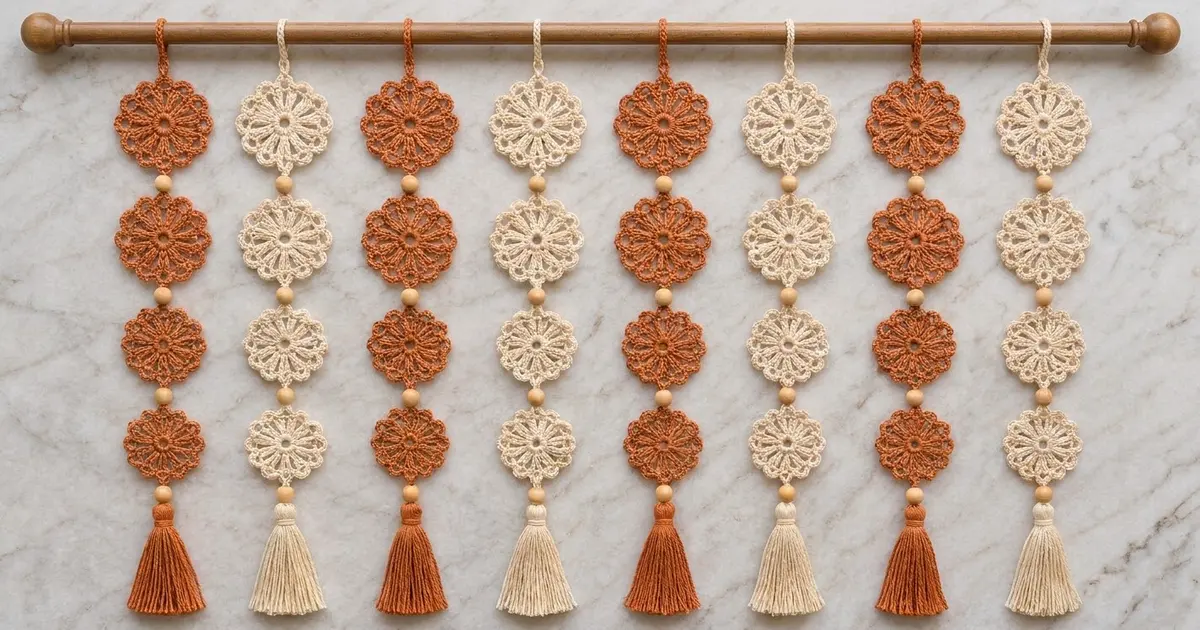
The Terracotta Bloom Curtain is a light, airy room divider made from lacy flower motifs strung into long vertical strands. Each motif has an open center ring, twelve paired spokes and a scalloped edge of twelve round petals, so light passes through every flower.
The colors are warm and earthy. Terracotta strands alternate with cream strands, and natural wooden beads sit between the motifs. A full tassel finishes the bottom of every strand. The look suits boho, farmhouse and warm neutral rooms, and it works in a doorway, a window or an open shelf.
This pattern uses US crochet terms. Each motif measures 4 in (10.2 cm) across. Each finished strand hangs 44.5 in (113.0 cm) from the top of the rod to the tip of the tassel. Eight strands spaced 5 in (12.7 cm) apart cover a width of 39 in (99.1 cm).
Construction is simple. You crochet 56 separate motifs in the round and join them vertically with short beaded chain links. Then you add a hanging loop to the top motif and a bead plus tassel to the bottom motif, and hang the strands on a rod.
Finished Size and Construction
- Finished curtain: 39 in (99.1 cm) wide x 44.5 in (113.0 cm) long
- Skill level: Easy to intermediate
- Terminology: US crochet terms
- Yarn weight: DK (weight 3) cotton
- Hook: 3.5 mm (US E-4)
- Number of pieces: 56 motifs (28 terracotta, 28 cream) plus 8 tassels
- Layout: 8 strands x 7 motifs, with the color alternating by strand
- Motif size: 4 in (10.2 cm) diameter
- Size before border (after Round 3): 3.25 in (8.3 cm)
- Border depth: 3/8 in (1.0 cm) on each side, which adds 3/4 in (1.9 cm) to the diameter
Materials
Choose a smooth, mercerized or combed cotton in DK weight, at about 115 m per 50 g. Cotton keeps the petals crisp and hangs straight without stretching. Avoid very springy acrylic blends, because the strands may curl or twist over time.
For the colors, pick a warm rust or terracotta and a soft cream with a slightly yellow undertone. A stark white can look harsh next to natural wood beads.
- Terracotta (Color A): 200 g, about 460 m
- Cream (Color B): 200 g, about 460 m
- Wooden beads: 60 round natural beads, 16 mm, with holes of at least 4 mm (56 needed plus spares)
Tools:
- 3.5 mm (US E-4) crochet hook
- Tapestry needle
- Big-eye beading needle or a loop of thin wire to thread the beads
- Stitch markers
- Stiff card 4.5 in (11.4 cm) tall, for the tassels
- Sharp scissors
- Blocking mat, rust-proof pins and a spray bottle
- Curtain rod or tension rod, up to 1.25 in (3.2 cm) in diameter
The quantities include a margin of about 20 percent to allow for differences in gauge and for the tassels.
Abbreviations (US Terms)
- ch – chain
- sl st – slip stitch
- sc – single crochet
- dc – double crochet
- tr – treble crochet
- sp – space
- st(s) – stitch(es)
- rep – repeat
Special technique – Bead link: Thread one bead onto the working yarn before you start the link. Work the chains given in the pattern, slide the bead up snug against the hook, then work the next chain around it. This locks the bead between chains.
Gauge and Checkpoints
Make one complete motif first, then block it and measure it. For this project, gauge is measured by the size of each round, not by a swatch.
- After Round 1: 1.25 in (3.2 cm) across
- After Round 2: 2.75 in (7.0 cm) across
- After Round 3: 3.25 in (8.3 cm) across
- After Round 4 (border): 4 in (10.2 cm) across, after blocking
If your motif is larger than 4 in (10.2 cm), go down 0.5 mm in hook size. If it is smaller, go up 0.5 mm. Small differences add up: being off by only 1/4 in (0.6 cm) per motif adds up to 1.75 in (4.4 cm) over 7 motifs, so check carefully before you make the full set.
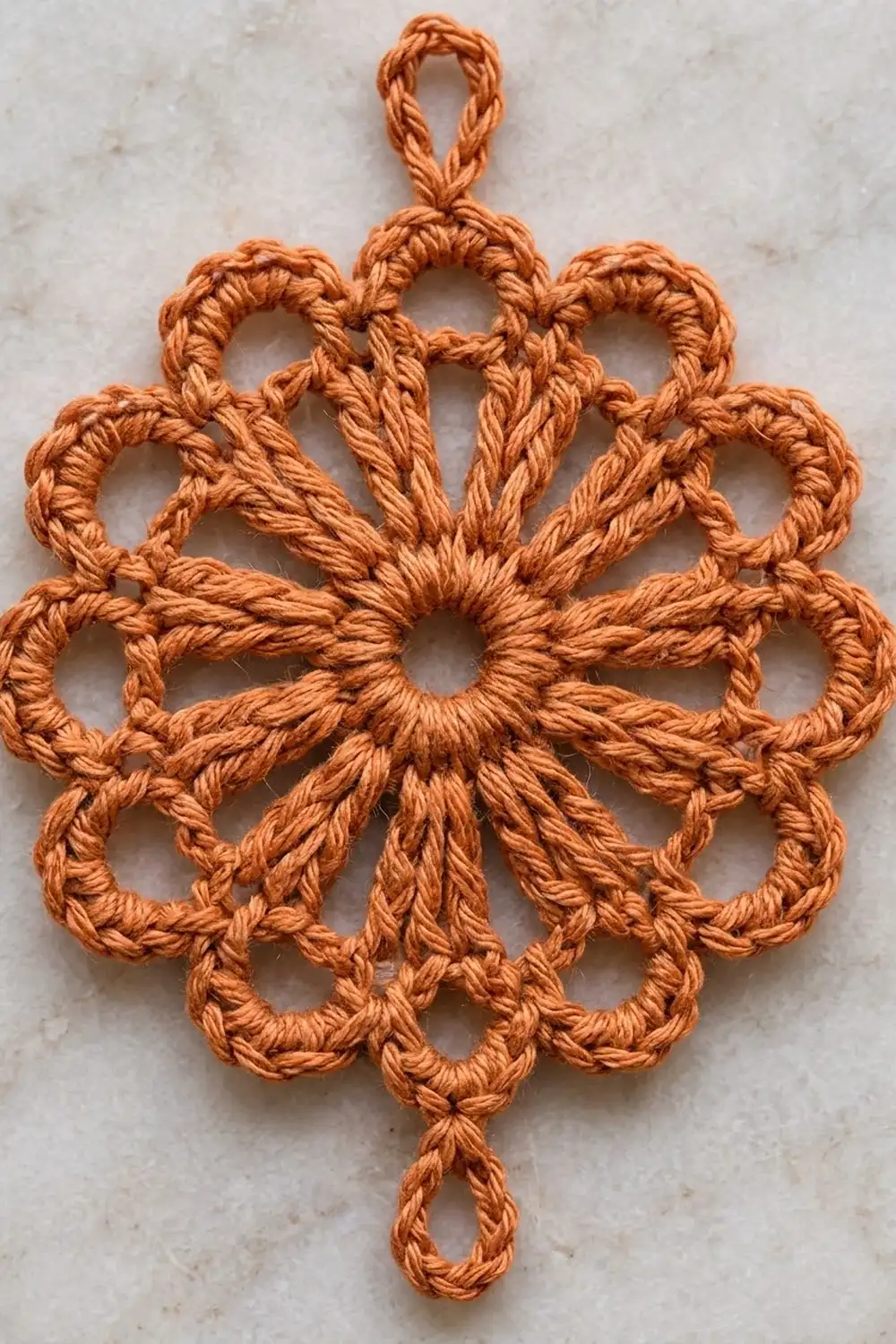
Motif Pattern
Make 28 motifs in terracotta and 28 in cream. All motifs are worked the same way, with the right side facing and without turning.
Foundation: Ch 6, sl st in the first ch to form a ring.
Round 1: Ch 3 (counts as dc), work 23 dc in the ring. Join with a sl st to the top of the beginning ch-3. (24 dc)
Pull the starting tail gently to close the ring a little, but leave an open center about 1/2 in (1.3 cm) wide.
Round 2 (spokes): Ch 4 (counts as tr), tr in next st, ch 2. Tr in each of next 2 sts, ch 2. Rep from * 10 more times. Join with a sl st to the top of the beginning ch-4. (24 tr in 12 pairs, 12 ch-2 sps)
Each pair of treble crochets forms one spoke, so you now have 12 spokes radiating from the center. Keep the trebles straight and the same height so the spokes look even.
Round 3 (loops): Sl st in next tr and into the first ch-2 sp. Ch 1, sc in the same sp, ch 6. Sc in next ch-2 sp, ch 6. Rep from * 10 more times. Join with a sl st to the first sc. (12 sc, 12 ch-6 loops; 84 sts total)
Each ch-6 loop arches over one spoke. The motif should now measure 3.25 in (8.3 cm) across. Go straight on to the border round below without fastening off.
Border: Scalloped Petal Round
The border is Round 4 of every motif. It covers each chain loop with single crochet to form the rounded petals.
Border gauge: 9 sc fill one ch-6 loop and form one petal about 1 in (2.5 cm) wide along the outer edge.
Round 4: Work 9 sc in next ch-6 loop, sl st in next sc. Rep from * 11 more times, working the last sl st into the joining sc. Fasten off and weave in the ends. (12 petals; 108 sc + 12 sl st = 120 sts)
How the count works for this conversion round:
– 12 sl sts are worked 1 into each existing sc.
– 72 sc are worked 1 per chain over the 72 chains.
– 36 extra sc are added, 3 per loop.
– That gives 12 + 72 + 36 = 120 sts.
Why the math works: A loop of 6 chains forms an arch, which is longer than a straight 6-stitch edge. Working 1.5 sc per chain (9 sc per 6 ch) fills that curve so the petal sits flat and round. Fewer stitches pull the petal tight and make the motif cup. More stitches make the petals ruffle. The border adds 3/8 in (1.0 cm) on each side, taking the motif from 3.25 in (8.3 cm) to 4 in (10.2 cm).
Mark the petals: Place a marker in the center sc (the 5th of 9) of any petal. This is the top petal. Count 6 petals around and mark the center sc of the 7th petal. This is the bottom petal. The two points sit exactly opposite each other, so the strand hangs straight.
Make All Pieces
- Terracotta (Color A): 28 motifs, 4 tassels
- Cream (Color B): 28 motifs, 4 tassels
Layout grid (T = terracotta strand, C = cream strand; each column is one strand, read top to bottom):
Strand:  1  2  3  4  5  6  7  8
Row 1:   T  C  T  C  T  C  T  C
Row 2:   T  C  T  C  T  C  T  C
Row 3:   T  C  T  C  T  C  T  C
Row 4:   T  C  T  C  T  C  T  C
Row 5:   T  C  T  C  T  C  T  C
Row 6:   T  C  T  C  T  C  T  C
Row 7:   T  C  T  C  T  C  T  C
Tassel:  T  C  T  C  T  C  T  C
Block all the motifs flat before joining (see Final Blocking), so every strand starts with motifs of the same size.
Joining
The motifs are joined one below the other with a beaded chain link. Always use the strand’s own color for the links.
Stitch-to-stitch logic: Every link runs from the center sc of the bottom petal of one motif to the center sc of the top petal of the next motif. Both points are the 5th of 9 sc, so the link is centered and each motif hangs upright.
Bead link (make 6 per strand):
- Cut a 20 in (50.8 cm) length of yarn and thread 1 bead onto it.
- Join the yarn with a sl st in the center sc of the bottom petal of the upper motif.
- Ch 3, slide the bead up to the hook, then ch 3 around the bead.
- Sl st in the center sc of the top petal of the next motif.
- Fasten off and weave the ends back into the petals.
Tension advice: Keep the chains firm and even. Loose chains let the bead slip and make the links different lengths. If you can, work all 6 links on a strand in one sitting so your tension stays the same.
Hanging loop (top motif only): Join yarn in the center sc of the top petal. Ch 24, then sl st in the same sc. Work 30 sc into the loop, then sl st into the starting sc. Fasten off. When folded over the rod, the covered loop drops about 2 in (5.1 cm).
Tassel link (bottom motif only): Thread 1 bead onto a 20 in (50.8 cm) length of yarn. Join in the center sc of the bottom petal and ch 3. Slide the bead up, ch 3, then fasten off, leaving an 8 in (20.3 cm) tail to attach the tassel.
Tassel (make 8):
1. Wrap yarn 40 times around the 4.5 in (11.4 cm) card.
2. Slide an 8 in (20.3 cm) strand under the wraps at the top and tie it tightly.
3. Cut the wraps at the bottom.
4. Wrap a separate strand tightly around the tassel 1/2 in (1.3 cm) below the top. Tie it and hide the ends inside.
5. Trim the tassel to 4 in (10.2 cm).
6. Pass the tassel link tail through the tied top of the tassel, knot it securely and bury the ends inside the tassel.
Size checkpoint: Each link measures 1.5 in (3.8 cm) from petal tip to petal tip. One strand of 7 motifs and 6 links measures 28 in + 9 in = 37 in (94.0 cm). Adding the 2 in (5.1 cm) loop drop, the 1.5 in (3.8 cm) tassel link and the 4 in (10.2 cm) tassel gives 44.5 in (113.0 cm).
Final Blocking
- Lay each finished strand flat on a blocking mat.
- Spray with water until damp, not soaked.
- Pin each motif to 4 in (10.2 cm) across, with a pin at the tip of every petal.
- Straighten each link so the beads sit centered between the motifs.
- Check that the strand measures 37 in (94.0 cm) from the top petal of the first motif to the bottom petal of the last.
- Comb the tassel straight with your fingers and trim any uneven ends.
- Let it dry completely, then unpin.
- Hang the strands on the rod 5 in (12.7 cm) apart, center to center, in the order shown in the layout grid.
Final Quality-Control Checklist
- Every motif has 24 dc, 24 tr, 12 loops and 12 petals of 9 sc.
- All motifs measure 4 in (10.2 cm) across.
- Top and bottom petals are exactly opposite each other.
- All links measure 1.5 in (3.8 cm) and each holds one locked bead.
- All 8 strands are the same length, 44.5 in (113.0 cm).
- Hanging loops are firmly secured and fit the rod.
- Tassels are 4 in (10.2 cm) long and tied tightly.
- All ends are woven in and can’t be seen from either side.
Troubleshooting
Motif cups like a bowl: The chains in Round 3 are too tight, or you worked fewer than 9 sc per loop. Loosen the chains or recount.
Petals ruffle: There are too many sc per loop, or the loops are very loose. Keep exactly 9 sc per loop and tighten the chains slightly.
Center hole closes completely: Don’t pull the starting tail too hard. Leave the center open about 1/2 in (1.3 cm).
Spokes lean or twist: Make sure each tr pair is worked into 2 neighboring dc, and that you have exactly 12 ch-2 spaces.
Strand twists when hung: The link was not worked into the center sc of opposite petals. Recount and re-attach it.
Bead slides around: Work the chain just after the bead tightly so it locks in place.
Strands are different lengths: Measure each link and re-block the strand. Re-work any link that is more than 1/4 in (0.6 cm) off.
Care
Spot clean, or hand wash in cool water with mild soap, keeping the wooden beads out of soaking water when possible. Lay flat to dry and re-block if needed.
Final Notes
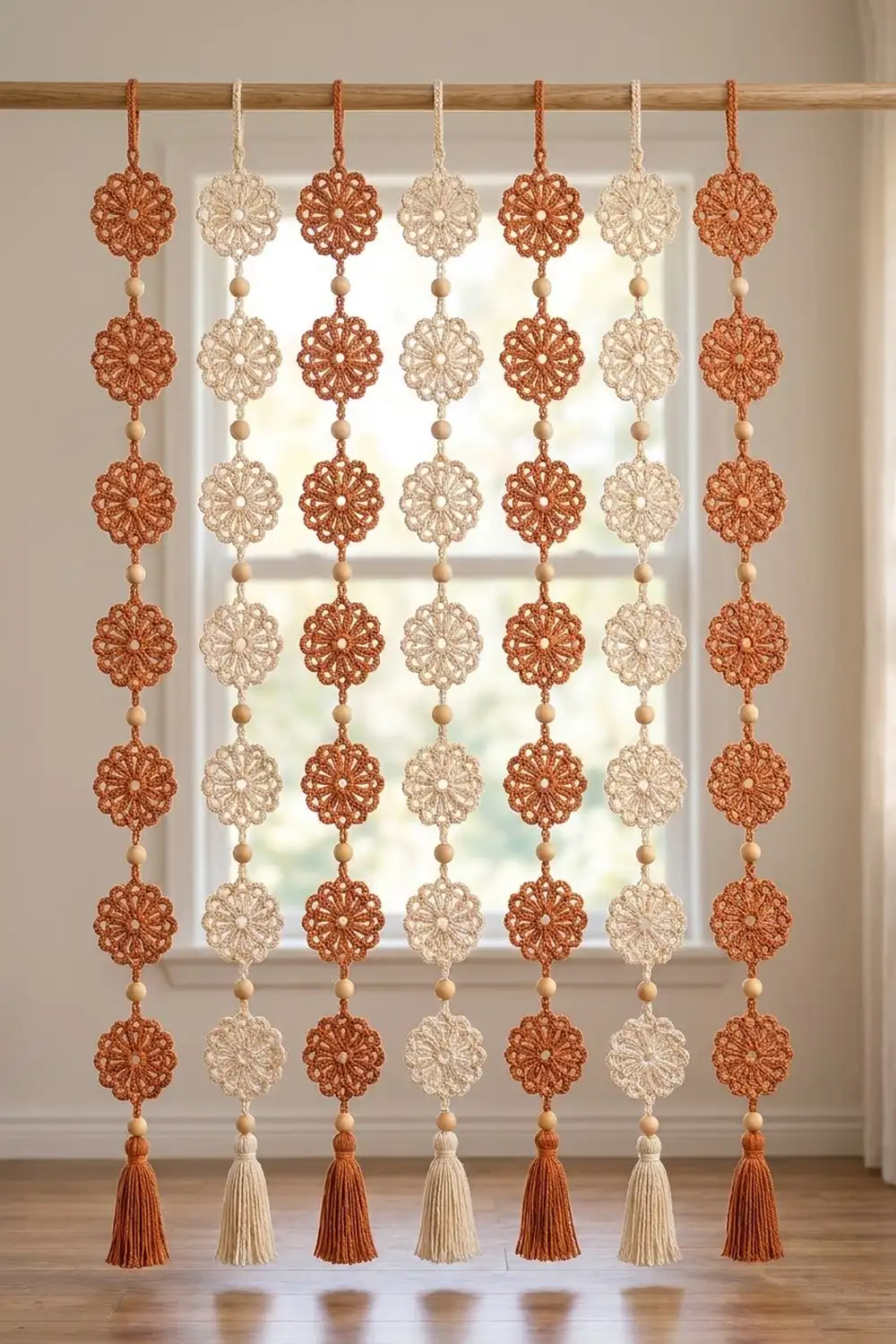
The measurement chain is simple. Round 1 is 1.25 in (3.2 cm), Round 2 is 2.75 in (7.0 cm) and Round 3 is 3.25 in (8.3 cm). The petal border then brings each motif to 4 in (10.2 cm). Seven motifs and six 1.5 in (3.8 cm) links make a 37 in (94.0 cm) strand. The loop, tassel link and tassel bring it to 44.5 in (113.0 cm). Eight strands spaced 5 in (12.7 cm) apart give a curtain 39 in (99.1 cm) wide. If your first motif matches, every strand will match too.
Happy crocheting!