

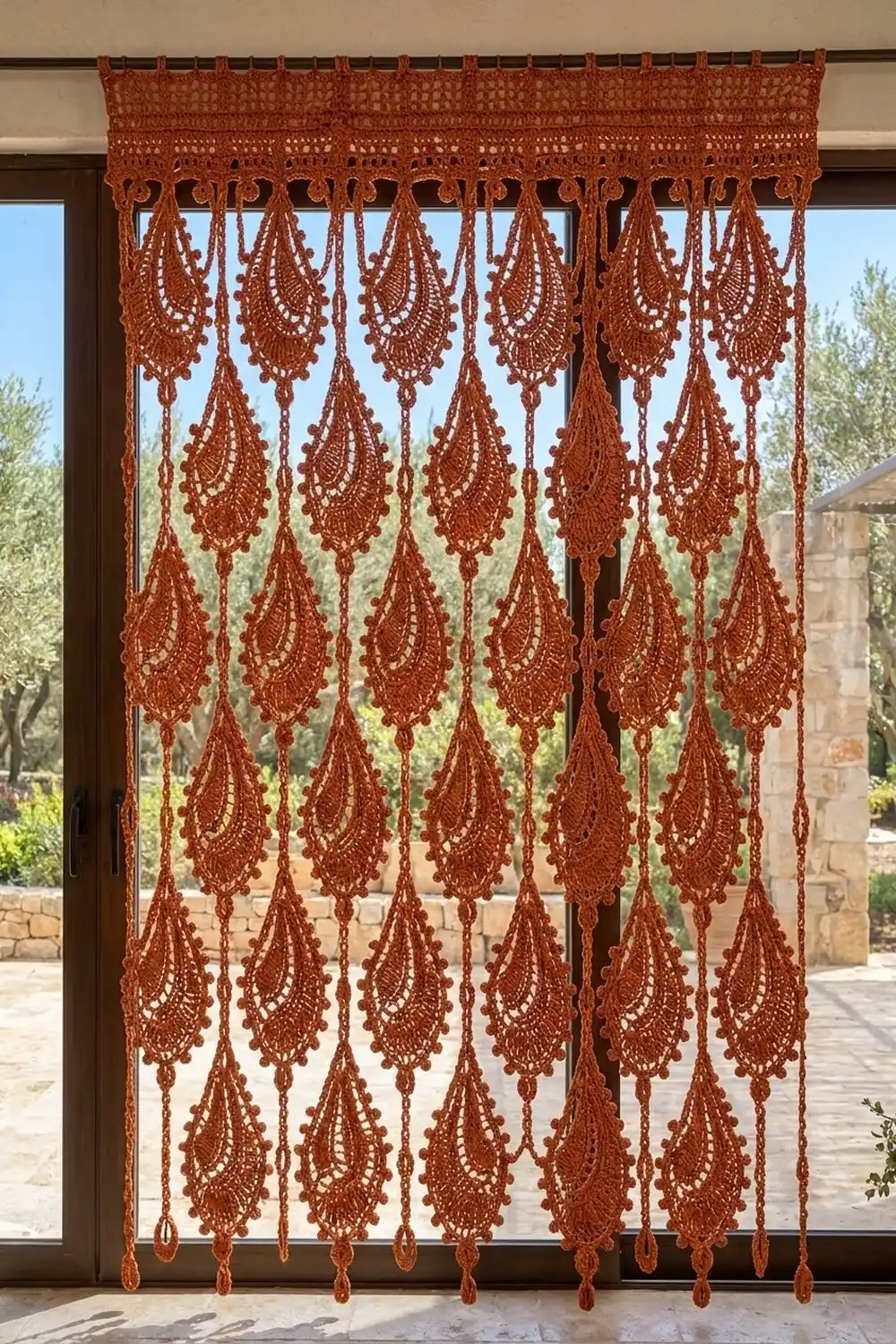
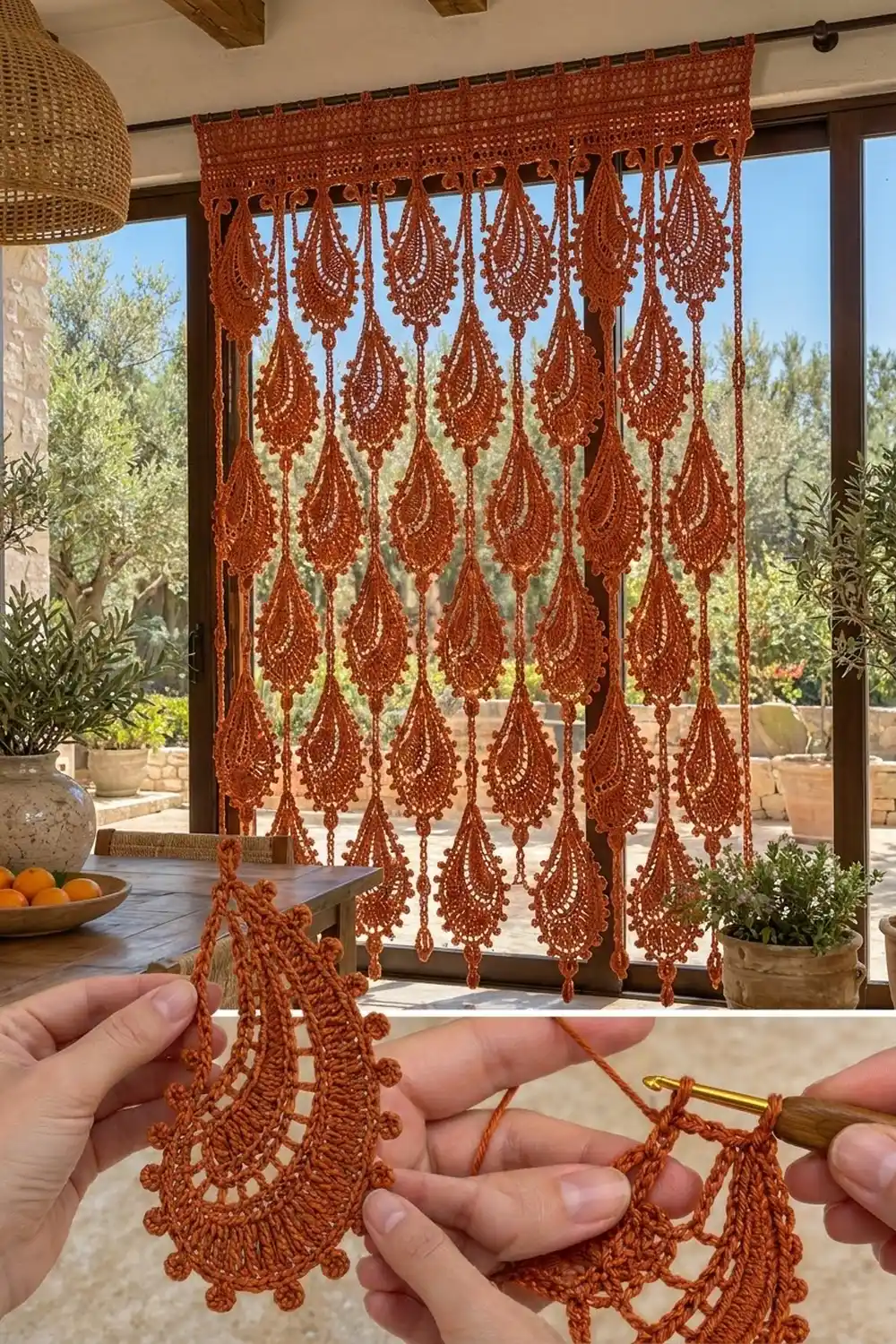
This curtain is a cascade of lacy paisley drops in one warm terracotta shade. Each paisley has a solid center teardrop, a ring of small eyelets, a band of tall stitches, a ring of open chain spaces and an edge of round bobble picots. The motifs hang in vertical strands from a gridded mesh header, and the light comes through every gap.
The style is Mediterranean boho. It suits a patio door, a kitchen window or a room divider. Every strand is set half a motif lower or higher than the one beside it, so the bobbles nest together instead of lining up in rows.
This pattern uses US crochet terms. The finished curtain is about 41.5 in (105.4 cm) wide. The shorter strands hang 59.5 in (151.1 cm) from the top of the header and the longer strands hang 63.5 in (161.3 cm).
You make 77 paisley motifs in 5 rounds each, worked around a foundation chain. Motifs are joined into 11 strands of 7 as you go, using short corded chains. Last, you crochet a mesh header band and hang each strand from its own section of the header.
Finished Size and Construction
- Finished size: 41.5 in (105.4 cm) wide × 59.5–63.5 in (151.1–161.3 cm) long
- Skill level: Intermediate
- Terminology: US
- Yarn weight: DK (light worsted, #3), mercerized cotton
- Hook: 3.5 mm (E-4)
- Number of pieces: 77 paisley motifs + 1 header band
- Layout: 11 strands × 7 motifs, staggered
- Piece size: 5.5 in (14.0 cm) tall × 4 in (10.2 cm) wide, after blocking
- Size before border: one strand is 53.5 in (135.9 cm) long without its top drop
- Border (header) depth: 4 in (10.2 cm)
Materials
Use a smooth mercerized cotton. It shows stitch detail clearly, keeps the bobbles round and hangs without stretching. Avoid acrylic: long strands of it can grow over time.
- Terracotta / rust: 550 g (about 1,155 m), based on roughly 210 m per 100 g
- Motifs: about 5 g (10.5 m) each, 385 g total
- Connectors and drops: about 15 g
- Header band: about 60 g
These quantities include a margin of about 20%. Buy all of the yarn from one dye lot.
Tools:
– 3.5 mm (E-4) crochet hook
– Tapestry needle
– Stitch markers
– Blocking mats, rust-proof pins and a spray bottle
– Curtain rod or tension rod, up to 0.75 in (1.9 cm) thick
– Measuring tape
Abbreviations (US Terms)
- ch – chain
- sl st – slip stitch
- sc – single crochet
- hdc – half double crochet
- dc – double crochet
- tr – treble crochet
- dc3tog – double crochet 3 together
- sk – skip
- sp(s) – space(s)
- st(s) – stitch(es)
- tch – turning chain
Special stitch: Bobble picot (bp). Ch 3, then work dc3tog in the 3rd ch from the hook. You get a small round knob that sits on the outer edge.
Gauge and Checkpoints
Header gauge: 18 sc and 4 sc rows = 4 in (10.2 cm) × 1 in (2.5 cm). One dc row = 0.5 in (1.3 cm).
Chain gauge: 9 ch = 2 in (5.1 cm).
Make one complete motif before anything else, then block it. Check these sizes along the way:
- After Round 1: 3.25 in × 1 in (8.3 cm × 2.5 cm)
- After Round 3: 4.5 in × 2.75 in (11.4 cm × 7.0 cm)
- After Round 5, blocked: 5.5 in × 4 in (14.0 cm × 10.2 cm)
If your motif is more than 0.25 in (0.6 cm) too big, change to a 3.25 mm hook. If it is too small, change to a 3.75 mm hook. Make the header with the same hook as the motifs, and check its gauge on the first 2 rows.
Paisley Motif (make 77)
Every round starts at the tip and goes down Side A (the inner curve, with short stitches), around the bottom and back up Side B (the outer curve, with tall stitches). Because Side B is taller, the teardrop leans over into a paisley curl.
Foundation: Ch 14.
Round 1 (center teardrop): Sc in 2nd ch from hook, hdc in next 2 ch, dc in next 9 ch, 7 dc in last ch. Turn the work and continue along the opposite side of the foundation: dc in next 9 ch, hdc in next 2 ch, sc in next ch (the same ch as the first sc). Ch 3 for the tip space and sl st in the first sc.
Count: 31 sts (Side A 12, bottom 7, Side B 12) + tip ch-3 sp.
Round 2 (eyelets): Ch 2 (does not count).
– Side A: [hdc in next st, ch 1, sk next st] 6 times.
– Bottom: [dc in next st, ch 1] 7 times.
– Side B: [tr in next st, ch 1, sk next st] 4 times, dc in next st, ch 1, sk next st, hdc in next st, sk last st.
– Ch 4 for the tip space and sl st in the first hdc.
Count: 19 sts + 18 ch-1 sps (Side A 6 + 6, bottom 7 + 7, Side B 6 + 5) + tip ch-4 sp.
Round 3 (tall band): Ch 2 (does not count).
– Side A: hdc in each st and each ch-1 sp, 12 hdc in all.
– Bottom: 2 dc in each dc and dc in each ch-1 sp, giving 7 × 2 + 7 = 21 dc.
– Side B: [tr in next st, tr in next sp] 4 times, dc in next st, dc in next sp, hdc in last st, 11 sts in all.
– Ch 4 for the tip space and sl st in the first hdc.
Count: 44 sts (12 + 21 + 11) + tip ch-4 sp.
Round 4 (open spaces): Ch 1 (does not count).
– Side A: [sc in next st, ch 2, sk next st] 6 times.
– Bottom: [dc in next st, ch 2, sk next st] 10 times, dc in next st, ch 2.
– Side B: [tr in next st, ch 2, sk next st] 4 times, dc in next st, ch 2, sk next st, hdc in last st.
– Ch 4 for the tip space and sl st in the first sc.
Count: 23 sts + 22 ch-2 sps (Side A 6 + 6, bottom 11 + 11, Side B 6 + 5) + tip ch-4 sp.
Round 5 (bobble edge): Ch 1 (does not count). Work around the whole motif: sc in each st, and (sc, bp, sc) in each ch-2 sp. In the tip ch-4 sp work (2 sc, ch 3, 2 sc). Sl st in the first sc and fasten off.
Count: 23 sc on top of sts + 44 sc in spaces + 4 sc at tip = 71 sc, plus 22 bp and 1 tip ch-3 loop.
Center bottom bobble: This is the bp in the 6th of the 11 bottom ch-2 sps. It is the point where the next motif hangs. Mark it on each finished motif.
Make All Pieces
- Terracotta: 77 motifs
- First make 11 complete motifs with plain tip loops. These go at the top of the strands.
- Make the other 66 motifs with the join in Round 5 (see Joining), 6 below each top motif.
Layout grid (H = header, M = motif, | = drop chain; odd strands sit high and even strands sit low):
Strand: 1  2  3  4  5  6  7  8  9  10 11
        H  H  H  H  H  H  H  H  H  H  H
        |  |  |  |  |  |  |  |  |  |  |
        M  |  M  |  M  |  M  |  M  |  M
        |  M  |  M  |  M  |  M  |  M  |
        M  |  M  |  M  |  M  |  M  |  M
        |  M  |  M  |  M  |  M  |  M  |
       ... 7 motifs in every strand ...
        M  |  M  |  M  |  M  |  M  |  M
           M     M     M     M     M
Joining
Each strand is joined from the top down, as you go. The connector is a corded chain: chain out, slip stitch into the motif above, then slip stitch back down the chain. This doubles the chain into a firm cord that will not twist or stretch.
Join in Round 5 (motifs 2–7 of every strand): Work Round 5 as written until you reach the tip ch-4 sp. Work 2 sc in it, then ch 11. Sl st in the marked center bottom bp of the motif above, then sl st in each of the 11 ch back down. Work 2 sc in the same tip sp, sl st in the first sc and fasten off.
Stitch logic: one connector joins one tip to one bottom bobble. Nothing is added to the motif counts. The 11-ch cord replaces the 3-ch tip loop.
Tension: Work the slip stitches back down at the same tension as the chains. If you pull them tight, the cord gets shorter and the strands end up uneven.
Checkpoint: Lay each finished strand flat and measure it. Seven motifs of 5.5 in plus six connectors of 2.5 in (6.4 cm) come to 53.5 in (135.9 cm). Every strand should be within 0.5 in (1.3 cm) of the others.
Border: Mesh Header Band
Border gauge: 18 sc = 4 in (10.2 cm). Each strand gets 17 sts of the header, which is about 3.8 in (9.7 cm).
Starting count: 11 strands × 17 sts = 187 sts. No extra stitches are added between strands. The width is 187 ÷ 4.5 sc per in, about 41.5 in (105.4 cm). That is just under 11 motifs edge to edge, so the staggered strands nest without crowding.
Row 1: Ch 188, sc in 2nd ch from hook and in each ch across, turn. (187 sc)
Row 2: Ch 1, sc in each st across, turn. (187 sc)
Row 3 (mesh): Ch 4 (counts as dc + ch 1), sk next st, [dc in next st, ch 1, sk next st] across to the last st, dc in last st, turn. (94 dc + 93 ch-1 sps = 187)
Row 4 (solid): Ch 3 (counts as dc), dc in each ch-1 sp and each dc across, ending with dc in 3rd ch of tch, turn. (187 dc)
Rows 5–6: Repeat Rows 3–4.
Row 7: Repeat Row 3.
Row 8 (rod channel mesh): Ch 4 (counts as dc + ch 1), sk ch-1 sp, [dc in next dc, ch 1, sk ch-1 sp] across, dc in 3rd ch of tch, turn. (94 dc + 93 ch-1 sps = 187)
Row 9: Ch 1, sc in each dc and each ch-1 sp across, turn. (187 sc)
Row 10: Ch 1, sc in each st across. Do not fasten off.
Edging Round: Ch 1. Turn so you are working down the short edge and work 1 sc in each sc row end and 2 sc in each dc row end, so 4 + (6 × 2) = 16 sc. Sl st along the foundation edge. Work 16 sc up the other short edge in the same way and fasten off.
Why the math works: 4 sc rows at 0.25 in + 6 dc rows at 0.5 in = 4 in (10.2 cm). The 16 edge sc lie flat because they follow the actual row heights.
Attach the strands: Count along the foundation edge. Strand 1 hangs from st 9, the center of the first 17-st section. Each strand after that hangs 17 sts further along: sts 9, 26, 43, 60, 77, 94, 111, 128, 145, 162 and 179. That leaves 8 sts, about 1.8 in (4.6 cm), at each end.
For each strand, join yarn at its attachment st and make a drop. For odd strands, ch 9, which is 2 in (5.1 cm). For even strands, ch 27, which is 6 in (15.2 cm). Sl st in the tip ch-3 loop of the top motif, sl st back up every ch and fasten off. The 4 in (10.2 cm) difference between the drops is half of one motif-plus-connector repeat (5.5 + 2.5 = 8 in, 20.3 cm), so the stagger comes out exactly half a step.
Final Blocking
- Weave in all ends inside the solid rounds. Leave 1 in (2.5 cm) tails and trim them after blocking.
- Soak the whole curtain in cool water for 15 minutes, then press the water out in a towel. Do not wring it.
- Pin the header flat to 41.5 in × 4 in (105.4 cm × 10.2 cm), with the mesh squared.
- Lay the strands out straight and pin every motif to 5.5 in × 4 in (14.0 cm × 10.2 cm). Put a pin in each bobble to round it.
- Straighten each connector to 2.5 in (6.4 cm).
- Let it dry completely, which takes 24 hours. Starch the header lightly if you want a crisper top edge.
Final Quality-Control Checklist
- All 77 motifs are the same size, within 0.25 in (0.6 cm)
- Every motif has 22 bobble picots, all pointing outward
- All motifs curl the same way, with Side B on the same side
- Connectors are firm, untwisted and 2.5 in (6.4 cm) long
- The header has 187 sts and is 41.5 in (105.4 cm) wide
- Strands hang from sts 9, 26, 43 and so on, 17 sts apart
- Odd strands end at 59.5 in (151.1 cm) and even strands at 63.5 in (161.3 cm)
- All ends are secure and trimmed
Troubleshooting
- The motif cups: Your bottom stitches are too tight. Loosen up in Rounds 3–4, or go up a hook size.
- The motif ruffles: Check that you skip a stitch between the ch-2 spaces in Round 4.
- There is no curl: Side B needs the tr stitches. Hdc there makes a plain teardrop.
- The bobbles are flat: Pull the dc3tog closed firmly and pin each bobble while blocking.
- The strands are uneven: Count the connector chains and redo any slip stitches that were worked tight.
- The header flares: Recount to 187 sts and check that the mesh rows skip exactly 1 st.
Care
Hand wash in cool water with a mild soap, then press flat in a towel and pin to dry. Do not hang it wet, because the weight of the strands will stretch the connectors.
Final Notes
Everything depends on the measurement chain. A 5.5 in × 4 in (14.0 cm × 10.2 cm) motif and a 2.5 in (6.4 cm) connector make a 53.5 in (135.9 cm) strand. The header carries 11 strands × 17 sts = 187 sts, 41.5 in (105.4 cm) wide and 4 in (10.2 cm) deep. With 2 in (5.1 cm) and 6 in (15.2 cm) drops, the curtain is 59.5–63.5 in (151.1–161.3 cm) long. Check your test motif first and the rest follows.
Happy crocheting!