

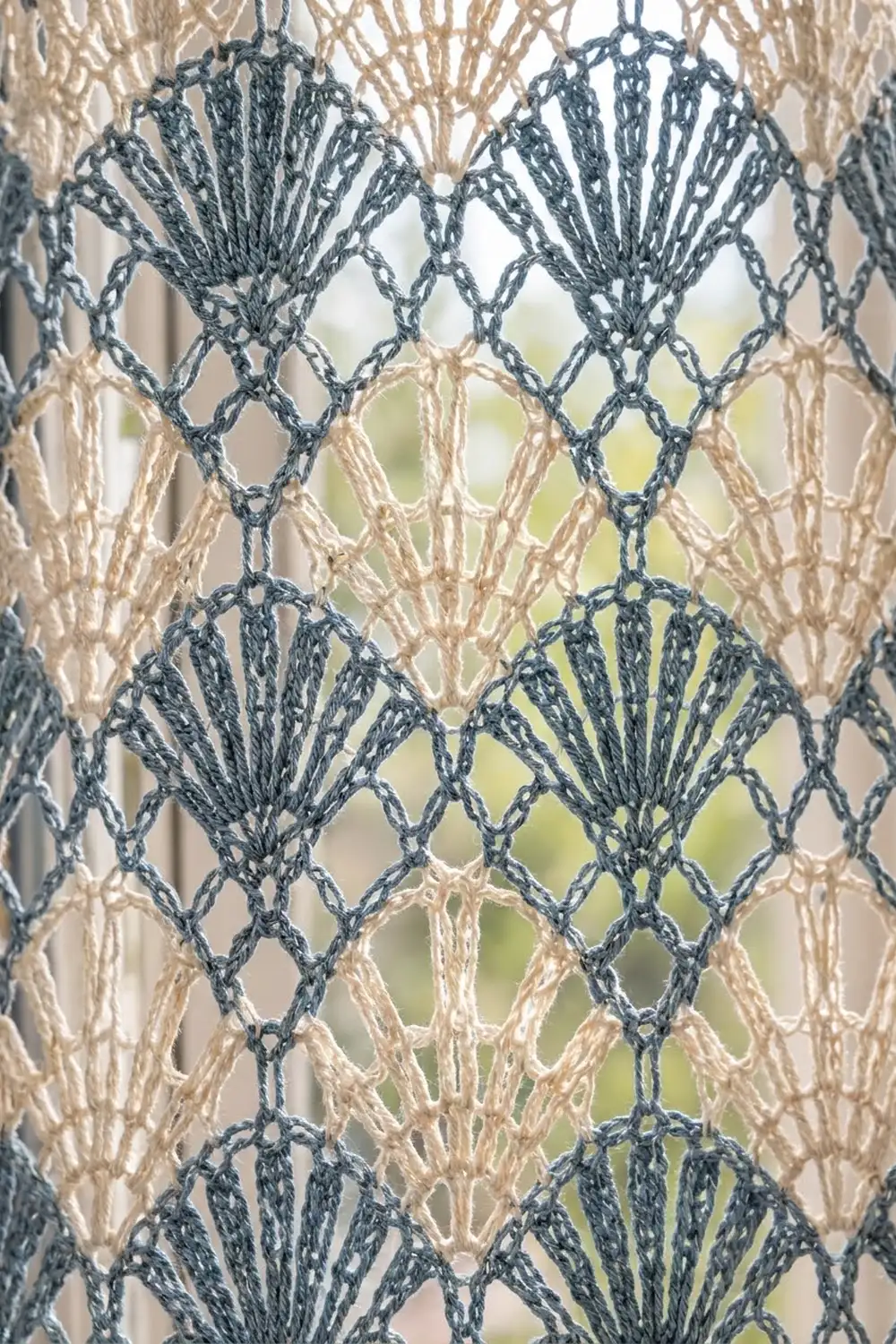
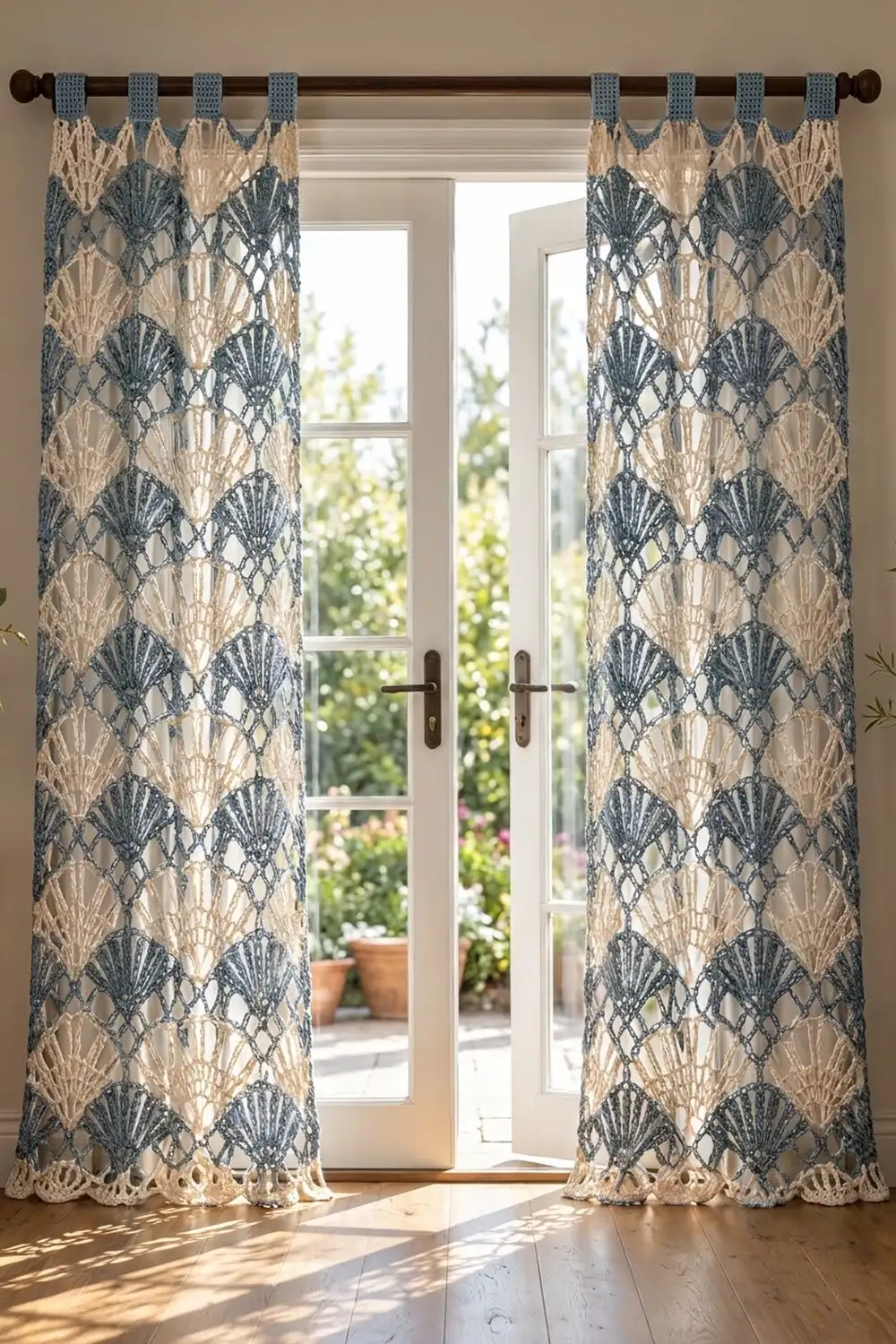
The Tidewater Fan Lace Curtain Panel is a light, airy tab-top curtain made of rows of open fan shells. Dusty blue and cream fan bands alternate in a brick pattern, so each fan nests between two fans of the opposite color. The fans sit in a net of chain loops, which lets daylight through and gives a relaxed, coastal look.
The panel is written in US crochet terms. Each finished panel measures 36.5 in (92.7 cm) wide and 77.75 in (197.5 cm) long from the scalloped hem to the top of the header. The tab loops add another 3 in (7.6 cm), for a hanging length of 80.75 in (205.1 cm).
Each panel is worked from the bottom up in one piece. You start with a net row, then repeat a 4-row fan pattern, and then add a solid header and seven tabs. A scalloped trim goes along the foundation edge, and a single-crochet border straightens both long sides. Make two panels for a standard pair.
The pattern is a 2-row fan band repeated many times, so once your gauge is right the rest is rhythm and counting.
Finished Size and Construction
- Finished size (one panel): 36.5 in x 77.75 in (92.7 cm x 197.5 cm), plus 3 in (7.6 cm) tab loops
- Skill level: Intermediate
- Terminology: US crochet terms
- Yarn weight: Worsted (#4) cotton or cotton blend
- Hook: 5.0 mm (H-8)
- Number of pieces: 2 identical panels, each worked as one piece; the panels are not joined
- Layout: Panels hung side by side on one rod
- Pattern repeat size: 3 in (7.6 cm) wide x 2.5 in (6.4 cm) tall per fan band
- Size before border: 36 in x 75.5 in (91.4 cm x 191.8 cm)
- Border depth: scalloped hem 1 in (2.5 cm); header 1.25 in (3.2 cm); side borders 0.25 in (0.6 cm) each
Materials
Choose a smooth cotton or cotton-linen blend in worsted weight. Cotton holds the fan shapes crisply and doesn’t stretch much while hanging. Avoid fuzzy yarns, because they blur the lace.
For one panel:
– Dusty blue: 500 g, approx. 850 m
– Cream: 450 g, approx. 765 m
For a pair of panels:
– Dusty blue: 1000 g, approx. 1700 m
– Cream: 900 g, approx. 1530 m
These amounts assume a yarn of about 170 m per 100 g, and they include a margin of roughly 10 percent for swatching and weaving in ends.
Tools:
– 5.0 mm (H-8) crochet hook
– 5.5 mm (I-9) hook for the foundation chain (optional)
– Tapestry needle
– Stitch markers
– Rust-proof blocking pins and foam mats or a large flat surface
– Measuring tape
Abbreviations (US Terms)
- ch – chain
- sc – single crochet
- dc – double crochet
- tr – treble crochet
- sk – skip
- sp(s) – space(s)
- st(s) – stitch(es)
Special stitches:
– Fan: (tr, ch 1) 6 times, tr, all in the same st. That makes 7 tr and 6 ch-1 sps. The center of the fan is the 4th tr.
– Half fan: (tr, ch 1) 3 times, tr, in the same st, which makes 4 tr. When a half fan starts a row, the beginning ch 4 counts as the first tr.
Gauge and Checkpoints
Gauge (blocked): 1 pattern repeat (2 net loops, or 1 fan) = 3 in (7.6 cm) wide. One fan band (a fan row plus a net row) = 2.5 in (6.4 cm) tall.
Test swatch: Ch 26 and work Rows 1–5 below over 3 repeats. Use the counts in square brackets, which are the swatch counts. Block the swatch. It should measure 9 in (22.9 cm) wide and 5.5 in (14.0 cm) tall.
- Swatch too big: go down to a 4.5 mm hook, or shorten your treble trebles by pulling the loops snug.
- Swatch too small: go up to a 5.5 mm hook, and keep the ch-5 loops relaxed.
Checkpoints on the panel:
– After Row 1: 36 in (91.4 cm) wide, measured gently stretched
– After Row 21 (10 bands): 25.5 in (64.8 cm) tall
– After Row 41 (20 bands): 50.5 in (128.3 cm) tall
– After Row 61 (30 bands): 75.5 in (191.8 cm) tall
Measure flat and lightly pinned, not hanging. Lace that hangs under its own weight reads longer.
Panel Body
Color sequence: Row 1 is cream. After that, work 2 rows in blue and 2 rows in cream, and keep alternating. Because every color stripe is 2 rows, you can carry the unused yarn loosely up the side edge. The side border covers it later.
Foundation: With cream, ch 98 [26]. Use the larger hook if your chains tend to be tight.
Row 1 (net): Sc in the 2nd ch from the hook. Ch 5, sk 3 ch, sc in the next ch. Repeat from * 24 [6] times. Turn.
Count: 25 [7] sc and 24 [6] ch-5 loops.
Row 2 (fan row, blue): Ch 4 (counts as tr), ch 2, sk the next loop, fan in the next sc, ch 2, sk the next loop. Sc in the next sc, ch 2, sk the next loop, fan in the next sc, ch 2, sk the next loop. Repeat from * 11 [2] times. Tr in the last sc. Turn.
Count: 12 [3] fans, 11 [2] sc, and 2 edge tr.
Row 3 (net, blue): Ch 3 (counts as dc). Ch 5, sc in the center tr of the next fan, ch 5, sc in the next sc. Repeat from * 11 [2] times. Ch 5, sc in the center tr of the last fan, ch 5, dc in the top of the turning ch-4. Turn.
Count: 24 [6] ch-5 loops, 23 [5] sc, and 2 edge dc.
Row 4 (offset fan row, cream): Ch 4 (counts as tr), then (ch 1, tr) 3 times in the first dc to make a half fan. Ch 2, sk the next loop, sc in the next sc, ch 2, sk the next loop. Fan in the next sc, ch 2, sk the next loop, sc in the next sc, ch 2, sk the next loop. Repeat from * 11 [2] times. Work a half fan in the top of the turning ch-3. Turn.
Count: 11 [2] full fans, 2 half fans, and 12 [3] sc.
These fans sit on the sc that lie above the centers of the Row 2 fans. That shifts this band half a repeat and creates the brick layout.
Row 5 (net, cream): Ch 3 (counts as dc), ch 5, sc in the next sc. Ch 5, sc in the center tr of the next fan, ch 5, sc in the next sc. Repeat from * 11 [2] times. Ch 5, dc in the top of the turning ch-4. Turn.
Count: 24 [6] ch-5 loops, 23 [5] sc, and 2 edge dc.
At this point your swatch is finished.
Rows 6–61: Repeat Rows 2–5 another 14 times. Row 61 is a cream net row. You now have 30 fan bands, and the body measures 75.5 in (191.8 cm).
Header and Tabs
Row 62 (conversion row, blue): Ch 1. Sc in the first dc, then 5 sc in the next loop, sc in the next sc. Repeat from * across, working the last sc in the top of the turning ch-3. Turn.
Count: 25 sc worked 1-per-existing-stitch + 120 sc worked into the loops = 145 sc.
Rows 63–66: Ch 1, sc in each st across. Turn. Count: 145 sc.
The header is 5 rows deep and measures 1.25 in (3.2 cm). Fasten off.
Tabs (make 7): With the right side facing, join blue in stitches 1, 24, 47, 70, 93, 116, and 139 of Row 66. Each tab is 7 sc wide, and the gaps between tabs are 16 sts. That gives 7 x 7 + 6 x 16 = 145.
For each tab, work Row 1: ch 1, sc in the joining st and in the next 6 sts. Turn. Count: 7 sc. Repeat Row 1 until the tab has 29 rows, about 7.25 in (18.4 cm). Fasten off and leave a long tail.
Fold each tab to the back and sew its end flat across the back of Rows 62–66. The overlap is 1.25 in (3.2 cm), which leaves a loop about 3 in (7.6 cm) tall above the header.
Border
Border gauge: 4 sc = 1 in (2.5 cm) along the edges, which matches the header.
Scalloped hem (bottom edge, cream)
With the right side facing, join cream at the first foundation ch.
Row B1 (conversion row): Ch 1. Sc in the base of the first Row 1 sc. Sc in each of the 3 skipped foundation ch, sc in the base of the next Row 1 sc. Repeat from * across. Turn.
Count: 25 sc worked 1-per-existing-stitch + 72 sc worked into the skipped ch = 97 sc.
Row B2 (scallops): Ch 1, sc in the first sc. Sk 3 sc, 9 dc in the next sc, sk 3 sc, sc in the next sc. Repeat from * across. Fasten off.
Count: 12 scallops of 9 dc each, and 13 sc.
Why the math works: Each scallop uses 8 stitches, and 12 x 8 + 1 = 97. Every scallop is centered under a Row 2 fan, so each scallop repeat is the same 3 in (7.6 cm) as the fan repeat. The hem adds 1 in (2.5 cm).
Side borders (both long edges, blue)
With the right side facing, join blue at the end of Row 1 and work up the side. Work 1 sc in the end of Row 1. Then, for each fan row, work 6 sc around the edge tr post, and for each net row, work 4 sc around the edge dc post. Finish with 1 sc in the end of each header row. Fasten off, then work the other long edge the same way.
Count per side: 1 + (30 bands x 10 sc) + 5 = 306 sc.
Why the math works: Those 306 sc cover 0.5 in + 75 in + 1.25 in = 76.75 in (194.9 cm), which is 3.99 sc per inch. That matches the 4 sc per inch border gauge, so the edge neither ruffles nor pulls in. The border also hides the carried yarn and adds 0.25 in (0.6 cm) per side. That brings the width to 36.5 in (92.7 cm).
Finished panel: 36.5 in x 77.75 in (92.7 cm x 197.5 cm), plus 3 in (7.6 cm) tabs.
Make All Pieces
Make 2 identical panels:
– Blue per panel: 15 fan bands, the header, 7 tabs, and 2 side borders
– Cream per panel: Row 1, 15 fan bands, and the scalloped hem
Layout (as hung):
[ Panel A ]  [ Panel B ]
 7 tabs        7 tabs
 36.5 in       36.5 in
The panels are hung separately and are never joined. Finish Panel A completely, then match Panel B to it row for row.
Final Blocking
- Weave in all ends along the side borders or through solid stitches.
- Soak the panel in cool water with a little wool wash for 15 minutes. Press the water out gently, without wringing.
- Roll the panel in towels to remove extra water.
- Lay it flat on mats and pin the long sides straight at 36.5 in (92.7 cm) wide.
- Pin the length to 77.75 in (197.5 cm), not counting the tabs.
- Pin the tip of each scallop, then open each fan into an even semicircle.
- Let the panel dry completely before you unpin it.
- Block the second panel to the same pin lines.
Final Quality-Control Checklist
- Each fan row has the right count: 12 full fans on Row 2 rows, or 11 full fans plus 2 half fans on Row 4 rows
- Each net row has 24 loops
- The fans alternate blue and cream and sit in a brick pattern
- The header has 145 sc and the hem has 12 scallops
- Each side border has 306 sc and lies flat
- All 7 tabs are evenly spaced and the same length
- Both panels match within 0.5 in (1.3 cm)
Troubleshooting
- Fans cup or ruffle: Your tr are too loose or the ch-1 sps are too long. Go down a hook size for the fan rows.
- The panel narrows as you go: The ch-5 loops are too tight. Relax them, or work them with the larger hook.
- The brick pattern lines up in columns instead: You worked the fans into the wrong set of sc. On Row 2 rows, the fans go above the sc that sit between the fans of the band below.
- Side edges wave: Recheck the 6 and 4 sc counts per row end, then re-block.
- Tabs twist: Sew them down flat and keep each tab’s end square with the header.
Care
Hand wash or machine wash on a gentle cool cycle inside a mesh bag. Reshape and dry flat, because hanging lace to dry stretches it.
Final Notes
Everything starts with gauge: one 3 in (7.6 cm) repeat and one 2.5 in (6.4 cm) band. Twelve repeats give the 36 in (91.4 cm) width, and thirty bands plus Row 1 give the 75.5 in (191.8 cm) body. The 1 in (2.5 cm) hem and the 1.25 in (3.2 cm) header bring each panel to 77.75 in (197.5 cm), and the side borders bring it to 36.5 in (92.7 cm) wide. The tabs add 3 in (7.6 cm) for hanging. If you check your counts at every checkpoint, both panels will match.
Happy crocheting!