

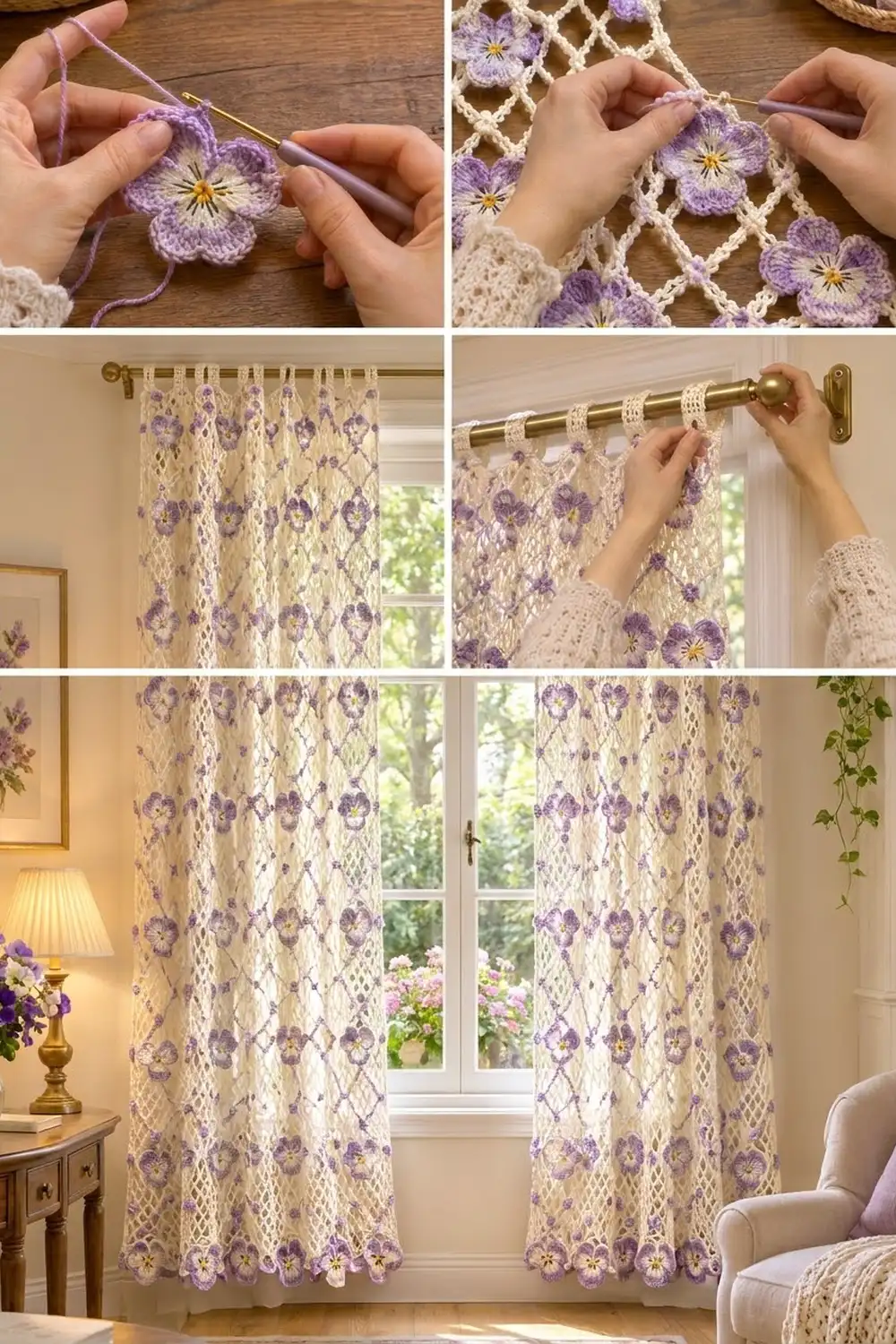
This curtain panel combines soft cream net mesh with a cottage-garden look. Lavender diagonal lines cross the mesh to make large diamonds. Tiny lavender flower knots sit where the lines meet, and pansies with yellow centers fill the diamonds. A row of pansies along the bottom makes a scalloped hem.
The colors are cream, lavender, yellow and a little deep violet for the pansy veins. The mesh is light, so daylight still comes through. All instructions use US crochet terms.
One finished panel is 32 in (81.3 cm) wide and 79 in (200.7 cm) long, measured from the top of the tab loops to the tips of the hem pansies. Without the tabs, the panel body is 76 in (193.0 cm) long. The photo shows a pair, so make two identical panels.
How it’s made: you crochet one mesh panel in rows. Then you add a solid top band with tabs, a narrow bottom band and side edging. The pansies and flower knots are made separately and sewn on. The lavender lattice lines are added last with surface chain.
Finished Size and Construction
- Finished size (one panel): 32 in (81.3 cm) × 79 in (200.7 cm), including 3 in (7.6 cm) tab loops
- Skill level: Intermediate
- Terminology: US terms
- Yarn weight: DK cotton (weight 3)
- Hook: 4.0 mm (G-6)
- Pieces per panel: 1 mesh panel, 26 pansies, 60 flower knots
- Layout: 18 pansies staggered in the diamond centers, plus a hem row of 8
- Pansy size: 4 in (10.2 cm) across
- Mesh size before bands: 32 in (81.3 cm) × 71.5 in (181.6 cm)
- Band depths: top band 1.5 in (3.8 cm), bottom band 0.5 in (1.3 cm), side edging 1 row of sc
Materials
Use a smooth mercerized or combed DK cotton, about 120 m per 50 g. Cotton keeps the mesh open and hangs straight. These amounts are for one panel, so double them for a pair.
- Cream: 900 g (2,160 m): mesh, bands, tabs, pansy centers
- Lavender: 150 g (360 m): pansy edges, knots, lattice lines, bottom band
- Yellow: 25 g (60 m): pansy centers
- Deep violet: 10 g (24 m): pansy veins
Tools:
- 4.0 mm (G-6) hook
- Tapestry needle
- Locking stitch markers and rustproof pins
- Measuring tape
- Blocking mats (or a sheeted carpet) and a spray bottle
All amounts include a margin of about 15 percent for swatches and sewing tails.
Abbreviations (US Terms)
- ch: chain
- sl st: slip stitch
- sc: single crochet
- hdc: half double crochet
- dc: double crochet
- tr: treble crochet
- sk: skip
- sp: space
- rep: repeat
- 2-dc cl (2-dc cluster): (yarn over, insert hook in the ring, pull up a loop, yarn over, pull through 2 loops) twice, then yarn over and pull through all 3 loops.
- Surface chain: hold the yarn behind the work. Insert the hook from front to back through a mesh opening, pull up a loop and draw it through the loop on your hook.
Gauge and Checkpoints
- Sc gauge: 16 sc and 16 rows = 4 in (10.2 cm)
- Mesh gauge: 4 ch-5 loops = 4 in (10.2 cm) wide, and 8 mesh rows = 4 in (10.2 cm) tall, lightly blocked
Make one pansy first. It’s the quickest way to test your tension.
- After Pansy Rnd 2: about 1.5 in (3.8 cm) across
- After Pansy Rnd 4: 4 in (10.2 cm) across
Next, make a mesh swatch: ch 18 (4 loops), work 9 rows and block it. It should measure 4 in (10.2 cm) wide.
Panel checkpoints:
- Mesh Row 1: 32 in (81.3 cm) wide, relaxed
- After 23 rows: 11.5 in (29.2 cm) tall
- After Row 143: 71.5 in (181.6 cm) tall, blocked
If your pieces come out too big, use a hook 0.5 mm smaller. If they’re too small, use one 0.5 mm larger. For the mesh only, you can also change the ch-5 loops to ch-4 or ch-6. Use the same number in every row.
Part A: Mesh Panel (Cream)
Ch 130.
Row 1: Sc in 2nd ch from hook, *ch 5, sk 3 ch, sc in next ch; rep from * across. Turn. (33 sc, 32 ch-5 loops)
Row 2: Ch 5 (counts as dc + ch 2), sc in first ch-5 loop, *ch 5, sc in next ch-5 loop; rep from * across, ch 2, dc in last sc. Turn. (32 sc, 31 ch-5 loops, 2 half loops)
Row 3: Ch 1, sc in first dc, *ch 5, sc in next ch-5 loop; rep from * to turning ch, ch 5, sc in 3rd ch of turning ch. Turn. (33 sc, 32 ch-5 loops)
Rows 4–143: Rep Rows 2–3 seventy times. Row 143 is worked like Row 3 (33 sc, 32 loops). Don’t fasten off.
The sc points stack up in 45-degree diagonals. Each row moves half a loop sideways: 0.5 in (1.3 cm) over and 0.5 in (1.3 cm) up. The lattice lines will follow these diagonals later.
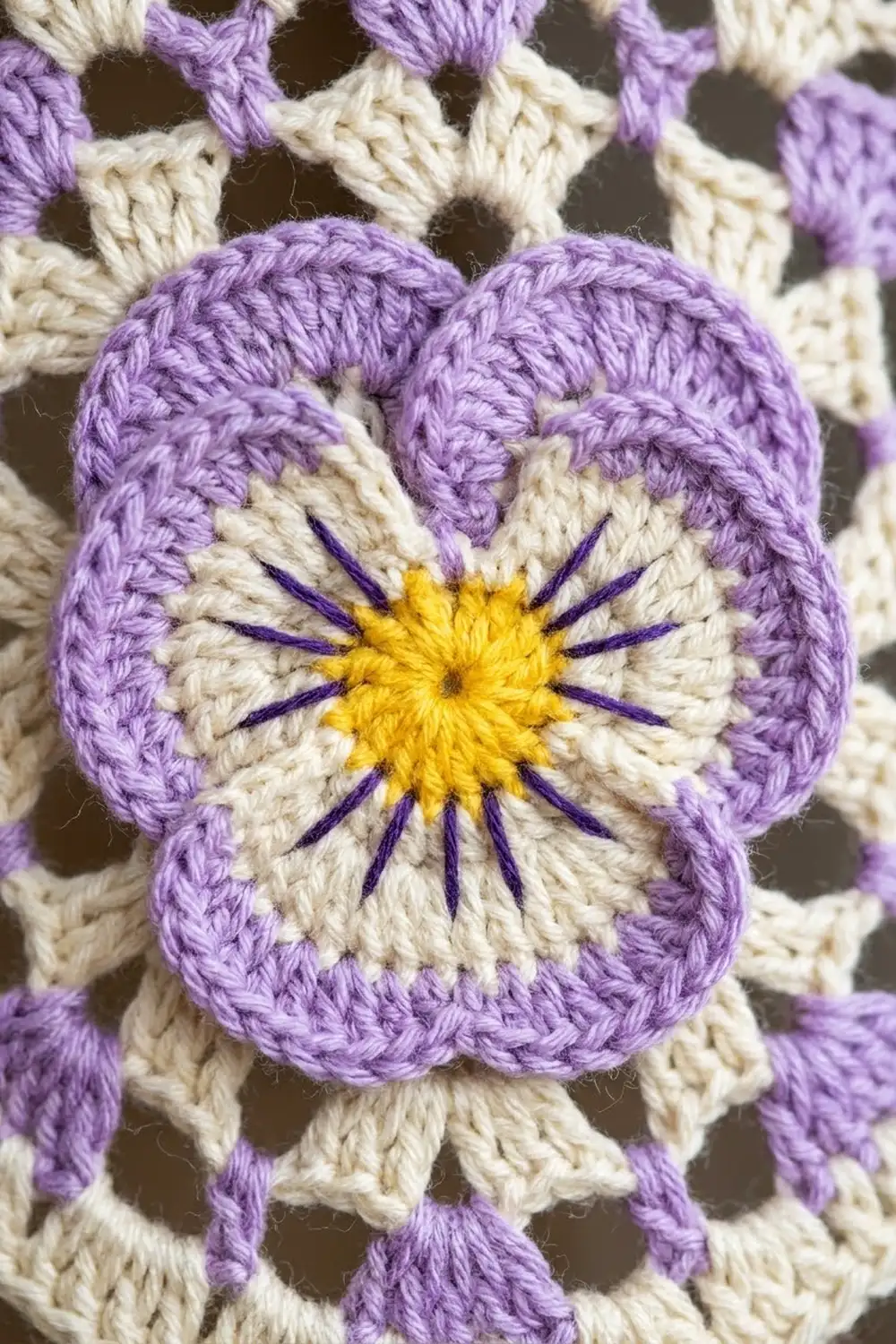
Part B: Pansy (make 26)
Rnd 1 (yellow): Magic ring, ch 1, 10 sc in ring, sl st to first sc. Pull the ring closed. (10 sc) Fasten off.
Rnd 2 (cream): Join in any sc, ch 1, sc in same st, ch 3, sk next sc, *sc in next sc, ch 3, sk next sc; rep from * 3 more times, sl st to first sc. (5 sc, 5 ch-3 sps)
Rnd 3 (cream): Work each petal into one ch-3 sp, with a sl st in each sc between petals:
- Petals 1–2 (upper): (hdc, 4 dc, hdc) in ch-3 sp, sl st in next sc. (6 sts each)
- Petals 3–5 (lower): (dc, 5 tr, dc) in ch-3 sp, sl st in next sc. (7 sts each)
Total: 33 petal sts + 5 sl sts. Fasten off.
Rnd 4 (lavender, trim round): Join in the sl st before Petal 1.
- Each upper petal: sc in hdc, 2 hdc in each of next 4 dc, sc in hdc, sl st in next sl st. (10 sts)
- Each lower petal: sc in dc, 2 dc in each of next 5 tr, sc in dc, sl st in next sl st. (12 sts)
Count: (33 sts worked 1 per existing stitch) + (23 increases: 4 on each upper petal, 5 on each lower petal) = 56 petal sts, plus 5 sl sts. The doubled stitches give the lavender edge a soft ruffle. Fasten off and leave a 12 in (30.5 cm) tail for sewing.
Veins (deep violet): Use the tapestry needle to embroider 3 straight stitches on each lower petal. Each one starts at the yellow center and runs out over the cream, about 0.5 in (1.3 cm) long. That’s 9 veins per pansy. Weave in all ends except the lavender sewing tail.
Part C: Flower Knot (make 60)
Rnd 1 (lavender): Magic ring, *ch 2, 2-dc cl in ring, ch 2, sl st in ring; rep from * 3 more times. (4 petals) Pull the ring tight. Fasten off and leave an 8 in (20.3 cm) tail.
Each knot is about 0.75 in (1.9 cm) across.
Make All Pieces
Per panel:
- Mesh panel: 1, cream
- Pansies: 26 (18 for the body, 8 for the hem)
- Flower knots: 60, lavender
Positions are measured on the blocked mesh. x is the distance from the left edge, and y is the height above the foundation edge. The lattice lines run along every diagonal where x + y or x − y is a multiple of 8 in (20.3 cm). This makes diamonds 8 in (20.3 cm) wide and 8 in (20.3 cm) tall.
Layout grid (K = knot, P = pansy, positions in inches):
y \ x   4    8    12   16   20   24   28
 68     K         K         K         K
 64     P    K    P    K    P    K    P
 60     K         K         K         K
 56          K         K         K
 52     K    P    K    P    K    P    K
 ...    continue the same 4 in steps down to y = 4
Exact positions:
- Knots at y = 4, 12, 20 … 68 in: x = 4, 12, 20, 28 in (10.2, 30.5, 50.8, 71.1 cm). 9 rows × 4 = 36 knots.
- Knots at y = 8, 16 … 64 in: x = 8, 16, 24 in (20.3, 40.6, 61.0 cm). 8 rows × 3 = 24 knots.
- Pansies at y = 16, 40, 64 in (40.6, 101.6, 162.6 cm): x = 4, 12, 20, 28 in. 3 rows × 4 = 12 pansies.
- Pansies at y = 28, 52 in (71.1, 132.1 cm): x = 8, 16, 24 in. 2 rows × 3 = 6 pansies.
Total: 60 knots and 18 body pansies, with each pansy centered in its own diamond.
Joining: Lattice Lines and Appliqués
Finish the bands and side edging (see Border) and block the panel before you mark anything. Then pin every knot and pansy position.
Lattice lines: With lavender, start a line at each bottom-edge point (x = 0, 8, 16, 24, 32 in) and at every 8 in (20.3 cm) up each side. Work surface chain along the diagonal, one stitch into each mesh opening. The line follows the stacked sc points and rises 0.5 in (1.3 cm) per stitch. Stop when you reach the top band or a side edge. Keep the stitches loose so each line is no shorter than the mesh under it. After every few lines, check that the panel still measures 32 in (81.3 cm) wide.
Knots: Center a knot over each place where two lines cross. Sew through its center and around 2 petals into the mesh below.
Pansies: Center each body pansy on its pin, with the upper petals toward the top. Whipstitch the lavender edge to the mesh at 8 points around the flower.
Size checkpoint: The body should still measure 32 in (81.3 cm) × 73.5 in (186.7 cm), bands included. If it has drawn in, your sewing or surface chain is too tight.
Border: Bands, Tabs, Edging and Pansy Hem
The border uses the sc gauge: 4 sc = 1 in (2.5 cm), and 4 rows = 1 in (2.5 cm).
Top band (cream), worked straight on from Row 143:
- Row 1 (conversion row): Ch 1, sc in each sc and 3 sc in each ch-5 loop across. Count: (33 sc worked 1 per existing sc) + (96 sc added, 3 in each of 32 loops) = 129 sc. Turn.
- Rows 2–6: Ch 1, sc in each sc across. Turn. (129 sc)
Six rows give a band 1.5 in (3.8 cm) deep. At 4 sc per inch, 129 sc comes to 32.25 in (81.9 cm). The extra 0.25 in (0.6 cm) eases out when you block.
Tabs: 9 tabs of 9 sc each, separated by 8 gaps of 6 sc each: 9 × 9 + 8 × 6 = 81 + 48 = 129. Every band stitch is used exactly once.
- Tab 1: Ch 1, sc in first 9 sc. Work 23 more rows of 9 sc (24 rows total). Fasten off.
- Tabs 2–9: Sk 6 sc, join in next sc and work as for Tab 1.
Each tab is 2.25 in (5.7 cm) wide and 6 in (15.2 cm) long. Fold each tab to the back and whipstitch its last row to band Row 1. This makes a 3 in (7.6 cm) loop.
Bottom band:
- Row 1 (cream): Turn the panel upside down. Join in the free loop of the 2nd foundation ch, ch 1, then sc in each foundation ch to the end. (129 sc)
- Row 2 (lavender): Ch 1, sc in each sc across. (129 sc) Fasten off.
Two rows give a band 0.5 in (1.3 cm) deep.
Side edging (cream): Work each long side separately, starting at the bottom corner:
- 1 sc in each bottom band row end (2 sc)
- 2 sc in each mesh row end (143 × 2 = 286 sc)
- 1 sc in each top band row end (6 sc)
Total: 294 sc per side, and 294 ÷ 4 = 73.5 in (186.7 cm). That matches the edge length of 0.5 + 71.5 + 1.5 in, so the sides won’t ruffle or pull in.
Pansy hem: Lay the 8 hem pansies edge to edge along the bottom band: 8 × 4 in = 32 in (81.3 cm), so each pansy covers 16 sc. Let the top 1.5 in (3.8 cm) of each pansy overlap the band and 2.5 in (6.4 cm) hang below it. Sew the upper petals to the band, then tack neighboring pansies together where they touch. The hanging lower petals form the scallops.
Total length: 3 in tab loop + 1.5 in top band + 71.5 in mesh + 0.5 in bottom band + 2.5 in hem = 79 in (200.7 cm).
Final Blocking
- Weave in all remaining tails along the mesh strands.
- Soak the panel in cool water for 15 minutes. Press the water out without wringing.
- Roll the panel in towels to remove extra water.
- Lay it flat, face up, on mats or a sheeted floor.
- Pin the body to 32 in (81.3 cm) × 73.5 in (186.7 cm).
- Pin the sides every 4 in (10.2 cm), keeping the lattice lines at 45 degrees.
- Shape each pansy with your fingers and space the hem scallops evenly.
- Let it dry completely, at least 24 hours.
Final Quality-Control Checklist
- Body measures 32 in (81.3 cm) × 73.5 in (186.7 cm)
- Each mesh row has either 32 loops, or 31 loops plus 2 half loops
- Top band has 129 sc: 9 tabs of 9 sc and 8 gaps of 6 sc
- Each side has 294 sc
- 60 knots sit on line crossings, and 18 pansies sit in diamond centers
- 8 hem pansies span the full width
- Lattice lines lie flat
- Both panels are the same length
Troubleshooting
- Mesh slants to one side: a half loop is missing. Every row worked like Row 2 must start with ch 5 and end with ch 2, dc.
- Top of the panel is narrow: the conversion row is too tight. Work it more loosely.
- Pansy cups: go up one hook size for Rnd 3.
- Pansy ruffles too much: on the upper petals of Rnd 4, work 2 sc instead of 2 hdc.
- Lattice line puckers: pull it out and rework it with a larger hook.
- Tabs twist: whipstitch through both loops of the band stitches.
Care
Hand wash in cool water with mild soap and dry flat. Don’t hang the curtain while it’s wet, because the mesh will stretch.
Final Notes
Each measurement builds on the one before. A 4 in (10.2 cm) pansy confirms your tension. Thirty-two 1 in (2.5 cm) loops give a width of 32 in (81.3 cm), and 143 rows give 71.5 in (181.6 cm) of mesh. The bands (129 sc) and side edges (294 sc) match those sizes, and 8 hem pansies fill the 32 in (81.3 cm) width exactly. If you check each stage, the panel will hang straight.
Happy crocheting!