

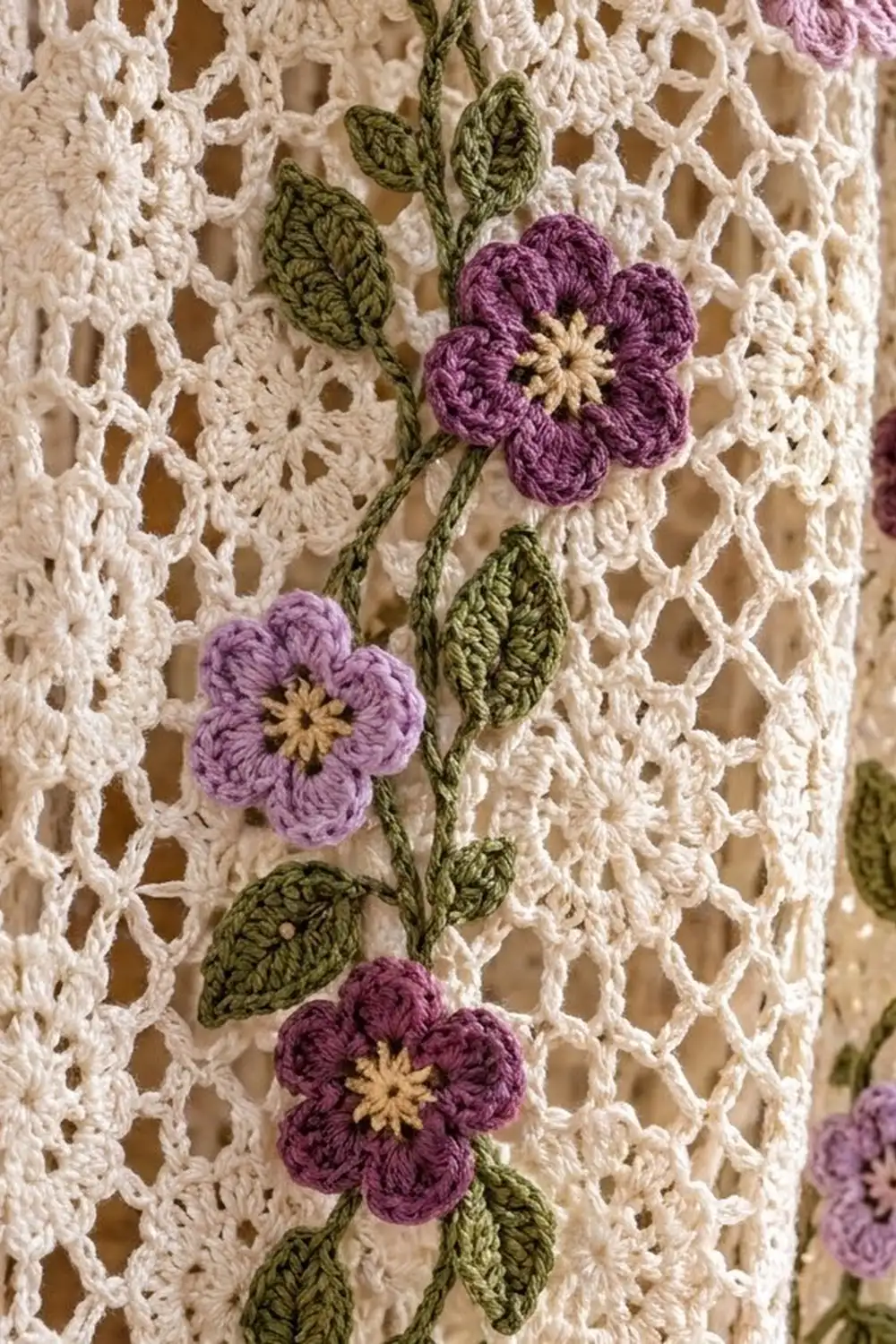
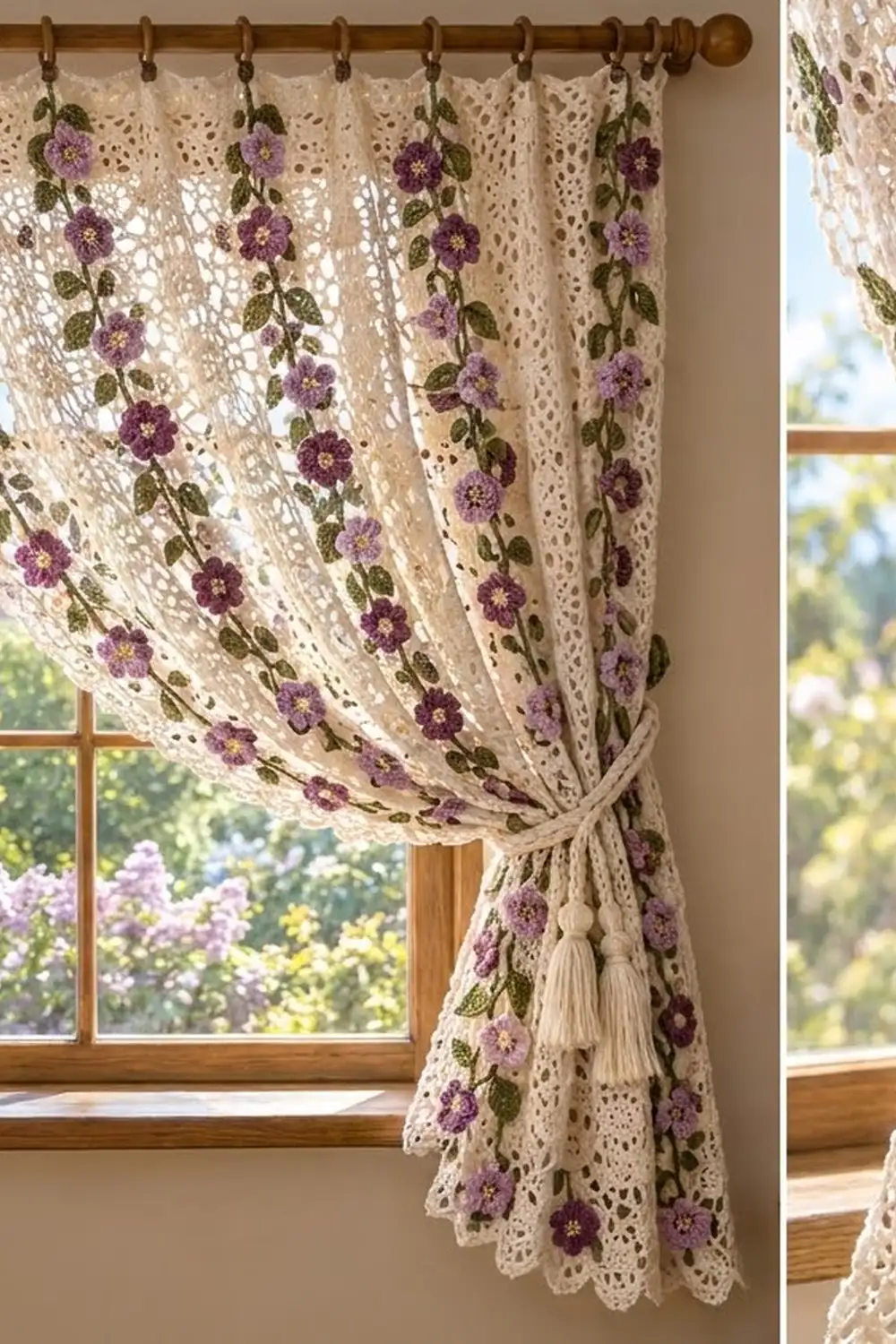
This curtain panel pairs open cream lace with trailing vines of purple flowers. The background is a grid of square lace motifs, each with a spoked wheel at its center. Green chain vines run the full length of the panel, carrying deep plum and soft lavender blossoms with pale yellow centers.
The style is cottage-garden: light passes through the lace, and the flowers add color without hiding it. All instructions use US crochet terms.
The finished panel measures 41.5 in (105.4 cm) wide by 61.25 in (155.6 cm) long. The hanging loops drop about 2 in (5.1 cm) more from the rod.
Construction overview:
- Make 96 identical lace squares.
- Join them with slip stitch seams into a grid 8 motifs wide by 12 motifs tall.
- Work a two-round border, with shells on the sides and bottom and hanging loops across the top.
- Sew on 4 chain vines, 48 flowers, and 96 leaves.
- Optionally, add a braided tieback.
Finished Size and Construction
- Finished size: 41.5 x 61.25 in (105.4 x 155.6 cm), not counting the loops
- Skill level: Intermediate
- Terminology: US
- Yarn weight: Sport (2) mercerized cotton
- Hook: 3.0 mm
- Number of pieces: 96 motifs joined into one panel, plus appliqués
- Layout: 8 wide x 12 tall
- Motif size: 5 in (12.7 cm) square, 30 stitches per side
- Size before border: 40 x 60 in (101.6 x 152.4 cm)
- Border depth: 0.75 in (1.9 cm) on the sides and bottom; 0.5 in (1.3 cm) on the top
Materials
Use a smooth mercerized cotton. It gives crisp lace, holds its shape while hanging, and resists sun-fading. The amounts below assume about 140 m (153 yd) per 50 g.
- Cream (main color): 700 g, about 1960 m
- Plum: 50 g, about 140 m
- Lavender: 50 g, about 140 m
- Pale yellow: 15 g, about 42 m
- Moss green: 100 g, about 280 m
All quantities include a margin of about 10%. If you skip the tieback, you need about 60 g less cream.
Tools:
- 3.0 mm hook
- Tapestry needle
- Rustproof pins
- Blocking mats
- Tape measure
- Spray bottle
- Stitch markers
- Scissors
- A 5 in (12.7 cm) piece of card for the tassels
Abbreviations (US Terms)
- ch: chain
- sl st: slip stitch
- sc: single crochet
- hdc: half double crochet
- dc: double crochet
- sk: skip
- sp(s): space(s)
- st(s): stitch(es)
- MR: magic ring
- RS: right side
Corner group: (3 dc, ch 3, 3 dc) in the same space.
Gauge and Checkpoints
Gauge: One blocked motif measures 5 in (12.7 cm) square. Along its edge, Round 5 gives 6 sc per 1 in (2.5 cm).
Make and block one test motif before you start the rest. Measure it flat after each round:
- After Round 1: 1.25 in (3.2 cm) across
- After Round 2: 2 in (5.1 cm) across
- After Round 3: 3.25 in (8.3 cm) across
- After Round 4: 4.5 in (11.4 cm) square
- After Round 5, blocked: 5 in (12.7 cm) square
If your motif is too big, go down 0.25 mm in hook size.
If it is too small, go up 0.25 mm.
Small errors add up. Being just 0.125 in (0.3 cm) off per motif changes the panel width by 1 in (2.5 cm).
Part 1: Lace Motif (make 96)
Use cream throughout.
Round 1: MR, ch 3 (counts as dc), 15 dc in ring, sl st to top of ch-3. (16 dc)
Round 2: Ch 5 (counts as dc + ch 2), dc in next dc, ch 2; repeat from * 14 more times, sl st to 3rd ch of beginning ch-5. (16 dc, 16 ch-2 sps; these form the wheel spokes)
Round 3: Sl st into first ch-2 sp, ch 1, sc in same sp, ch 5, sc in next ch-2 sp; repeat from * 14 more times, ch 5, sl st to first sc. (16 sc, 16 ch-5 loops)
Round 4 (squaring round):
- Sl st in next 2 ch to reach the center of the loop.
- Ch 3 (counts as dc), then (2 dc, ch 3, 3 dc) in the same loop. This is the first corner.
- [Ch 5, sc in next loop] 3 times, ch 5, corner group in next loop; repeat from * 2 more times.
- [Ch 5, sc in next loop] 3 times, ch 5, sl st to top of ch-3.
Count: 24 dc, 12 sc, 16 ch-5 loops, and 4 ch-3 corner spaces. The 16 loops from Round 3 become 4 corner loops plus 12 side loops.
Round 5 (conversion round):
- Ch 1, sc in same st and in next 2 dc.
- 3 sc in corner ch-3 sp, sc in next 3 dc, [5 sc in next ch-5 loop, sk next sc] 3 times, 5 sc in next ch-5 loop, sc in next 3 dc; repeat from * 3 more times. On the final repeat, leave out the last 3 sc, because you already worked them at the start.
- Sl st to first sc. Fasten off.
Round 5 count: (24 sc worked 1 per dc) + (80 sc worked into the 16 loops) + (12 corner sc) = 116 sc.
The middle sc of each 3-sc corner is the corner stitch. Each side has 30 sts, counting corner stitch to corner stitch inclusive: 1 + 1 + 26 + 1 + 1. The 4 corner stitches are each shared by two sides, so the round total is 4 x 30 − 4 = 116.
Make All Pieces
Make 96 motifs in cream. Block them in batches to 5 in (12.7 cm) square.
Layout: 8 columns (A–H) by 12 rows. Each X is one motif.
     A B C D E F G H
 1   X X X X X X X X
 2   X X X X X X X X
 ...
12   X X X X X X X X
The vines will run along the seams between columns A/B, C/D, E/F, and G/H.
Joining
Method: Slip stitch seam through the back loops.
- Hold two motifs RS together, matching corner stitch to corner stitch.
- Slip stitch through the back loops of matching stitches, 1 to 1, across all 30 sts.
The ridge sits on the wrong side, and the free front loops keep the RS flat.
Order:
- Join the 8 motifs of each row into a strip, using 7 short seams.
- Join the 12 strips with 11 long seams. Each long seam is 8 x 30 = 240 sts.
Where four corners meet, work each corner stitch once. Do not chain across the junction.
Tension: Keep the slip stitches as loose as the motif stitches. Tight seams make the panel pucker and narrow. If needed, use a hook one size larger for joining.
Checkpoint: The joined panel measures 40 x 60 in (101.6 x 152.4 cm). The top and bottom edges each have 8 x 30 = 240 sts, and each side has 12 x 30 = 360 sts. That works out to exactly 6 sts per 1 in (2.5 cm).
Border
Border gauge: 6 sc per 1 in (2.5 cm), the same as the motif edge.
Round 1:
- With RS facing, join cream in the top-right panel corner stitch.
- Ch 1, then work 3 sc in that corner stitch.
- Sc in each stitch along every edge, and work 3 sc in each of the other 3 panel corner stitches.
- Sl st to the first sc.
Count from corner center to corner center:
- Top and bottom edges: 242 sc each
- Sides: 362 sc each
- Total: 1196 existing sts + 8 added corner sts = 1204 sc
Round 2, sides and bottom:
- Work 7 dc in each bottom corner center sc.
-
Along each edge, between the corner centers, work sc in next st, sk 2, 5 dc in next st, sk 2. End just before the next corner center.
-
Bottom edge: 240 interior sts ÷ 6 = 40 shells
- Each side: 360 ÷ 6 = 60 shells
Round 2, top edge:
- Work 1 sc in each top corner center.
- Across the 240 interior sts: sc in next 8 sts, ch 24, sk 4, sc in next 16 sts; repeat from * 10 more times, ch 24, sk 4, sc in last 8 sts.
- Check the stitches used: 8 + (11 x 20) + 4 + 8 = 240. This gives 12 loops and 192 sc.
- Sl st to join and fasten off.
Why the math works: Each interior count (240 or 360) is a multiple of the repeat, so every shell and every loop ends exactly at a corner. The loops are 20 sts, about 3.3 in (8.4 cm), apart. They fit rods up to 1 in (2.5 cm) thick.
Part 2: Appliqués
Flower (make 24 plum and 24 lavender)
Round 1: With pale yellow, MR, ch 1, 10 sc in ring, sl st to join. Fasten off. (10 sc)
Round 2: Join petal color in any sc. Ch 1, sc in same st, ch 3, sk next st, sc in next st, ch 3, sk next st; repeat from * 3 more times, sl st to join. (5 sc, 5 ch-3 sps)
Round 3: Work (sc, hdc, 3 dc, hdc, sc) in each ch-3 sp, sl st to join. (5 petals, 35 sts)
Leave a 12 in (30.5 cm) tail for sewing. With the petal color, make a French knot in the center of the flower. Each flower is 1.75 in (4.4 cm) across.
Leaf (make 96)
With green, ch 9.
- Starting in the 2nd ch from the hook, work: sl st, sc, hdc, dc, dc, hdc, sc, then 3 sc in the last ch.
- Working along the other side of the chain, work: sc, hdc, dc, dc, hdc, sc, sl st.
That gives 17 sts. Fasten off and leave a tail for sewing. Each leaf is 1.5 in (3.8 cm) long.
Vine (make 4)
- With green, chain until the chain measures 66 in (167.6 cm), about 330 ch.
- Sl st in the back bump of each ch to make a firm cord.
The extra length lets the vine curve gently along the 60 in (152.4 cm) of lace.
Part 3: Placement
- Vines: Pin the vines along the 4 marked seams. They sit 5, 15, 25, and 35 in (12.7, 38.1, 63.5, 88.9 cm) from the left edge. Curve each vine about 0.75 in (1.9 cm) to either side of its seam.
- Flowers: Pin 12 flowers on each vine, one at the middle of each motif row. Alternate the colors:
- Vines 1 and 3: start with plum.
- Vines 2 and 4: start with lavender.
- Leaves: Pin 2 leaves beside each flower.
- Sewing: Whipstitch each piece to the solid lace stitches underneath, using matching yarn. Tack the vines every 0.5 in (1.3 cm).
Part 4: Optional Tieback
- Hold cream double and make 3 chains, each 30 in (76.2 cm) long.
- Knot the chains together at one end, braid them, and knot the other end. The braid should be about 24 in (61.0 cm) long.
- For each tassel, wrap cream 40 times around the 5 in (12.7 cm) card. Tie the top and cut the bottom.
- Wrap the tassel neck 0.5 in (1.3 cm) below the top.
- Sew one tassel to each end of the braid.
Final Blocking
- Soak the panel in cool water and gently press the water out.
- Roll it in towels.
- Lay it RS up on blocking mats.
- Pin it to 41.5 x 61.25 in (105.4 x 155.6 cm), with a pin at every motif corner along the edges.
- Pin out each shell.
- Straighten the seams against a long ruler.
- Shape the petals and leaves with your fingers.
- Let it dry completely before unpinning.
Final Quality-Control Checklist
- [ ] Every motif measures 5 in (12.7 cm) with 30 sts per side
- [ ] All seams match corner to corner
- [ ] The panel measures 40 x 60 in (101.6 x 152.4 cm) before the border
- [ ] Border Round 1 has 1204 sc
- [ ] There are 40 bottom shells, 60 shells per side, and 12 loops
- [ ] 4 vines, 48 flowers, and 96 leaves are secure
- [ ] All ends are hidden
Troubleshooting
- Motif ruffles: The loops are too long. Try ch 4 instead of ch 5.
- Motif cups: The loops are too tight. Go up one hook size.
- Seams pucker: Rework them with a larger hook.
- Shells don’t land at the corner: Recount Round 1 on that edge. It should have 242 or 362 sts.
- Loops twist: Pin the loops flat while blocking.
- Appliqués pull the lace: Loosen your sewing stitches.
Care
Hand wash in cool water with mild detergent. Reshape the panel and dry it flat. Avoid strong direct sun so the purples don’t fade.
Final Notes
Every measurement in this pattern builds on the one before it:
- One motif is 5 in (12.7 cm) with 30 sts per side.
- 8 x 12 motifs make a 40 x 60 in (101.6 x 152.4 cm) panel, with 240 and 360 edge stitches.
- The border adds stitches only at the corners, so the shells and loops divide evenly.
- The finished panel is 41.5 x 61.25 in (105.4 x 155.6 cm).
If your first motif matches the gauge, the rest of the panel will come out to size.
Happy crocheting!