

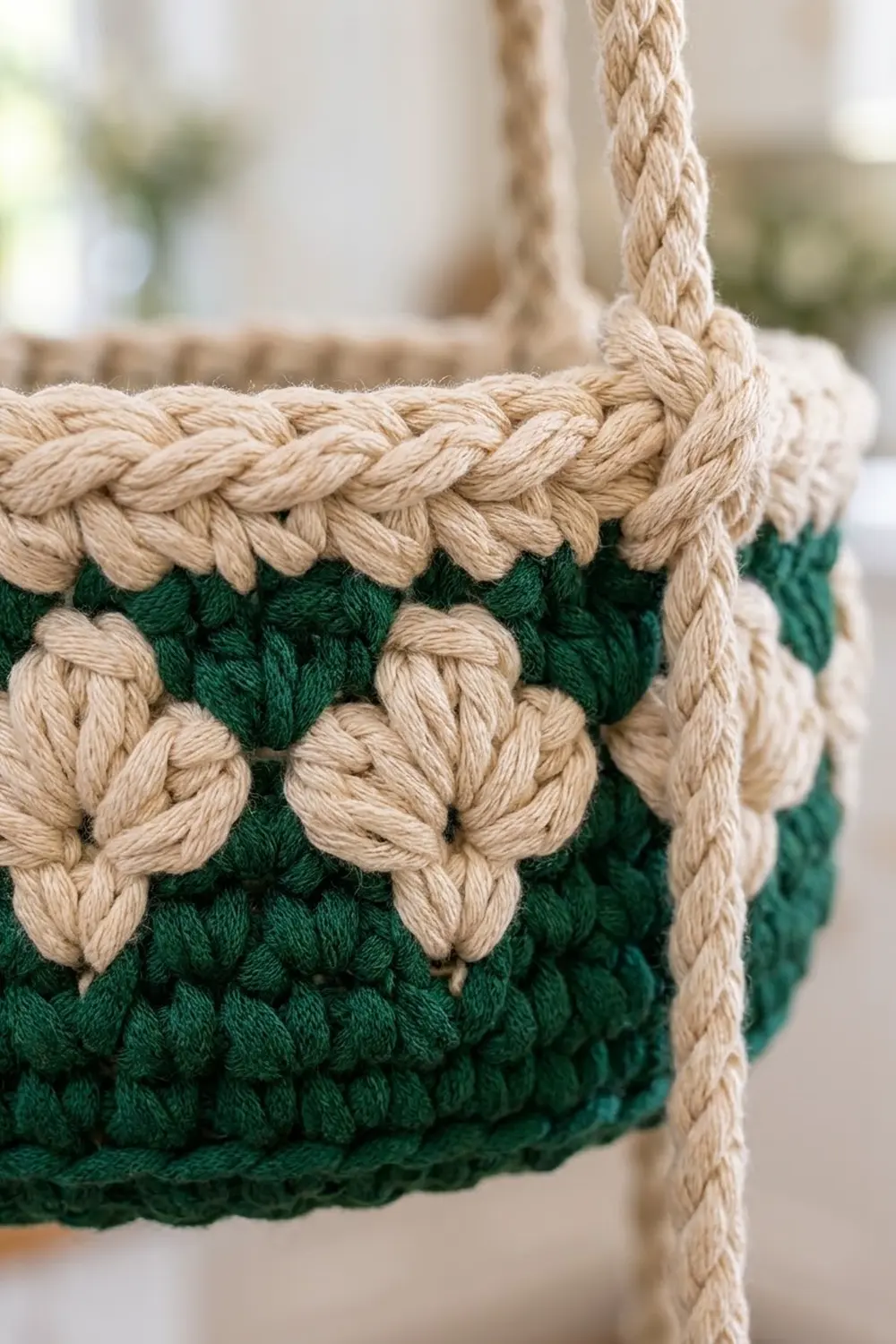
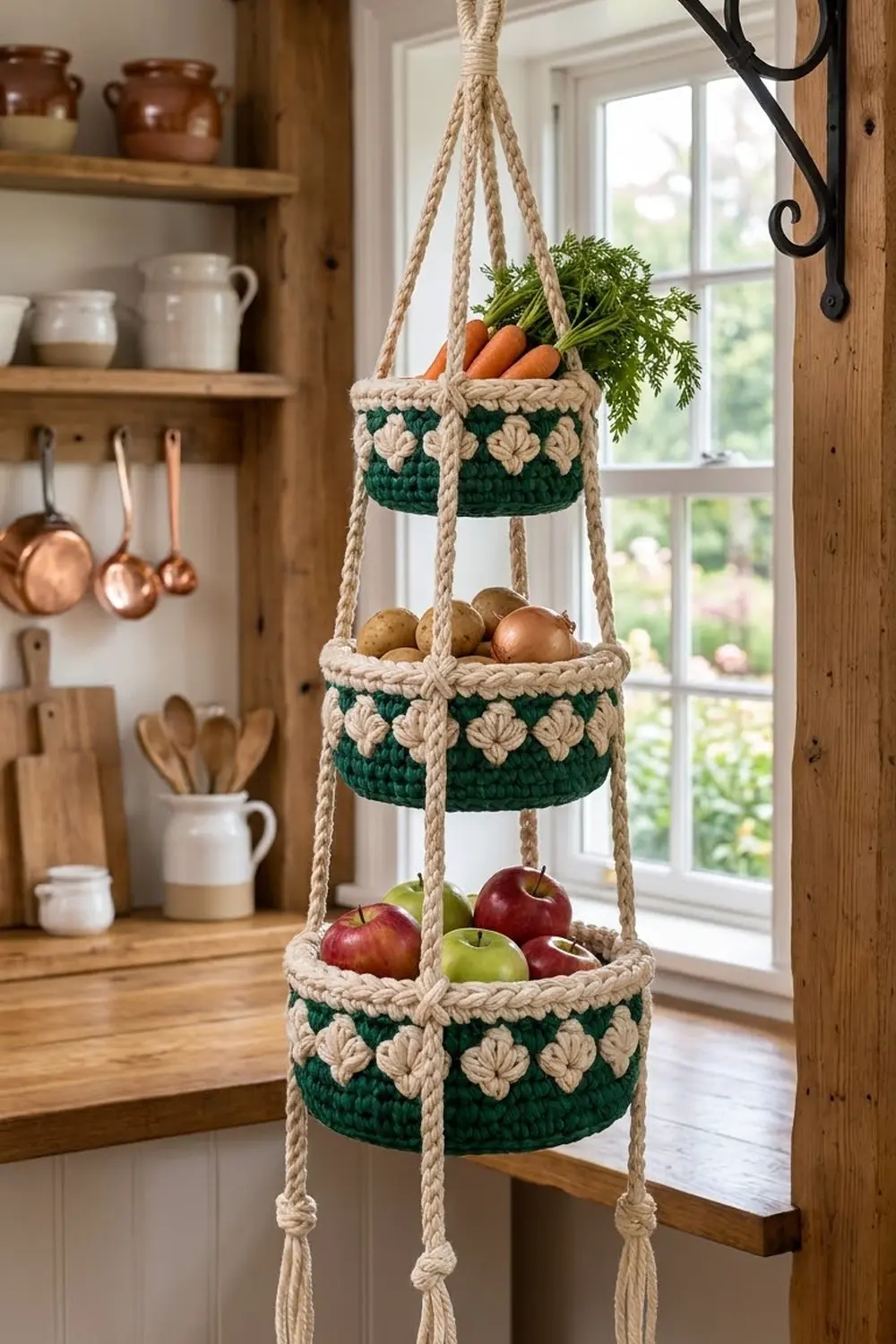
This three-tier hanging basket adds a calm, handmade touch to the kitchen. Three sturdy round baskets in deep evergreen hang one above the other on cream crocheted cords. Each basket has a band of cream shell motifs and a thick, rope-like cream rim.
The style is farmhouse-meets-modern: just two colors, crisp contrast, and a chunky cotton cord that keeps its shape when filled with carrots, potatoes, apples, onions or bread rolls. Each shell is a small fan that starts at a single point and opens into three rounded lobes at the top.
This pattern uses US crochet terms. The finished baskets measure 6 in (15.2 cm), 8 in (20.3 cm) and 10 in (25.4 cm) across the base. They are 3.7 in (9.4 cm), 4 in (10.2 cm) and 4.3 in (10.9 cm) tall. The full hanger is about 44 in (111.8 cm) long from ring to cord tips.
The construction is simple. Each basket starts as a flat single crochet circle, turns upward with a back-loop round, and builds straight walls. You work the shell band in tapestry crochet, then finish the edge with a three-round cream rim. Three chain cords and a small ring hold everything together.
Finished Size and Construction
- Finished size: Small 6 in (15.2 cm) diameter x 3.7 in (9.4 cm) tall; Medium 8 in (20.3 cm) x 4 in (10.2 cm); Large 10 in (25.4 cm) x 4.3 in (10.9 cm)
- Overall hanging length: about 44 in (111.8 cm)
- Skill level: Intermediate (tapestry color changes)
- Terminology: US
- Yarn weight: Bulky (#5) cotton cord
- Hook: 6 mm (J-10)
- Number of pieces: 3 baskets, 3 hanging cords, 1 hanging ring
- Layout: vertical stack: Small on top, Medium in the middle, Large at the bottom
- Piece size: see finished size above
- Height before border: Small 2.7 in (6.9 cm), Medium 3 in (7.6 cm), Large 3.3 in (8.4 cm)
- Border (rim) depth: 3 rounds, about 1 in (2.5 cm)
Materials
Choose a bulky cotton or cotton-blend cord with a firm twist, about 110 m per 100 g. Cotton keeps the walls upright and holds the weight of produce better than acrylic. Avoid very soft, loosely plied yarns, because they stretch under load.
- Evergreen (Color G): 360 g / 396 m
- Cream (Color C): 220 g / 242 m
These amounts include a margin of about 15 percent for gauge differences, swatching, and the strand you carry in the tapestry rounds.
Tools:
- 6 mm (J-10) crochet hook
- 5 locking stitch markers
- Large-eye tapestry needle
- Scissors
- Tape measure
- Spray bottle and pins for blocking
Abbreviations (US Terms)
- ch – chain
- sl st – slip stitch
- sc – single crochet
- inc – 2 sc in the same stitch
- BLO – back loop only
- st(s) – stitch(es)
- rep – repeat
- G / C – Evergreen / Cream
Tapestry sc: Lay the color you aren’t using along the tops of the stitches and work over it, so it is hidden inside each sc. To change color, work the last sc before the change until 2 loops remain on the hook. Then finish that sc with the new color.
Crab stitch (reverse sc): Work from left to right. Insert the hook in the next st to the right, pull up a loop, yarn over, and pull through both loops. This makes the rope-like rim.
Gauge and Checkpoints
Gauge: 12 sc and 12 rounds = 4 in (10.2 cm) in sc worked in joined rounds.
Make the Small basket first. It is the quickest way to test your gauge, tension and tapestry work before you start the two larger baskets.
Checkpoints:
- Base Rnd 6 (36 sts): 4 in (10.2 cm) across
- Base Rnd 9 (54 sts): 6 in (15.2 cm) across
- Base Rnd 12 (72 sts): 8 in (20.3 cm) across
- Base Rnd 15 (90 sts): 10 in (25.4 cm) across
- Every 3 wall rounds: 1 in (2.5 cm) of height
If your base is too big, go down a hook size. If it is too small, go up a size. A base that ruffles means your tension is loose; a base that cups means it is tight. Tapestry rounds often come out a little tighter, so relax your hand through the shell band.
The Base (All Baskets)
Work in joined rounds. Start each round with ch 1 (it does not count as a st), and join each round with a sl st to the first sc. With G:
Rnd 1: Make a magic ring, 6 sc in ring. (6)
Rnd 2: Inc in each st around. (12)
Rnd 3: *Sc 1, inc; rep from * 6 times. (18)
Rnd 4: *Sc 2, inc; rep from * 6 times. (24)
Rnd 5: *Sc 3, inc; rep from * 6 times. (30)
Rnds 6–15: Keep going the same way, adding one more sc between increases each round. Every round has 6 x the round number in stitches.
| Round | Repeat | Count |
|---|---|---|
| 6 | sc 4, inc | 36 |
| 7 | sc 5, inc | 42 |
| 8 | sc 6, inc | 48 |
| 9 | sc 7, inc | 54 |
| 10 | sc 8, inc | 60 |
| 11 | sc 9, inc | 66 |
| 12 | sc 10, inc | 72 |
| 13 | sc 11, inc | 78 |
| 14 | sc 12, inc | 84 |
| 15 | sc 13, inc | 90 |
Stop at: Small Rnd 9 (54 sts), Medium Rnd 12 (72 sts), Large Rnd 15 (90 sts).
Tip: On the larger rounds, move the increases over by a few stitches each round so the circle stays round instead of turning into a hexagon. The stitch count does not change.
The Walls
The stitch count stays the same on every wall round: Small 54, Medium 72, Large 90. Do not increase.
Wall Rnd 1 (turning round): With G, sc in BLO of each st around. (54/72/90) The unused front loops form a neat ridge that marks the edge of the base.
Plain wall rounds: Sc in each st around. (54/72/90) Work 2 rounds for Small, 3 for Medium and 4 for Large. That gives 3/4/5 green wall rounds in total.
On the last plain round, start carrying C so it is ready for the shell band.
The Shell Band (Tapestry)
Each shell is a 6-st repeat. Small has 9 repeats, Medium 12 and Large 15. Carry the unused color inside every stitch on all four rounds.
Shell Rnd 1: *Sc 2 G, sc 1 C, sc 3 G; rep from * around. (54/72/90)
Shell Rnd 2: *Sc 1 G, sc 3 C, sc 2 G; rep from * around. (54/72/90)
Shell Rnd 3: *Sc 5 C, sc 1 G; rep from * around. (54/72/90)
Shell Rnd 4: *Sc 1 C, sc 1 G, sc 1 C, sc 1 G, sc 1 C, sc 1 G; rep from * around. (54/72/90)
Each shell grows from 1 st at the point to 3 sts, then 5 sts, then splits into three lobes. The 6th st of every repeat stays green, so a green column separates each shell from the next.
Here is one repeat as a grid, read from bottom to top (G = green, C = cream):
Rnd 4:  C G C G C G
Rnd 3:  C C C C C G
Rnd 2:  G C C C G G
Rnd 1:  G G C G G G
Green round: With G, sc in each st around, still carrying C. (54/72/90)
Checkpoint: Measured from the BLO ridge, the basket is now 2.7 in (6.9 cm), 3 in (7.6 cm) or 3.3 in (8.4 cm) tall.
Make All Pieces
Baskets:
- Small: 1 (G base and walls, C shells and rim)
- Medium: 1
- Large: 1
Hanging cords (make 3), C: Holding 2 strands of C together, ch 162, about 54 in (137.2 cm). Fasten off. The cords are a little longer than you need so you can adjust the spacing.
Hanging ring (make 1), C: Ch 8, sl st to the first ch to form a ring. Ch 1, work 16 sc into the ring, sl st to the first sc. Fasten off. The ring is about 2 in (5.1 cm) across.
Layout grid (front view):
        [ring]
        / | \
     [ Small  ]   54 sts, 9 shells
        | | |
     [ Medium ]   72 sts, 12 shells
        | | |
     [  Large ]   90 sts, 15 shells
        | | |
       tails
The Rim (Border)
The rim has the same gauge as the body: 12 sc = 4 in (10.2 cm), and 3 rounds = 1 in (2.5 cm). Cut G and work only in C. Place 3 markers to divide the round into equal thirds. These mark where the cords will go later.
- Small: a marker every 18 sts (3 shells per third)
- Medium: a marker every 24 sts (4 shells per third)
- Large: a marker every 30 sts (5 shells per third)
Put each marker in the green 6th stitch of a shell repeat so the cords sit between shells.
Rim Rnd 1: With C, sc in each st around. (54/72/90; 18/24/30 per third)
Rim Rnd 2: Sc in each st around. (54/72/90; 18/24/30 per third)
Rim Rnd 3: Ch 1, crab stitch in each st around. (54/72/90; 18/24/30 per third) Sl st to the first st and fasten off.
Why the math works: The rim has the same stitch count as the wall, so it stands straight instead of flaring out or pulling in. Each total is a multiple of 6 (for the shells) and of 3 (for the cords): 54 / 3 = 18, 72 / 3 = 24 and 90 / 3 = 30, and each third is a whole number of shell repeats. Move your markers up as you work the rim so they stay lined up with the green columns you chose.
Finished heights: Small 3.7 in (9.4 cm), Medium 4 in (10.2 cm), Large 4.3 in (10.9 cm).
Joining
Method: Each cord runs down the outside of all three baskets. At each basket, tie it to the rim at a marker and tack it to the BLO ridge so the baskets hang level.
Step 1 (Top): Thread the top end of each cord through the hanging ring. Fold back 3 in (7.6 cm) and bind it tightly to the cord with a short strand of C, wrapping 5 times. Space the cords evenly around the ring.
Step 2 (Small): Measure 12 in (30.5 cm) down each cord from the ring. Lay the cord against the outside of the Small basket at a marker. Pass the cord under Rim Rnd 1, then tie an overhand knot so it sits on top of the rim. Tack the cord to the BLO ridge with a few whipstitches in C.
Step 3 (Medium): Measure 10 in (25.4 cm) down each cord from the Small rim. Tie the rim knot and tack the ridge the same way at the Medium markers.
Step 4 (Large): Measure 11 in (27.9 cm) down each cord from the Medium rim. Repeat at the Large markers.
Step 5 (Tails): Let 4 in (10.2 cm) of each cord hang below the Large basket’s base ridge. Tie an overhand knot at that point. Unravel any extra chains, then fasten off and weave in the end.
Stitch-to-stitch logic: Each cord is tied at the same green column on all three tiers, one third of the way around: sts 18, 36 and 54 on Small; sts 24, 48 and 72 on Medium; sts 30, 60 and 90 on Large. Line up the three markers vertically before you tie.
Tension advice: Tie the knots firmly, but don’t pull the rim inward. The cord should lie flat against the wall without puckering it.
Size checkpoint: Hang the piece. Every rim should be level, and the overall length from the ring should be about 44 in (111.8 cm).
Final Blocking
- Lightly mist each basket with water until damp, not soaked.
- Stuff each basket firmly with a towel, or set it over a bowl of the right diameter.
- Press the base flat and pinch the BLO ridge crisp with your fingers.
- Straighten the shell band so the green columns run straight up and down.
- Roll the crab-stitch rim between your fingers to even out the rope texture.
- Let everything dry completely, about 24 hours, before hanging.
- If the cords twist, pin or weight them straight while they dry.
Final Quality-Control Checklist
- The bases measure 6 in (15.2 cm), 8 in (20.3 cm) and 10 in (25.4 cm) across and lie flat.
- Every wall and rim round has 54, 72 or 90 sts.
- There are 9, 12 and 15 shells, each separated by one green column.
- No carried cream shows through the green stitches.
- The rims stand straight, without flaring or pulling in.
- The cords are tied at matching green columns on every tier.
- All three baskets hang level.
- All ends are woven in securely.
Troubleshooting
Base is wavy: You have too many stitches for your tension. Go down a hook size or tighten your hand.
Base cups upward: Your tension is tight. Go up a hook size.
Cream peeks through the green: Keep the carried strand snug along the tops of the stitches, and pull up slightly taller loops.
Shells lean diagonally: Single crochet naturally slants a little each round. Joined rounds keep this small, and blocking straightens the rest.
Walls bulge out: An increase may have slipped in. Count each round.
Basket tilts when hanging: One cord is longer than the others. Untie the knot, measure again and retie.
Rim flares: Your crab stitches are loose. Rework Rim Rnd 3 with a smaller hook.
Care
Hand wash in cool water with mild soap, press out the water, and reshape the baskets to dry flat. Empty and shake out the baskets often so dirt from produce doesn’t settle into the stitches.
Final Notes
Here is the measurement chain. A gauge of 12 sc and 12 rounds = 4 in (10.2 cm) gives bases of 6 in (15.2 cm), 8 in (20.3 cm) and 10 in (25.4 cm). Straight walls of 54, 72 and 90 sts hold 9, 12 and 15 shells, and the rim keeps the same counts. The cords sit one third of the way around each basket and are tied at intervals of 12 in (30.5 cm), 10 in (25.4 cm) and 11 in (27.9 cm). The result is a sturdy, level hanger about 44 in (111.8 cm) long. Check your Small basket first, and the other two will follow.
Happy crocheting!