

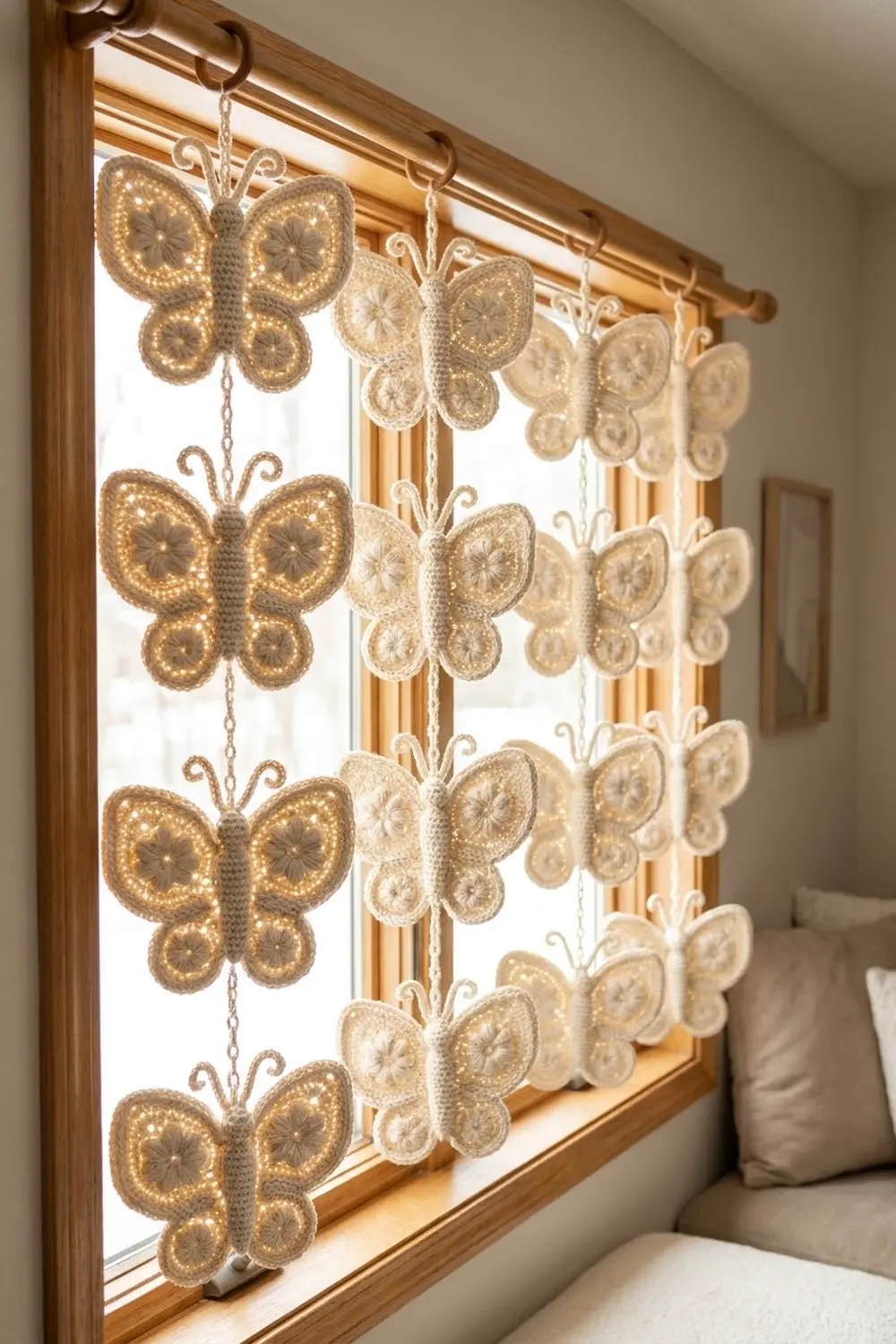
The Winter Flutter Butterfly Curtain is an airy window hanging made of lacy crochet butterflies linked into vertical strands. Each butterfly has two rounded upper wings, two smaller round lower wings, a ridged body and two antennae with bobble tips. Every wing has a puff-stitch flower center, a ring of small openings and a firm rope-like rim.
The whole curtain is one warm cream cotton. It looks wintry and calm and still lets the light through.
This pattern uses US crochet terms. One butterfly measures 7 in (17.8 cm) wide by 5 in (12.7 cm) tall, plus 1.5 in (3.8 cm) of antennae. The curtain has 4 strands of 6 butterflies, 24 butterflies in all. It measures 29.5 in (74.9 cm) wide on the rod and 39 in (99.1 cm) long, including the hanging loops.
You crochet four wings and a body for each butterfly, then sew them together. Reinforced chain links join the butterflies into strands, and a hanging loop at the top of each strand forms the header.
Finished Size and Construction
- Finished curtain: 29.5 in (74.9 cm) wide x 39 in (99.1 cm) long
- Skill level: Intermediate
- Terminology: US crochet terms
- Yarn weight: Worsted (#4) cotton
- Hook: 4.0 mm (US G-6)
- Number of pieces: 24 butterflies, each sewn from 5 crocheted parts (2 upper wings, 2 lower wings, 1 body)
- Layout: 4 vertical strands x 6 butterflies
- Piece size: one butterfly is 7 in (17.8 cm) x 5 in (12.7 cm), not counting the antennae
- Size before border: each strand is 34.5 in (87.6 cm) long before the header
- Border depth: the header adds 4.5 in (11.4 cm): a 3 in (7.6 cm) drop plus a 1.5 in (3.8 cm) hanging loop
Materials
Yarn: Use a smooth, tightly plied worsted cotton in cream or ivory. It shows the puffs and rope rims clearly, and it stretches less than acrylic when it hangs.
- Cream: 600 g, about 1,020 m (1,115 yd)
One butterfly uses about 20 g. The links and headers use about 15 g in total. The quantity above includes a margin of about 20% for gauge differences and swatching.
Tools:
– 4.0 mm (US G-6) crochet hook
– Tapestry needle
– Stitch markers
– Scissors and measuring tape
– Blocking mats and rust-proof pins
– Spray bottle
– Curtain rod with 4 rings (optional)
Abbreviations (US Terms)
- ch – chain
- sl st – slip stitch
- sc – single crochet
- hdc – half double crochet
- dc – double crochet
- BLO – back loop only
- MR – magic ring
- sp – space
- st(s) – stitch(es)
- RS – right side
Special stitches:
- Puff: (Yarn over, insert hook in st, pull up a loop to about 0.5 in / 1.3 cm) 3 times, yarn over, pull through all 7 loops on hook.
- Bobble (4-dc bobble): (Yarn over, insert hook in st, pull up a loop, yarn over, pull through 2 loops) 4 times in the same st, yarn over, pull through all 5 loops on hook.
- Reverse sc (crab stitch): Working left to right (right to left if you’re left-handed), insert hook in the next st to the right, pull up a loop, yarn over, pull through both loops.
Gauge and Checkpoints
Base gauge: 18 sc and 18 sc rows = 4 in (10.2 cm). Chain gauge: 4 ch = 1 in (2.5 cm).
Make one complete butterfly before production. Check these measurements as you go:
- Upper wing after Rnd 2 (flower): 1.75 in (4.4 cm) across
- Upper wing after Rnd 4: 3 in (7.6 cm) wide
- Upper wing finished: 3.5 in (8.9 cm) wide x 3 in (7.6 cm) tall
- Lower wing after Rnd 4: 2.25 in (5.7 cm) across
- Lower wing finished: 2.75 in (7.0 cm) across
- Body: 0.7 in (1.8 cm) x 4 in (10.2 cm)
- Assembled butterfly: 7 in (17.8 cm) x 5 in (12.7 cm)
If it’s too big: Use a 3.75 mm (US F-5) hook and pull up shorter loops on the puffs.
If it’s too small: Use a 4.5 mm (US 7) hook.
If the wings cup: Go up half a hook size for Rnd 4 only.
If the wings ruffle: Go down half a hook size for Rnds 4–5.
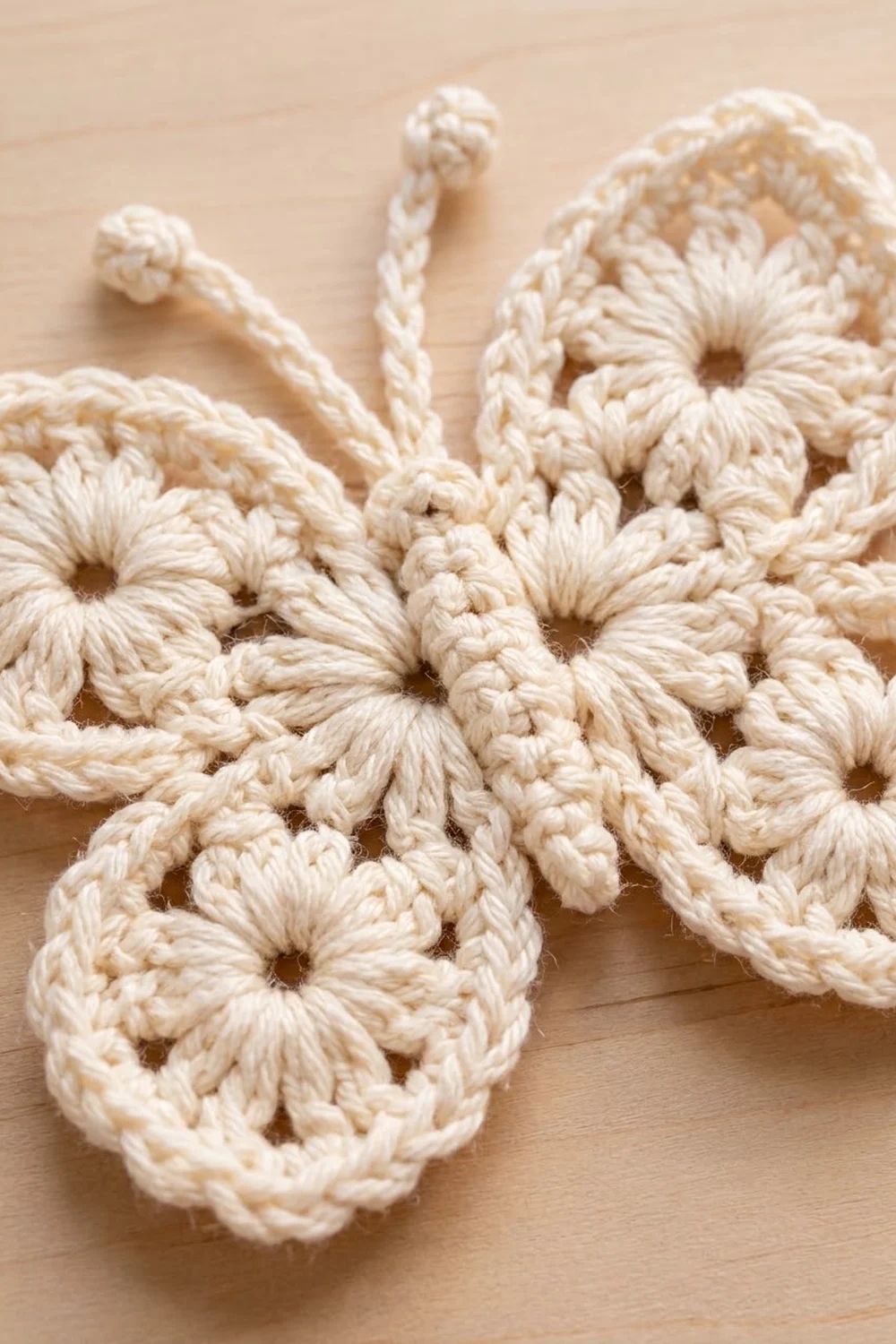
Upper Wing (Make 2 per butterfly)
The upper wing is a rounded teardrop. It gets that shape from Rnd 4, which uses shorter stitches on the body side and taller stitches everywhere else.
Rnd 1: MR, ch 1, 8 sc in ring, sl st to first sc to join. Pull the ring closed, but leave a small center hole. (8 sc)
Rnd 2: Ch 2 (does not count as a st), puff in first sc, ch 2, puff in next sc, ch 2; repeat from * 6 more times, sl st to top of first puff to join. (8 puffs, 8 ch-2 sps)*
Rnd 3: Sl st in first ch-2 sp, ch 1, sc in same sp, ch 4, sc in next ch-2 sp, ch 4; repeat from * 6 more times, sl st to first sc to join. (8 sc, 8 ch-4 loops)* The loops make the openings around the flower.
Rnd 4 (shaping): Sl st in first ch-4 loop, ch 1 (does not count). Work into the loops only, and skip the sc of Rnd 3:
– Loop 1 (body side): 2 sc, 1 hdc, 2 dc (5 sts)
– Loops 2–7: 5 dc in each loop (30 sts)
– Loop 8 (body side): 2 dc, 1 hdc, 2 sc (5 sts)
Sl st to first sc to join. (40 sts) Put a marker between the first and last sc. It marks the narrow edge that will sit against the body.
Rnd 5 (rim base): Ch 1, sc in each of next 4 sts, 2 sc in next st; repeat from * 7 more times, sl st to first sc to join. (40 sts worked 1 per st + 8 extra sc = 48 sc)*
Rnd 6 (rope rim): Ch 1, reverse sc in each st around, sl st to first st to join. (48 reverse sc) Fasten off, leaving a 12 in (30.5 cm) tail for sewing.
Lower Wing (Make 2 per butterfly)
Rnd 1: MR, ch 1, 8 sc in ring, sl st to first sc to join. (8 sc)
Rnd 2: Work as Upper Wing Rnd 2. (8 puffs, 8 ch-2 sps)
Rnd 3: Sl st in first ch-2 sp, ch 1, sc in same sp, ch 3, sc in next ch-2 sp, ch 3; repeat from * 6 more times, sl st to first sc to join. (8 sc, 8 ch-3 loops)*
Rnd 4: Sl st in first ch-3 loop, ch 1 (does not count), 4 hdc in each ch-3 loop around, sl st to first hdc to join. (32 hdc)
Rnd 5 (rim base): Ch 1, sc in each of next 3 sts, 2 sc in next st; repeat from * 7 more times, sl st to first sc to join. (32 sts worked 1 per st + 8 extra sc = 40 sc)*
Rnd 6 (rope rim): Ch 1, reverse sc in each st around, sl st to join. (40 reverse sc) Fasten off, leaving a 12 in (30.5 cm) tail.
Body and Antennae (Make 1 per butterfly)
Working in the back loops only gives the body its ridged, segmented look.
Foundation: Ch 4.
Row 1: Sc in 2nd ch from hook and in each of next 2 ch. (3 sc)
Rows 2–18: Ch 1, turn, sc in BLO of each st across. (3 sc)
The body should measure 0.7 in (1.8 cm) x 4 in (10.2 cm). Don’t fasten off.
Antennae: Keep the working loop in the first st of Row 18.
– First antenna: Ch 10, bobble in 4th ch from hook, sl st in each of next 6 ch, sl st in the same body st.
– Cross over: Sl st in the center st, then sl st in the third st.
– Second antenna: Ch 10, bobble in 4th ch from hook, sl st in each of next 6 ch, sl st in the same body st.
Each antenna is 1.5 in (3.8 cm) long. The 3 skipped chains curl around the bobble to form the knob. Fasten off, leaving a 20 in (50.8 cm) tail.
Assembling One Butterfly
- Lay both upper wings RS up so the marked narrow edges face each other and the rims touch at the center.
- Put the lower wings below them, with each one tucked 0.75 in (1.9 cm) under its upper wing. The two lower wings should touch at the center.
- Use the wing tails to whipstitch through the back loops wherever the rims touch or overlap.
- Center the body on top with the antennae pointing up. About 0.5 in (1.3 cm) of wing should show above the body and below it.
- Use the body tail to whipstitch both long edges of the body to the wings.
Checkpoint: the butterfly is 7 in (17.8 cm) x 5 in (12.7 cm).
Make All Pieces
In cream, make 48 upper wings, 48 lower wings and 24 bodies with antennae. Assemble them into 24 butterflies, then label them by strand and position:
        Strand A   Strand B   Strand C   Strand D
Top:      A1         B1         C1         D1     <- header
          A2         B2         C2         D2
          A3         B3         C3         D3
          A4         B4         C4         D4
          A5         B5         C5         D5
Bottom:   A6         B6         C6         D6
Joining: Chain Links
Each link is a reinforced chain. You make a chain, then work slip stitches back along it so it can’t stretch.
Stitch-to-stitch logic: Each link runs from the center st of Row 1 (the bottom of the body) on one butterfly to the center st of Row 18 (the top of the body, between the antennae) on the next butterfly. That keeps every butterfly on the same vertical line.
Link (5 per strand, 20 total): With RS facing, join with a sl st in the center st of Row 1 on butterfly 1. Ch 8, then sl st in the center st of Row 18 on butterfly 2. Turn and sl st in the back bump of each ch back to butterfly 1 (8 sl st). Sl st in the starting st. Fasten off and weave the ends into the body. Repeat between butterflies 2–3, 3–4, 4–5 and 5–6.
Tension: Keep the slip stitches loose enough that the link lies straight. If it puckers or curls, redo the slip stitches with a hook one size larger.
Size checkpoint: Each link is 2 in (5.1 cm). One strand is six 4 in (10.2 cm) bodies, five 2 in (5.1 cm) links and the 0.5 in (1.3 cm) of lower wing below the last body. That makes 34.5 in (87.6 cm) per strand before the header.
Border: Hanging Header
This open curtain doesn’t get a rectangular edging. Each wing already has its own rope rim, so the header at the top of each strand is the border.
Border gauge: 4 ch = 1 in (2.5 cm).
Round 1 (drop and loop): With RS facing, join with a sl st in the center st of Row 18 on butterfly 1. Ch 12 for the drop. Ch 12 more, then sl st in the 13th ch from the hook (the last drop ch) to close the loop. (12-ch drop + 12-ch loop)
Round 2 (reinforce): Sl st in each ch of the loop, then in the back bump of each drop ch back to the butterfly, then sl st in the starting st. (12 + 12 = 24 sl st) Fasten off.
Counts per side: The top edge has 4 strands x 1 header = 4 loops. Nothing is added to the bottom or the sides.
Why the math works: At 4 ch per inch, the 12 drop chains make 3 in (7.6 cm). The 12-ch loop is 3 in (7.6 cm) around, so it hangs 1.5 in (3.8 cm) when flat. That gives 34.5 + 3 + 1.5 = 39 in (99.1 cm) per strand. On the rod, space the loops 7.5 in (19.1 cm) apart, center to center. That gives 3 x 7.5 + 7 = 29.5 in (74.9 cm), with a 0.5 in (1.3 cm) gap between neighboring wings.
Final Blocking
- Weave in all remaining tails.
- Lay each strand RS up on blocking mats.
- Spray until damp, not soaked.
- Shape the upper wings to 3.5 x 3 in (8.9 x 7.6 cm) and the lower wings to 2.75 in (7.0 cm).
- Pin each wing rim at 6–8 points, and open the puff petals with a fingertip.
- Straighten the links and header. Check that the strand is 39 in (99.1 cm).
- Curve the antennae slightly outward and pin the knobs.
- Let it dry completely, at least 24 hours, before you unpin it.
Final Quality-Control Checklist
- Every wing has 8 puff petals around an open center.
- Upper wings have 48 rim sts. Lower wings have 40.
- The narrow edge of each upper wing faces the body.
- Each body has 18 ridged rows and 2 antennae with bobble tips.
- Each butterfly measures 7 x 5 in (17.8 x 12.7 cm).
- Each strand has 6 butterflies, 5 links and 1 header, and measures 39 in (99.1 cm).
- All butterflies hang centered and face the same way.
Troubleshooting
- Flat puffs: Pull the loops up taller and keep them even.
- Center hole too big: Tighten the magic ring before you weave in the tail.
- Rim ruffles: Redo Rnd 6 with a smaller hook.
- Wings flop forward: Add 2–3 whipstitches where the upper and lower wings overlap.
- Strands twist: Block again, and check that every link starts and ends in a center st.
- Strands are different lengths: Redo any link that isn’t 8 ch.
Care
Hand wash in cool water with mild soap, press out the water in a towel, and dry flat, pinned to shape. Don’t hang it while wet, because the weight of the water will stretch the links.
Final Notes
Each measurement builds on the one before it. A 1.75 in (4.4 cm) flower gives a 3.5 in (8.9 cm) upper wing. The wings and the 4 in (10.2 cm) body give a 7 x 5 in (17.8 x 12.7 cm) butterfly. Six butterflies and five 2 in (5.1 cm) links make 34.5 in (87.6 cm), and the header brings each strand to 39 in (99.1 cm). Four strands fill 29.5 in (74.9 cm) of rod. If your first butterfly matches these numbers, the rest of the curtain will too.
Happy crocheting!