

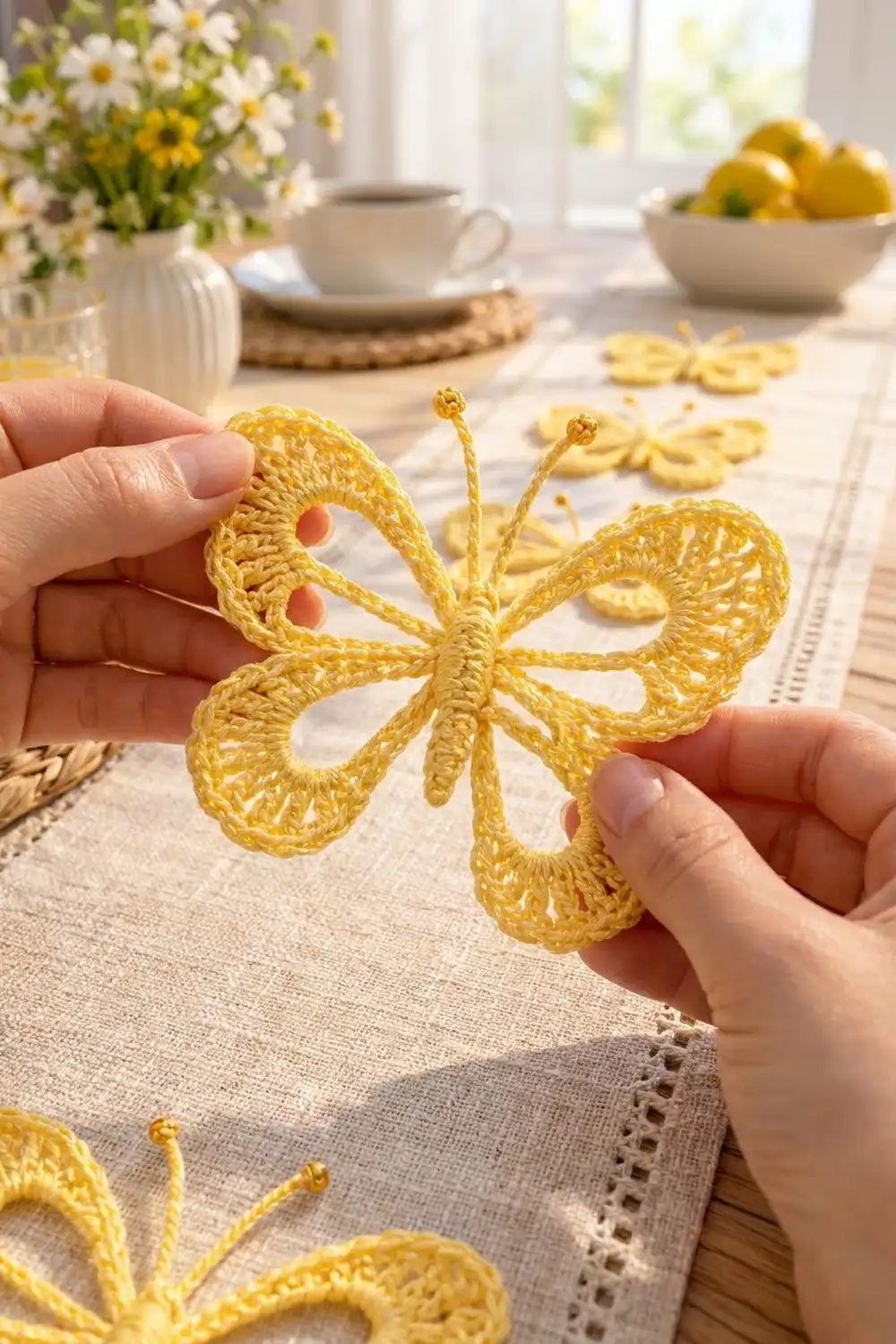
This lacy butterfly is a small, cheerful motif with four open wings, a raised body, and two bobble-tipped antennae. Each wing has a large open window, and a fan of tall stitches spreads around its outer edge like sunlight. The piece looks delicate but holds its shape well.
The sample uses one color only: a soft lemon-yellow mercerized cotton. A single color lets the texture show: the clean outline around each window, the airy gaps between the fan stitches, and the shine on the segmented body.
The pattern is written in US crochet terms. The finished butterfly measures about 5.5 in (14.0 cm) across the wings and 4.5 in (11.4 cm) tall, or about 5.25 in (13.3 cm) tall counting the antennae.
Construction is simple. You chain four loops from one shared center point and cover them with single crochet. Next you add a fan to the outer half of each wing, and one continuous border round runs around the whole outline. Last, you make a small tapered body, sew it over the center, and work the antennae from the head.
Finished Size and Construction
- Finished size: 5.5 in (14.0 cm) wide x 4.5 in (11.4 cm) tall, not counting antennae
- Skill level: Intermediate
- Terminology: US crochet terms
- Yarn weight: Sport weight (2, fine) mercerized cotton
- Hook: 2.75 mm (C-2)
- Number of pieces: 1 butterfly motif (wing base plus a small sewn-on body appliqué)
- Layout: 4 wings around one center point, 2 upper and 2 lower
- Piece size: 5.5 in (14.0 cm) x 4.5 in (11.4 cm)
- Size before border: 5.25 in (13.3 cm) x 4.25 in (10.8 cm)
- Border depth: about 0.125 in (0.3 cm), one round of single crochet
Materials
Choose a smooth mercerized cotton in sport weight. It gives crisp stitch definition and a slight sheen, and it blocks flat without sagging. Avoid fuzzy or stretchy yarns, because the wing windows will lose their shape.
Yarn:
– Lemon yellow: 10 g, about 30 m (33 yd)
This amount includes a comfortable margin for a gauge check, tails, and the body wraps. The butterfly itself uses about 7 g.
Tools:
– 2.75 mm (C-2) crochet hook
– Tapestry needle
– Scissors
– 4 locking stitch markers
– Rust-proof pins and a blocking mat
– Spray bottle with clean water
– Optional: light fabric stiffener or starch spray
Abbreviations (US Terms)
- ch – chain
- sl st – slip stitch
- sc – single crochet
- hdc – half double crochet
- dc – double crochet
- tr – treble crochet
- st(s) – stitch(es)
- sp – space
- rep – repeat
- Rnd – round
Special stitch – Bobble: *Yarn over, insert hook in indicated st, yarn over and pull up a loop, yarn over and pull through 2 loops; rep from * 3 more times in the same st (5 loops on hook), yarn over and pull through all 5 loops.
Gauge and Checkpoints
Gauge: 24 sc and 26 rows = 4 in (10.2 cm) in sc worked flat.
Gauge matters here because the wing windows are built from fixed chain counts. Treat Rnd 1 of the base as your test piece and compare it with Checkpoint 1 before you go further.
Checkpoint 1 (after Rnd 1): Each upper window measures about 1.75 in (4.4 cm) long x 1.25 in (3.2 cm) wide. Each lower window measures about 1.5 in (3.8 cm) x 1 in (2.5 cm).
Checkpoint 2 (after Row 4 of the fans): Each upper wing reaches about 2 5/8 in (6.7 cm) sideways from the center line. Each lower wing reaches about 2 in (5.1 cm) down and outward from the center.
Checkpoint 3 (before border): The wing base measures about 5.25 in (13.3 cm) x 4.25 in (10.8 cm).
Checkpoint 4 (after border): The butterfly measures 5.5 in (14.0 cm) x 4.5 in (11.4 cm).
Checkpoint 5 (body): The body measures about 2.25 in (5.7 cm) long x 0.5 in (1.3 cm) wide at the thorax.
If your piece is too big, go down one hook size to 2.5 mm. If it’s too small, go up to 3.0 mm. Don’t change the stitch counts, because the fans are calculated to lie flat at this gauge.

Pattern
Part 1: Wing Base (Four Loops)
All four loops start from one shared chain, called the center ch. The body covers it later.
Foundation:
Ch 37. Sl st in the 37th ch from hook (the very first ch made). That ch is the center ch, and the 36 ch after it form Loop A, the upper right wing.
Ch 30, sl st in the center ch (Loop B, lower right wing).
Ch 30, sl st in the center ch (Loop C, lower left wing).
Ch 36, sl st in the center ch (Loop D, upper left wing).
You now have four chain loops of 36, 30, 30, and 36 ch.
Rnd 1: Ch 1. Sc in each ch of Loop D (36 sc), sl st in center ch. Sc in each ch of Loop C (30 sc), sl st in center ch. Sc in each ch of Loop B (30 sc), sl st in center ch. Sc in each ch of Loop A (36 sc), sl st in center ch. Fasten off.
Stitch count: 132 sc total (36 + 30 + 30 + 36), plus 4 sl sts at the center.
Number the sc of each loop starting from the center, so the first sc after a center sl st is st 1. On each upper loop, sts 10–27 are the 18-st outer half. On each lower loop, sts 9–23 are the 15-st outer half. Mark st 10 on both upper loops and st 9 on both lower loops.
Lay the base flat with the upper loops pointing up and outward and the lower loops pointing down and outward. Check Checkpoint 1.
Part 2: Upper Wing Fans (Make 2)
Work these rows on Loop A and on Loop D. The fans are worked back and forth over the outer half only, so the inner edge of each window stays a plain sc band.
Row 2: With the right side facing, join yarn with a sl st in the marked st 10. Ch 3 (counts as dc), 2 dc in next st, dc in next st, 2 dc in next st; rep from * 7 more times. Turn. (27 dc)*
This growth row turns 18 sts into 27: 9 of the 18 sts get 2 dc.
Row 3: Ch 5 (counts as tr + ch 1), tr in next dc, ch 1, tr in next dc; rep from * across, ending with the last tr in the top of the turning ch. Turn. (27 tr, 26 ch-1 sps)*
These tall tr with small gaps create the lacy fan.
Row 4: Ch 1, sc in first tr, sc in next ch-1 sp, sc in next tr; rep from * across. Fasten off. (53 sc = 27 sc in tr + 26 sc in ch-1 sps)*
Part 3: Lower Wing Fans (Make 2)
Work these rows on Loop B and on Loop C.
Row 2: With the right side facing, join yarn with a sl st in the marked st 9. Ch 3 (counts as dc), dc in same st, dc in next st, 2 dc in next st; rep from * 6 more times. Turn. (23 dc)*
This growth row turns 15 sts into 23: 8 of the 15 sts get 2 dc.
Row 3: Ch 4 (counts as dc + ch 1), dc in next dc, ch 1, dc in next dc; rep from * across, ending with the last dc in the top of the turning ch. Turn. (23 dc, 22 ch-1 sps)*
The lower wings use dc instead of tr, which keeps them smaller and more teardrop-shaped.
Row 4: Ch 1, sc in first dc, sc in next ch-1 sp, sc in next dc; rep from * across. Fasten off. (45 sc = 23 sc in dc + 22 sc in ch-1 sps)*
Weave in the fan tails along the wrong side of Row 2. Check Checkpoints 2 and 3.
Border
Border gauge: 6 sc per 1 in (2.5 cm), the same as the main gauge. Along row ends, work 2 sc per dc row end, 3 sc per tr row end, and 1 sc per sc row end.
Border Rnd: With the right side facing, join yarn with a sl st in the center ch next to st 1 of Loop A. Work around each wing in turn, always moving in the same direction.
Each upper wing (Loops A and D):
– Sc in each of plain sts 1–9 of Rnd 1: 9 sc
– First fan edge: 1 sc in the Row 4 end, 3 sc in the Row 3 end, 2 sc in the Row 2 end, worked in the order your hook meets them: 6 sc
– Sc in each sc across Row 4: 53 sc
– Second fan edge: 6 sc, as above
– Sc in each of plain sts 28–36: 9 sc
– Sl st in center ch.
Upper wing total: 9 + 6 + 53 + 6 + 9 = 83 sc
Each lower wing (Loops B and C):
– Sc in each of plain sts 1–8: 8 sc
– First fan edge: 1 sc in the Row 4 end, 2 sc in the Row 3 end, 2 sc in the Row 2 end: 5 sc
– Sc in each sc across Row 4: 45 sc
– Second fan edge: 5 sc
– Sc in each of plain sts 24–30: 7 sc
– Sl st in center ch.
Lower wing total: 8 + 5 + 45 + 5 + 7 = 70 sc
Fasten off after the last wing. Total border: 83 + 70 + 70 + 83 = 306 sc, plus 4 center sl sts.
Why the math works: Every existing st gets exactly 1 sc, so the border doesn’t gather or ruffle along the plain bands or across Row 4. The row-end ratios match stitch height: a dc is about 2 sc tall and a tr is about 3 sc tall. The plain sts plus the outer-half sts equal each loop’s full count (upper: 9 + 18 + 9 = 36; lower: 8 + 15 + 7 = 30), so no stitch is skipped or doubled. The round adds about 0.125 in (0.3 cm) at each outer edge. That takes the piece from 5.25 in (13.3 cm) to 5.5 in (14.0 cm) wide and from 4.25 in (10.8 cm) to 4.5 in (11.4 cm) tall.
Body and Antennae
Body (Appliqué)
The body is worked around both sides of a foundation chain. Changing stitch heights shape it into a narrow tail, a wider thorax, and a rounded head.
Ch 14.
Rnd 1: Sl st in 2nd ch from hook (tail tip), sc in next 3 ch, hdc in next 3 ch, dc in next 4 ch, hdc in next ch, 5 dc in last ch (head). Rotate the piece and work along the opposite side of the foundation ch: hdc in next ch, dc in next 4 ch, hdc in next 3 ch, sc in next 3 ch, sl st in last ch. (29 sts = 12 + 5 head + 12)
Fasten off, leaving a 24 in (61.0 cm) tail.
Segments: Thread the tail onto the tapestry needle. Starting just below the head, wrap it snugly around the body 5 times, about 0.25 in (0.6 cm) apart. After each wrap, pass the needle through the body to lock the wrap in place. Finish at the tail tip and keep the rest of the tail for sewing. Check Checkpoint 5.
Attach the Body
Center the body over the wing base, with the head just above the center ch and the tail pointing down between the lower wings. Whipstitch around the body’s edge through the wing base, catching all 4 center sl sts. Let the body stay slightly domed.
Antennae (Make 2)
With the right side facing, join yarn with a sl st in the 2nd dc of the head’s 5-dc group. Ch 12. Work a Bobble in the 4th ch from hook. Sl st in each of the remaining 8 ch. Sl st in the same head st and fasten off.
For the second antenna, join yarn in the 4th dc of the head group and repeat. Each antenna is about 1.25 in (3.2 cm) long, and the two angle outward in a gentle V.
Final Blocking
- Weave in all remaining ends on the wrong side, following solid stitches so nothing shows through the lace.
- Spray the butterfly evenly until it’s damp but not dripping.
- Lay it wrong side up on the blocking mat.
- Pin the center first. Then pin each upper wing tip 2.75 in (7.0 cm) from the center line, for a total width of 5.5 in (14.0 cm).
- Pin the lower wings so the height from the top of the upper wings to the bottom of the lower wings is 4.5 in (11.4 cm).
- Pin each window into a smooth teardrop, and pin every 3rd or 4th fan stitch so the gaps open evenly.
- Turn it right side up and shape the body and antennae with your fingers.
- For a firmer finish, mist lightly with stiffener.
- Let it dry completely before you unpin it.
Final Quality-Control Checklist
- Rnd 1 has 36, 30, 30, and 36 sc, and no window is twisted.
- Upper fans: 27 dc, then 27 tr with 26 ch-1 sps, then 53 sc.
- Lower fans: 23 dc, then 23 dc with 22 ch-1 sps, then 45 sc.
- Border: 83 sc per upper wing, 70 sc per lower wing, 306 sc total.
- The butterfly measures 5.5 in (14.0 cm) x 4.5 in (11.4 cm).
- The body is 2.25 in (5.7 cm) long with 5 even wraps and covers the center.
- The antennae are the same length, each with a round bobble tip.
- No tails show on the right side.
Troubleshooting
The fan ruffles. Your tall stitches are probably shorter than gauge and packing too tightly. Go up a hook size for Rows 2–3 only, or block more firmly.
The fan cups or distorts the window. Your tall stitches are too loose. Go down a hook size for the fans and keep yarn-overs snug.
The windows twist at the center. A loop flipped while you were chaining. Before Rnd 1, lay all four loops flat and make sure none crosses itself.
Gaps appear where the fan meets the plain band. Work the border’s row-end sts into the edge of the row, not into the window, and keep them firm.
The body is lopsided. Count both sides of Rnd 1. Each must have exactly 12 sts, in the same order.
The bobbles look flat. Pull the final yarn-over snug, then push the bobble to the right side.
Care
Hand wash in cool water with mild soap, press out the water in a towel, and dry flat after reshaping. If you used stiffener, mist and reshape again after washing.
Final Notes
The measurement chain is short. Rnd 1 sets the upper windows at 1.75 in (4.4 cm) long and the lower windows at 1.5 in (3.8 cm) long. The fans carry the upper wings 2 5/8 in (6.7 cm) sideways from the center line and the lower wings 2 in (5.1 cm) from the center, so the base measures 5.25 in (13.3 cm) x 4.25 in (10.8 cm). The 306-st border brings the butterfly to 5.5 in (14.0 cm) x 4.5 in (11.4 cm). The 2.25 in (5.7 cm) body and 1.25 in (3.2 cm) antennae finish it.
Happy crocheting!