

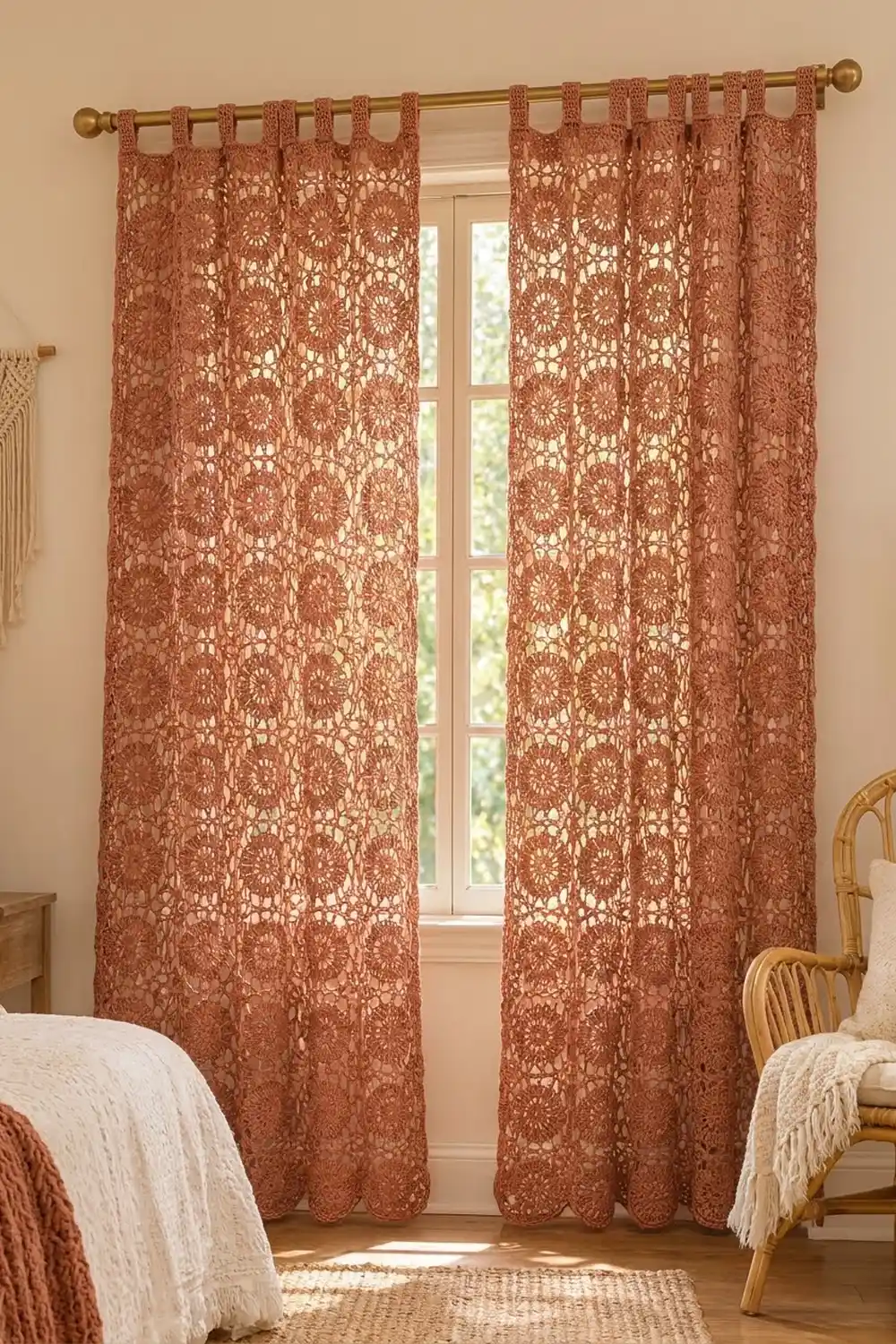
These lace curtain panels are made from round wheel motifs set in an open chain mesh. Each wheel has a small solid center, a ring of tall spokes, and a solid outer band. Chain loops fill the space between the wheels, so daylight comes through in a soft, even net.
The panels use a single warm terracotta shade of worsted-weight cotton. The style is boho and a little vintage, and it suits a bedroom or living room window. At the bottom, a scalloped edge curves under each wheel in the last row. At the top, simple crocheted tabs slide straight onto a curtain rod.
This pattern uses US crochet terms. One finished panel is 26 in (66.0 cm) wide and 86.5 in (219.7 cm) long. The 3 in (7.6 cm) tab loops sit above that. The window shown uses a pair, so make two panels.
Each panel has 56 motifs, joined as you go on the last round: 4 across and 14 down. A three-round border then goes all the way around the panel. On the bottom edge, Round 2 of the border forms the scallops. Five tabs finish the top.
Finished Size and Construction
- Finished size (one panel): 26 in x 86.5 in (66.0 cm x 219.7 cm), plus 3 in (7.6 cm) tabs
- Skill level: Intermediate
- Terminology: US
- Yarn weight: Worsted (#4), cotton or cotton blend
- Hook: 5.0 mm (H-8)
- Number of pieces: 56 motifs per panel; 112 for a pair
- Layout: 4 motifs wide x 14 motifs long
- Motif size: 6 in (15.2 cm) square, blocked
- Size before border: 24 in x 84 in (61.0 cm x 213.4 cm)
- Border depth: 1 in (2.5 cm) on the top and sides; 1.5 in (3.8 cm) at the center of each bottom scallop
Materials
Yarn: Use a smooth worsted-weight cotton, either mercerized or combed, with about 170 m per 100 g. Cotton hangs well, keeps the wheels crisp, and handles sunlight better than most acrylics. Buy all of it from one dye lot. With light coming through the window, any color shift will show.
- Terracotta: 550 g (935 m) per panel; 1,100 g (1,870 m) for a pair
These amounts include a margin of about 15% for swatching, joining, and weaving in ends.
Tools:
- 5.0 mm (H-8) crochet hook
- Tapestry needle
- Stitch markers
- Measuring tape
- Rust-proof pins and foam blocking mats, or a clean carpet covered with a sheet
- Spray bottle
Abbreviations (US Terms)
- ch – chain
- sl st – slip stitch
- sc – single crochet
- hdc – half double crochet
- dc – double crochet
- tr – treble crochet
- sp(s) – space(s)
- st(s) – stitch(es)
- beg – beginning
- rep – repeat
- RS / WS – right side / wrong side
Special technique – join-loop: On a ch-5 loop you are joining, work ch 2, sl st into the matching ch-5 loop of the motif next to it, then ch 2.
Join-corner: On a ch-7 corner you are joining, work ch 3, sl st into the corner loop of the motif next to it, then ch 3. If that corner already has a join, sl st into the existing joining sl st instead.
Gauge and Checkpoints
Make and block one full motif first. Every measurement of the panel depends on it.
- After Round 1: 1.5 in (3.8 cm) across
- After Round 2: 3 in (7.6 cm) across
- After Round 3: 4 in (10.2 cm) across; this completes the solid wheel
- After Round 4: 5 in (12.7 cm) across, still round
- After Round 5: 6 in (15.2 cm) square, measured corner to corner along one side after blocking
Border gauge: 13 sc = 3 in (7.6 cm), or about 4.33 sc per inch.
If your blocked motif is larger than 6 1/4 in (15.9 cm), use a hook half a millimeter smaller. If it is smaller than 5 3/4 in (14.6 cm), use a hook half a millimeter larger. Small errors add up over 14 rows. If each motif is off by 1/4 in (0.6 cm), the panel length changes by 3.5 in (8.9 cm).
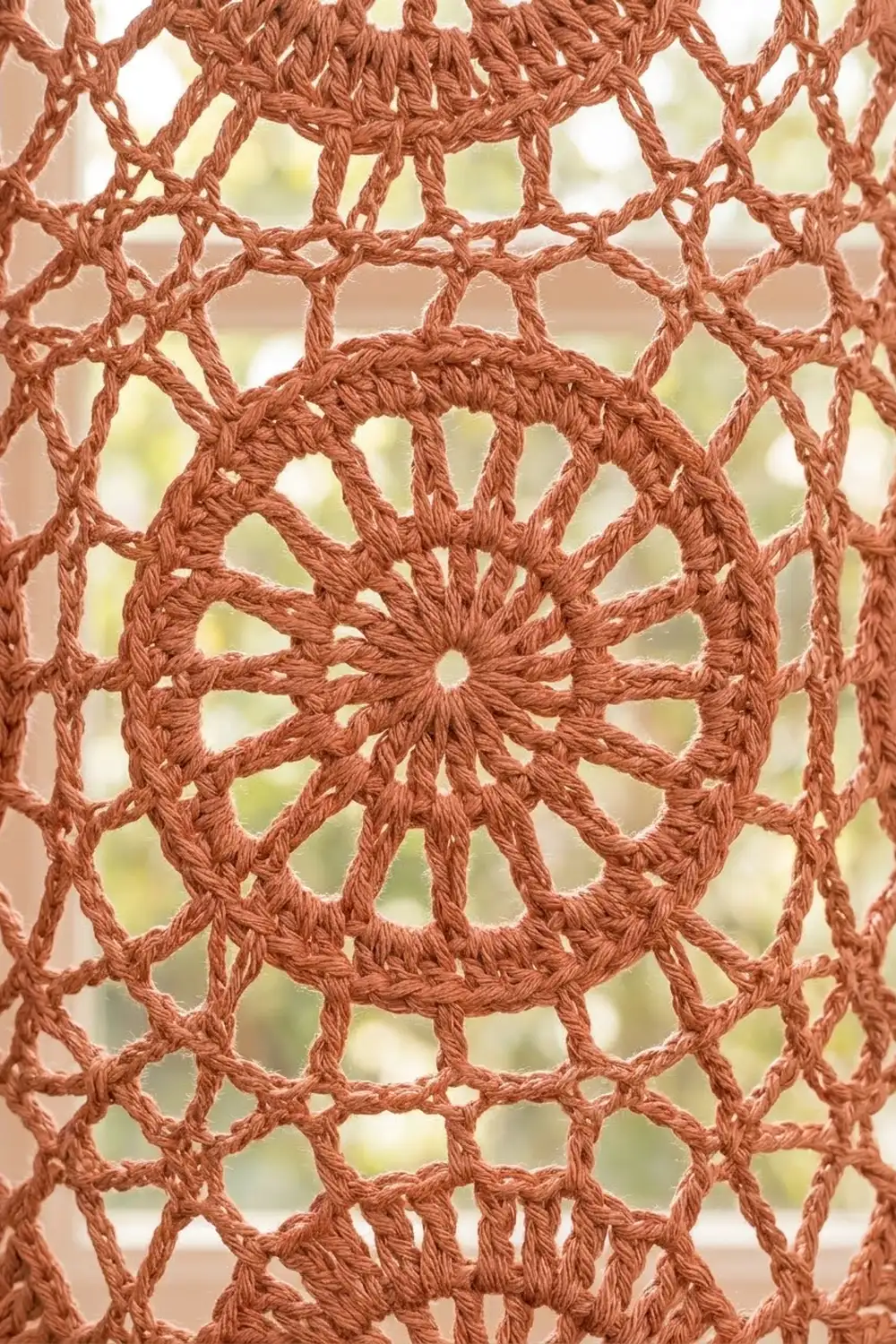
Motif
Work each motif in the round with the RS facing. Do not turn.
Round 1: Make a magic ring. Ch 3 (counts as dc), work 15 dc in the ring, and join with a sl st to the top of the beg ch-3. Pull the ring closed. (16 dc)
Round 2 (spokes): Ch 6 (counts as tr + ch 2). Then work [tr in next dc, ch 2] 15 times. Join with a sl st to the 4th ch of the beg ch-6. (16 tr, 16 ch-2 sps)
These tall, open stitches form the ring of spokes around the center.
Round 3 (solid band): Sl st into the first ch-2 sp. Ch 3 (counts as dc) and work 2 dc in the same sp. Work 3 dc in each remaining ch-2 sp around. Join to the top of the beg ch-3. (48 dc)
The dc fill the spaces completely and make the solid outer ring of the wheel. Check that the wheel is 4 in (10.2 cm) across and lies flat.
Round 4 (mesh): Ch 1, sc in the same st, ch 5, skip 2 dc. Then work [sc in next dc, ch 5, skip 2 dc] 15 times. Join with a sl st to the first sc. (16 sc, 16 ch-5 loops)
Round 5 (squaring, first motif only):
- Sl st into the first 3 ch of the first ch-5 loop to reach its center.
- Ch 1, then work (sc, ch 7, sc) in the same loop. This is the first corner.
- Work [ch 5, sc in next loop] 3 times, ch 5, then (sc, ch 7, sc) in the next loop. Repeat from * 2 more times.
- Work [ch 5, sc in next loop] 3 times, ch 5, and join to the first sc. Fasten off.
(20 sc, 16 ch-5 loops, 4 ch-7 corner loops)
Each side now has 4 ch-5 loops between two ch-7 corner loops. The mesh rounds square off the round wheel, so the motifs line up in a grid while the wheels stay round.
All other motifs: Work Rounds 1–4 the same way. Work Round 5 as written, but use join-loop and join-corner on every side that meets a finished motif.
Make All Pieces
- Terracotta: 56 motifs per panel (112 for a pair)
Each motif uses about 9 m of yarn. Join each new motif as soon as you finish it. Work row by row, starting at the top left.
Layout (M = motif; Row 1 is the top of the curtain):
Row  1:  M  M  M  M
Row  2:  M  M  M  M
Row  3:  M  M  M  M
Row  4:  M  M  M  M
Row  5:  M  M  M  M
Row  6:  M  M  M  M
Row  7:  M  M  M  M
Row  8:  M  M  M  M
Row  9:  M  M  M  M
Row 10:  M  M  M  M
Row 11:  M  M  M  M
Row 12:  M  M  M  M
Row 13:  M  M  M  M
Row 14:  M  M  M  M
The bottom of Row 14 becomes the scalloped hem.
Joining
Method: Join as you go on Round 5.
How the stitches match: Each side of a motif has exactly 4 ch-5 loops between its 2 corners. They join one-to-one, in order, to the 4 loops on the side of the motif next to it, and each pair of corners joins at a single point. The counts are equal, so you don’t need to ease anything. Where four motifs meet, all four corners join at the same sl st.
Order: Join the second motif in Row 1 along one side. On the first motif of Row 2, join only the top side. Every motif after that joins its top side and its left side.
Tension: Make the join-loop chains (ch 2, sl st, ch 2) with the same tension as a free ch-5. If the joins are too tight, the seams pucker. If they are too loose, the lattice sags. Every few motifs, lay the work flat and check that the corner joins line up straight in both directions.
Size checkpoints: Measure flat without stretching.
- After Row 1: 24 in (61.0 cm) wide
- After Row 7: 42 in (106.7 cm) long
- After Row 14: 84 in (213.4 cm) long
Border
With the RS facing, join the yarn in any ch-5 loop on the top edge.
Border gauge: 13 sc = 3 in (7.6 cm).
Round 1 (sc): Along each motif edge, work these stitches:
- 3 sc in the corner-loop half at the start. This is the ch-7 half, or the ch-3 segment on a joined motif.
- 5 sc in each of the 4 ch-5 loops.
- 3 sc in the corner-loop half at the end.
That makes 26 sc per motif side, with both corner halves already counted. Do not add stitches at the seams.
At each of the 4 outer corners of the panel, work (3 sc, ch 2, 3 sc) in the single ch-7 loop. These 3-sc groups are part of each side’s 26. Join to the first sc.
- Top and bottom: 4 motifs x 26 = 104 sc each
- Sides: 14 motifs x 26 = 364 sc each
- Total: 936 sc + 4 corner ch-2 sps
Round 2 (dc and scallops): Ch 3 (counts as dc), then work as follows:
- Top and both sides: dc in each sc.
- Every corner: (2 dc, ch 2, 2 dc) in the ch-2 sp.
- Bottom edge: Work 1 scallop over each motif’s 26 sc. Work sc in the 1st st, hdc in the next 2 sts, dc in the next 3 sts, tr in the next 14 sts, dc in the next 3 sts, hdc in the next 2 sts, and sc in the last st. That is 1 + 2 + 3 + 14 + 3 + 2 + 1 = 26 sts. Work 4 scallops in all.
Join to the top of the beg ch-3.
- Top and bottom: 104 + 2 + 2 = 108 sts each, between the corner ch-2 sps
- Sides: 364 + 2 + 2 = 368 sts each
- Total: 952 sts + 4 corner ch-2 sps
The tr in the middle of each scallop hang lower than the sc at the seams, so each scallop curves down under its wheel.
Round 3 (sc trim): Ch 1, sc in each st around, with 3 sc in each corner ch-2 sp. Join and fasten off. (952 + 12 = 964 sc)
- Top and bottom: 112 sc each, counted from one corner’s center sc to the other, both included (108 sts + 2 from each corner group)
- Sides: 368 + 2 + 2 = 372 sc each, counted the same way
Why the math works: Each motif side gives exactly 26 sc. At the border gauge, 26 / 4.33 = 6 in (15.2 cm), the same width as the motif, so the edges lie flat and don’t ruffle or cup. Round 2 goes 1 stitch into each stitch, and its corner groups only turn the corners. Round 3 adds 3 stitches at each corner and nothing else.
Tabs
With the RS facing, count the 112 top stitches starting from the top-right corner’s center sc, which is stitch 1. Join the yarn in stitch 1.
Row 1: Ch 1, sc in the same st and in the next 7 sts, turn. (8 sc)
Rows 2–26: Ch 1, sc in each st, turn. (8 sc)
Each tab measures 6 in (15.2 cm) long and 1.8 in (4.6 cm) wide. Fasten off and leave a 12 in (30.5 cm) tail. Fold the tab to the WS and sew the last row to the base of Border Round 1. This makes a 3 in (7.6 cm) loop that fits a rod up to 1.5 in (3.8 cm) thick.
Skip 18 sts, then work the next tab over the next 8 sts. Make 5 tabs in total. The math is 5 x 8 = 40 tab sts plus 4 x 18 = 72 gap sts, for 112 sts. The two outer tabs line up with the corners.
Final Blocking
- Weave in all ends along chain loops or through the solid dc bands, where they won’t show against the light.
- Soak the panel in cool water with a little wool wash for 20 minutes. Press the water out gently, and don’t wring.
- Roll the panel in towels to remove as much water as you can.
- Lay it flat on blocking mats or a carpet covered with a sheet. Don’t hang it, because wet cotton is heavy and will stretch.
- Pin the edges to 26 in x 86.5 in (66.0 cm x 219.7 cm), and pin each scallop into a smooth curve.
- Ease each wheel into a circle, and straighten the lines of corner joins.
- Let it dry completely, which takes 24–48 hours. Block the second panel to the same pin marks.
Final Quality-Control Checklist
- All 56 motifs are 6 in (15.2 cm) square, with flat, round wheels.
- Every motif has 16 spokes and a solid band of 48 dc.
- The corner joins line up straight in both directions.
- Before the border, the panel measures 24 in x 84 in (61.0 cm x 213.4 cm).
- Border Round 1 has 104 / 364 / 104 / 364 sc.
- There are 4 even scallops, each centered under a wheel.
- The 5 tabs are evenly spaced, and each loop is 3 in (7.6 cm).
- The two panels are within 1/2 in (1.3 cm) of each other in length.
Troubleshooting
- Wheel cups: Round 3 is too tight. Use a hook one size larger for that round.
- Wheel ruffles: The tr are too tall. Snug the loops down onto the hook.
- Seams pucker: The join chains are too tight. Loosen the ch 2 on each side of the joining sl st.
- Gaps where four corners meet: Sl st into the existing joining sl st, not into the corner loop next to it.
- Border ruffles or pulls: Count 26 sc per motif side. The usual cause is extra stitches at the seams.
- Flat scallops: Make full-height tr, and pin the curves firmly when you block.
- Panels don’t match: Block the two panels side by side, and adjust the pins by up to 1 in (2.5 cm).
Care
Hand wash in cool water, or machine wash on a gentle cycle inside a mesh bag. Always dry the panels flat, because hanging them wet will stretch the lace.
Final Notes
Every measurement comes back to the 6 in (15.2 cm) motif, which gives 26 border sc per side. Four motifs across make 24 in (61.0 cm) and 104 sc. Fourteen motifs down make 84 in (213.4 cm) and 364 sc. The three border rounds bring each panel to 26 in x 86.5 in (66.0 cm x 219.7 cm). Keep your first motif as a reference and check your measurements as you join, so the two panels hang evenly.
Happy crocheting!