

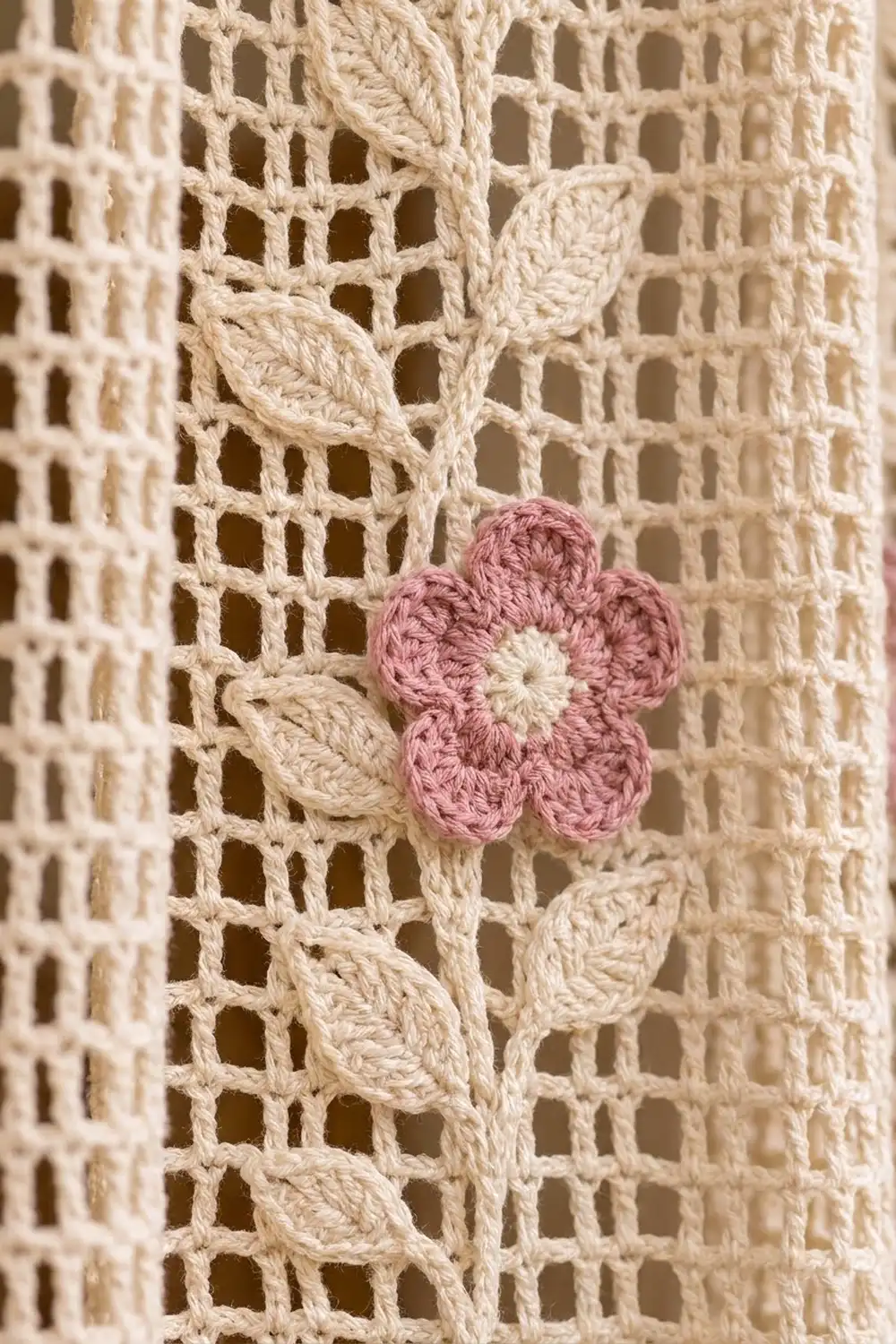
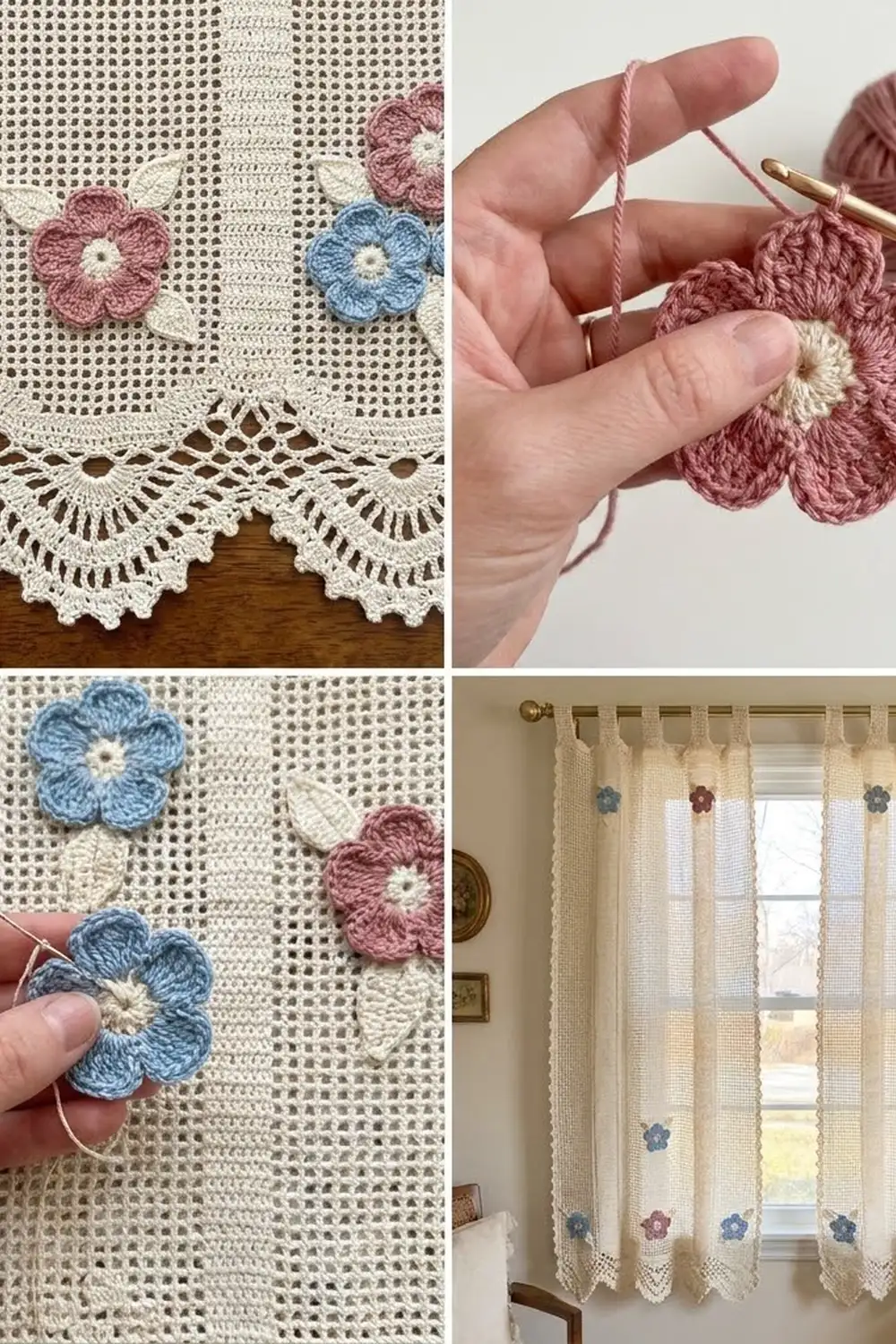
The Cottage Bloom curtain panel is a soft cream filet mesh. Narrow columns of solid blocks run from top to bottom, and between them, cream vines climb the open grid carrying little leaves and five-petal flowers. A scalloped lace hem weighs down the bottom edge, and the top hangs from simple folded tabs.
The palette is gentle: a cream base, dusty rose and powder blue flowers, and cream flower centers that tie them back to the mesh. The style is cottage and vintage, and it works in a kitchen, bedroom or sunny breakfast nook. All instructions use US crochet terms.
One finished panel measures 30.5 in (77.5 cm) wide by 58 in (147.3 cm) long from the top edge to the scallop tips. The tab loops add another 3 in (7.6 cm) above. The photo shows a pair, so make two identical panels for one window.
Construction is simple. You work the panel body in rows of filet mesh as a single piece, add one edging round, then work the scalloped hem across the bottom and the tabs across the top. The flowers, leaves and vine cords are made separately and sewn onto the mesh.
Finished Size and Construction
- Finished size (one panel): 30.5 in x 58 in (77.5 cm x 147.3 cm), plus 3 in (7.6 cm) tab loops
- Skill level: Intermediate
- Terminology: US crochet terms
- Yarn weight: DK / light (3), cotton
- Hook: 4.0 mm (G-6)
- Number of pieces: 1 panel body per curtain, plus sewn-on appliqués (24 flowers, 40 leaves, 4 vine cords)
- Layout: 50 meshes wide x 108 rows tall, with 5 vertical block columns
- Panel body size before border: 30 in x 54 in (76.2 cm x 137.2 cm)
- Border depth: edging round about 0.25 in (0.6 cm) on every edge; scalloped hem 3.5 in (8.9 cm)
Materials
Use a smooth mercerized or combed cotton in DK weight. Cotton holds the mesh crisp, takes blocking well, and washes cleanly. Avoid fuzzy yarns, because they blur the open squares. The amounts below are for one panel, so double them for a pair. The yardage assumes balls of 50 g / 115 yd (105 m).
- Cream (main color): 900 g, 2,070 yd (1,890 m)
- Dusty rose: 50 g, 115 yd (105 m)
- Powder blue: 50 g, 115 yd (105 m)
Tools:
- 4.0 mm (G-6) crochet hook
- Tapestry needle
- Locking stitch markers
- Rust-proof pins and a large blocking surface
- Measuring tape
- Spray bottle
All quantities include a margin of about 15% for swatching and tails.
Abbreviations (US Terms)
- ch: chain
- sl st: slip stitch
- sc: single crochet
- hdc: half double crochet
- dc: double crochet
- sk: skip
- sp(s): space(s)
- st(s): stitch(es)
- rep: repeat
- RS / WS: right side / wrong side
Special stitches:
- Mesh: ch 2, sk 2 sts, dc in next st.
- Block: dc in each of next 3 sts. Over a mesh, work 2 dc in the ch-2 sp, then dc in the next dc.
- V-st: (dc, ch 2, dc) in the same st.
- Picot: ch 3, sl st in 3rd ch from hook.
Gauge and Checkpoints
Filet gauge: 5 meshes (15 sts) = 3 in (7.6 cm) wide, and 6 rows = 3 in (7.6 cm) tall. So one mesh is 0.6 in (1.5 cm) wide and one row is 0.5 in (1.3 cm) tall.
Edging gauge: 5 sc = 1 in (2.5 cm).
Before you start the full panel, test one piece. Make one flower and one leaf to check your tension, then work a swatch of 10 meshes by 12 rows. That swatch should measure 6 in x 6 in (15.2 cm x 15.2 cm) after a light steam.
Checkpoints:
- Row 1: the width is 30 in (76.2 cm) with the chain relaxed.
- Row 24: the height is 12 in (30.5 cm).
- Row 54: the height is 27 in (68.6 cm).
- Row 108: the body measures 30 in x 54 in (76.2 cm x 137.2 cm).
- Flower: 2.25 in (5.7 cm) across. Leaf: 1.75 in (4.4 cm) long.
If your swatch is too big, go down half a hook size. If it is too small, go up half a size. If only the height is off, change how high you draw up the dc loops, and keep your hook size for the width.
Panel Body
The panel is 151 sts wide, which is 50 units of 3 sts plus 1. Each row has 51 dc posts. The blocks fill 10 of the units, so every row has 71 dc and 40 ch-2 sps in total.
Foundation: With cream, ch 155.
Row 1: Dc in the 8th ch from hook. This makes the first mesh. Ch 2, sk 2 ch, dc in next ch; rep from * 2 more times (4 meshes made). Dc in each of next 6 ch (2 blocks). [Ch 2, sk 2 ch, dc in next ch] 8 times. Rep from ** to ** 3 more times. Dc in each of next 6 ch (2 blocks). [Ch 2, sk 2 ch, dc in next ch] 4 times. Turn.
Count: 50 units (40 meshes and 10 blocks), 151 sts. The blocks sit at units 5–6, 15–16, 25–26, 35–36 and 45–46.
Row 2: Ch 5 (counts as dc and ch 2), dc in next dc. [Ch 2, dc in next dc] 3 times. Dc in each of next 6 dc. [Ch 2, dc in next dc] 8 times. Rep from ** to ** 3 more times. Dc in each of next 6 dc. [Ch 2, dc in next dc] 3 times, then ch 2, dc in 3rd ch of turning ch. Turn.
Count: 50 units, 151 sts.
Rows 3–108: Rep Row 2. The blocks stack into 5 solid columns, each 2 units wide (1.2 in / 3.0 cm). Between the columns are four open bands of 8 meshes each, 4.8 in (12.2 cm) wide, and the vines will go in these bands. At each side edge is an open band of 4 meshes. Do not fasten off; you will use this yarn for the edging round.
Flowers (make 24: 16 dusty rose, 8 powder blue)
Rnd 1 (cream): Make a magic ring, ch 1, work 10 sc in the ring, sl st to first sc. Pull the ring closed tightly. Fasten off. (10 sc.)
Rnd 2 (petal color): Join in any sc. Ch 1, sc in same sc. Ch 3, sk next sc, sc in next sc; rep from * 3 more times. Ch 3, sk last sc, sl st to first sc. (5 sc, 5 ch-3 loops.)
Rnd 3: In each ch-3 loop work (sc, hdc, 3 dc, hdc, sc). Sl st to first sc. (5 petals, 7 sts each, 35 sts.)
Fasten off, leaving a 12 in (30.5 cm) tail for sewing. The cream center sits slightly raised inside the ring of petals.
Leaves (make 40, cream)
Ch 9. Sl st in 2nd ch from hook, then sc, hdc, dc, dc, hdc and sc in the next 6 ch, one stitch in each ch. Work (sc, ch 2, sc) in the last ch to form the tip. Now work along the other side of the foundation chain: sc, hdc, dc, dc, hdc and sc in the next 6 ch, then sl st in the last ch. Fasten off, leaving a 10 in (25.4 cm) tail.
The finished leaf is pointed at both ends, with 16 sts plus the ch-2 tip.
Vine Cords (make 4, cream)
Ch 180, or until the chain measures 54 in (137.2 cm) when slightly stretched. Sl st in the back bump of each ch. Fasten off. This makes a firm, flat cord.
Arrange and Sew the Appliqués
Do this before the border. Lay the panel flat with the RS up.
- Vines: Pin one cord up the center of each 8-mesh band, starting at Row 4 and ending at Row 104 (50 in / 127.0 cm of height). Ease the cord into a gentle S-wave that swings between the 2nd and 7th mesh of the band, with a full curve about every 8 in (20.3 cm). Whipstitch the cord to the dc posts it crosses.
- Flowers: Place 6 flowers on each vine, centered at Rows 8, 24, 40, 56, 72 and 88. The colors on each vine run rose, blue, rose, rose, blue, rose from the bottom up. Sew around the cream center and through each petal tip so the flower stays flat.
- Leaves: Place 10 leaves on each vine, one or two between each pair of flowers. Tuck the base of each leaf under the cord and angle the tip upward. Sew down the center line and at the tip.
Check that every band looks the same. Then weave in all tails on the WS.
Border
Border gauge: 151 sc across the top or bottom must lie flat over 30 in (76.2 cm), and 270 sc along each side must lie flat over 54 in (137.2 cm).
Edging Rnd 1: Continuing from Row 108 with the RS facing, ch 1.
- Top edge: 151 sc, one in each st.
- Corner: Ch 2.
- Side: 270 sc along the row ends, working 2 sc and 3 sc into alternate rows (54 x 2 + 54 x 3 = 270).
- Corner: Ch 2.
- Bottom edge: 151 sc. Work 1 sc at the base of each dc (51 sc) and 2 sc in each 2-ch section or block (100 sc).
- Corner: Ch 2.
- Second side: 270 sc.
- Corner: Ch 2. Sl st to the first sc.
Count: 842 sc and 4 corner ch-2 sps. The corners are spaces, not stitches, so each side’s count is its full count. Fasten off.
Scalloped Hem
Work across the 151 bottom sc only, with the RS facing.
Row 1 (RS): Join in the first bottom sc. Ch 1, sc in the same sc. Ch 5, sk 4 sc, sc in next sc; rep from * 29 more times. Turn. (31 sc, 30 ch-5 loops.)
Row 2 (WS): Ch 1, sc in first loop. Ch 3, work (dc, [ch 1, dc] 4 times) in next loop, ch 3, sc in next loop. Ch 1, sc in next loop. Rep from * to * 9 more times, ending with the final sc in loop 30 (do not work the ch 1 and sc after the last scallop). Turn.
Count: 10 fans of 5 dc each, 20 sc, 20 ch-3 sps, 9 ch-1 sps.
Row 3 (RS): Ch 1, sc in first sc. Ch 3, [V-st in next dc, ch 1] 4 times, V-st in next dc, ch 3, sc in next sc. Sc in next ch-1 sp, sc in next sc. Rep from * to * 9 more times, ending with the final sc in the last sc (no sc in a ch-1 sp after the last scallop). Turn.
Count: 50 V-sts, 29 sc, 20 ch-3 sps.
Row 4 (WS): Ch 1, sc in first sc. 3 sc in ch-3 sp. [(Sc, hdc, picot, hdc, sc) in next ch-2 sp, sc in next ch-1 sp] 4 times. (Sc, hdc, picot, hdc, sc) in next ch-2 sp. 3 sc in next ch-3 sp, sc in next sc. Sk next sc, sc in next sc. Rep from * to * 9 more times, ending with the final sc in the last sc. Fasten off.
Count: 10 scallops, 50 picots.
Why the math works: Row 1 uses 1 + (30 x 5) = 151 sc, which is exactly the bottom count. The 30 loops make 10 scallops of 3 loops each. Each scallop covers 15 sc, or 3 in (7.6 cm), and 10 x 3 in = 30 in (76.2 cm), so the hem is exactly as wide as the body.
Top Tabs (make 8)
Each tab is 11 sc wide, 2.2 in (5.6 cm), and the gaps between tabs are 9 sc, 1.8 in (4.6 cm). Check the math: 8 x 11 + 7 x 9 = 151.
With the RS facing, join in top sc number 1, 21, 41, 61, 81, 101, 121 or 141.
- Row 1: Ch 1, sc in same st and next 10 sc. (11 sc.)
- Rows 2–30: Ch 1, turn, sc in each sc. (11 sc.) The tab is 6 in (15.2 cm) long.
Fold each tab to the WS and whipstitch Row 30 along the base of the tab. This forms a 3 in (7.6 cm) loop.
Final Blocking
- Weave in any remaining tails, and check that the appliqué stitches are secure.
- Soak the panel in cool water for 15 minutes, then press out the water in towels. Do not wring it.
- Lay it flat with the RS down on a padded surface, so the flowers keep their raised look.
- Pin the body to 30.5 in x 54.5 in (77.5 cm x 138.4 cm) including the edging. Keep the block columns straight and vertical.
- Pin each scallop to 3.5 in (8.9 cm) deep, and pin out every picot.
- Ease each flower round and each leaf flat with your fingers.
- Let it dry completely. Unpin, then check that the length to the scallop tips is 58 in (147.3 cm).
Final Quality-Control Checklist
- Every row has 151 sts and 5 aligned block columns.
- The body measures 30 in x 54 in (76.2 cm x 137.2 cm) before the border.
- The edging has 151 / 270 / 151 / 270 sc.
- There are 10 even scallops with 50 picots.
- All 8 tabs are evenly spaced and the same length.
- Each vine has 6 flowers and 10 leaves, all sewn flat.
- No tails show on the RS.
Troubleshooting
- Meshes lean or look like rectangles: Your ch-2 sps are too tight or too loose compared with your dc. Adjust your chain tension, not your hook.
- Block columns drift sideways: You missed or added a st. Count to 151 every 10 rows.
- The hem ruffles: The ch-5 loops are too loose. Use ch 4 instead and re-block.
- The hem pulls in: Go up half a hook size for the hem rows only.
- Side edges ripple: Use 2 sc in more of the row ends, but keep the total at 270.
- Flowers cup: Rnd 1 is too tight. Work it with a looser ring.
Care
Hand wash cool with mild soap, then dry flat and reshape the scallops. A light steam from the WS refreshes the mesh between washes.
Final Notes
The measurement chain is short and reliable. A 6 in (15.2 cm) swatch gives a 30 in x 54 in (76.2 cm x 137.2 cm) body. The edging round brings it to 30.5 in (77.5 cm) wide, and the 3.5 in (8.9 cm) hem brings it to 58 in (147.3 cm) long. Check your counts at each stage, make a second panel to match, and your window will be framed in flowers.
Happy crocheting!