

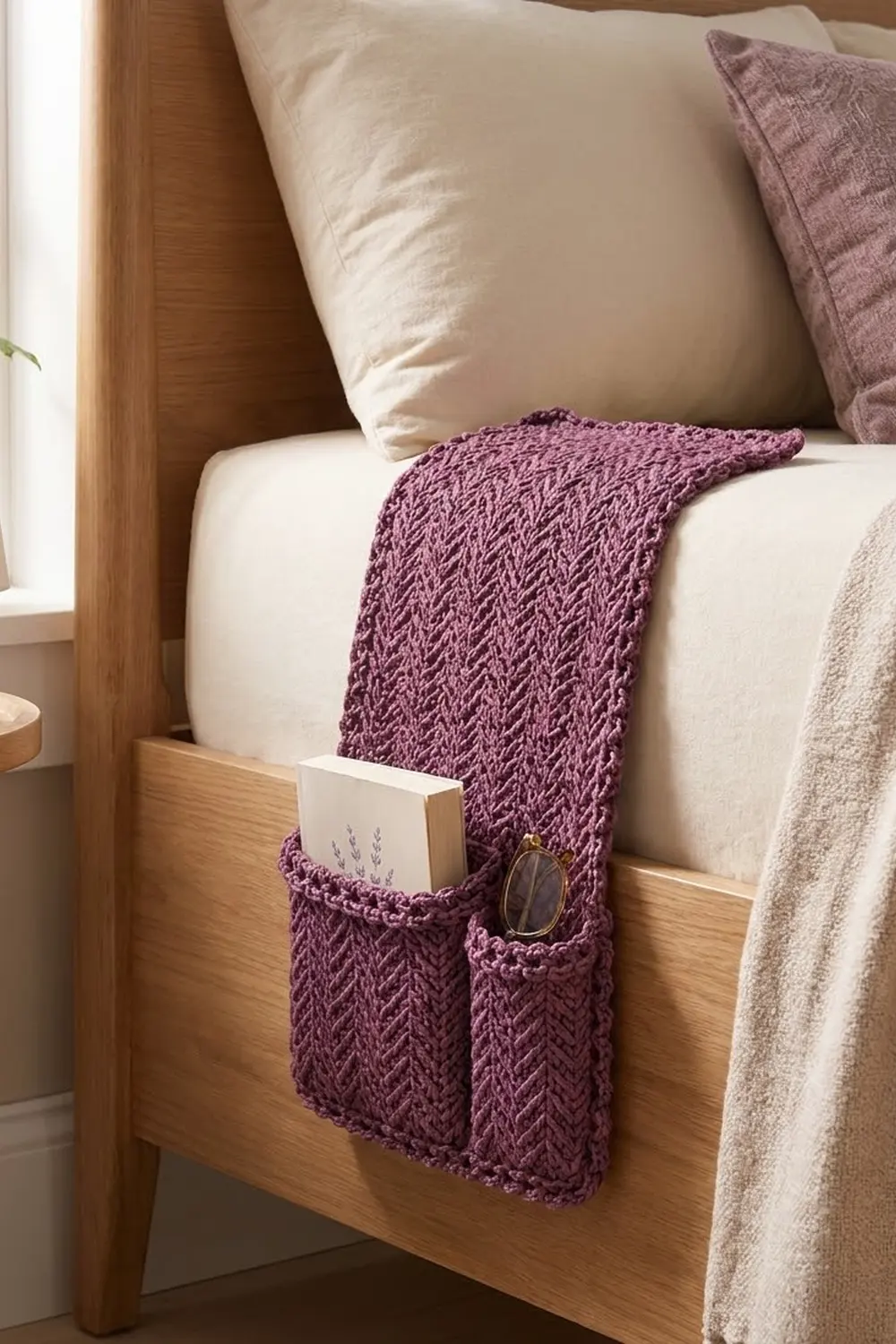
This bedside caddy is one compact organizer: a deep two-pocket box with a long, flat strap that tucks under your mattress. The pockets hang against the side of the bed and hold a paperback, reading glasses, a phone, or a remote.
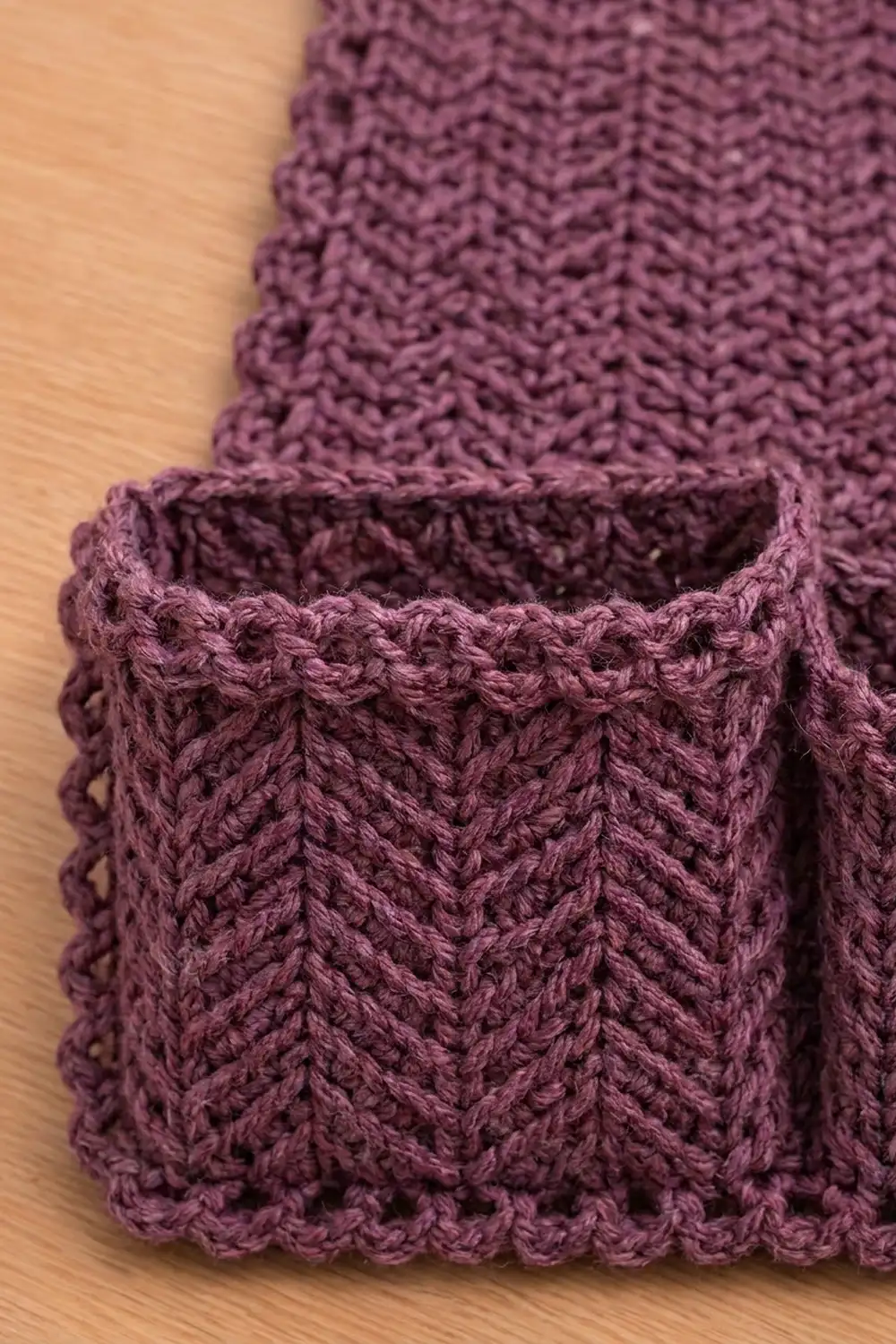
The sample is worked in one solid plum shade. Herringbone half double crochet worked in turned rounds gives the walls and strap a dense zigzag texture that looks a lot like knitting. A raised, beaded edge of reverse single crochet runs around the base, along the pocket tops, and around the strap.
The pattern uses US crochet terms. The caddy measures about 9 in (22.9 cm) wide, 2 in (5.1 cm) deep and 6.25 in (15.9 cm) tall at the pockets. The overall length from the bottom edge to the top of the strap is about 21 in (53.3 cm).
Construction is continuous. You work an oval base in single crochet rounds, then raise the walls in turned rounds of herringbone hdc. The divider is crocheted in place, and the strap is worked in rows straight off the back wall. Beaded edgings finish everything, so there is no sewing apart from weaving in ends.
Finished Size and Construction
- Finished size: pocket unit 9 in (22.9 cm) wide x 2 in (5.1 cm) deep x 6.25 in (15.9 cm) tall; strap 6 in (15.2 cm) wide x 14.75 in (37.5 cm) long above the pockets; total length 21 in (53.3 cm)
- Skill level: Intermediate
- Terminology: US
- Yarn weight: worsted (#4), cotton or cotton blend
- Hook: 5 mm (H-8)
- Number of pieces: 1 (base, walls, divider, and strap are all worked as one piece)
- Layout: two pockets side by side, wide pocket on the left and narrow pocket on the right, with the strap rising from the back wall
- Strap size before border: 5.5 in (14.0 cm) x 14.5 in (36.8 cm)
- Border depth: about 0.25 in (0.6 cm) per edge
Materials
Use a smooth, firm worsted-weight cotton or cotton blend. Cotton holds the pocket shape and doesn’t stretch much under the weight of a book. Avoid fuzzy or very soft acrylics, because they blur the herringbone texture and let the pockets sag.
- Plum (main and only color): 250 g, about 425 m (465 yd)
Tools:
- 5 mm (H-8) crochet hook
- 6 stitch markers
- Tapestry needle
- Scissors
- Tape measure
- Pins and a spray bottle for blocking
The quantity includes a safety margin of about 15%. The sample used close to 215 g.
Abbreviations (US Terms)
- ch – chain
- sl st – slip stitch
- sc – single crochet
- BLO – back loop only
- FLO – front loop only
- HBhdc – herringbone half double crochet (see below)
- rev sc – reverse single crochet (crab stitch)
- st(s) – stitch(es)
- rnd(s) – round(s)
Herringbone half double crochet (HBhdc): Yarn over and insert the hook in the stitch. Yarn over and pull up a loop, drawing it straight through the first loop on the hook (the yarn-over), so 2 loops remain. Yarn over and draw through both loops.
Reverse single crochet (rev sc): Working from left to right (right-handers), insert the hook in the next stitch to the right, yarn over, pull up a loop, yarn over, and draw through both loops. This makes the beaded, corded edge.
Turned rounds: At the end of each wall round, join with a sl st to the first st, ch 2 (doesn’t count as a stitch), and turn. The direction of the slant changes every round, and that is what creates the herringbone zigzag.
Gauge and Checkpoints
- HBhdc: 16 sts and 11 rows = 4 in (10.2 cm)
- sc: 16 sts and 18 rows = 4 in (10.2 cm)
Before you start, crochet a swatch of 20 HBhdc for 12 turned rows. Herringbone hdc pulls tighter than regular hdc, so measure the swatch rather than assuming it matches your usual tension. Since the walls sit straight on the base, the sc and HBhdc stitch widths have to match.
Checkpoints:
- After Rnd 4, the base measures about 9 x 2 in (22.9 x 5.1 cm).
- After Rnd 13, the walls measure about 3 in (7.6 cm) above the base ridge.
- After Rnd 21, the walls measure about 5.8 in (14.7 cm).
- After strap Row 20, the strap measures about 7.25 in (18.4 cm).
- After strap Row 40, the strap measures 14.5 in (36.8 cm).
If the work is too big, go down a hook size (4.5 mm). If it’s too small, go up to 5.5 mm. If the walls flare outward over the base, your HBhdc is wider than your sc. Work the walls with a hook 0.5 mm smaller than the one you used for the base.
Base
Ch 31.
Rnd 1: Sc in 2nd ch from hook, sc in next 28 ch, 3 sc in last ch. Rotate and work along the other side of the foundation ch: sc in next 28 ch, 2 sc in the last ch (the same ch as the first sc). Join with a sl st to the first sc. (62 sts)
Rnd 2: Ch 1. 2 sc in first st, sc in next 28 sts, 2 sc in each of next 3 sts, sc in next 28 sts, 2 sc in each of next 2 sts. Join. (68 sts: 2 + 28 + 6 + 28 + 4)
Rnd 3: Ch 1. (2 sc in next st, sc in next st) once, sc in next 28 sts, (2 sc in next st, sc in next st) 3 times, sc in next 28 sts, (2 sc in next st, sc in next st) twice. Join. (74 sts: 3 + 28 + 9 + 28 + 6)
Rnd 4: Ch 1. (2 sc in next st, sc in next 2 sts) once, sc in next 28 sts, (2 sc in next st, sc in next 2 sts) 3 times, sc in next 28 sts, (2 sc in next st, sc in next 2 sts) twice. Join. (80 sts: 4 + 28 + 12 + 28 + 8)
The base is now a rounded rectangle with 28 straight sts along each long side and 12 sts around each curved end.
Rnd 5 (turning ridge): Ch 1. Sc BLO in each st around. Join. (80 sts)
This round turns the work upward, and the free front loops of Rnd 4 are kept for the beaded bottom edge later on.
Markers: Choose one long side as the front. Count 17 straight sts in from its left end and place marker A between st 17 and st 18. On the opposite long side (the back), skip the first 3 straight sts from each end and mark the first and last of the 22 center sts with markers B and C.
Walls
Rnd 6: Ch 2 (doesn’t count). HBhdc in each st around. Join, turn. (80 sts)
Rnds 7–21: Ch 2. HBhdc in each st around. Join, turn. (80 sts each round)
That makes 16 wall rounds in total. Check the height: 5.8 in (14.7 cm).
Rnd 22: Ch 1. Sc in each st around. Join. (80 sts) Move markers B and C up to the matching sts of this round. Fasten off.
The pocket box now stands 6 in (15.2 cm) tall from the base ridge.
Divider
The divider is worked in rows across the inside of the box, from the front wall to the back wall, and joined to both walls at each row end.
Foundation: Hold the box with the opening facing you. Working on the inside of the base, make 8 surface sl sts in a straight line from the front wall at marker A across to the back wall. (8 sts)
Row 1: Ch 2 (doesn’t count). HBhdc in the back loop of each surface sl st across. Sl st into the wall beside the last st on the matching round (Rnd 6), turn. (8 sts)
Rows 2–16: Ch 2. HBhdc in each st across. Sl st into the adjacent wall on the matching round, turn. (8 sts each row)
Row 17: Ch 1. Sc in each st across, sl st into Rnd 22 of the wall. (8 sts) Don’t fasten off.
Row 18: Ch 1. Without turning, rev sc in each st across. (8 sts) Fasten off.
The divider makes a wide left pocket, about 5.25 in (13.3 cm) across, and a narrow right pocket, about 3.5 in (8.9 cm) across.
Strap
Row 1: With the outside of the back wall facing you, join yarn in the st at marker B on Rnd 22. Ch 2 (doesn’t count), HBhdc in the same st and in each st up to and including the st at marker C. Turn. (22 sts)
Rows 2–40: Ch 2. HBhdc in each st across. Turn. (22 sts each row)
After Row 20, the strap should measure 7.25 in (18.4 cm). After Row 40, it should measure 14.5 in (36.8 cm) and be 5.5 in (14.0 cm) wide. Fasten off.
Edgings and Border
Pocket Rim
Join yarn in the st of Rnd 22 just to the left of marker C. Ch 1 and rev sc in each st around the sides and front, ending in the st just to the right of marker B. (58 sts: 80 − 22 strap sts) Fasten off.
The rim stops where the strap begins, so the strap continues smoothly up from the back wall.
Beaded Base Edge
Turn the caddy upside down. Join yarn in any free front loop of Rnd 4. Ch 1 and rev sc FLO in each st around. Join. (80 sts) Fasten off.
Strap Border
Border gauge: Work 3 sc for every 2 HBhdc rows along the long edges, and 1 sc per st across the top.
Row 1: With the right side facing, join yarn at the lower right edge of the strap, right where it meets the pocket rim. Ch 1.
- Right side: 3 sc for every 2 row-ends, up all 40 rows. (60 sts)
- Top: 3 sc in the first st, sc in the next 20 sts, 3 sc in the last st. (26 sts, corners included)
- Left side: 3 sc for every 2 row-ends, down all 40 rows. (60 sts)
Total: 60 + 26 + 60 = 146 sts.
Row 2: Ch 1. Without turning, rev sc in each st across. (146 sts) Fasten off.
Why the math works: Two HBhdc rows stand 0.73 in (1.9 cm) tall, and 3 sc at 4 sts per inch cover 0.75 in (1.9 cm). Those lengths are almost identical, so the long edges stay flat. The 22 top sts give 20 straight sts plus the 2 corner sts, and each corner gets 3 sc so that it turns cleanly without cupping. With a 0.25 in (0.6 cm) border on each long edge, the 5.5 in (14.0 cm) strap blocks to 6 in (15.2 cm) wide.
Final Blocking
- Weave in all ends along stitches of the same color, keeping them inside the pocket box or on the wrong side of the strap.
- Spritz the whole caddy until it is damp but not soaked.
- Lay the strap flat and pin it to 6 x 14.75 in (15.2 x 37.5 cm), with straight edges and square corners.
- Stuff the pockets firmly with folded towels or a small box so the walls stand straight at 6.25 in (15.9 cm) tall.
- Shape the base to 9 x 2 in (22.9 x 5.1 cm), and press the beaded base edge so it sits straight.
- Leave it to dry completely, usually overnight, before you take out the pins and stuffing.
Final Quality-Control Checklist
- Base Rnd 4 has 80 sts, with 28 straight sts on each long side.
- All 16 wall rounds have 80 sts, and the herringbone zigzag alternates every round.
- The divider has 16 HBhdc rows and is joined to both walls on every row.
- The strap is 22 sts wide for 40 rows.
- The pocket rim has 58 rev sc and the base edge has 80.
- The strap border has 146 sts on each row.
- The total length is about 21 in (53.3 cm).
- The strap lies flat without ruffling or pulling in.
Troubleshooting
Walls lean out or in: The stitch widths don’t match. Change the hook size for the walls only, and keep 80 sts.
Zigzag looks like plain diagonals: You forgot to turn. Every wall round has to be turned.
The seam line drifts: That’s normal in turned rounds. Keep the join at the same side corner every round.
Divider bulges: Make the sl st joins on the matching wall round, not one round higher or lower.
Strap edges ruffle: Work fewer border sc, for example 4 sc per 3 rows. If the edges pull in, work 2 sc per row.
Strap slips out from under the mattress: Add 6 to 8 more strap rows. Each 2 rows add 0.73 in (1.9 cm).
Rim looks stringy: Rev sc needs a slightly loose loop. Pull each loop up to the height of a regular sc.
Care
Hand wash in cool water and lay flat to dry, reshaping the pockets while they are damp. Don’t tumble dry, because cotton can shrink and pull the walls out of shape.
Final Notes
Everything rests on a chain of measurements. Swatch at 16 sts = 4 in (10.2 cm) and you get an 80-st base of 9 x 2 in (22.9 x 5.1 cm). That base carries 16 turned wall rounds of 5.8 in (14.7 cm), plus a sc round and rim, for a 6.25 in (15.9 cm) pocket. The 22-st strap grows 40 rows to 14.5 in (36.8 cm), and a 146-st border brings it to 6 x 14.75 in (15.2 x 37.5 cm). The whole caddy comes to about 21 in (53.3 cm). Check each number as you reach it, and the finished caddy will hang straight and hold its shape at the bedside.
Happy crocheting!