
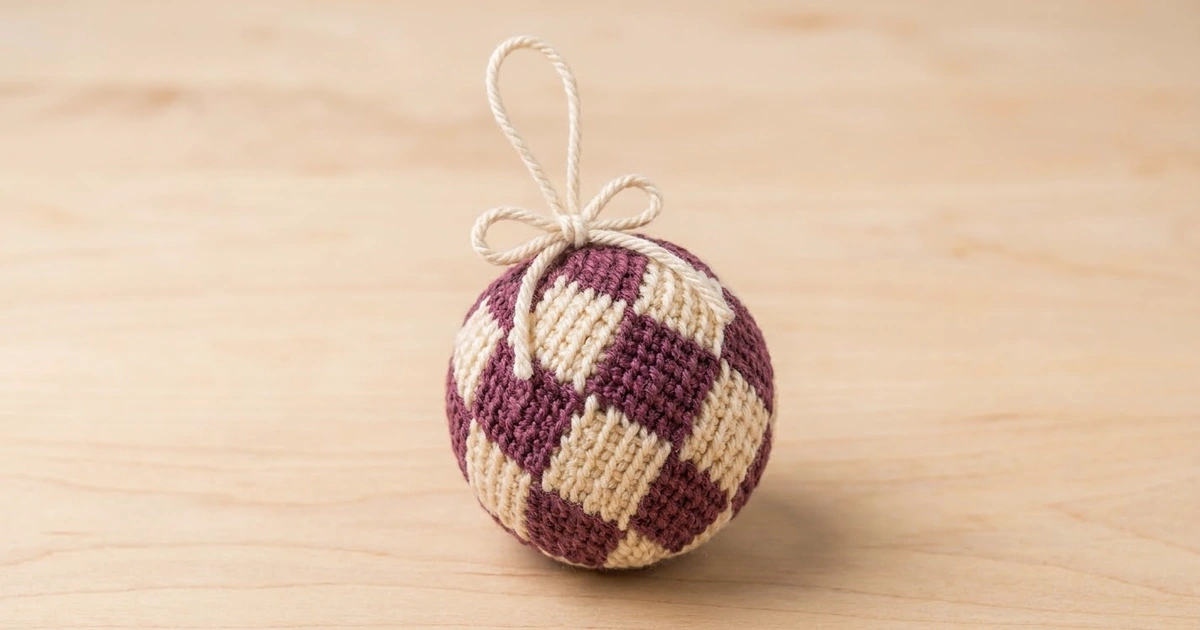
This ornament has a classic harlequin look. Plum and cream diamonds sit on point in a neat diagonal checkerboard, and the finished ball is topped with a cream hanging loop and a small bow. The dense single crochet colorwork looks woven and holds its round shape well.
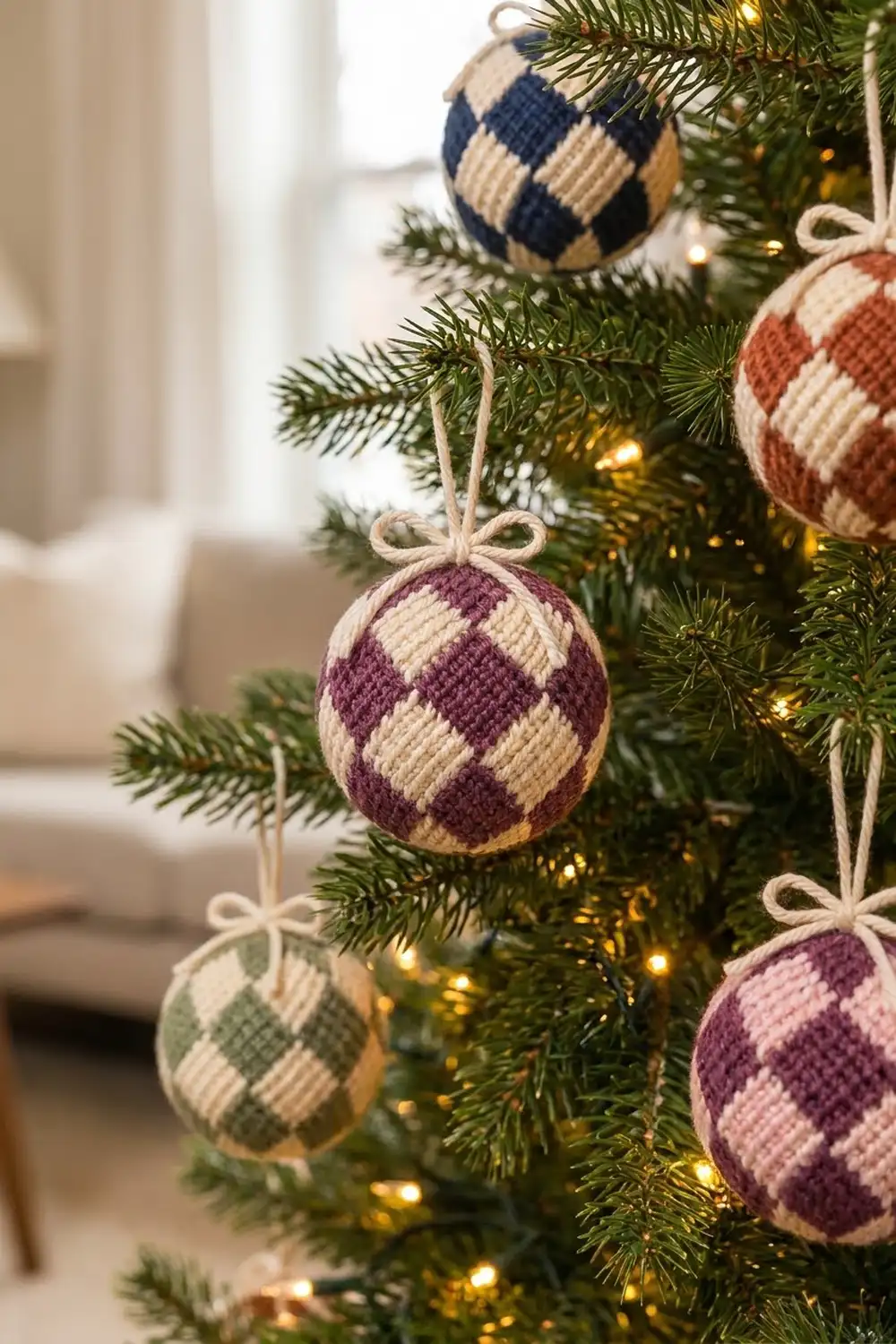
The sample uses deep plum and soft cream. The design also works in navy, rust, sage or dusty pink, always paired with cream so the diamonds stand out.
This pattern uses US crochet terms. The finished ornament is about 3 in (7.6 cm) in diameter. The flat panel measures 9.6 in × 4.73 in (24.4 cm × 12.0 cm) before you seam it.
Construction is simple. You crochet one flat tapestry panel in rows, add a cream edge row along the top and bottom, and seam the short sides to make a tube. Then you gather one end, stuff the tube, gather the other end and add the loop and bow.
Finished Size and Construction
- Finished size: about 3 in (7.6 cm) diameter
- Skill level: Intermediate (tapestry color changes)
- Terminology: US crochet terms
- Yarn weight: DK (#3)
- Hook: 3.5 mm (E-4)
- Number of pieces: 1 panel
- Layout: single rectangle, seamed into a tube and gathered at both ends
- Panel size: 48 sts × 26 rows, 9.6 in × 4.73 in (24.4 cm × 12.0 cm)
- Size before edging: 48 sts × 24 rows, 9.6 in × 4.36 in (24.4 cm × 11.1 cm)
- Edging depth: 1 sc row on each long edge, about 0.18 in (0.5 cm) each
Materials
Choose a smooth, firmly twisted DK yarn. Wool, a wool blend or mercerized cotton all work. Fuzzy yarns blur the diamond edges, so avoid them.
- Color A – Cream: 10 g, about 23 m. This covers the panel, edging, gathering strands, hanging loop and bow.
- Color B – Plum: 8 g, about 18 m
These quantities include a safety margin of about 20% for carried strands, swatching and tails.
Tools:
– 3.5 mm (E-4) crochet hook
– Polyester fiberfill, about 10 g
– Tapestry needle
– Scissors
– 2 stitch markers
– Ruler or tape measure
– Pins for blocking
Abbreviations (US Terms)
- ch – chain
- sc – single crochet
- sl st – slip stitch
- st(s) – stitch(es)
- RS / WS – right side / wrong side
- A / B – Color A (cream) / Color B (plum)
Tapestry single crochet (special technique): Work each sc over the unused color so that strand is hidden inside the stitches. To change color, work the last sc of the old color until 2 loops are on the hook. Then yarn over with the new color and pull it through both loops. Drop the old color and carry it along the top of the row, working over it.
Gauge and Checkpoints
Gauge: 20 sc × 22 rows = 4 in (10.2 cm) in tapestry sc, worked flat.
Tapestry sc is tighter than plain sc, so swatch in colorwork. Work 16 sts (2 repeats) for 16 rows (2 repeats) of the chart below. The swatch should measure 3.2 in wide × 2.91 in tall (8.1 cm × 7.4 cm).
Checkpoints:
– One diamond repeat (8 sts × 8 rows): 1.6 in × 1.45 in (4.1 cm × 3.7 cm)
– After Row 8: 9.6 in × 1.45 in (24.4 cm × 3.7 cm)
– After Row 24: 9.6 in × 4.36 in (24.4 cm × 11.1 cm)
– After edging: 9.6 in × 4.73 in (24.4 cm × 12.0 cm)
If your panel is too big, go down to a 3.25 mm hook, or carry the unused strand with a little less slack. If it’s too small, go up to a 3.75 mm hook. Up to about 0.25 in (0.6 cm) of extra width is fine, because the ends are gathered. A larger difference changes the ball’s diameter.
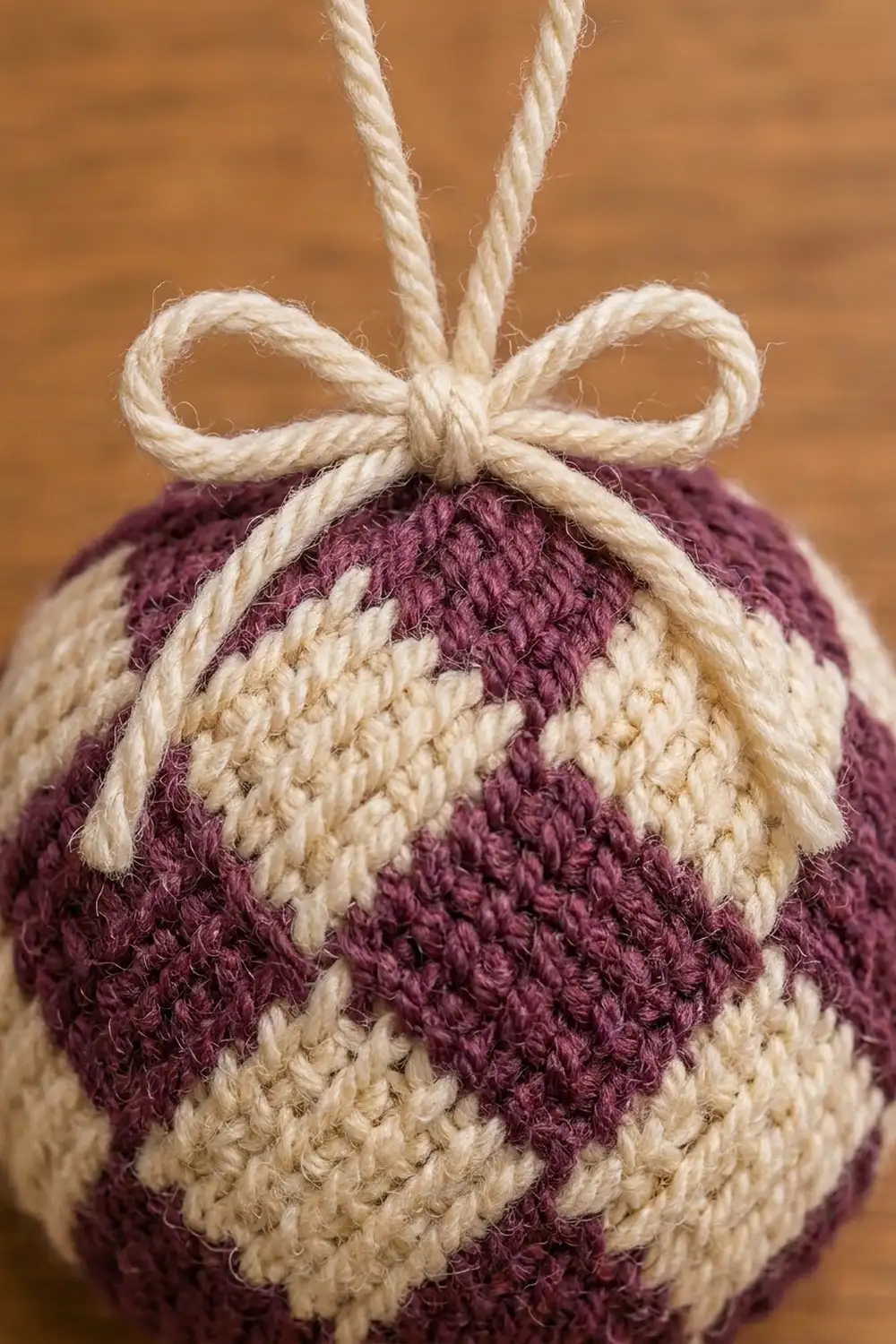
Diamond Chart (Written)
The repeat is 8 sts wide and 8 rows tall. Each row has 6 repeats, for 48 sts. Every chart row is symmetrical, so it reads the same on RS and WS rows.
- Chart Row 1: 3A, 2B, 3A
- Chart Row 2: 2A, 4B, 2A
- Chart Row 3: 1A, 6B, 1A
- Chart Row 4: 8B
- Chart Row 5: 1A, 6B, 1A
- Chart Row 6: 2A, 4B, 2A
- Chart Row 7: 3A, 2B, 3A
- Chart Row 8: 8A
Each plum diamond grows 2, 4, 6, 8 sts wide and then shrinks 6, 4, 2. The cream areas between them form the same diamond shape, offset by half a repeat. That gives you the true diagonal checkerboard.
Panel
Foundation: With A, ch 49.
Row 1 (RS): Chart Row 1. Start in the 2nd ch from the hook and carry B from the first st. Repeat (3A, 2B, 3A) 6 times. Ch 1 and turn. (48 sc: 24 A, 12 B… see note)
Note on counts: Row 1 has 36 A and 12 B. Every row has 48 sc. The ch-1 turn never counts as a stitch.
Row 2: Chart Row 2. Repeat (2A, 4B, 2A) 6 times. Ch 1 and turn. (48 sc: 24 A, 24 B)
Row 3: Chart Row 3. Repeat (1A, 6B, 1A) 6 times. Ch 1 and turn. (48 sc: 12 A, 36 B)
Row 4: Chart Row 4. Work 48 sc in B, carrying A. Ch 1 and turn. (48 sc: 48 B)
Row 5: As Row 3. (48 sc)
Row 6: As Row 2. (48 sc)
Row 7: As Row 1. (48 sc)
Row 8: Chart Row 8. Work 48 sc in A, carrying B. Ch 1 and turn. (48 sc: 48 A)
Checkpoint: 9.6 in × 1.45 in (24.4 cm × 3.7 cm).
Rows 9–16: Repeat Rows 1–8. (48 sc each row)
Rows 17–24: Repeat Rows 1–8. (48 sc each row)
At the end of Row 24, cut B and leave a 4 in (10.2 cm) tail. Keep A attached.
Checkpoint: 48 sts × 24 rows, 9.6 in × 4.36 in (24.4 cm × 11.1 cm). You now have three bands of plum diamonds, six diamonds across each band.
Edging (Border)
Edging gauge: 5 sc per inch (2.54 cm) along each long edge, which matches the body gauge. There is 1 sc per existing stitch and no increases.
Top edging (Row 25): With A still attached, ch 1. Work 1 sc in each of the 48 sts of Row 24. Fasten off and leave a 12 in (30.5 cm) tail for gathering. (48 sc: 48 worked 1-per-stitch + 0 added)
Bottom edging (Row 26): Turn the panel upside down. Join A in the first free loop of the foundation chain. Ch 1, then work 1 sc in each of the 48 free chain loops. Fasten off and leave a 12 in (30.5 cm) tail. (48 sc: 48 worked 1-per-stitch + 0 added)
Short sides: No edging. These two edges are seamed in the next step. Each short side has 26 row ends: Rows 1–24 plus the 2 edging rows.
Per-side summary:
– Top: 48 sc
– Bottom: 48 sc
– Left side: 26 row ends, left unworked
– Right side: 26 row ends, left unworked
Why the math works: 48 sts is exactly 6 diamond repeats of 8 sts. The edging keeps the same 48 sts, so the edges don’t flare or pucker before gathering. Each edging row adds 0.18 in (0.5 cm). That brings the height from 4.36 in to 4.73 in (11.1 cm to 12.0 cm), which is close to half the ball’s circumference: 9.6 in ÷ 2 = 4.8 in (12.2 cm). That’s why the panel wraps from pole to pole without leaving gaps.
Checkpoint: 9.6 in × 4.73 in (24.4 cm × 12.0 cm).
Seaming the Tube
- Fold the panel with RS together so the two short sides meet. Place a stitch marker at each end to hold them.
- Thread the tapestry needle with a 14 in (35.6 cm) strand of A.
- Whipstitch row end to row end, 26 times, catching both loops of the edge stitch on each side.
- Keep the seam firm but not tight. It should be the same length as the rest of the panel: 4.73 in (12.0 cm).
- Turn the tube RS out. Stitch 48 sits next to stitch 1, so the diamond pattern runs unbroken across the seam.
Checkpoint: The tube’s circumference is 9.6 in (24.4 cm). Laid flat, it measures 4.8 in (12.2 cm) wide.
Gathering and Stuffing
- Thread the bottom 12 in (30.5 cm) tail onto the needle. Weave it in and out through the front loops of all 48 bottom edging sts.
- Pull tight to close the hole completely. Make 2 small stitches across the center and knot securely inside.
- Stuff firmly with fiberfill, about 10 g. Shape the ball with your hands as you go, filling the “shoulders” so it rounds out evenly.
- Weave the top tail through all 48 top edging sts in the same way.
- Before closing, add a little more stuffing until the ball feels firm. Then pull tight and secure.
- Push the needle through the center of the ball and out the bottom pole, and back again. Pull lightly to flatten both poles slightly, then bury the tail.
Checkpoint: About 3 in (7.6 cm) diameter, measured across the middle.
Hanging Loop and Bow
Loop: Cut 2 strands of A, each 14 in (35.6 cm) long. Hold them together, thread both onto the needle and pass them under 2–3 sts at the top gathering point. Even out the ends. Tie an overhand knot so a 2.5 in (6.4 cm) loop stands above the ball. Twist the strands before knotting if you want a corded look.
Bow: Cut 1 strand of A, 10 in (25.4 cm) long. Tie it around the base of the loop in a bow with loops about 1 in (2.5 cm) long. Trim the bow tails to about 1.5 in (3.8 cm) and let them rest on the ball.
Final Blocking
- Before seaming, pin the flat panel to 9.6 in × 4.73 in (24.4 cm × 12.0 cm) on a blocking mat.
- Mist with water until damp. For wool, you can steam it lightly, holding the iron above the fabric without touching it.
- Let it dry fully. This evens out the slant that tapestry sc tends to have, and squares up the diamonds.
- After finishing, roll the stuffed ball between your palms to settle the stitches.
- Mist the bow lightly and shape the loops with your fingers. Let it dry.
Final Quality-Control Checklist
- Every row has 48 sts. Each edging row has 48 sc.
- There are 3 full bands of plum diamonds, 6 diamonds across each band.
- The pattern runs unbroken across the seam.
- No carried plum shows through the cream areas, and no cream shows through the plum.
- Both poles are fully closed, with no stuffing visible.
- The ball is about 3 in (7.6 cm) across and evenly round.
- The loop stands 2.5 in (6.4 cm) high and is firmly anchored.
- The bow is tied tightly at the base of the loop.
- All tails are buried inside the ball.
Troubleshooting
Diamonds lean to one side: This is normal slant for tapestry sc worked flat. Blocking fixes most of it. Working back and forth in rows, as written, keeps the slant smaller than working in the round.
Carried yarn peeks through: Hold the carried strand along the top of the previous row and keep it a little snug. Use a smooth yarn with good contrast.
Panel curls or puckers: The carried strand is too tight. Stretch the stitches slightly along the hook after each color change.
Holes at the poles: Pull the gathering strand tighter. Make two small stitches across the center, then knot.
Ball looks like an egg: Too much stuffing at the center, or the panel is taller than 4.73 in (12.0 cm). Move stuffing toward the poles, or work 1 fewer edging row next time.
Ball is too small: Check your gauge. You need 5 sts per inch (2.54 cm). Go up one hook size.
Care
Spot clean with a damp cloth and let it air-dry. If you used wool, keep the ornament away from moths when you store it between seasons.
Final Notes
The measurement chain is short and reliable:
– Gauge: 20 sc × 22 rows = 4 in (10.2 cm)
– Each diamond: 1.6 in × 1.45 in (4.1 cm × 3.7 cm)
– Panel before edging: 9.6 in × 4.36 in (24.4 cm × 11.1 cm)
– Panel after edging: 9.6 in × 4.73 in (24.4 cm × 12.0 cm)
– Tube circumference: 9.6 in (24.4 cm)
– Finished ball: about 3 in (7.6 cm)
Once you’ve made one, swap plum for navy, rust, sage or dusty pink to make a matching set for the tree.
Happy crocheting!